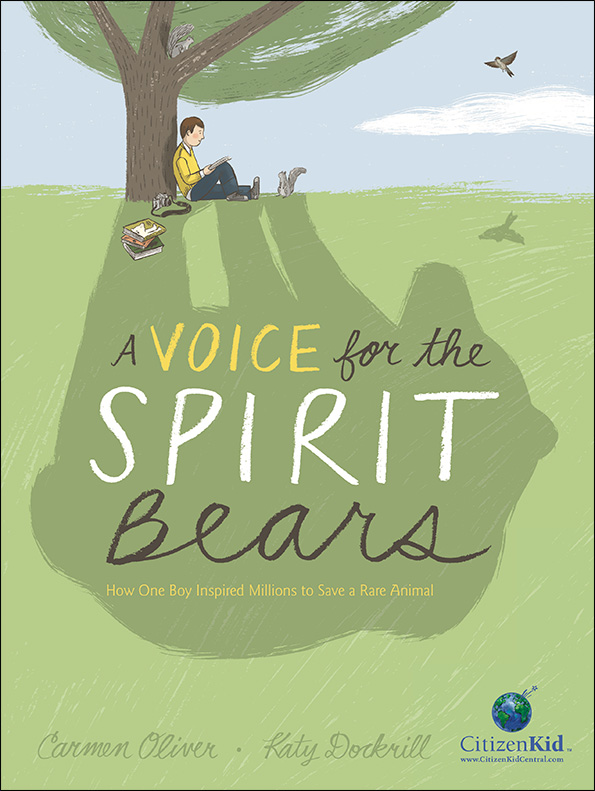
 A Voice for the Spirit Bears: How One Boy Inspired Millions to Save a Rare Animal, by Carmen Oliver/Illustrated by Katy Dockrill, (May 2019, Kids Can Press/CitizenKid), $18.99, ISBN:
Ages 7-10
Simon Jackson doesn’t quite fit in with the other kids as a child; he was bullied over his stutter, and found himself most at home in the woods, exploring, photographing, and learning about wildlife. As a teen, he found himself fascinated by a rare subspecies of black bear called a Spirit Bear and became an advocate and activist for the bears when their habitats were threatened with deforestation. Jackson founded the Spirit Bear Coalition, met Dr. Jane Goodall, and hiked the Great Bear Rainforest, always using his activism to educate others and advocate for the Spirit Bears. A Voice for Spirit Bears tells Jackson’s story, and shows kids that one is never too young to advocate for change. The book is an inspiring call to action for young activists (suggest a letter-writing exercise for a cause they believe in!). I would have liked to see a little more on the indigenous T’simshian people, for whom the Spirit Bear is sacred, but all in all, A Voice for Spirit Bears is a good biography on a young activist, with lovely, muted artwork. There are discussions to be had on overcoming obstacles, environmentalism and conservation, and activism, and would be a good STEM read-aloud. Check out the downloadable educator guide for discussion questions and an activity.
The Spirit Bear Coalition concluded its mission in 2014, after 20 years of advocacy. Their website is still active and offers education and information.
 Teddy: The Remarkable Tale of a President, a Cartoonist, a Toymaker and a Bear, by James Sage/Illustrated by Lisk Feng, (May 2019, Kids Can Press), $18.99, ISBN: 9781771387958
Ages 6-10
Teddy brings together the story of the teddy bear in three parts. First, we have the legend: President Theodore Roosevelt refused to kill a “scruffy, no-account cub” while hunting. This story spread, and the Washington Post ran a political cartoon by Clifford Berryman, entitled, “Drawing the Line in Mississippi“, which led to husband-and-wife toymakers Morris and Rose Michtom creating a bear doll to honor “the President’s big warm heart”. They received permission from President Roosevelt to feature “Teddy’s Bears” in their shop, and an iconic toy was born. The book tracks the evolution of the teddy bear from those first bears, stuffed with wood shavings and with sewed on buttons for eyes, through today and notes how the teddy bear endures. It’s a happy, warm story, and the digital illustrations lend a realistic yet warmly colored feel to the tale. An author’s note mentions the differing versions of the Teddy Roosevelt story. It’s a cute book to have in your nonfiction collections, and would make a nice display with the Caldecott Medal-winning Finding Winnie.
For readers interested in learning more about Clifford Berryman’s political cartoons, the National Archives has a wonderful Clifford Berryman collection, which includes a great piece featuring Berryman drawing a bear, while a black bear stands next to him. The Theodore Roosevelt Center at Dickinson State University has an interesting blog entry on the origin of the teddy bear, and a link to Berryman’s artwork in their digital library.

 Mom Read It