Posted in Intermediate, Non-Fiction, picture books

February Non-Fiction is all about the animals!

River Rescue, by Jennifer Keats Curtis & Tri-State Bird Rescue & Research, Inc./Illustrated by Tammy Yee, (Feb. 2019, Arbordale), $17.95, ISBN: 9781607188230

Ages 5-8

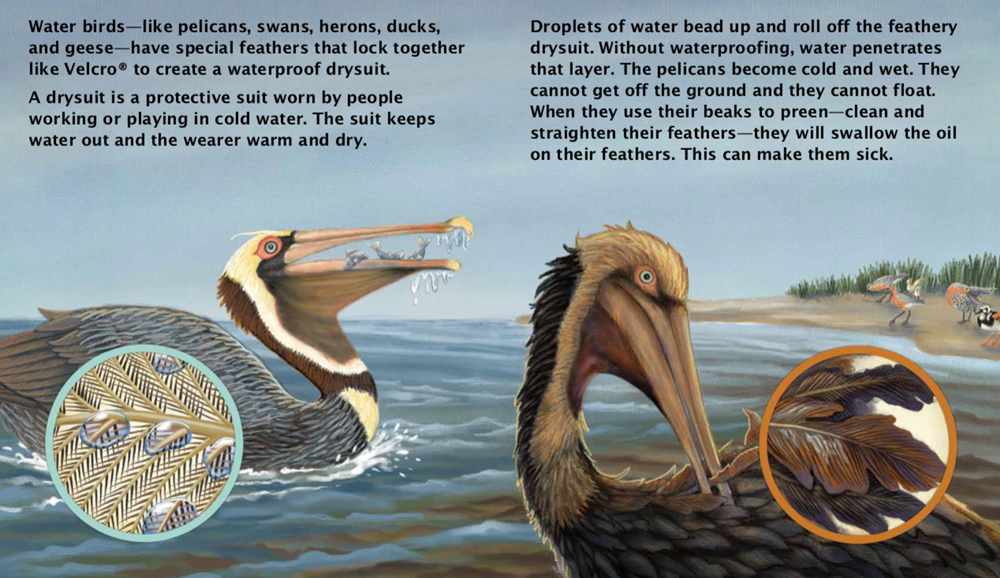
River Rescue illustrates how an oil spill – even one drop of oil – can be devastating to plan and animal life. Introducing readers to the Wildlife Response Team at Tri-State Bird & Rescue, a Delaware-based organization that rescues and rehabilitates animals affected by oil, River Rescue teaches readers about the delicate cleaning process and the care so critical to helping evaluate, treat, and rehabilitate affected animals.

There are so many questions to ask: is the animal alert on arrival? What kind of oil is on the animal? The cleansing process brings more questions: what kind of bird is this? Is it a flocking bird, or a solitary one? Is it a water bird or a land bird? After the rehabilitation process, animals are released back into the wild, preferably in the area where they were rescued.

River Rescue provides an informative look into animal rescue and rehabilitation and encourages good environmental citizenship among readers. The earth-toned art is realistic and the text is easy to understand. Back matter includes a 4-page For Creative Minds section allowing teachers, parents, and caregivers to photocopy and distribute activities on identifying wildlife, a Q&A with Tri-State Executive Director Dr. Lisa Smith, and information on preventing oil spills and helping animals.
The Long and Short Tale of Colo and Ruff, by Diane Lang/Illustrated by Laurie Allen Klein, (Feb. 2019, Arbordale Publishing), $17.95, ISBN: 9781607187387

Ages 4-7

Colo is a cougar and Ruff is a wild cat. The two friends want to play, but Ruff’s short tail prevents him from jumping as far as Colo can. As the two search for a new tail for Ruff, they encounter all the different things other animals can do with their tails and Ruff decides that his tail is just right after all.

This fun story is nonfiction with fiction wrapping: great for preschoolers and kindergartners! Colo and Ruff are realistically illustrated, but with softer artwork, playing up the cute factor. They encounter lizards, hawks, skunks and gophers on their search for a new tail, and callout facts throughout provide information that’s perfect for pleasure reading or an animal report. The For Creative Minds back matter includes a table comparing three kinds of cats and cat habitat maps.

Animal Noses, by Mary Holland, (Feb. 2019, Arbordale Publishing), $17.95, ISBN: 9781607188056

Ages 4-9

Noses, beaks, tongues, antennae – animals have a bunch of different ways to use their senses of smell, and Animal Noses is all about animal noses, how animals transmit messages through scent, and which animals have super noses versus which animals don’t. Loaded with sharp, full-color photos and facts, this is a nice add to science sections, especially when teachers come in looking for books on the five senses – always fun to throw something unexpected, like this, into my readers’ advisory, and show the similarities and differences between how we use our senses versus how animals use theirs.

Arbordale always has good back matter, too: their For Creative Minds sections allow for photocopying and distribution for educational use. The Animal Noses For Creative Minds covers fun facts about scent, a match the nose game, and spotlights animals with great senses of smell.


If a Mummy Could Talk…, by Rhonda Lucas Donald/Illustrated by Cathy Morrison, (Feb. 2019, Arbordale Publishing), $17.95, ISBN: 9781607187370

Ages 7-10

Meet some mummies and hear their stories: this volume contains stories about 12 different mummies: elephants, bison, dogs, cats, and humans, including the world’s most famous mummy, King Tut. Each spread focuses on one mummy, providing its date and location, and “before” and “after” illustrations that show readers what the animal or person most likely looked life while alive, and what its mummy looks like today. Facts gleaned from research and scientific observation bring each mummy’s story to life for readers, and provide clues to each demise. Discussions about different types of mummification, a mummy map of the world, and features on scientists’ tools and technology make up the back matter For Creative Minds section.

There are better books on mummies available, but this is an entertaining introduction for intermediate readers with an interest in natural history. The illustrations are realistic and colorful, and callout fact boxes appear throughout the book, clarifying bits of information contained in the text.


Posted in picture books, Preschool Reads, Toddler Reads

Crescendo, where a child is a symphony in composition

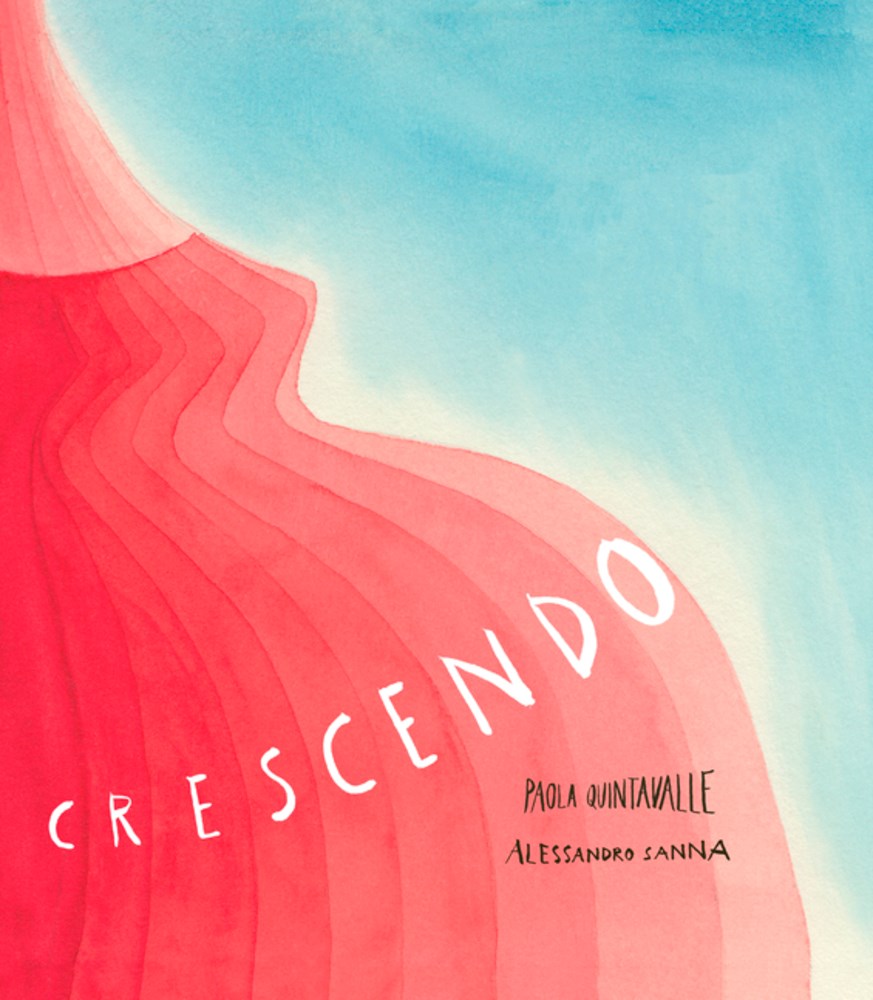
Crescendo, by Paola Quintavalle/Illustrated by Alessandro Sanna, (Feb. 2019, Enchanted Lion Books), $19.95, ISBN: 9781592702558

All ages

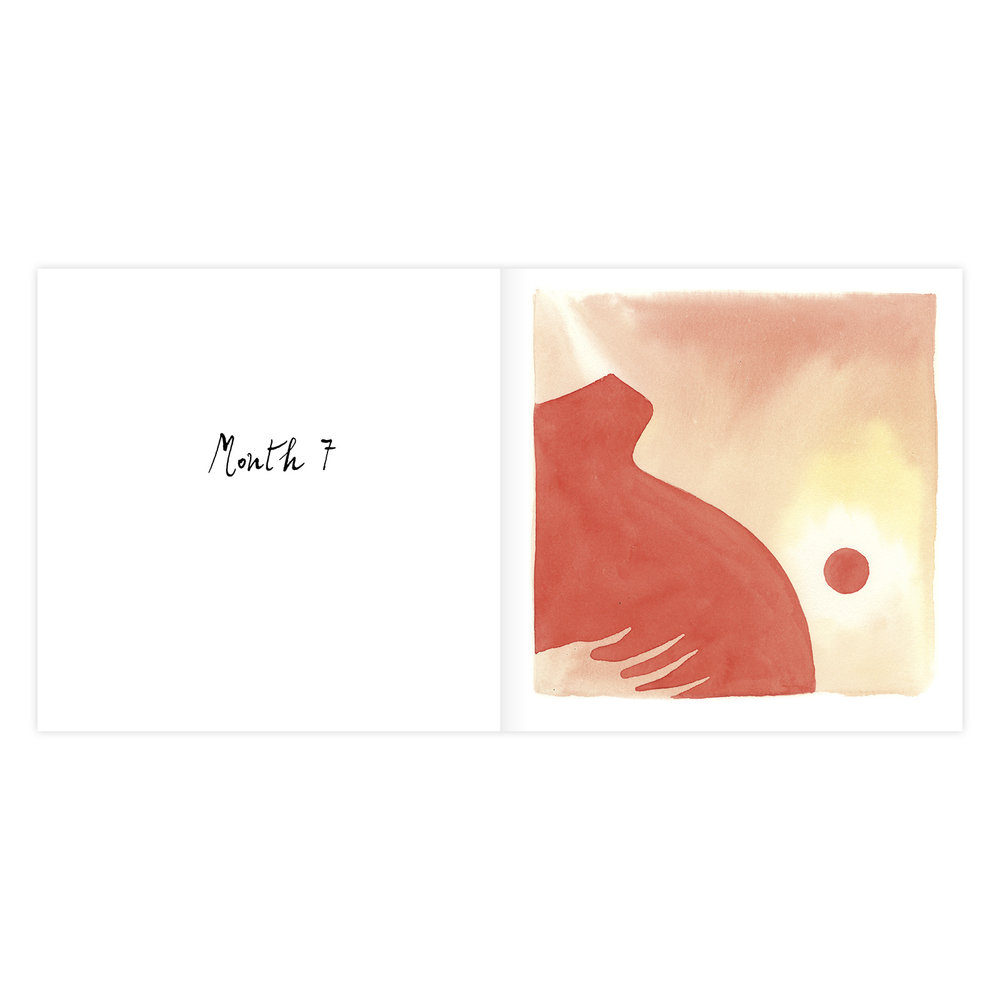
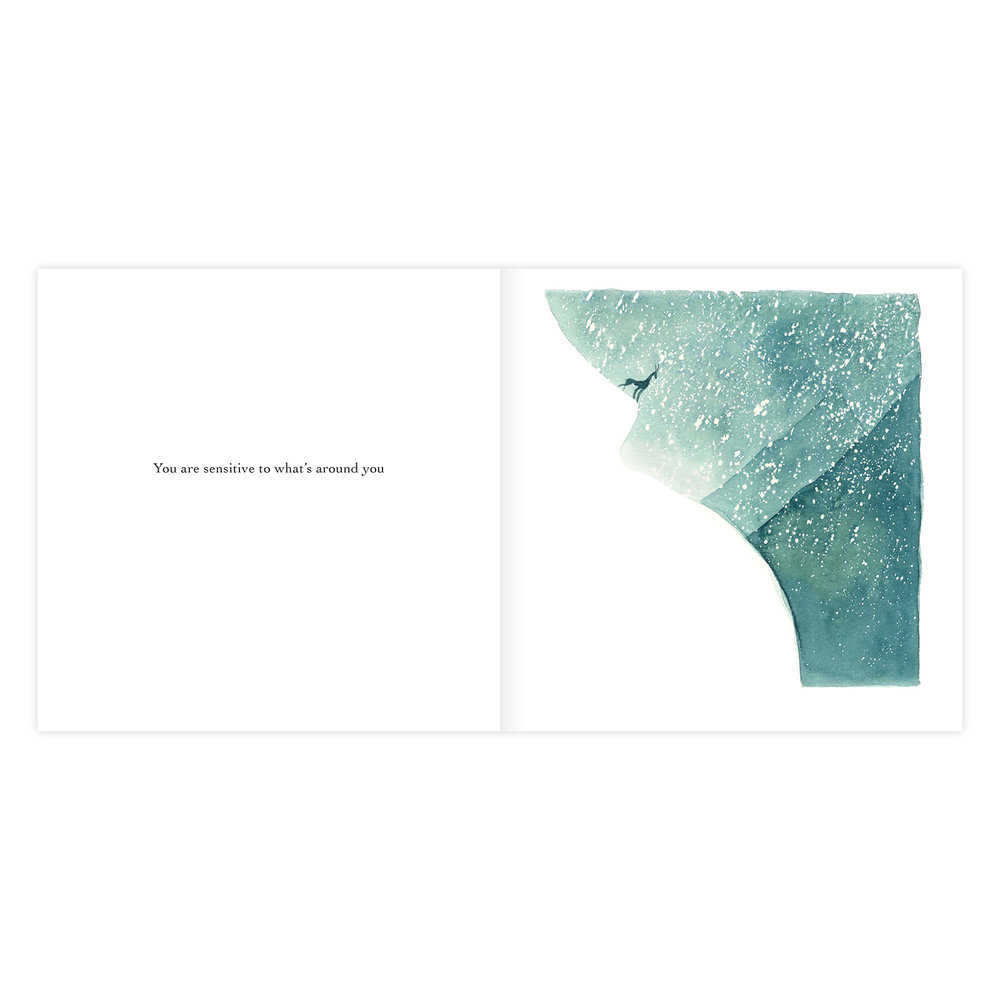
Written to a growing baby in utero, Crescendo beautifully marks milestones in development with loving observations and illustrations. Each spread reflects on a week of pregnancy, with each month presenting a woman in side view, her body growing to accommodate her baby and forming a landscape upon which birds soar, plants bloom, and horses roam. Beginning with the fifth week of pregnancy: “you are as big as a sesame seed”, the text is beautifully presented as a mother’s thoughts. At week 20, “patterns are drawn on your fingertips for you and you alone”; at week 27, “you cannot see, but you sense the light”. At week 39, “Mother earth is ready to greet you”, and at week 40, mother holds baby and the text reads, “And so am I”.

This is a great baby shower gift, and a lovely book to return to time and again, curled up with your baby and child as they grow, revisiting the magic of “when I lived in your belly”. It’s a beautiful journal of pregnancy and birth, filled with wonder. Back matter that includes a month-by-month breakdown of developmental milestones that inspired the text. The watercolor artwork is almost ethereal, with muted, washed out color that soothes. Originally released in Italy, Crescendo is a book that would make for a cuddly Mommy and Me storytime and would pair nicely with Kate Hosford’s Mama’s Belly and Thrity Umrigar’s When I Carried You in My Belly.

Posted in Animal Fiction, picture books, Preschool Reads

Get down with Bear Moves!

Bear Moves, by Ben Bailey Smith/Illustrated by Sav Akyüz, (Oct. 2018, Candlewick), $15.99, ISBN: 9780763698317

Ages 3-7

This companion to I Am Bear (2016) gets kids up and dancing along with our favorite big, purple bear. Bear has some moves to tell you about, and this rhyming story has a beat that invites you to slip right into a rap/read. Bear – at first appearing in a white skinny tank and tidy whities – is here to dance. His squirrel and bunny assistants don’t seem too excited about the situation, but Bear won’t be denied. Hit the music and watch him bust a move; whether he’s Furry Breaking, holding a stance, doing the Running Bear, or the Robot. He finds a lady partner to tear up the floor with, but before too long, Bear is tuckered out, to the chagrin of his lady.

Big, bold colors and thick black lines make this an instant eye catcher, and the infectious rhyme makes this a storytime must. I just read this at a Saturday storytime, and the kids shrieked and giggled. You can’t sit still reading this book! Get the kiddos up and dancing; show them how to do a robot, and get them to pose in their best stance. Hilarious moments abound, including a quick snack break that takes Squirrel by surprise, and a trio of shaking booties twisting to the beat. This book is a workout and a storytime hit in one volume. An irresistible add to storytime and picture book collections.

Posted in Graphic Novels, Middle Grade, Non-Fiction, Non-fiction, Teen, Tween Reads

Maker Comics: DIY your life!

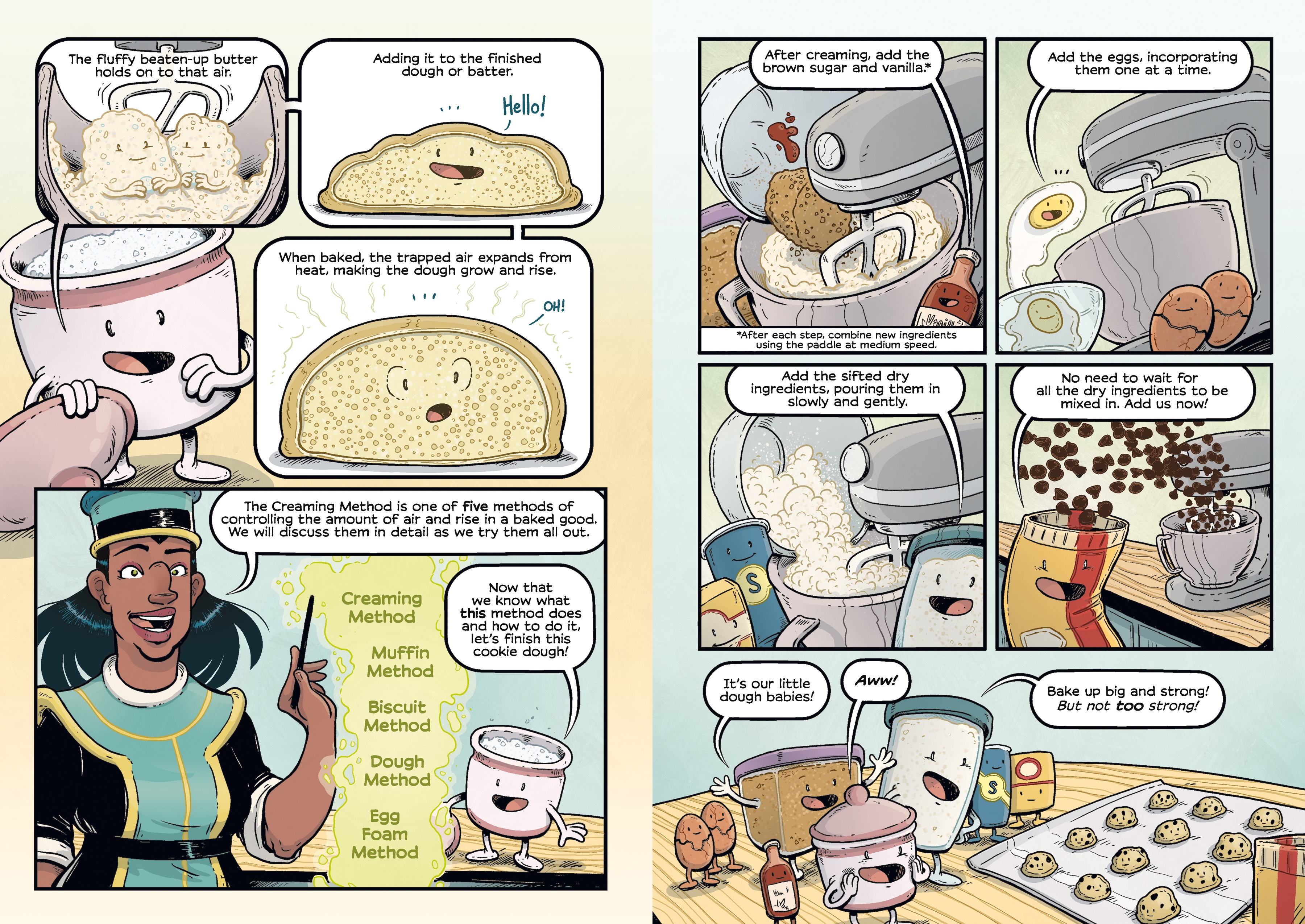
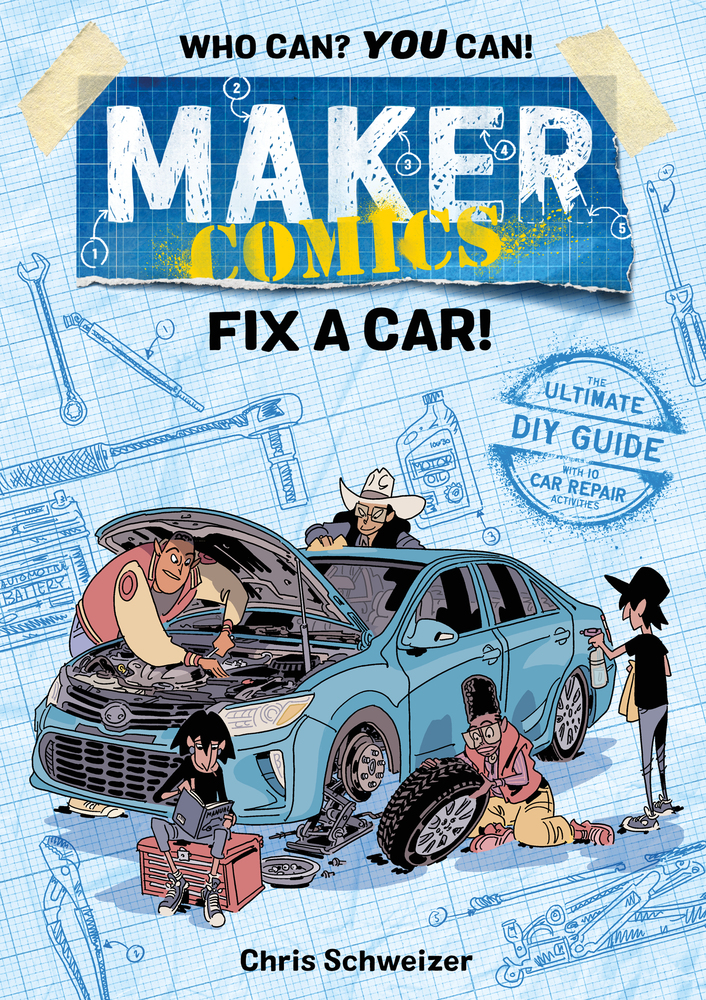
First Second has a new line of nonfiction graphic novels debuting in February: Maker Comics is a perfect DIY companion to their Science Comics series, adding a more hands-on component to the science behind everyday things. The first two titles to hit shelves are Bake Like a Pro! and Fix a Car! With the tag line, “Who Can? You Can!”, these books are ready to take readers step-by-step into the world of making and hands-on STEAM.

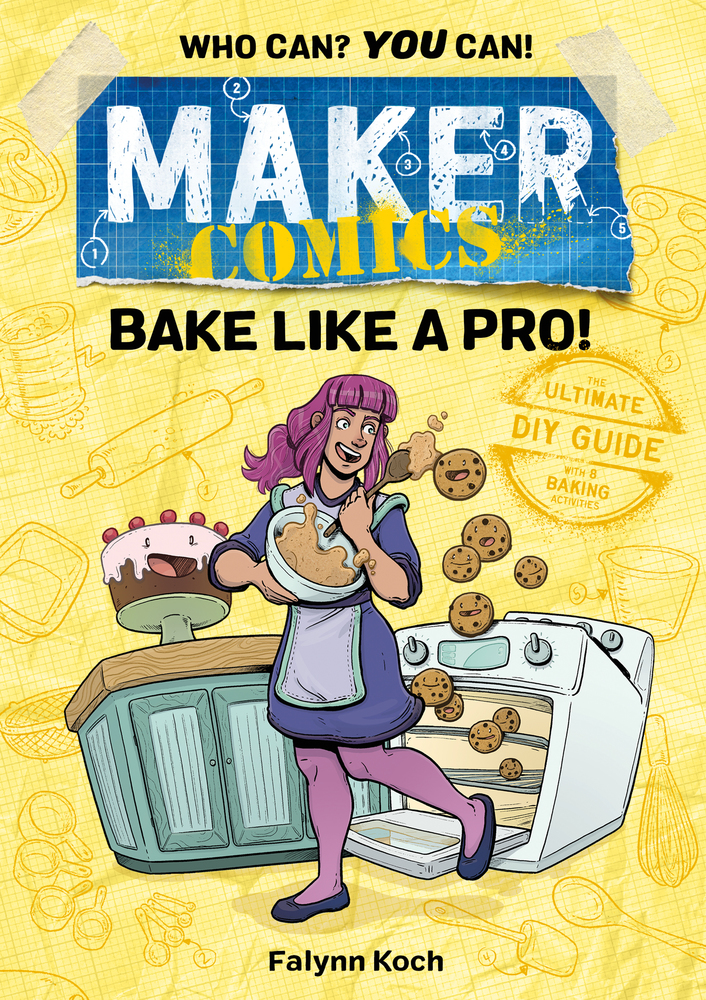
Maker Comics: Bake Like a Pro!, by Falynn Koch, (Feb. 2019, First Second), $12.99, ISBN: 9781250150066

Ages 10-14

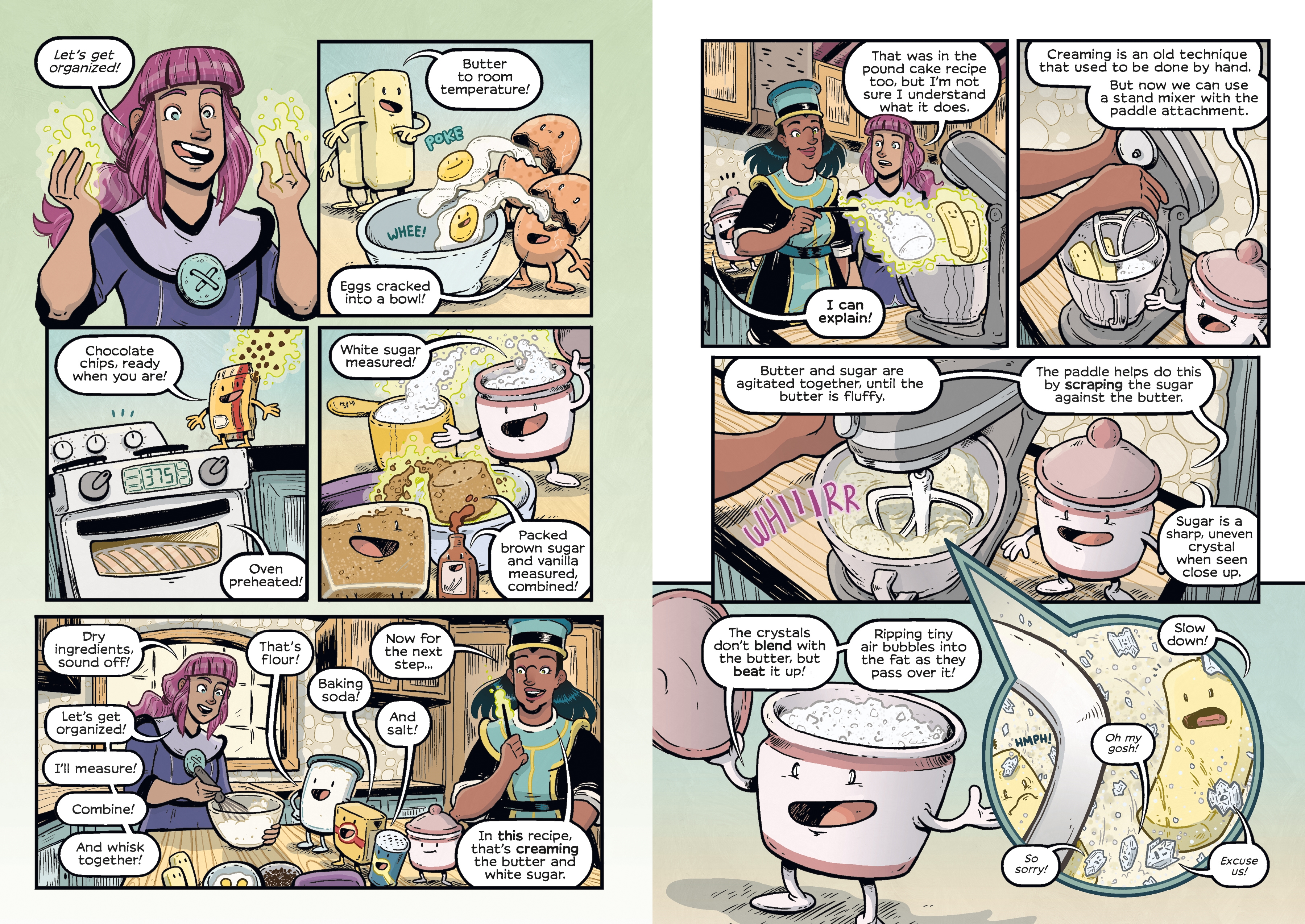
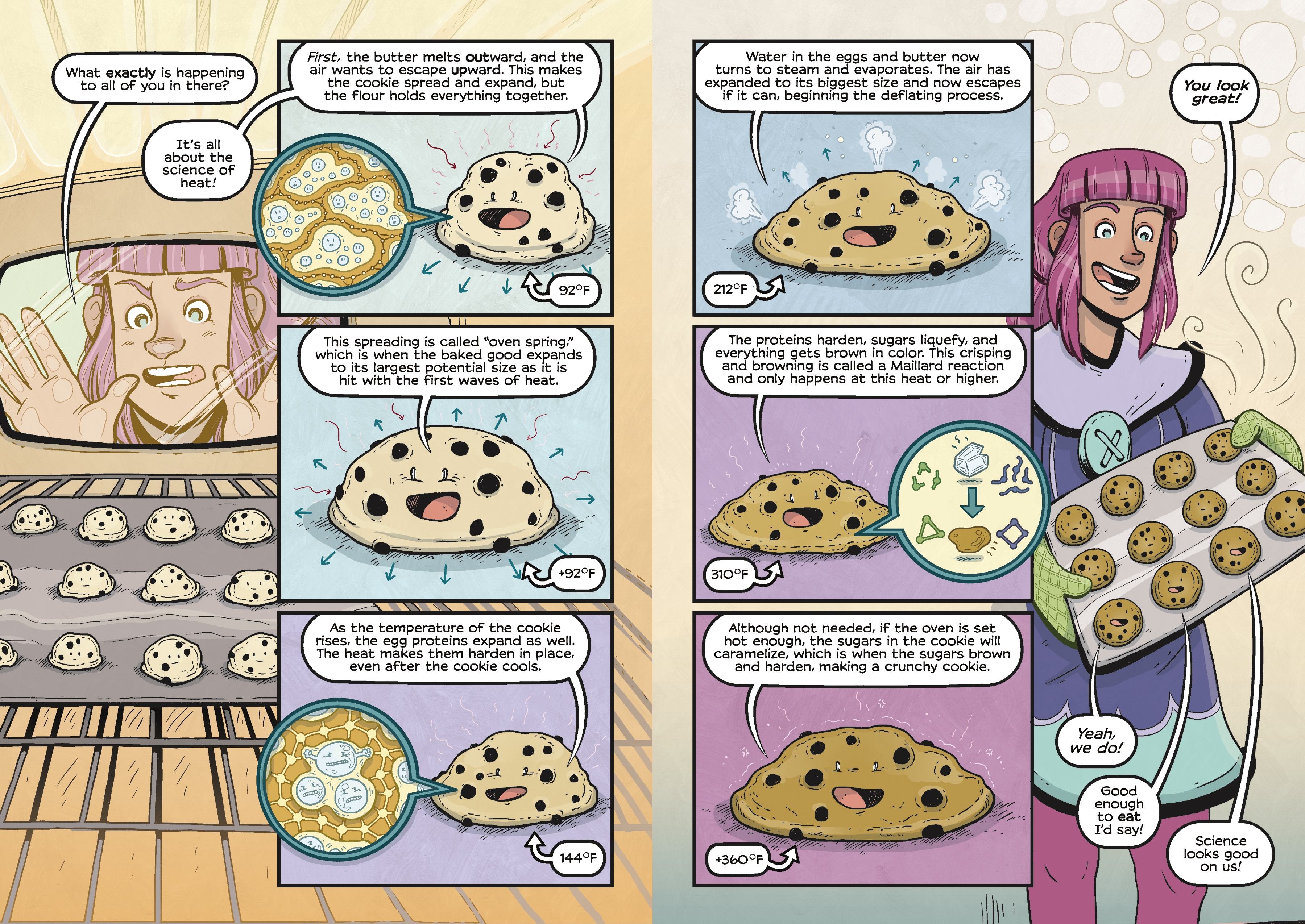
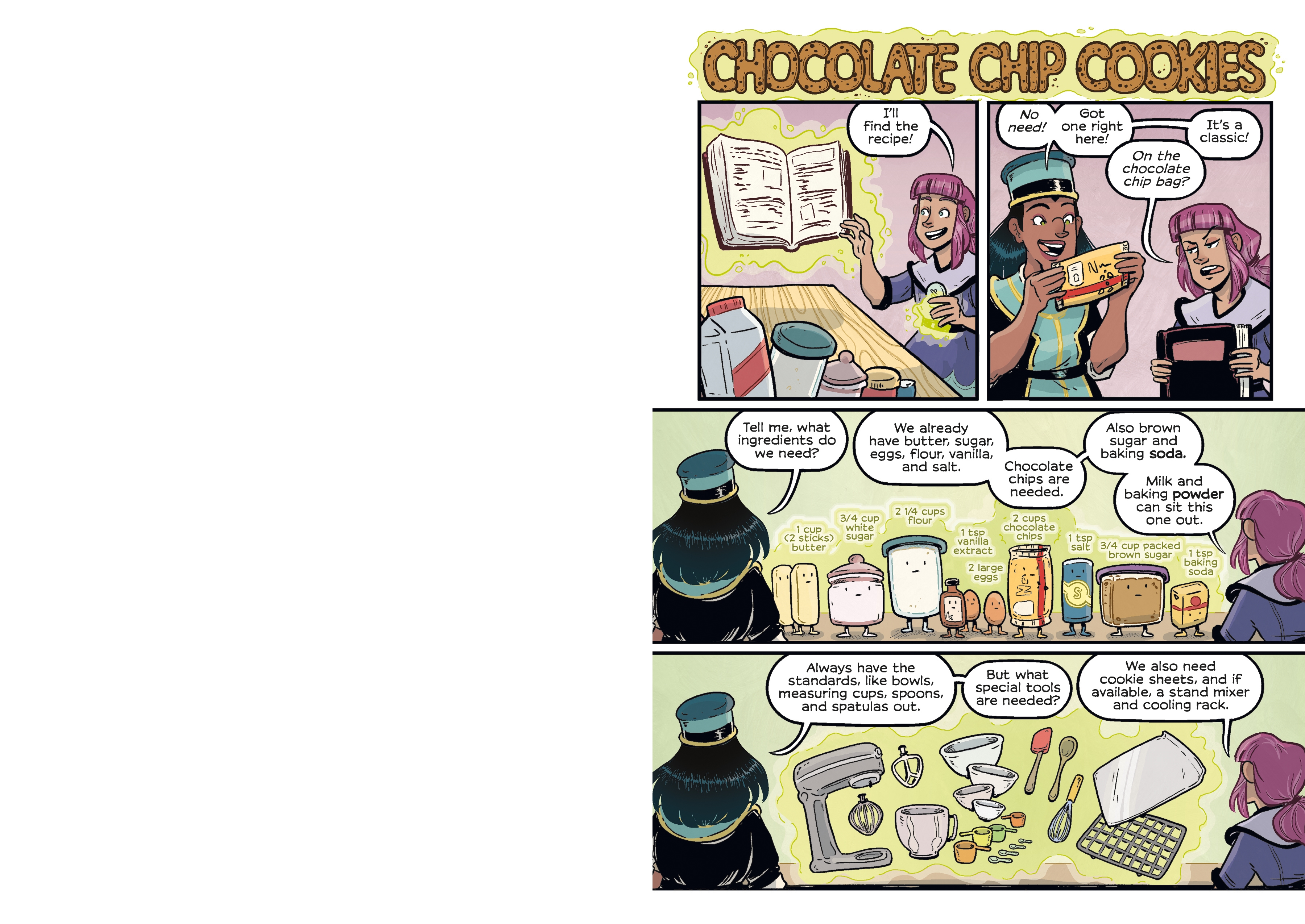
Written and illustrated by Science Comics alum Falynn Koch, Bake Like a Pro! follows a young wizard in training, Sage, as she’s apprenticed to baking master mage Korian. Sage is not thrilled with this turn of events, because she thinks baking is boring. Where’s the pyromancy? Where’s the transfiguration? But what Sage doesn’t realize yet is that baking is a magic and science all its own: it’s a delicious form of alchemy! Korian and a group of enchanted ingredients teach Sage all about the science behind baking: how to combine different proteins, fats, and liquids to craft incredible pies, cookies, breads, cookies, dough, and more.

At once a science lesson, a fantasy tale, and a recipe book for new bakers, Bake Like a Pro! is perfect for middle schoolers and upper elementary readers who are ready to take on some next-level making. There are step-by-step explanations of how ingredients come together – and what happens when ingredients go wrong (always sift the flour!), plus an illustrated walk-through for 8 different recipes, including chocolate chip cookies, cheesy biscuits, pizza dough, and sponge cake with buttercream frosting. At the end of the story, Sage proudly serves up her delicious treats to her fellow novice mages, proudly proclaiming, “Every step in baking is magic!”

Like Science Comics, there’s a quick reference at the end that puts all the major info in one place. Here, we get some helpful reminders on the six baking methods, effects of ingredients and conversion tables, bread techniques, and continued reading (including one of my favorites, I’m Just Here for the Food, by Alton Brown).

Maker Comics: Fix a Car!, by Chris Schweizer, (Feb. 2019, First Second), $12.99, ISBN: 9781250150042

Ages 10-14

Next up is Fix a Car! by Crogan’s Adventures and The Creeps author and illustrator Chris Schweizer. A group of tweens and teens meet up when they join Car Club, overseen by auto whiz Ms. Gritt. Lena, Mason, and Abner are teens with their own wheels, and twin siblings Rocky and Esther are seventh graders who  love cards and want to learn all they need to know so they can be ready when they are old enough to drive. They’re different kids with different lives and circumstances, but the one thing they have in common is a love for automobiles, and Ms. Gritt is happy to show them all they need to know.

The story smoothly moves between each character’s life outside of car club, building a relationship between characters and readers and giving kids background that they can relate to, from a stressed out teen determined to excel in all the things, to the kids working through grief over a parent. Car Club gives them all a landing place, a place to belong, and place to come together and get their hands dirty.

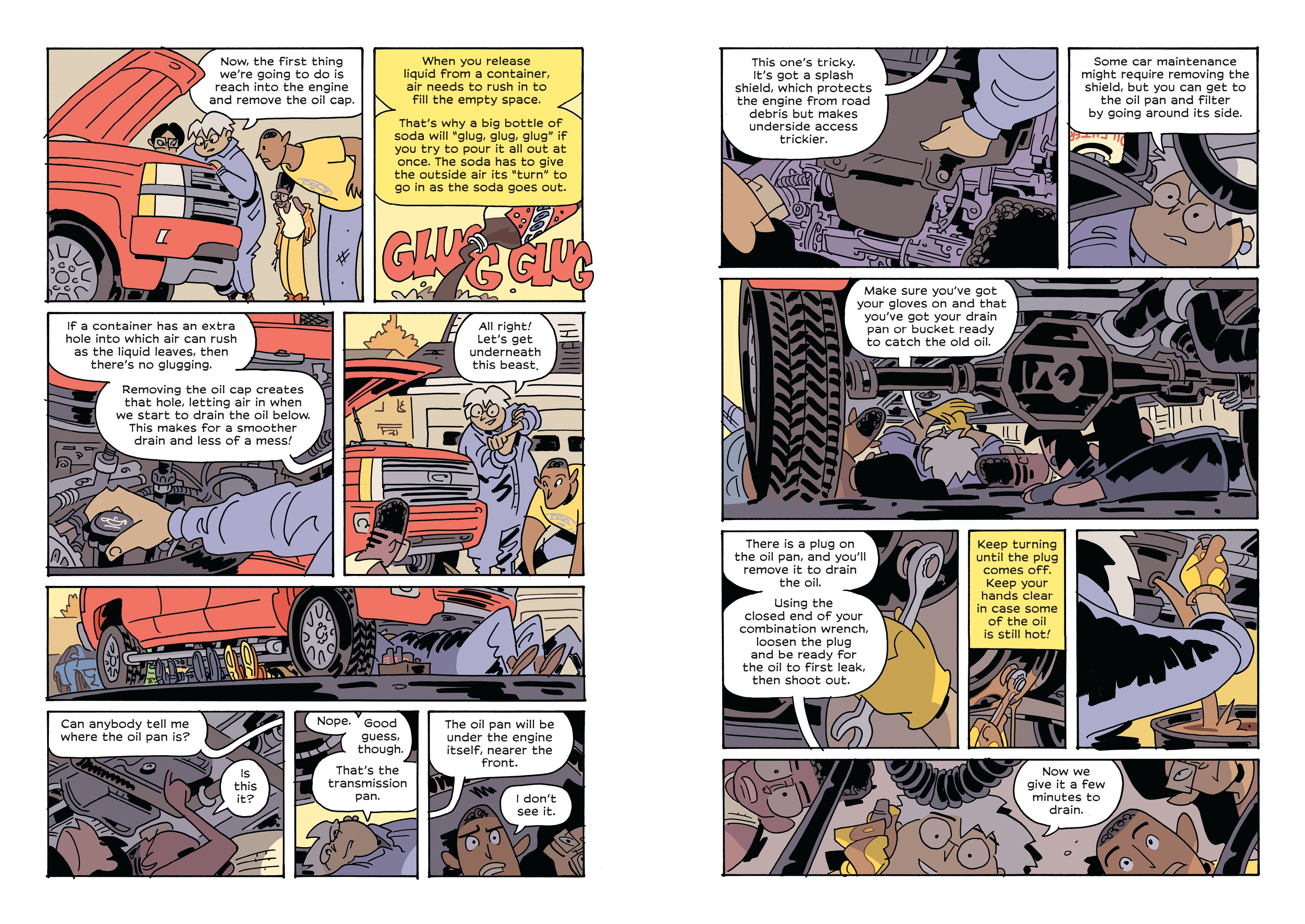
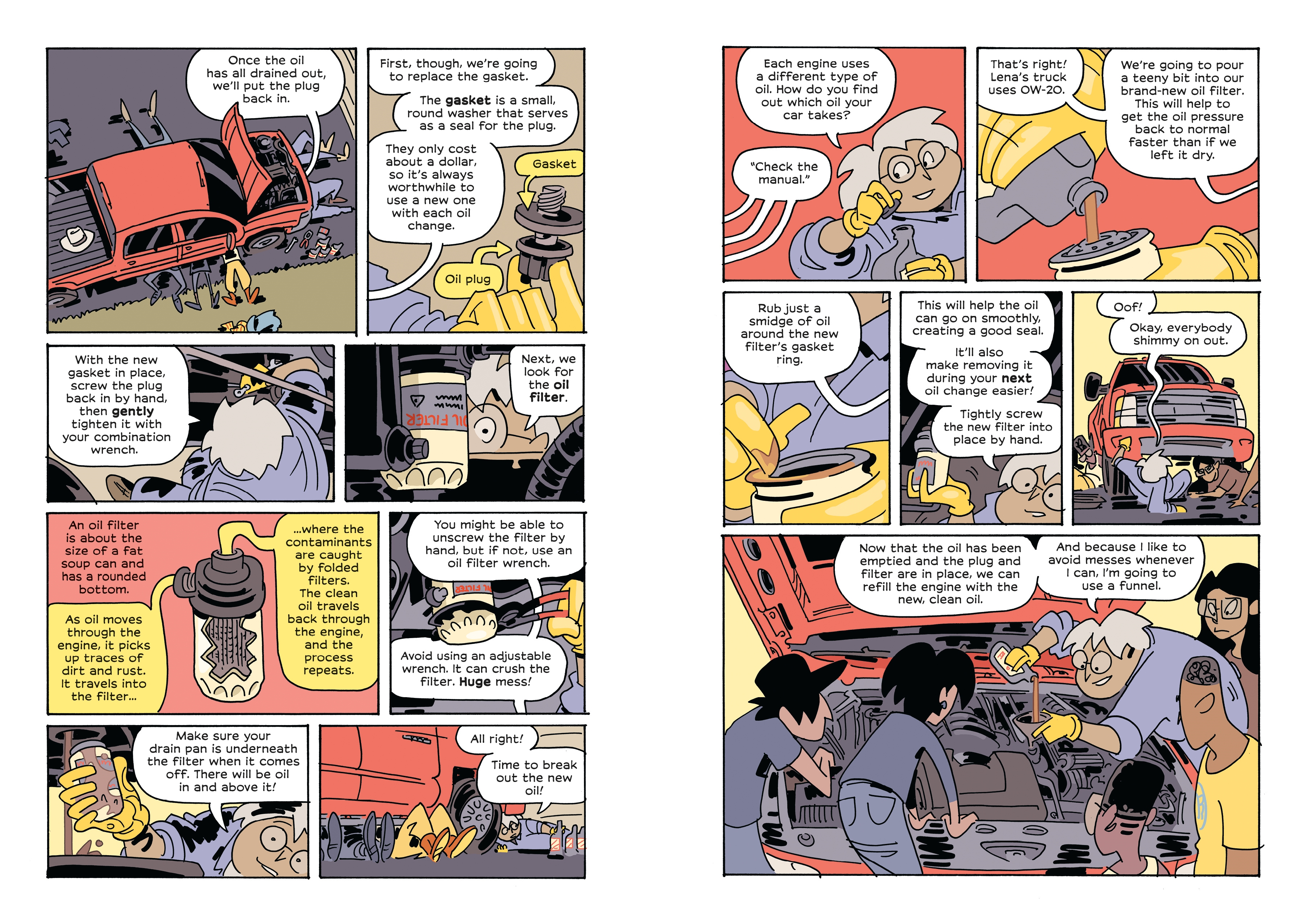
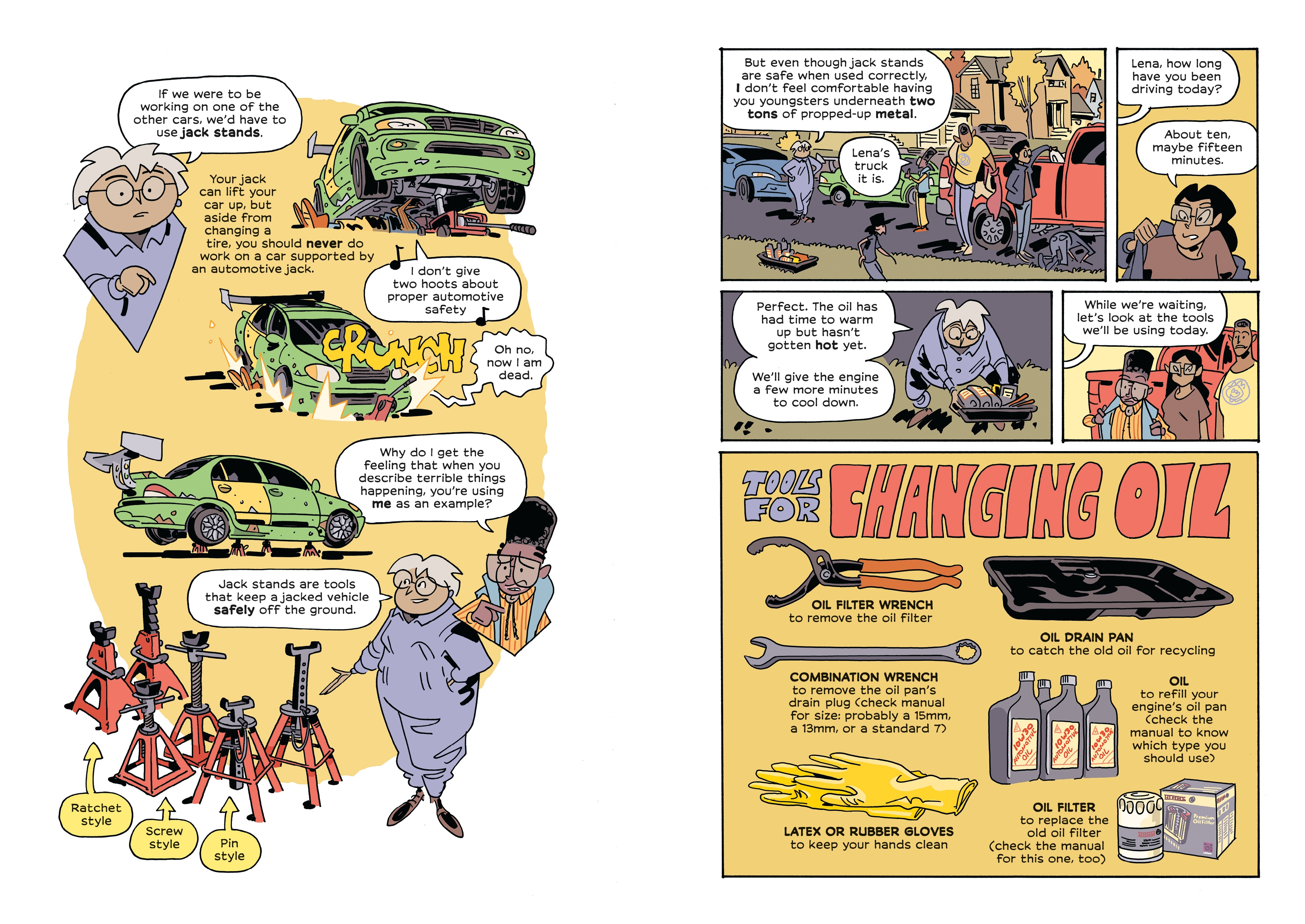
Fix a Car! is incredible in its detail: Ms. Gritt teaches her group how to check the oil and how often to check it; how to check the pressure in their tires, and how to change a tire; how to investigate a squeaky noise. Full-color diagrams introduce readers to the complex systems and inner workings of autos, and safety is paramount, with Ms. Gritt providing smart advice on how to be safe while changing a tire including how to locate a spare tire in your car and the difference between spare tires and donuts (not of the Dunkin’ variety). There are instructions on 10 different parts of auto care, including creating a portable tool kit, changing the oil, replacing a drive belt or pulley, and washing and detailing a car (bonus: adding a racing stripe). There’s a wealth of resources at the end of the book, including an author’s note on how Chris Schweizer learned to take care of his car and some further reading.

Because of the hands-on subject matter, I’d definitely include Maker Comics in my middle school collections, but the reading level works for middle grade as well. With adult supervision, I’m all for teaching younger kids to bake and learn their way around a car, so I’d consider it for either collection in a public library – many of the middle schoolers in my library go between Juvenile and YA collections – and a solid choice for middle school libraries. Create a solid graphic novel nonfiction section, and the kids will love you for it.

Posted in Intermediate, Non-Fiction, Preschool Reads

Pocket Bios: itty bitty picture book bios!

Somehow, I missed Pocket Bios until now. Introduced earlier this year, Pocket Bios are a series of pocket-sized picture book biographies. They’re filled with cute, colorful illustrations; more cartoon than realistic, and the text is fairly simple, giving big-picture facts to serve as a quick introduction to young readers. The first found of Pocket Bios drew from entertainment, sports, science, and civil rights figures, including Muhammad Ali, Charlie Chaplin, Marie Curie, and Gandhi; this next group of books includes The Buddha, Pocahontas, Marie Antoinette, and Vincent Van Gogh.

Buddha, by Al Berenger, (March 2019, Roaring Brook Press), $14.99, ISBN: 9781250168887

Ages 4-7

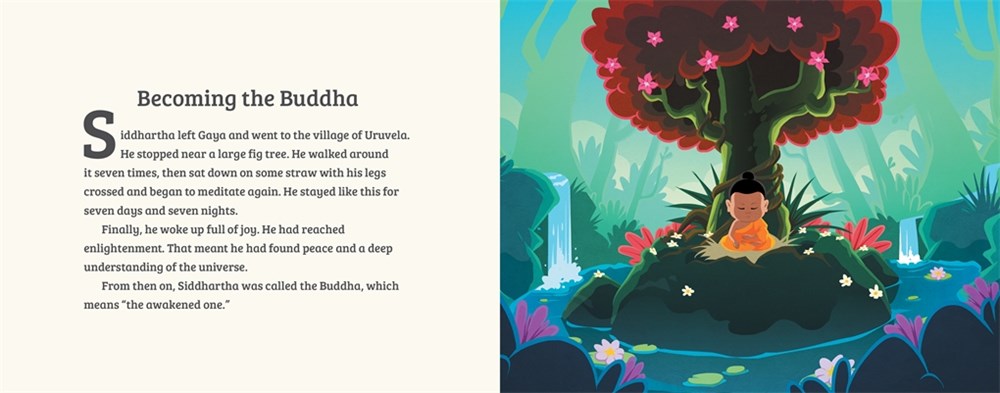
This picture book bio of Siddhartha, who would become the Buddha, the founder of Buddhism, touches on key moments in his life: his birth, youth, and marriage; his leaving the palace on his journey to find happiness, his new life as he sought and achieved enlightenment; his teaching and traveling, last days, and legacy. A timeline provides a more linear, dated glimpse at the events covered in the book, and a map shows readers important locations in Buddha’s life. People to Know offers profiles of important people in his life, including his mother and the Dalai Lama, and an illustrated “Did You Know” section offers some quick, additional facts on his life.

The art is rounded and bright, soft and cute, with some beautiful moments, particularly when Siddhartha fully realizes enlightenment, and as he teaches a group of students. A picture of an aging Buddha is gentle, tinged with an understanding that he will be moving on. There are some truly lovely moments to be found here.


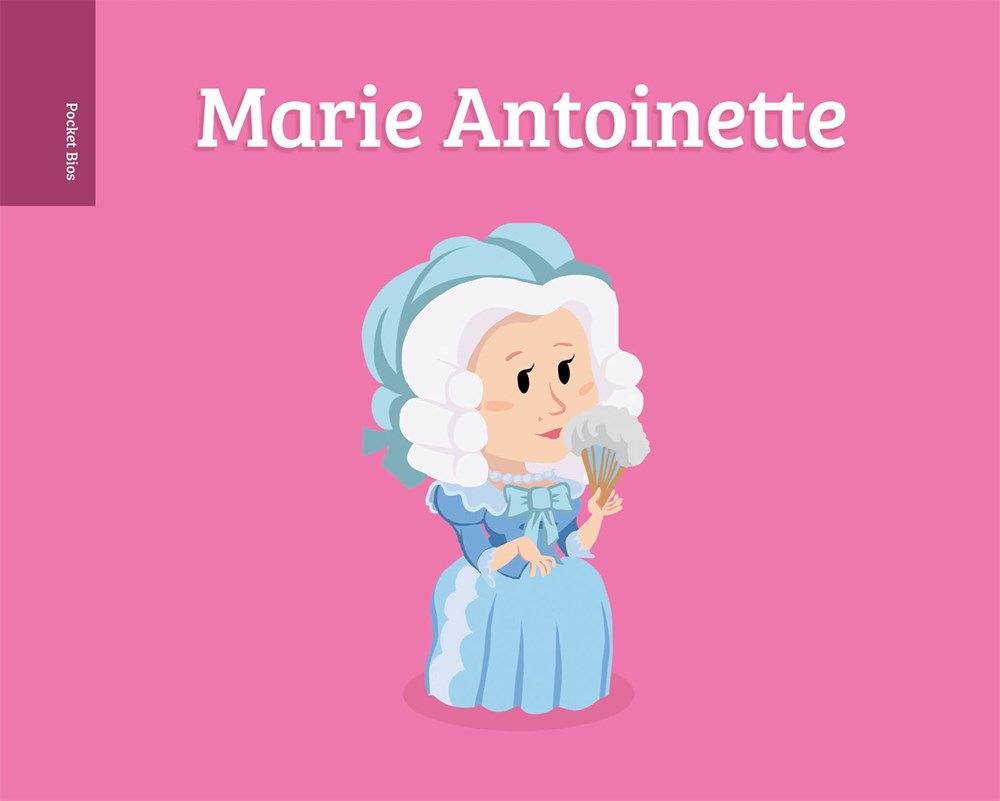
Marie Antoinette, by Al Berenger, (March 2019, Roaring Brook Press), $14.99, ISBN: 9781250168825

Ages 4-7

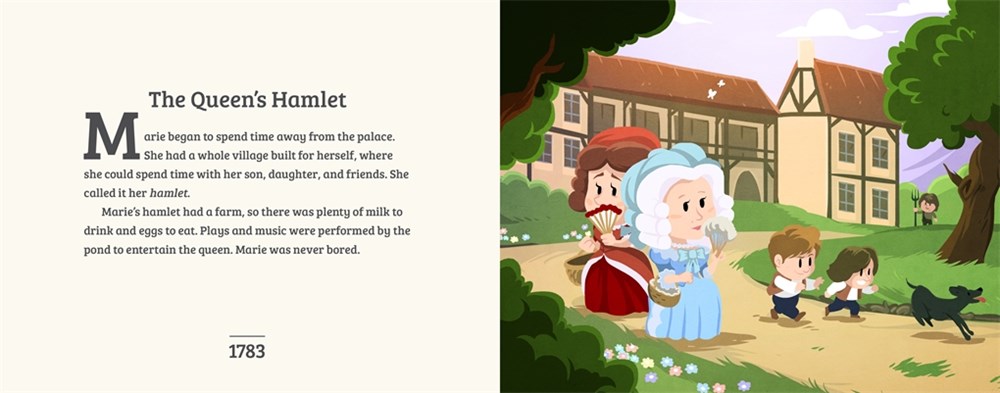
Each spread in Marie Antoinette’s Pocket Bio covers a major period in her life; the factual information on the left hand side provides the dates. We first meet her as a young princess in Vienna; move along to her 1770 wedding to Louis XVI, and then to his coronation. Then, we move into the Marie Antoinette period that everyone’s familiar with: the lavish lifestyle, depicted by a huge dinner party. As the text reminds readers, Marie Antoinette was not content in her royal duties, leading her to seek refuge at a village, built just for her, her children, and her friends. Meanwhile, revolution was in the works, and in 1789, the French Revolution began, illustrated with a French mob brandishing swords and pitchforks, outside the burning Bastille. As Marie, Louis, and their children tried to escape Paris in 1791, they were arrested and taken back to Paris, where they eventually met their ends at the guillotine – Louis, in 1793, Marie, soon after. The pictures are dramatic, loaded with shadows and flame during the Revolution; pastoral and soothing during the happier times in Marie’s life. There is a timeline, map and key of Europe in 1793, with key areas emphasized. People to Know include Marquis de Lafayette and Yolande de Polastron, one of Marie Antoinette’s close friends. Did You Know? fact to handsell the book: Marie Antoinette has some hairstyles that were four feet tall!


Vincent van Gogh, by Al Berenger, (March 2019, Roaring Brook Press), $14.99, ISBN: 9781250168863

Ages 4-7

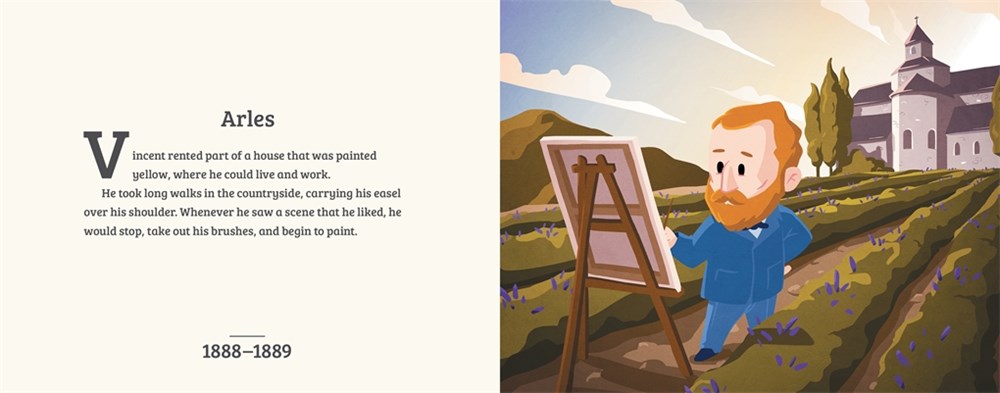
Artist Vincent Van Gogh’s biography also includes dates for the key represented moments in his life. We begin with his childhood in the Netherlands, and touches on the close relationship between van Gogh and his brother, Theo; we move onto an apprenticeship under his uncle, where he traveled to London and Paris, developing a love for art. He was a pastor in a coal-mining town from 1877-1880, and spoke out against the dangerous conditions in the mines, which influenced his painting, The Potato Eaters. From there, van Gogh embraced his love of art and began painting in 1880, after moving to Antwerp. From there, he moved to Paris, to be with Theo, but he tired of city life and relocated to Arles, where he could live and work in the countryside. The book touches on van Gogh’s struggle with mental illness and the work he created while in the hospital and under his doctor’s care. Finally, the narrative addresses his suspicious death – previously thought to be a suicide, and his posthumous fame. The timeline includes all of the moments written about in the book, and the map and key emphasize six key location in van Gogh’s life. People to know include his brother, Theo, and artist Paul Gaugin. Key Did You Know? takeaway: his most famous work, Starry Night, was painted during his time at a psychiatric hospital and he thought it was his greatest failure.


Pocahontas, by Al Berenger, (March 2019, Roaring Brook Press), $14.99, ISBN: 9781250168863

Ages 4-7

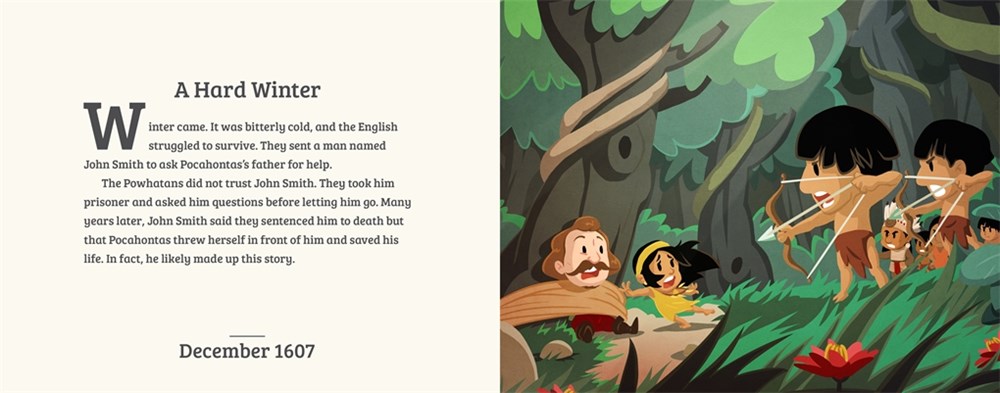
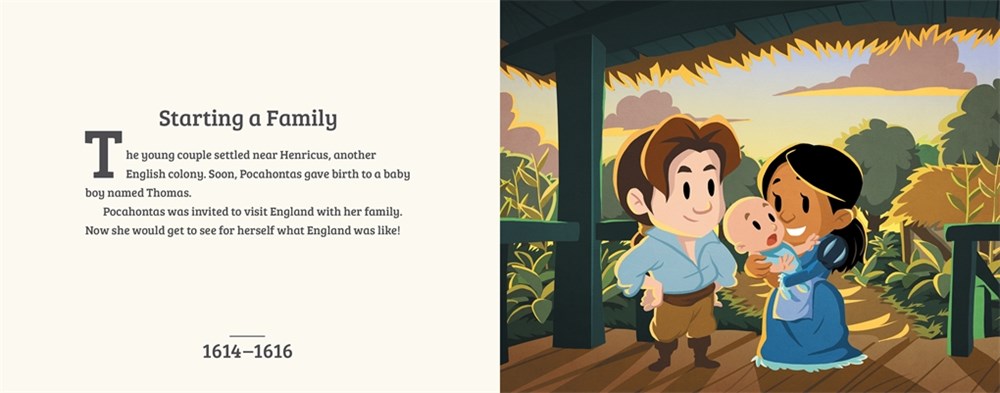
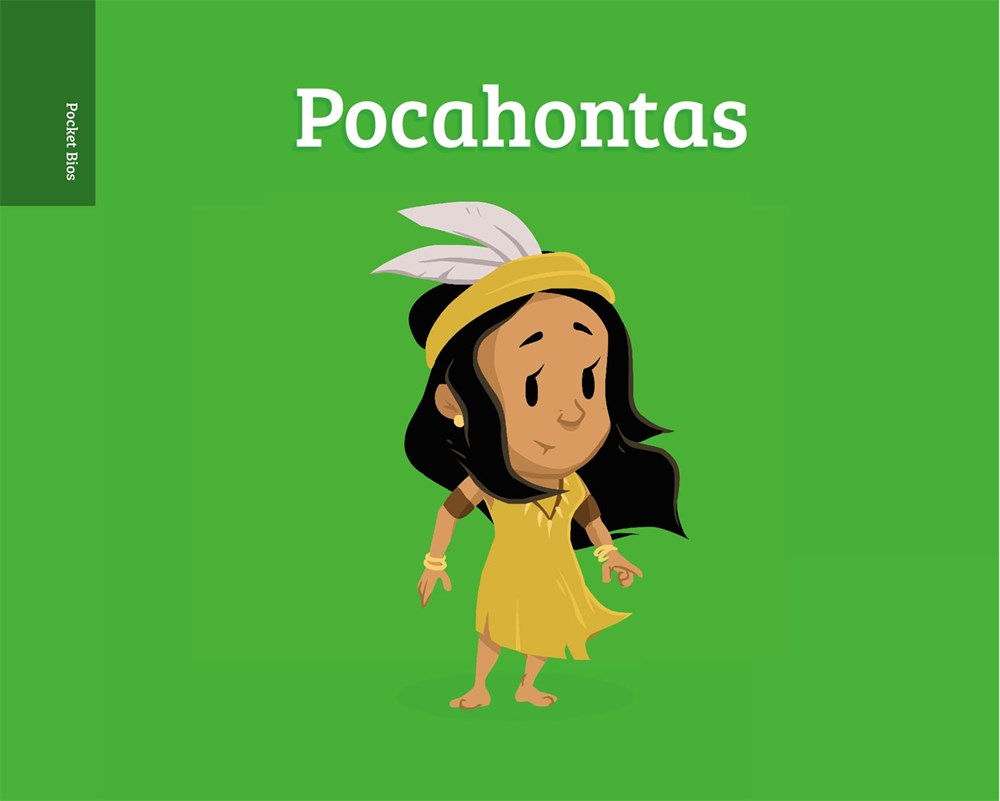
Pocahontas’ biography, also dated, starts with her years growing up in the Powhatan tribe, located where Virginia is now. The English arrived in 1607 and established the Jamestown colony; the illustration shows a young Pocahontas watching a ship dock at a newly built port. The brutal winter forced the settlers to send John Smith to ask the Powhatans for help, which led to his imprisonment. Here, the narrative diverges from the history books I grew up with (thank goodness) and points out that John Smith most likely made up the story of Pocahontas throwing herself in front of him to save him from certain death; she then becomes a friend of sorts to the Jamestown settlers, visiting them and working to keep peace between the Powhatans and the settlers. John Smith’s 1609 injury required him to head back to England – and Pochontas was told that he died on the voyage home. At this point in history, relations between the Powhatan tribe and the settlers fell apart, and they warred with one another. Pocahontas was taken prisoner and brought up English – her father refused to trade her for English prisoners – eventually marrying settler John Rolfe, converting to Christianity, and taking the English name, Rebecca. The wedding helped ease relations between the Native Americans and the settlers, and Pocahontas – now a mother of two sons – was invited to visit England. She became ill and died while traveling, and is buried in England.

There are some beautiful moments in the artwork here – a ship sailing into the golden sunlight, Pocahontas as a child, playing with other children, with a waterfall streaming in the background. There’s a timeline and illustrated map; people to know include Pocahontas’s father – not Powhatan, but Wahunsunacock, and King James I. A key Did You Know? fact reminds readers that John Smith was not the most reliable narrator.

The verdict? The Pocket Bios are a good start for younger readers, but aren’t the first resource you should seek. It’s a good series to start planting an interest in history and key people in history. Readers who enjoy Brad Meltzer’s Ordinary People Change the World series of biographies will likely enjoy these.

Posted in picture books

Crow Not Crow, birding, and a guest post from Jane Yolen!

Crow Not Crow, by Jane Yolen and Adam Stemple/Illustrated by Elizabeth Dulemba, (Aug. 2018, Cornell Lab Publishing Group), $16.95, ISBN: 978-1-943-645-31-2

Ages 5-9

Hi everyone! I hope you and yours are having a wonderful holiday season. I took a few days off from blogging to enjoy the chaos that is Christmas, but I’m back, with an armful of books to talk about. Today, I’ve got a book about birding, along with a guest post by author Jane Yolen, who’s basically a superhero in our home. Let’s dig right in.

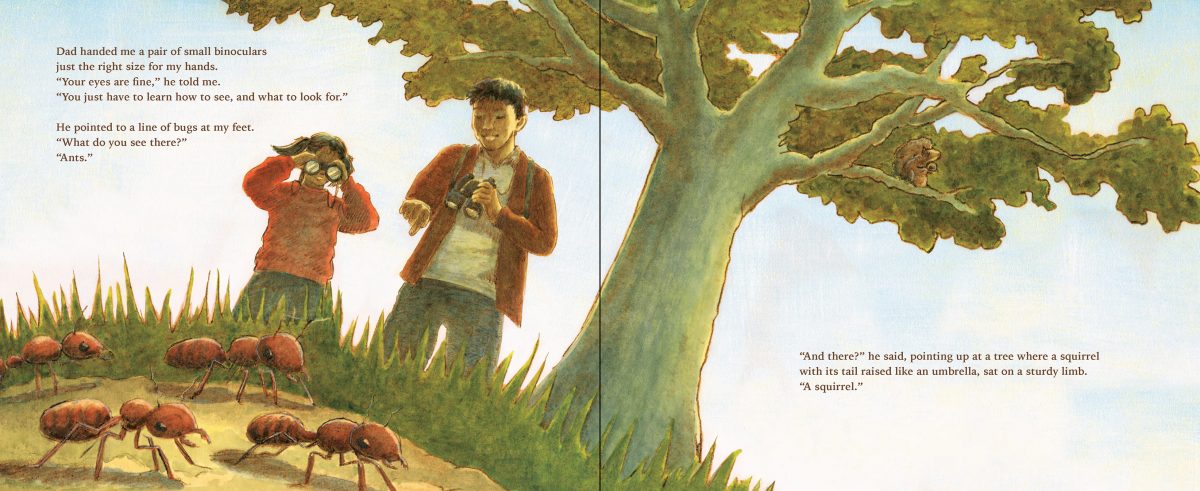
A dad and his daughter take a walk on a Fall day. She’s finally ready for her first birding walk – her brothers are all experts, but she thinks all the birds kind of look the same. Her dad teaches her a simple way to start identifying birds: Crow, Not Crow. Is it a crow? Dad asks leading questions as daughter looks on, describing identifying characteristics for the birds they encounter; he teaches her to look, really look, at colors, textures, beaks, wings – and boosts his daughter’s excitement and confidence as the story progresses. Back matter includes a section on the birds discovered in the book, split into “crow” and “not crows”. Download Cornell Lab’s Bird QR app to scan and hear bird calls for each bird.

I’ve enjoyed the Jane Yolen/Cornell Lab books. The nonfiction-fiction blend is a hit with my kids, and the artwork and words are soothing, calming, like a quiet morning. Crow Not Crow introduces birding to a young audience by giving them an accessible opening: identify a crow, note its characteristics, and go from there. Crow Not Crow teaches kids to be mindful and notice details, and creates a love and respect for nature within its pages. Elizabeth Dulemba’s color pencil artwork creates realistic, beautiful spreads with the birds taking center stage, and breathes life into a sweet story about a dad and his daughter spending a day together.

I’m thrilled that author Jane Yolen offered to write a guest post for MomReadIt! I hope you enjoy it as much as I do.

Everyone in my family is a birder, though I am the worst of them.The older I get, eyes compromised by small cataracts and Sjogren’s Syndrome, I find it harder to tell the small birds apart. LBJ’s they were dubbed—“little brown jobbies” by my husband years earlier. They seem to have gotten smaller and duller ever since. So I concentrate on crows and larger—raptors and corvids. (I am also in a band called Three Ravens, but that’s another story altogether.)

My (late) husband and our three (now grown) children were and are great birders. Not me. Though I try. In fact, I am very trying.

Not only are we bird fanatics, we are bird writers. Apart and together my family and I have published at least a dozen books about birds, starting with OWL MOON. And If you count stories and poems and songs—we are hitting somewhere north of 100. We have simply lost track.

But when Adam and I began this book—he’s the middle child with a wife and two children of his own—he professed to be bedazzled by writing a picture book. He insisted he was a song writer, a novelist, a poet, a short story writer. What did he know about picture books.

You had them read to you as a child,” I said, though in fact he was reading them himself by two-and a-half, and to his nursery school fellows by three.

I told him picture books, in their own way, are harder than all of the others and so much more of an interesting challenge. They have the line structure and lyricism of  a song or a poem. They have to have interesting characters, a plot, and an arc like a novel. They have to have a taste of adult language but be easy enough for a child (or a tired adult) to understand. They have to be about something a child is interested in. And all that has to be with every page being visual enough for an illustration.

He took a deep breath, and we began.

New York Times bestselling children’s author, Jane Yolen, and her son, Adam Stemple, have teamed up to write a gentle tale of a father introducing his daughter to the joys of bird watching. Using the simple “Crow, Not Crow” method for distinguishing one bird from another, father and daughter explore the birds near their home…and there are so many to see! After the story ends, readers learn more about all the birds that appear in the book with photographs, descriptions, and QR links to bird sounds.

Posted in Humor, picture books, Preschool Reads

Whatever you do, DON’T give the puffin a muffin!

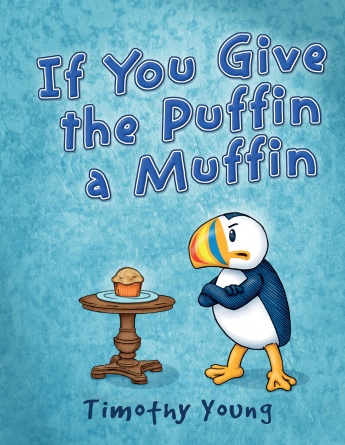
If You Give the Puffin a Muffin, by Timothy Young, (Sept. 2018, Schiffer Publishing), $16.99, ISBN: 9780764355523

Ages 4-7

If you enjoyed Timothy Young’s The Angry Little Puffin (2014), you’re going to laugh out loud at this sequel, which takes aim at some of our favorite kids’ books. With text that starts like another popular series out there – “If you give the puffin a muffin…”, the book is a vehicle for the Puffin’s dilemma. He doesn’t want a muffin; he doesn’t eat muffins; and he certainly hasn’t agreed to be the star of another book! He turns to another familiar character in the Timothy Young universe for some advice: the boy who starred in I Hate Picture Books, and Do Not Open This Box!, who suggests a magic crayon. We get laugh-out-loud visual jokes, including some suspiciously familiar children’s book icons, including penguins dressed as mice, pigs, and moose; crayons that run away; a magic door opening into a forest, where a surprised little girl drops her red crayon, and a mysterious little boy peeking out of a purple-shaded door that seems to have come from… well, nowhere. Timothy Young turns the joke on himself as the Puffin meets his author, and gives him a piece of his mind. And a muffin.

If You Give the Puffin a Muffin is funny, witty, and just plain smart.  The visual jokes make the book, and the curmudgeonly Puffin is too much fun to read and follow. The endpapers – naturally, all different types of muffins – let readers in on the joke early on. This one’s a good storytime book, and offers a fun chance to have readers spot characters and moments they recognize from other books. A fun add!

Posted in Middle Grade, Non-Fiction, Non-fiction, Tween Reads

Dinosaurs books for the arts and sciences!

The 50 State Fossils: A Guidebook for Aspiring Paleontologists, by Yinan Wang/Illustrations by Jane Levy, (Sept. 2018, Schiffer Publishing), $18.99, ISBN: 9780764355578

Ages 7-12

You know that states have their own flags. You probably even knew that states have their own trees, foods, and animals, but did you know that most states have their own fossils? It’s true! 50 State Fossils give readers a state-by-state look at each one. Maryland’s state fossil, for instance, is a Sea Snail, while Michigan’s is a Mastodon – a mammal similar to elephants and mammoths. Some state fossils are plants: Oregon’s is a Dawn Redwood, while North Dakota’s is Shipworm-Bored Petrified Wood. Each entry includes a photo and illustration of the fossil (or proposed fossil, for those states that don’t have a state fossil); a state map with a designated area where fossils can be found in that state; and a brief notation on the fossil: when the fossil dates from, when it was designated a state fossil, scientific names, and a paragraph or two about the fossil.

The State Fossils are the meat of the book, but this slim volume is packed with information for budding paleontologists: there are sections on how fossils form, how a state fossil is designated, dating fossils and the geologic time scale, and taxonomic rank.  There’s a glossary, a state-by-state breakdown of where to see fossils, and further reading. Endpapers are a colorful mix of various flora and fauna that can be found in the book.

50 State Fossils is one of those books a kid will carry to the museum to refer to while wandering through exhibits (I know I used to) and makes for a great book to give dino fans. It’s a nice add to nonfiction collections and a good gift idea.


If da Vinci Painted a Dinosaur, by Amy Newbold/Illustrated by Greg Newbold, (Oct. 2018, Tilbury House), $17.95, ISBN: 9780884486671

Ages 4-8

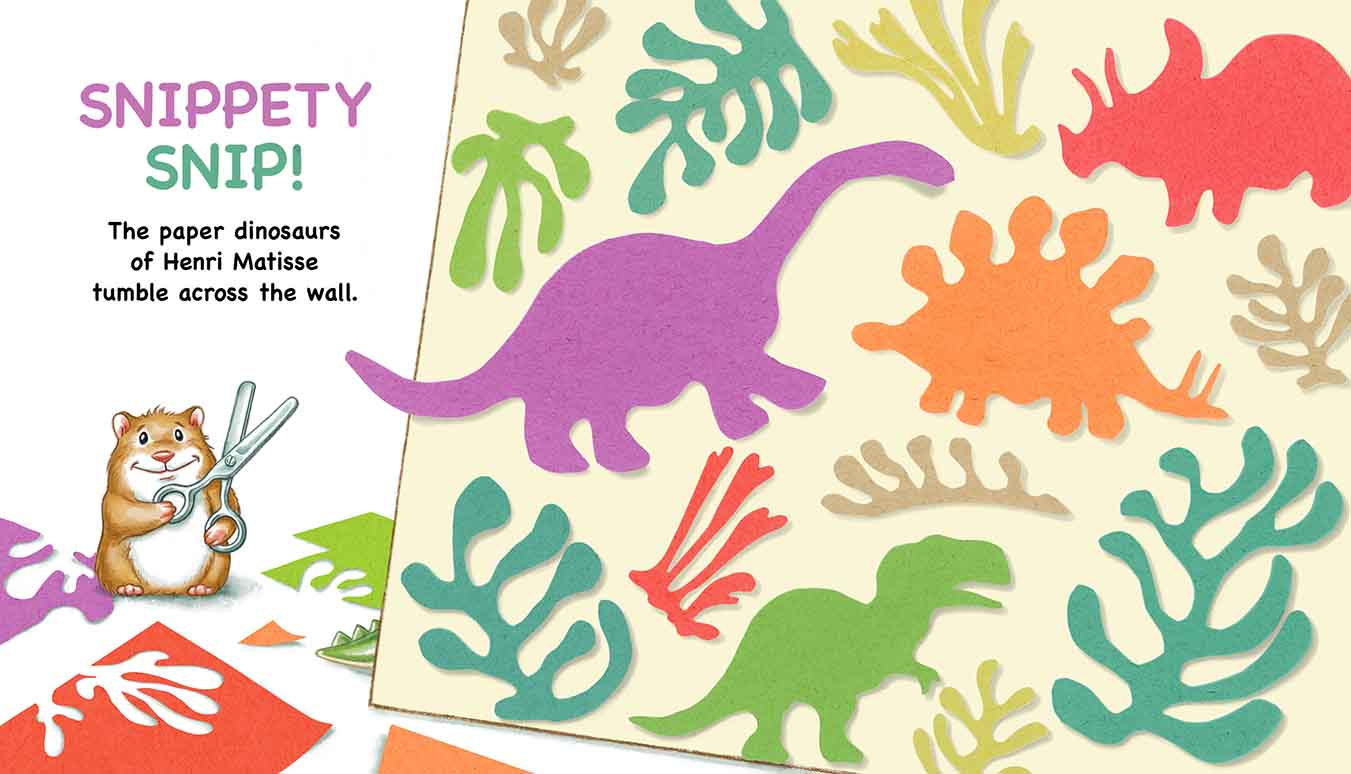
This follow up to 2017’s If Picasso Painted a Snowman is an enjoyable look at dinosaurs and art history. The hamster guide is back, escorting readers through an art gallery of different artists’ takes on dinosaurs, from a da Vinci-esque Virtruvian Dino, through Katusushika Hokusai’s giant wave (with dinosaurs wave surfing), and itty bitty dinosaurs hiding in Diego Rivera’s lilies. Who would da Vinci really paint, though, if he were painting dinosaurs? Why, Dino Lisa, of course! Readers are encouraged to copy a page sporting a blank easel and make their own dinosaur artwork, and featured artists get capsule biographies at the end, along with the dinosaur species designated to their paintings. A word from artist Greg Newbold encourages readers to draw, explore, and have fun on their own artist journeys. Endpapers inspired by Henri Matisse’s paper cutouts lead the reader in and usher them out, hopefully with a head full of ideas.

This book is just too much fun! It’s a great way to introduce art and science to kids, and begs for a program where kids can learn about artists and create their own dinosaurs. I’d have used this in my art storytime, for sure. (So maybe I need to dust that storytime off and revisit it.) Booktalk and feature in an art storytime with Lucy Volpin’s Crocdali; David Wiesner’s Art & Max; My Museum by Joanne Liu, and Henri’s Scissors by Jeanette Winter. This one’s an absolute add to collections.

Posted in picture books, Preschool Reads, Toddler Reads

Kwanzaa Books made the holidays bright!

My holds are in! I’ve got Kwanzaa books for everyone! (Okay, for kids. But that’s the most important audience here, right?) Let’s start the fun.

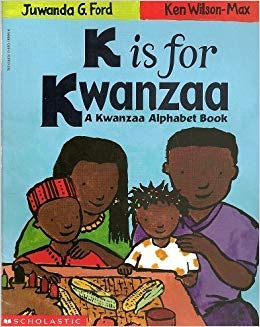
K is for Kwanzaa: A Kwanzaa Alphabet Book, by Juwanda G. Ford/Illustrated by Ken Wilson-Max, (Nov. 1997, Scholastic), $10.95, ISBN: 0-590-92200-9

Ages 3-7

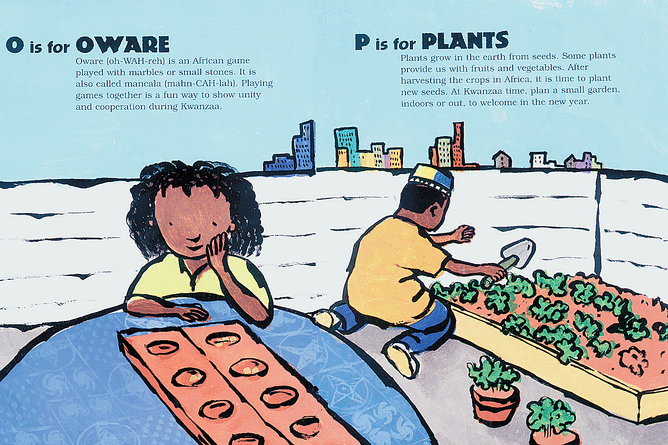
This holiday abcedary starts off with a history of the Kwanzaa holiday and the seven Kwanzaa principles, then journeys into the alphabetic aspects of Kwanzaa. Using English and non-English words, readers learn a Kwanzaa vocabulary, from Africa to Zawadi. There are phonetic pronunciations for all African words, which is a huge help for readers just learning about Kwanzaa and its icons, and Juwanda G. Ford explains each aspect of the holiday simply and fully enough for a child to understand, appreciate, and learn: the mkeka is a special mat used when setting a Kwanzaa table, and mazao are the fruits and vegetables symbolizing the harvest, set on the mkeka; neighborhoods are part of the Kwanzaa celebration, promoting community, working together, and respecting where we live, to make the world a better place. Gele, the cloth that African and African-American use as a headwrap, shows pride in African heritage, as does Jewelry, which also allows families to practice the creativity principle, Kuumba.

Ken Wilson-Max’s illustrations are lovely, featuring African-American families and African icons, instilling a pride in the beauty of African heritage. His illustrations are boldly outlined and feature bright colors, appealing to little eyes. Each letter and its corresponding word are emphasized with bold, black font that let the words pop off the page. The alphabet

K is for Kwanzaa lets kids learn about the holiday from A to Z, and is an enduring holiday book. It’s a strong introduction to Kwanzaa, and to African heritage.


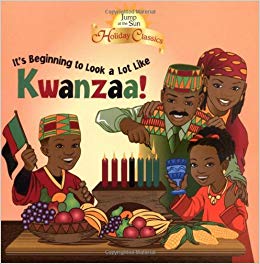
It’s Beginning to Look at Lot Like Kwanzaa!, by Rex Perry, (Sept. 2004, Jump at the Sun), $3.50, ISBN: 0-7868-0924-8

If the holiday standard, “It’s Beginning to Look at Lot Like Christmas” is stuck in your head as you read this Kwanzaa carol, don’t worry – I found myself reading along with a similar cadence, adjusting for some of the text. Families together, snow falling, and the repetitive phrase, “It’s beginning to look at lot like Kwanzaa!” invites readers to join this book’s family as they prepare for the holiday. The family wears Kwanzaa colors and kente, share food, and gifts, and touch on all of the holiday principles in the text. As Kwanzaa’s end nears, the family reflects on the holiday and the promises made for the year, and looks forward to the new year.
The artwork is bright, with bold outlines and warm colors that draws readers right into the story. Family members hold and dance with one another, having fun and showing affection, making the warmth contagious. You’ll want to cuddle your little ones as you read this rhyming story, guaranteed. The story focuses less on the facts and iconography – although they are present and alluded to in the text – and more on the family and togetherness theme of the season. A nice add to your holiday sections.


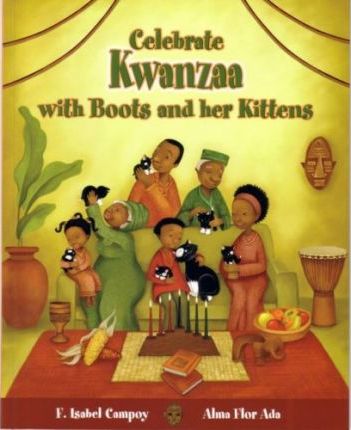
Celebrate Kwanzaa with Boots and Her Kittens, by Alma Flor Ada & F. Isabel Campoy/Illustrated by Valeria Docampo, Translated by Joe Hayes & Sharon Franco, (Feb. 2007, Alfaguara), $11.95, ISBN: 9781598201352

Ages 4-8

It’s time to come together and celebrate Kwanzaa, but wait! Boots the Cat is missing! A young boy and his family pull together and put the principles of Kwanzaa to work as they spend each day searching for the cat – with a sweet surprise on the last day.

Celebrate Kwanzaa with Boots and Her Kittens is half fiction, half non-fiction. The first half is the story of Boots and her family. The family dresses in African garb and have African decorations, including drums and masks, displayed in their home. The colors are warm and earthy. A page-a-day calendar and family members holding scroll with the day’s principles teach readers about each day’s principle and message.

The non-fiction section of the book uses photos and artwork to provide information about Kwanzaa, its place in African-American family homes, and how different families celebrate.

The combination of fiction and non-fiction in one spot makes this a good addition to your holiday shelves. It’s hard to find now, but check your local libraries for a copy!


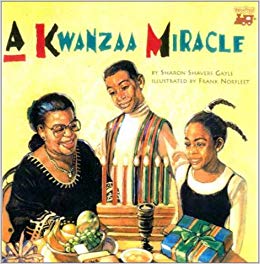
A Kwanzaa Miracle, by Sharon Shavers Gayle/Illustrated by Frank Norfleet, (Sept. 1996, Troll Communications), $3.50, ISBN: 0-8167-4182-4
Ages 5-9

This touching story is all about families. Ashley and Darryl Parker are siblings who are excited for the holidays; their parents are on the planning committee for their building’s Kwanzaa celebration, but their grumpy neighbor, Mrs. Parker, doesn’t seem to be interested in anything other than snapping at the kids. When Ashley and Darryl have a snowball fight and hit Mrs. Parker’s window, they expect to feel her full fury – and discover that their neighbor is a kind, loving person. With this new development, they work with the families on the planning committee to honor Mrs. Parker and reunite her with her sister.

This is a loving, kind story that will touch any reader. It busts that “mean old neighbor” trope and reminds kids – and adults! – that everyone has their own challenges. Darryl and Ashley are good kids who build a bridge between their neighbor, their building (community), and her sister. It’s a great story, and the oil painted artwork by Frank Norfleet gives us realistic characters and settings, with warm colors and expressive, kind faces and body language. The principles of Kwanzaa, explained in the back matter, are communicated through the characters’ actions, opening up the chance to discuss with your readers, and see if they can find examples of each.

I wish this was still in print! It’s such a wonderful book – check your local libraries, and third party sellers have some available.


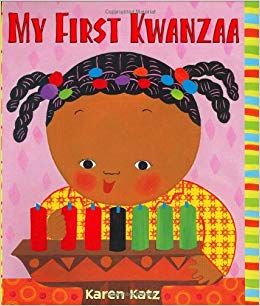
My First Kwanzaa, by Karen Katz, (Nov. 2003, Square Fish), $7.99, ISBN: 9781250050465

Ages 3-6

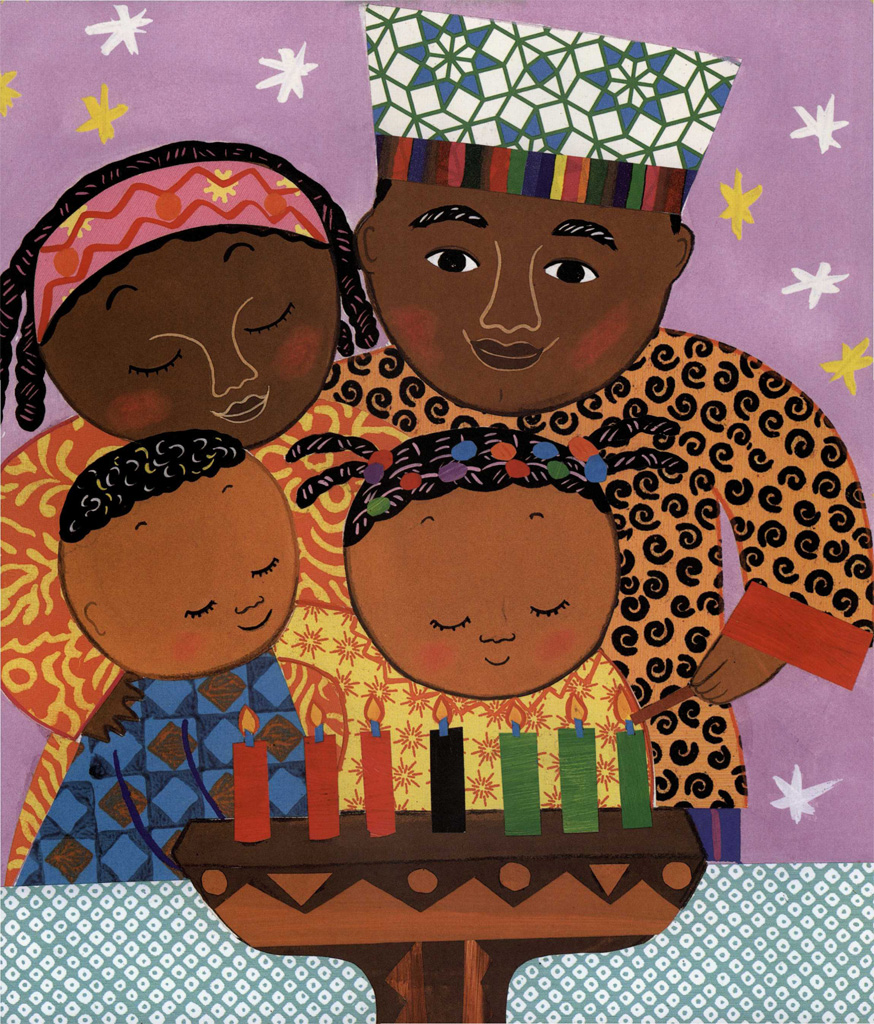
Karen Katz brings her adorable collage and mixed-media artwork to this adorable celebration of Kwanzaa. The text is spare but informative, speaking directly to children about each day of Kwanzaa, and how our protagonist – a young African-American girl – celebrates it. Phonetic pronunciation of the principles and and terms help introduce new vocabulary, and each explanation is empowering, offering ways for kids to take part in the celebration. From asking her mother to braid her hair “in a fancy African way” on the second day of Kwanzaa (kujichagulia – self-determination) and feeling pride in her heritage, to dreaming of being an African dancer like her Aunt Tasha on the fifth day (nia – purpose), to painting clay pots and weaving baskets on the sixth day (kuumba – creativity), there’s something for every child to take to heart.

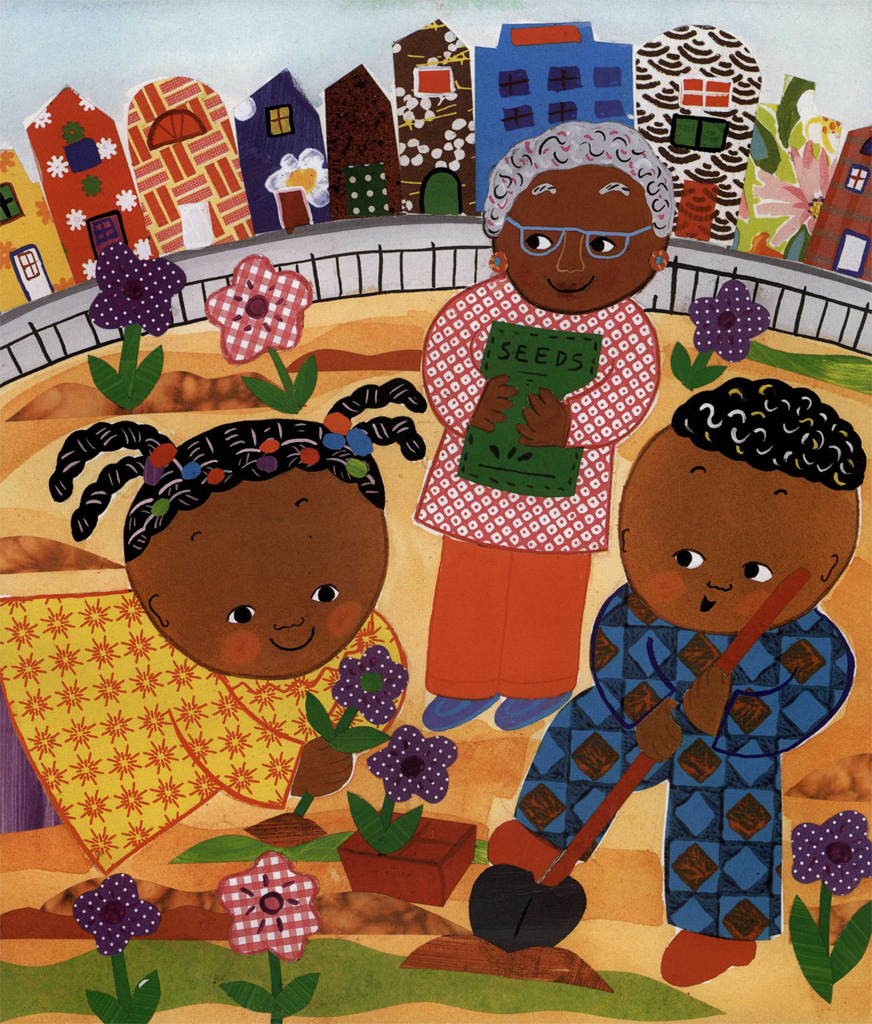
Karen Katz’s illustrations are precious. Her characters have round, sweet faces with gentle expressions. They all wear bright colors and have braided, beaded, and natural hair. A kinara appears on every spread, another candle lit, to visually represent the days of Kwanzaa. Holiday cuteness for littles and bigger kids alike.


So that’s my Kwanzaa book wrap-up! What have I learned from this year and last year’s roundups? That we need more Kwanzaa and Hanukkah books: published more frequently, in greater volume, and that stay in print longer. How can we make that happen next year?


Posted in picture books, Preschool Reads, Toddler Reads

New Baby love: Lots of Love, Little One!

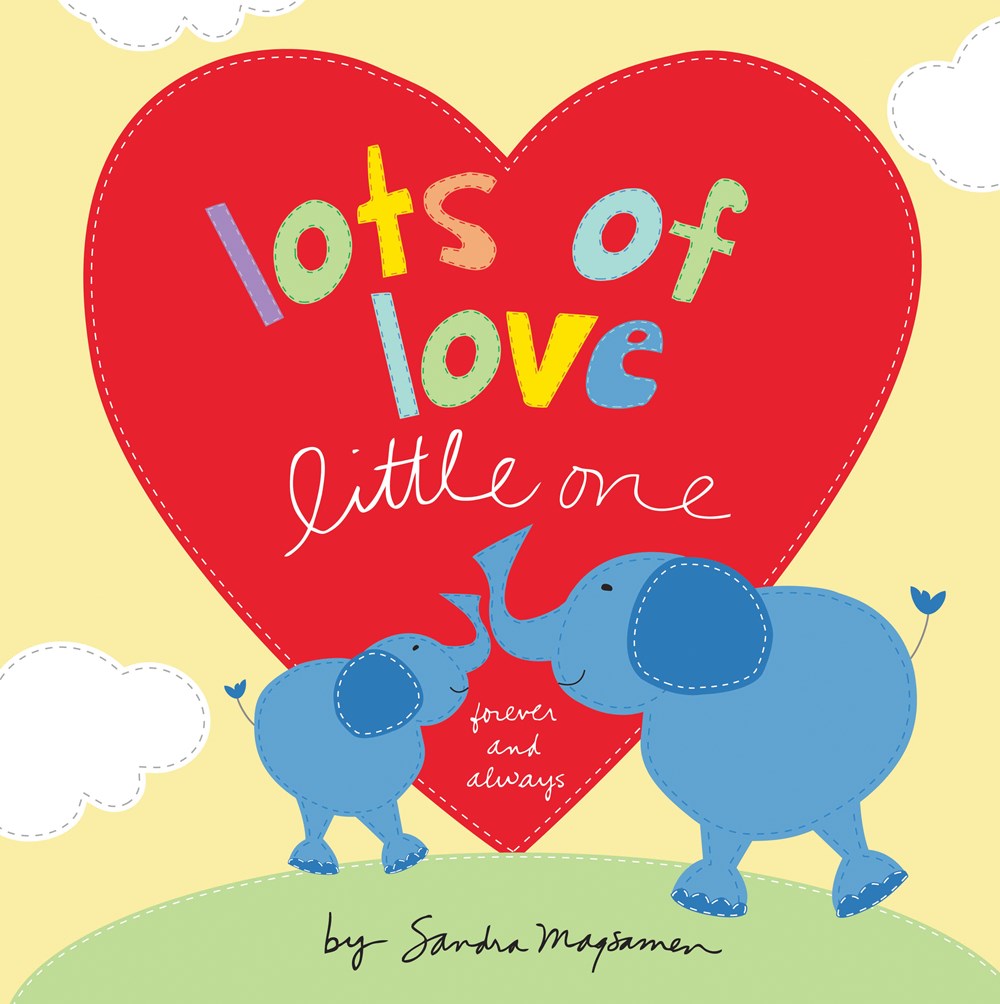
Lots of Love, Little One! (Forever and Always), by Sandra Magsamen, (Dec. 2018, Sourcebooks Jabberwocky), $17.99, ISBN: 9781492683988

Ages 0-4

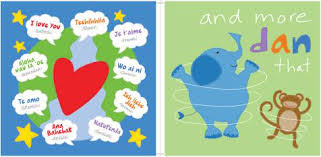
What better reason to celebrate love and life than a new baby? Although Lots of Love Little One can really be a book for anytime, anywhere, it’s perfect for a new baby/baby shower gift. Adorable illustrations and sweet phrases, like, “I love you more than all the stars that twinkle at night, and all the fireflies that glow so bright”, fill the pages with joy and adoration. The illustrations resemble stitched-together toys, and include a mother and baby elephant; spaghetti (it’s one of the rhymes); fireflies, and stars. A page dedicated to “I love you” in nine different languages includes Sioux, Hawaiian, and Swahili. The colors are bright and the art and words come together to create a love letter to the little ones in your life.

Sugary sweet, sure, but if you can’t give all the sweetness in the world to little ones, where’s the fun? An absolutely snuggly, cuddly book. Mommies-to-be, read this one to your bellies!