Posted in Graphic Novels, History, Non-Fiction, Teen, Tween Reads, Young Adult/New Adult

Graphic Novel Biographies: Nat Love and Bluma & Felix Goldberg

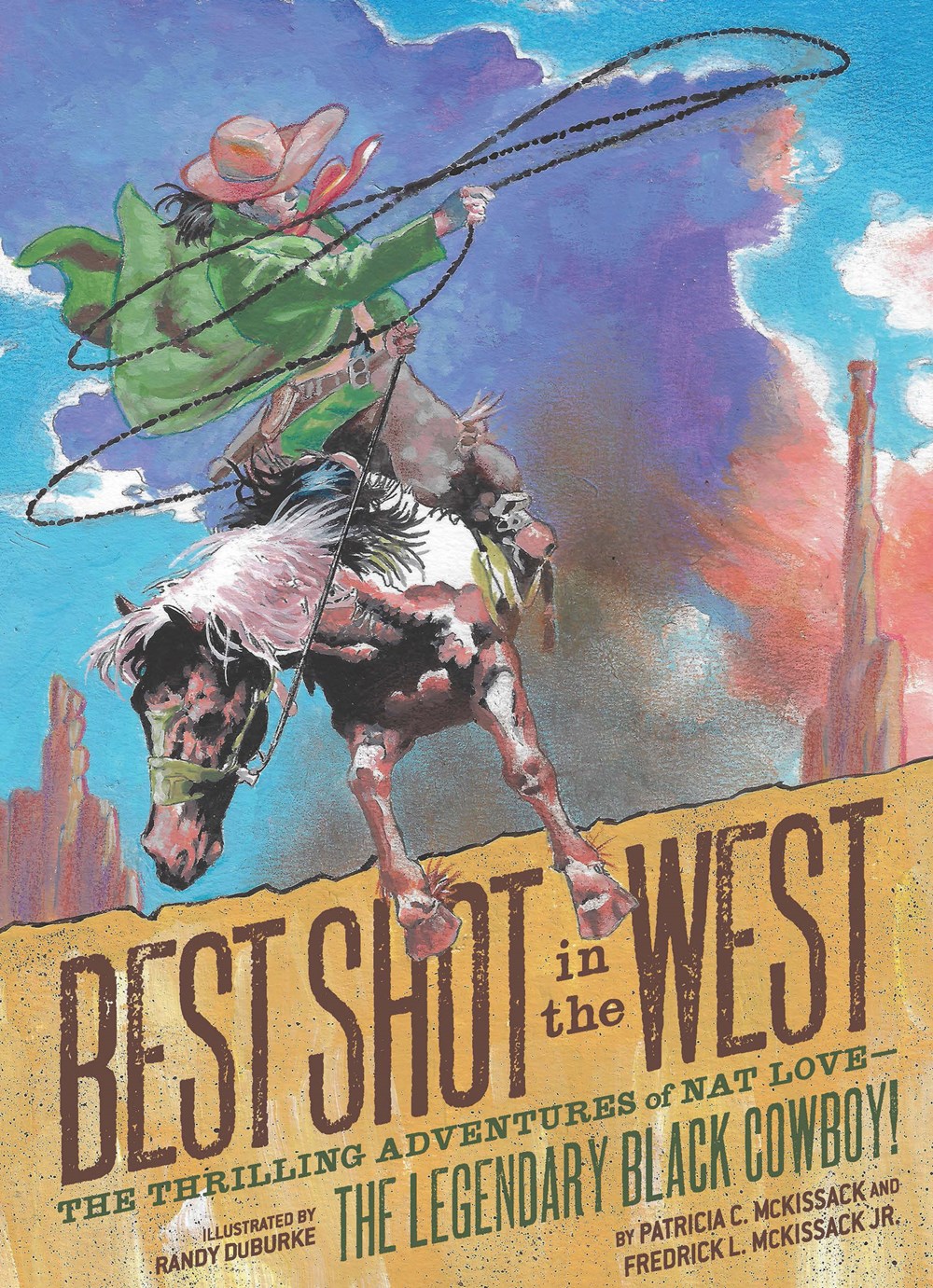
Best Shot in the West: The Thrilling Adventures of Nat Love – The Legendary Cowboy!, by Patricia C. McKissack and Frederick L. McKissack, Jr./Illustrated by Randy Duburke, (Aug. 2022, Chronicle Books), $9.99, ISBN: 9781797212517

Ages 10-13

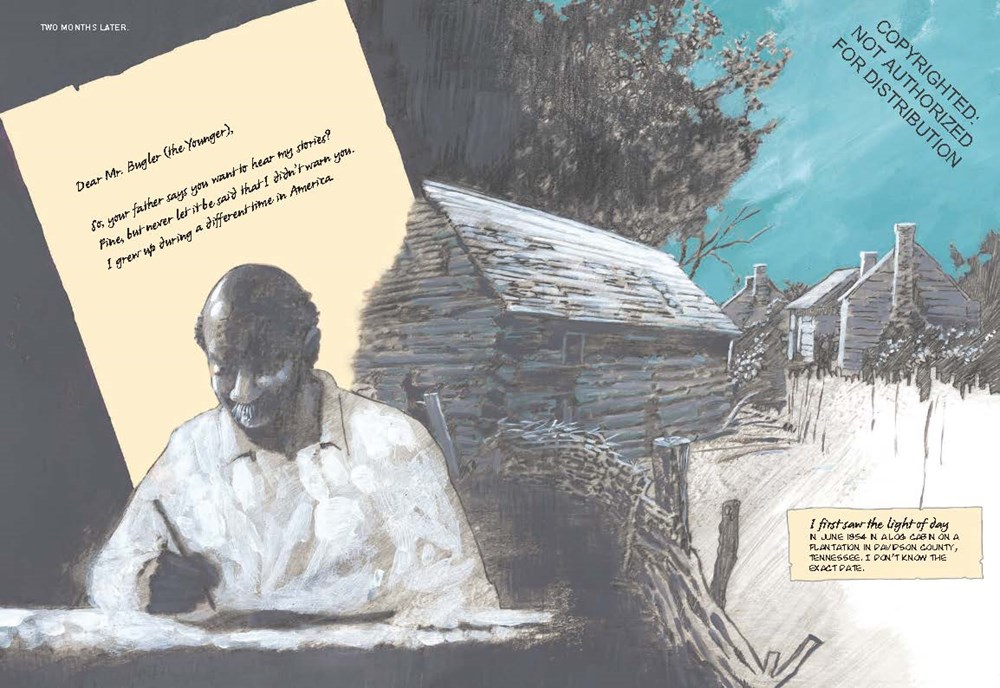
Originally published in 2012, this graphic novel biography of Nat Love, also known as Deadwood Dick, one of the most famous African-American cowboys in the Old West. Based on Love’s 1907 autobiography, The Life and Adventures of Nat Love, Better Known in the Cattle Country as “Deadwood Dick,” Best Shot in the West‘s adaptation by children’s literature greats Patricia and Frederick McKissack is told in Love’s voice, from his 1854 birth into slavery in Tennessee; his leaving home to find work as a cowpoke and his adventures across the country, and his decision to marry and work as a railroad porter in his later years. The McKissacks created a faithful adaptation that appeals to a younger readership, and Coretta Scott King/John Steptoe Award Winner Randy Duburke’s painted work brings Love’s work to life, with gray wash over color to add a sepia-toned aging to the artwork. A good purchase for libraries with robust graphic novel biographies and historical U.S. collections. Pair with books like Black Heroes of the Wild West and Bad News for Outlaws for a display on the Wild West your readers didn’t learn about!


We Survived the Holocaust: The Bluma and Felix Goldberg Story, by Frank W. Baker/Illustrated by Tim E. Ogline, (Sept. 2022, Imagine & Wonder), $19.99, ISBN: 9781637610206

Ages 14-18

In 2000, Holocaust survivor Felix Goldberg handed media literacy educator Frank W. Baker a copy of the speech he’d just delivered to a South Carolina synagogue and asked him to “do something with this”. Baker worked with the Goldberg’s children and illustrator Tim E. Ogline to bring Felix’s and Bluma’s stories to the world. Rendered in stark black and white, their stories unfold: Felix’s and Bluma’s early lives in Poland parallel the growing wave of hate and rage running through Germany; the antisemitic propaganda that dehumanized and turned a nation against a people; the explosion of violence that began the Holocaust. Felix and Bluma experienced untold horrors across concentration camps and death marches, losing family members but finding one another in a displaced persons camp, and arriving in America to begin a life together. It is an moving and powerful story, and a strong book to put on shelves next to Maus. Back matter includes a timeline of events; a glossary; recommended resources for further reading, and an index. You can find a Readers Guide at the Stories of Survival website.

 

Posted in Uncategorized

A haunting across decades: A Promise Stitched in Time

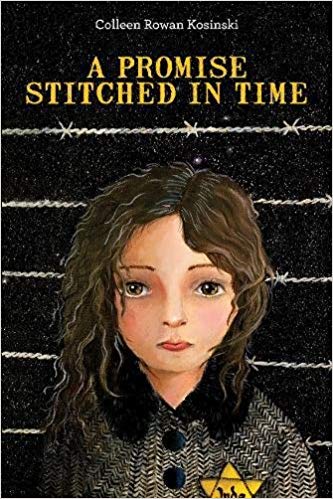
A Promise Stitched in Time, by Colleen Rowan Kosinski, (Sept. 2018, Schiffer Publishing), $12.99, ISBN: 978-0-7643-5554-7

Ages 10-13

Eighth grader Maggie McConnell is still grieving the loss of her father to cancer. The budding artist is agonizing over a project that will get her into the prestigious Peabody Academy; it was a promise she made to her father and herself. When she discovers a an old coat at her local thrift store, she’s drawn to it and buys it on the spot. Immediately, she begins having hallucinations about starving, burning chimneys, cruel voices and beatings, and terrifying dogs waiting to attack. She sees visions of a girl wearing the coat and reminding her of a promise made to a girl named Gittel. Turning to her friend Taj for help, the two try to unravel the source of the haunting. Meanwhile, Maggie is at odds with her popularity-obsessed sister, Patty, who doesn’t agree with Maggie’s choice in clothing or friends. As Maggie works toward the heart of the mystery, she discovers that Mrs. Berk, an elderly resident at a nursing home where Maggie teaches art, plays a key role.

A Promise Stitched in Time has an interesting main story that gets lost in its attempt to create a paranormal story. Having a coat haunted by a spirit of its former owner – a girl who died at Auschwitz – is an interesting concept on its own. Maggie’s father’s story seems to be more of a plot device that gets in the way, and the story’s resolution felt rushed, overcrowded in an already full narrative. It starts off strong, but ultimately left me wanting more.

Posted in Historical Fiction, Teen, Young Adult/New Adult

The Red Ribbon finds hope in the heart of despair

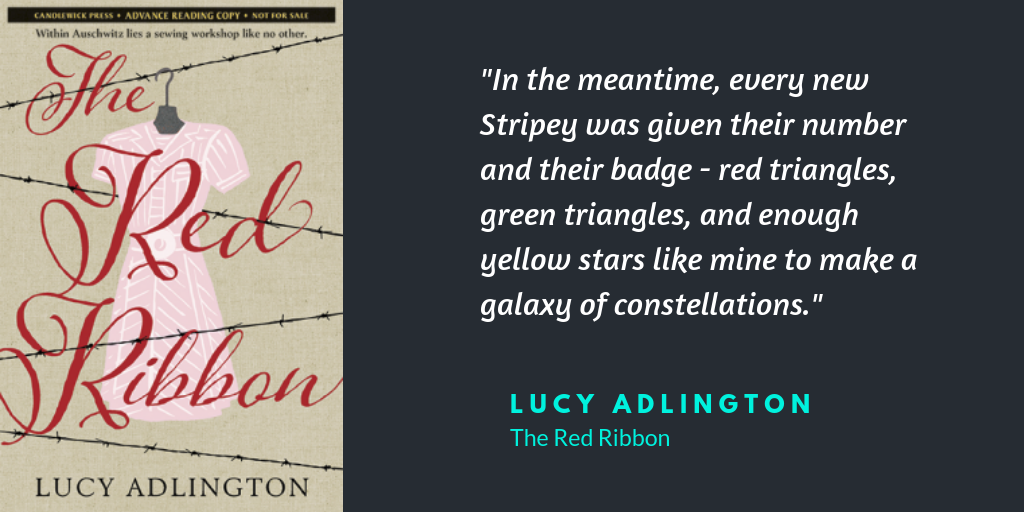
The Red Ribbon, by Lucy Adlington, (Sept. 2018, Candlewick Press), $17.99, ISBN: 9781536201048

Ages 12+

Ella is a 14-year-old young woman who lands in Auschwitz-Birkenau after being picked up on the way home from school. She lies about her age to be placed in the Upper Tailoring Studio; a dressmaking studio within the camp, where the skeletal women Ella calls “Stripeys”, referring to the prisoners’ striped uniforms, make dresses for their clients: the wives and girlfriends of the SS officers, and the female SS officers themselves. Ella has dreams of being a dressmaker and finds herself more than up to the task, but her friend Rose points out that there’s a fine line between doing what’s necessary for survival and collaborating with the enemy, no matter where one’s true passion lies.

The Red Ribbon looks at some big issues taking place during the Holocaust: there really was a dressmaking studio, where prisoners repurposed clothing taken from the arriving prisoners to make clothing for the SS wives, girlfriends, and officers. There were prisoners who acted as “prominents”: they oversaw other inmates and could be almost as cruel and demanding as their jailers. Ella’s talent for dressmaking gains her notice from one SS officer, an 18-year-old named Carla, who leaves her small gifts for trade and invites her to share birthday cake with her one time and viciously beats her another, calling her inhuman. Rose acts as Ella’s conscience, seeing through the illusion Ella desperately wants to create: an illusion where her grandmother is still safe at home and waiting to hear from her; an illusion where her dressmaking talent is valued, and the Auschwitz “Department Store” is a kind of thrift store and not a pile of stolen goods from stolen lives. Ella’s desperation to hone her dressmaking talent borders on collaboration, but she refuses to acknowledge it until a heartbreaking moment when her beloved grandmother’s sewing machine lands in front of her in the Studio. It smashes Ella’s naivete, but she and Rose bolster one another, and the women around them as they pray and wait for liberation.

There are some devastating moments in this story, and Lucy Adlington’s words weave beautiful, terrible visions. Prisoners tell each other to “Look down at your sewing, not up at the chimneys”. One prisoner is so desperate for news about her children that she asks about an SS officer’s son: “Tell us about the little boy –  how old?  My son was three when they took us.”

The book equally captures desperation and determination; hope and despair. It’s a good add where collections need YA fiction that discusses The Holocaust. Display and booktalk with Antonio Iturbe’s The Librarian of Auschwitz, The Diary of Anne Frank and John Boyne’s The Boy in the Striped Pajamas (I’ve seen this title in both Juvenile and YA collections); Elie Wiesel’s Night and Tatiana de Rosnay’s Sarah’s Key, and Art Spiegelman’s Maus. The Jewish Book Council has an excellent list of Holocaust-related YA books. There is a creative writing resource available for free download from The Hay Festival.

Posted in Intermediate, Non-Fiction

Fania’s Heart is a moving, true story

Fania’s Heart, by Anne Renaud/Illustrated by Richard Rudnicki, (Apr. 2018, Second Story Press), $18.95, ISBN: 9781772600575

Recommended for readers 7-10

Sorale, a 10-year-old girl, finds a tiny heart-shaped card in her mother’s dresser and asks her where she got it. Her mother sits down and finally tells her daughter the story of her survival in the Auschwitz concentration camp. Fania tells her daughter how she was taken to the camp, tattooed, and put to work with other women in the camp. She talks about their fear and their hunger, and how, on her birthday, the women came together to give her a birthday gift: a cake, from their bread rations, and the tiny card, folded into a heart-shape, which opens into a petaled flower, inscribed with their wishes for Fania. This little book is all that Sorale’s mother has left of her life before.

Based on a true story, Fania’s Heart embraces resilience, courage, and the strength we gain through our friendships. The realistic artwork may invoke strong emotions from readers: the pain of memory; the slumped shoulders of the Auschwitz women; the determination on Fania’s face, all carry powerful reactions. An author’s note tells Fania’s story and includes photos of Fania, Sorale (Sandy), and Fania’s heart, which is on display in the Montreal Holocaust Museum. Fania’s Heart is a good additional book to add to World War II and Holocaust collections.

Posted in Graphic Novels, History, Tween Reads

Hidden: A Child’s Story of the Holocaust tells a powerful tale, gently for younger readers.

Hidden: A Child’s Story of the Holocaust, by Loic Dauvillier (First Second, 2014), ISBN: 978-1-59643-873-6, $16.99

Pub Date: April 1, 2014

hiddenRecommended for ages 8-12

Hidden is a graphic novel, tells the story of the Holocaust as it stormed through Vichy France, from a child’s eyes.

Elsa is a little girl who discovers her grandmother deep in thought one night. She curls up on her lap, and her grandmother tells her why she’s been feeling sad. Doumia, Elsa’s grandmother, has had a nightmare, and proceeds to tell Elsa about her life as a little girl.

Doumia was a happy child, living in France, going to school, and had friends and a loving family. One day, her father tells Doumia that they are to become “a sheriff’s family”, as her mother sews yellow stars on their clothing. She later learns, when her friends and her own teacher ignore her, that the yellow star is not a sheriff’s star, but the mark of being a Jew. Nazi soldiers harass people in the streets; Doumia’s father loses his job, and, fearing for her safety, Doumia leaves school to be homeschooled by her parents.

Doumia’s parents scramble to hide her when the Nazis come for them. She is discovered by a neighbor, who, with a network of the French Resistance, change her name and send her, along with her neighbor, to a farm to wait out the danger. When the War ends, we wait, as Doumia does, to learn her parent’s fate.

This is a powerful, emotional, story of the Holocaust because it is told through a survivor’s eyes, but the eyes of a child. We hear this story, as Elsa does, in the safe, warm embrace of a  grandparent, with Marc Lizano’s and Greg Salsedo’s gentle cartoon art, with subdued colors, easing younger readers into history. Where is difficult in parts, there are bright spots to keep younger readers interested and happy – Doumia living safely in the French countryside with women who care for her; the farm animals she helps care for, reunions with lost family members. It’s a safe place to talk about a horrific event.

An afterword by Hellen Kaufmann, the President of AJPN – an organization dedicated to telling the stories of rescue and solidarity during World War II – gives us an overview of Vichy France during World War II.

This is a fantastic pick for younger readers, particularly with the difficult task of finding interesting, captivating, non-fiction to fit with the Common Core Learning Standards. The book is a valuable teaching tool for parents and educators alike.