Posted in Fiction, Middle Grade, Tween Reads

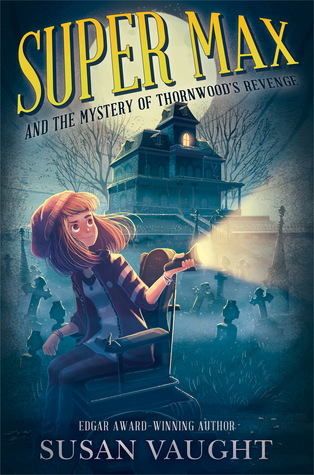
A new sleuth: Super Max and the Mystery of Thornwood’s Revenge

Super Max and the Mystery of Thornwood’s Revenge, by Susan Vaught, (Aug. 2017, Simon & Schuster/Pamela Wiseman), $16.99, ISBN: 9781481486835

Recommended for readers 9-12

Max is a 12 year-old girl living with her grandfather, Toppy, who also happens to be the chief of police in their town of Blue Creek. Her mother, an artist, lives in California, which is just fine with Max – ever since she and her mother were in the car accident that left Max wheelchair-bound at 4 years old, her mother has had trouble fitting Max into her life. She and Toppy lead a pretty happy life together; that is, if she’d stop getting in trouble for tinkering with her wheelchair to give it more power! When a cyber-bully starts a Facebook page and Twitter account slandering her grandfather and the town mayor, Max and Toppy try to blow it off, but things ramp up quickly, and the bully starts causing trouble for local businesses, too, all under the guise of an old town legend, Thornwood’s Revenge. Thornwood Manor is an abandoned mansion right next door to Toppy’s house, and it carries a lot of history with it, not all of it good. Is the bully really the ghost of Hargrove Thornwood, come to take his revenge, or is it someone with a grudge against an entire town? Max is going to get to the bottom of it.

I’m a Susan Vaught fan, so I was thrilled to read one of her middle grade books (I’ve only read her YA to date) and I’ve only read her heavier subject matter. This was good mystery reading all around. She’s got a very likable group of characters; I loved Toppy, gruff but lovable, whose disciplinary methods are creative and hilarious. Max is willful, complicated, and strong, like a middle grade heroine should be. She may be in a wheelchair, but she’s no victim: she’s an engineering whiz who loves to tinker in her eternal search for more power. Her relationship with her mother is complicated, and I liked Vaught’s exploration of that relationship. Max is driven by her desire to appear strong, not weak, not dependent; often to the point of frustrating her friends and family. She deals with her anger issues by reciting the names of Marvel and DC superheroes in alphabetical order, adding a nice geek check to the mix. I’d like to see another book or two starring Max and friends, and I think mystery fans will like this new supersleuth.


Susan Vaught is the Edgar Award-winning author of Footer Davis Probably Is Crazy (2016), and Trigger, which received three starred reviews and was an ALA Best Books for Young Adults. She is also a neuropsychologist at a state psychiatric facility, specializing in helping people with severe and persistent mental illness, intellectual disability, and traumatic brain injury. Her author website has more information about her books, essays, and links to her blog.
Posted in Adventure, Fantasy, Teen, Young Adult/New Adult

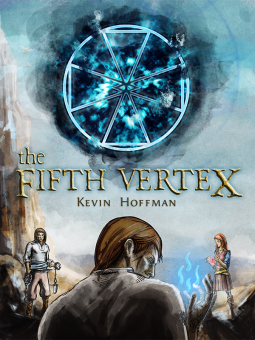
The Fifth Vertex – a young warrior discovers his true power

fifthvertexThe Fifth Vertex, by Kevin Hoffman (Aug. 2014) $11.99, ISBN: 978-0990647911

Recommended for ages 14+

Urus is a boy born into a warrior society, but he’s failed his warrior tests and is about to branded as a public burden – until all hell breaks loose. At the same time, an orphaned girl named Cailix, who has been living as a servant among a society of monks, finds herself on the run after a strange group of men slaughters her caretakers. What follows is a hero’s journey that will reveal to both Urus and Cailix who they really are: Urus comes from a line of Sigilords, who wield the power to create using ancient symbols, and Cailix discovers more about her origins than she could have ever imagined.

This is new fantasy series, self-published by the author, that really takes the classic hero’s quest and runs with it. Urus, who is deaf, must learn to rise above his low self-esteem and take control of the gifts he possesses – gifts only recently revealed to him. Cailix discovers her own gifts possess devastating power – but if used for good, can she turn things around? The two must figure these questions out while under the gun to save their world from a group of sorcerers determined to destroy five hidden vertices that protect their world.

This was a good read and a good start to a new fantasy adventure series for teens. There is a lot of slaughter and blood here – Urus’ society is a warrior society, and they’re fighting a band of sorcerers who use blood magic, so expect a bloodbath. If that’s not your thing, then this is not your series. I have no issue with it, and I thought the way Mr. Hoffman worked Urus’ deafness into the story, interweaving his with his signing ability as a sigilord, was really well done.  We’ve got some multiculturalism in the character descriptions, a strong female lead, and a few different hidden origins and conspiracies, all laying the groundwork for subsequent books. It’s a good start for fantasy fans who want something new to read.

Posted in Early Reader, Non-Fiction

Colors of the Wind – “The wind is like a rainbow.”

Layout 1Colors of the Wind: The Story of Blind Artist and Champion Runner, George Mendoza, by J.L. Powers (Sept. 2014, Purple House Press), $18.95, ISBN: 978-1930900738

Recommended for ages 7+

Colors of the Wind is one of those inspiring books that will take your breath away. Written for young readers and excellent for read-alouds in the classroom and the home, Colors of the Wind tells the story of George Mendoza, Olympic runner and painter.

As a child, George was always in motion. He was that kid that never stayed still; he wanted to be a basketball player when he got older. But his vision began to deteriorate, and he saw bursts of color. Suffering from a rare form of blindness called fundus flavimaculatus, his central vision has been destroyed, but he retains peripheral vision, which he refers to as “kaleidoscope eyes” because of the way objects reflect and are multiplied in his vision.

To take his mind off his blindness, George started running and ended up competing in two Olympics. He later began painting, remembering a priest who told him to paint what he saw. He uses fingerpaints, brushes – anything that will communicate to others the unique and beautiful way George sees the world.

This book is gorgeous. Illustrated with Mr. Mendoza’s paintings, this is a truly inspiring story of a man who literally changed his point of view. The text is enhanced with drawings by Hayley Morgan-Sanders. JL Powers presents Mr. Mendoza’s story with short sentences that are perfect for allowing young listeners to grasp the concepts presented and allows for deeper discussion on overcoming challenges and celebrating what gifts we have to work with.

The book includes a short biography on George Mendoza, and a list of paintings featured in the book. Two of my favorites are featured below: Purple Moon and Blind Man Touching the Sun.

purple_moon    blindmantouching

Colors of the Wind is available in stores now – ask your local bookstore, or order from Amazon!

Posted in History, Non-Fiction, Tween Reads, Women's History

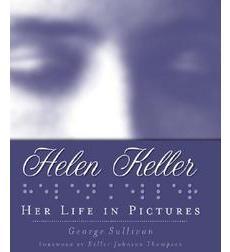
Book Review: Helen Keller: Her Life in Pictures (Scholastic, 2007)

Recommended for ages 8-12

As a little girl, I was captivated by Helen Keller’s life story. One can only imagine Helen Keller’s struggles, but even more amazing and inspirational are her triumphs: graduating college with honors at a time when women were still fighting for the right to vote. Learning to lip read while being blind and deaf, relying only on touch to communicate with the outside world. Becoming a political and social activist at a time when women were supposed to be seen and not heard. She was an amazing woman who was surrounded by amazing women; first, her beloved teacher Annie Sullivan and later Polly Thomson, and when I saw this book in my local library, I snatched it up.

I was not disappointed. Helen Keller: Her Life in Pictures is a gorgeous book filled with photos of Helen throughout her life. There are childhood pictures of her and pictures of her with Annie Sullivan; pictures throughout her college career at Radcliffe, and pictures of her with the many public officials she met throughout her life. Always mindful of her appearance so people would not look at her and see her handicap first, she is always dressed beautifully and perpetually smiling. There are some candid photos, including shots of her with her pets and even a shot of Helen, Annie, and Annie’s husband, John Macy.

Keller’s great-grandniece Keller Johnson-Thompson writes the foreward where she discusses asking her grandmother questions about her famous relative. Notes at the end of the book provide further reading on Helen Keller, including a link to Ms. Johnson-Thompson’s biography on the American Foundation for the Blind’s home page, where she serves as an Ambassador; there are many links to Helen Keller photographs and artifacts on this page. There is also a link to the Helen Keller birthplace museum.