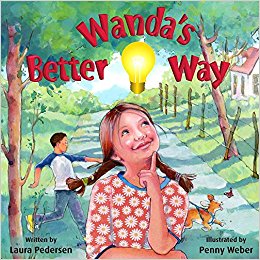
 Wanda’s Better Way, by Laura Pedersen/Illustrated by Penny Weber, (July 2017, Fulcrum Publishing), $17.95, ISBN:
Recommended for readers 4-8
A young girl finds a better way to do things as she goes through her day. The grownups around her think she’s not interested in the task at hand, but she’s really at work observing problems and creating workarounds – and then goes on to engineer them. When Wanda’s dance teacher suggests she consider gymnastics because she doesn’t appear interested in dance, we discover that she’s engineering a solution to the cluttered and messy dressing room. When she offers to help her landscape designer mother, she finds a solution that will keep squirrels out of a bird feeder. When she helps her chef father in the kitchen, she finds an easier way to separate eggs – and makes that her science fair project!
With short, easy to read and understand sentences and realistic illustrations, Wanda’s Better Way is a nice way to introduce STEM concepts and the scientific method to younger budding scientists and readers. Wanda’s ideas come to her in step-by-step thought bubbles and she’s illustrated with a light bulb going off over her head when solutions to come her. It’s a time-honored and effective way to communicate ideas! Kids will see how Wanda works out the problem and can discuss how she implements her solutions. Wanda tries on different career ideas while talking to her mother and father; something many kids will be familiar with. We’re often our kids’ first exposure to careers, so why wouldn’t they consider doing what we do? Wanda ultimately decides that she wants to be a scientist, which offers a nice topic for discussion: Wanda wants to be a scientist because she realizes her strength in figuring out problems. What are you really good at, and what can you do with your talent?
Wanda and her brother are biracial, with an African-American mother and white father. It sends a positive message about girls of color taking an interest in STEM! There is a two-page, age-appropriate explanation of the scientific method.
I’d put this with my Andrea Beaty books – Ada Twist, Scientist, Rosie Revere, Engineer, and Iggy Peck, Architect – and my other STEM picture books, like Ashley Spires’ The Most Magnificent Thing and Kobi Yamada’s What Do You Do With a Problem? and What Do You Do With an Idea? Great for STEM storytimes, and if you have blocks or other maker goodies handy, you can let the kiddos play for a little while and work up their own engineering challenges.
Laura Pedersen is an author, humorist, and playwright. Her website offers more information about her books and theater projects. Illustrator Penny Weber’s website has a gallery of her artwork.
 Mom Read It