Posted in Animal Fiction, Fiction, Graphic Novels, Humor, Intermediate

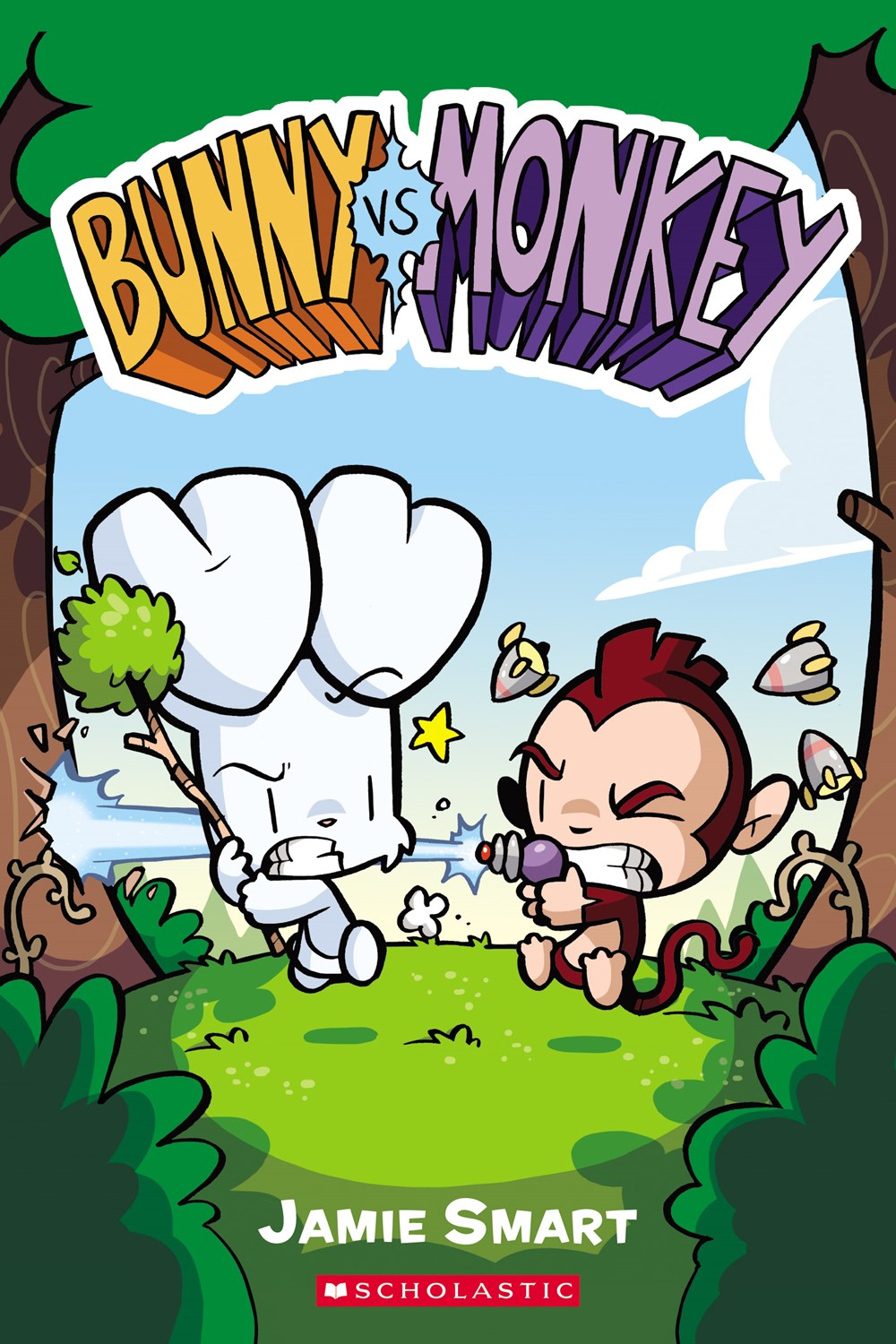
Bunny vs. Monkey: Power struggle in the forest!

bunny vs monkeyBunny vs. Monkey, by Jamie Smart (Jan. 2016, Scholastic), $7.99, ISBN: 9780545913751

Recommended for ages 7-10

A team of scientists send a monkey into space… but he doesn’t get very far. (Budget cuts to the space program really cause problems.) He crash lands in a peaceful forest, but don’t tell Monkey that – he thinks he’s on a new world, which he quickly claims for his own, and decides that he’s going to rule his world by banishing all the other animals and remaking the forest the way he wants it. Bunny knows this monkey is nuts, so he assembles his team of forest friends: a squirrel named Weenie, a pig named… Pig, and a crafty fox named Le Fox, to thwart Monkey at every turn. Monkey teams up with a Skunk named Skunky, who brings along his own crowd: Action Beaver and a dragon named Metal Steve, and the battle for the forest begins, with hilarious mayhem to follow.

Bunny vs. Monkey is a British comic featuring a series of crazy interactions between Bunny, Monkey, and their respective friends, taking place from January to June. Readers will see the seasons change and the plots increase in wackiness, from keeping Monkey awake after making noise all night, to driving a giant mole robot through the earth. The dialogue is manic, as is the action, but kids are going to love the back and forth between the animal teams and the crazy plots they come up with to outdo one another. A fun addition to younger graphic novel collections.

Posted in Preschool Reads

Book Review: I Want My Hat Back, by Jon Klassen (Candlewick Press, 2011)

i want my hat backRecommended for ages 4-8

Bear has lost his favorite hat and searches the forest, politely asking different animals he encounters if they have seen it. Just as he begins to despair ever seeing his hat again, Deer comes by and jolts his memory – he HAS seen his hat. The resolution is understated and sly, and adults will pick up on it right away; perhaps even before the children do. The book has won awards and accolades, including the Theodore Seuss Geisel Honor, but caregivers have voiced concerns over the implied ending being potentially disturbing or inappropriate for young children.

The Chinese ink illustrations are understated, as are the sandy hued backgrounds. Red is used to set off the color of Bear’s hat, and a change in emotion both in text and background. The endpapers set the mood for the story, with illustrations of the Bear and the animals featured in the story set on a dark brown background.

The book allows for a fun (and no doubt entertaining) discussion about the book’s ending. There are I Want My Hat Back-related activities on Candlewick’s website, including a printable world-building activity and a shape-identifying activity. There is also a Make Your Own Hat activity sheet that allows attendees to decorate, cut and tape together their own hat. For a bear-related read-aloud, decorate the reading area with toy bears of all sorts and encourage playtime afterwards.

Among the award and honors I Want My Hat Back has received are designation as an ALA Notable Children’s Books (2012), Colorado: Children’s Book Award Nominees (2013), Horn Book Fanfare (2011), Indies Choice Book Award for Picture Book (2012), Irma S. & James H. Black Picture Book Honor (2012), NY Times Best Illustrated Books (2011), NY Times Notable Children’s Books (2011), Publisher’s Weekly Best Children’s Books (2011), Texas: 2×2 Reading List (2012), Theodore Seuss Geisel Honor (2012), and Virginia: Readers’ Choice Award Nominees (2013).

Posted in History, Non-Fiction, Tween Reads

Book Review: Little House in the Big Woods, by Laura Ingalls Wilder (HarperCollins, 1971)

Recommended for ages 8+

Most people know Laura Ingalls Wilder’s stories, if not through her books, then through the long-running television series, Little House on the Prairie. A a pioneer child who wrote down her experiences and later had them published, Ms. Wilder wrote nine Little House books, originally published between 1932 and 1943. The series resonated with girls and young women and is popular to this day.

Little House in the Big Woods is the first book in the Little House series, and introduces the reader to the Ingalls family: Laura, her older sister, Mary, baby sister, Carrie, and parents, Ma and Pa (Caroline and Charles). The family lives in the Big Woods in Wisconsin in the later part of the 19th Century, shortly after the Civil War. (Laura even mentions a family member who is “wild since he came back from the army”.)

We go through each of the seasons with the Ingalls family and learn how families lived, ate, and had fun. There are family dances and visits, trips to town, and encounters with bears and bees. There is always time for work, though, and this is where the book acts as a primer. Laura details the process of preserving meats and vegetables to keep the family fed through the lean winter months; how Pa prepares an animal skin to be used as leather goods; how to get sap from a tree, and how to smoke bees out of a hive to be able to get to the honey. It’s a fascinating look at a different time, and while it is written with a girl’s voice, this is should not be considered a “girl’s book”: boys and girls alike can learn much about the wildnerness life.

Laura writes in a clear voice, drawing her readers in because her stories are real. The love of family and nostalgia as she looks back on her life bring to mind the feeling a child gets when listening to a parent or grandparent talking about their childhood. Black and white drawings by Garth Williams add to the book.

There is a wealth of information about Laura Ingalls Wilder online. Wilder’s home in Rocky Ridge Farm in Mansfield, Missouri, where she wrote the Little House books, is now the Laura Ingalls Wilder Historic Home and Museum and word finds, quizzes and coloring pages. The Little House Books website features a family tree tracking the girls of the Little House series from Laura’s great-grandmother to her daughter, Rose. The site also offers games and craft ideas, as well as information for teachers interested in teaching the book.