Littler Women: A Modern Retelling, by Laura Schaefer, (Sept. 2017, Simon & Schuster/Paula Wiseman Books), $16.99, ISBN: 9781481487610
Recommended for readers 8-12
The March sisters are back in this updated version of Louisa May Alcott’s classic, Little Women. Now, they’re coping with a dad who’s deployed overseas, and the girls are contending with school dances, sleepovers, and crushes. The characters are a little younger: Meg is 13 and a freshman in high school; Jo is 12; Beth is 10, and Amy is 9, and their overall personalities are wonderfully close to their original personas. Jo loves hockey, while Beth prefers to stay at home or visit their neighbors, the Lawrences, to play piano. Laurie and Demi are back in this update, too, with age-appropriate crushes on the March girls. Author Laura Schaefer sticks pretty close to the original story, with a happier resolution to Beth’s story. Each chapter contains a fun activity from one of the March sisters, including crafts and recipes. The sisters also create a family ‘zine, which I love – and tips on creating one – and I’m thrilled to see that ‘zines are becoming a thing again, popping up in books like Littler Women and Moxie.
Littler Women is such a good introduction to the classic for middle graders. It encourages creativity and emphasizes the bond between sisters, between family, and between friends; there are disagreements between characters, but they are able to work things out every time. Talk up the similarities and differences between Little Women and Littler Women (don’t forget to mention Little Men), and maybe even have a viewing of one of the several movie adaptations of the original. Definitely fun reading, worth adding to your shelves or giving to a classic-minded reader who loves a good story.
Author Laura Schaefer is also the author of The Tea Shop Girls series. Her website offers links to her blog and information about school visits.
The conclusion of Sandy Brehl’s Odin’s Promise trilogy is finally here! Mari’s Hope continues the story of Mari, a Norwegian girl living under the German occupation during World War II. Mari, who was 11 when the story began, is approaching age 14 when the latest book begins. Her family is active in the resistance, and Mari’s involvement increases as she is older now, willing and able to take greater risks. She works with the local doctor to care for the sick and elderly in her village, Ytres Arna; travels to the city of Bergen to procure more medicine – and information – for her village, and tries to stay out of the way of the Nazi officers who live in her home; particularly the one she calls Goatman, who is a drunk and a thief.
Written in third-person narrative with first-person journal entries from Mari to her brother, Bjorn, Mari’s Hope is written with the same gentle strength as the previous two entries in the series. We see Mari grow over the three books from girl to young woman – a change that has come too quickly under the occupation – and deal not only with being a member of the Norwegian resistance, but with the stress of worrying about her brother; grieving her dog, Odin, killed by Nazi soldiers in the first book; struggling with a former friend who threw in his lot with the NS – Nasjonal Samling – Norway’s version of Hitler Youth. The family and neighbors stick together, sharing what little they have to provide for one another, whether it’s to have a birthday party for Mari or a holiday dinner for Jul. There are tense moments that kept me turning pages, sometimes biting my lip with concern, and there are moments where I just needed a moment to process my relief. Sandy Brehl never whitewashes the German’s devastation; rather, she states it quietly, eloquently, and leaves it there for Mari – and us – to process and move on.
The Odin’s Promise trilogy is a gorgeously written series of books that take us into a part of World War II history we don’t often hear about. Hitler invaded Norway with the lie that he was sending soliders to “protect” his “Viking brothers”, but proceeded to strip all freedoms from them and tried to supersede his vision of Aryan superiority over their rich culture. Odin’s Promise, Bjorn’s Gift, and Mari’s Hope tell this story through the experiences of one village, one family, one girl, who pushed back. I love spending time with Mari and her family; while I’m sad to see this story end, the beauty of books lies in knowing I can meet them again whenever I want to.
Animal adventure books are guaranteed fun for readers, and mice are a consistently popular choice. Look at some of the most beloved, enduring children’s books: Stuart Little, Mrs. Frisby and the Rats of NIMH,The Rescuers, The Tale of Desperaux, and Babymouse, who’s growing up with her readers, having started with an elementary school character whose moved to middle school. There’s even a picture book that introduces younger readers to a young Babymouse. Mice are cute, tiny enough to get into places we can’t even fathom, for exciting adventures – and yet, small enough to be defenseless in a dangerous world. Kids can identify.
That said, we’ve got a giveaway for two books in a fun new series: The Adventures of Henry Whiskers! One lucky winner will receive copies of both Henry Whiskers books by Gigi Priebe–book 1, THE ADVENTURES OF HENRY WHISKERS, and book 2, THE LONG WAY HOME. (U.S. addresses). Enter a Rafflecopter giveaway today – ends September 7th! (Edit: The link was showing the contest had expired, so I’ve extended the deadline to September 7th and updated the link.
The Adventures of Henry Whiskers, by Gigi Priebe/Illustrated by Daniel Duncan, (Jan. 2017, Simon & Schuster Kids), $5.99, ISBN: 978-1-4814-6574-8
Recommended for readers 7-10
Henry Whiskers is a fun intermediate series starring a family of mice living in the drawers at the base of Queen Mary’s Dollhouse in Windsor Castle: quite possibly, the most famous dollhouse in the world. When the tourists are gone for the day, the mouse families wander the castle; for 25 generations, the Whiskers family have been caretakers of the dollhouse, and Henry Whiskers, son of the last caretaker, takes his job very seriously. He may be young, but has a deep sense of duty to the Whiskers legacy, living up to his father’s reputation. Henry can often be found reading the miniature classics in the dollhouse library when he’s not helping his mother take care of his family. In this first story, Henry and his cousin, Jeremy, set out in search of Henry’s sister, Isabel, who goes missing when the dollhouse is sent for cleaning. They’ll face off against Titus, the castle cat, and meet the rats who live in Rat Alley and aren’t fond of the mice at all. Henry shows bravery, a strong sense of justice and equality, and not only saves the day, and works to foster understanding between his own community and the rats.
The Adventure of Henry Whiskers: The Long Way Home, by Gigi Priebe/Illustrated by Daniel Duncan, (Aug. 2017, Simon & Schuster Kids), $5.99, ISBN: 978-1481465779
Recommended for readers 7-10
Henry’s latest adventure takes him outside the castle walls and into the city of London itself! He discovers an old map in the library, but he and Jeremy are caught by the palace cook, who believes she’s doing a good deed by sending them far away from the castle, so they won’t find their way back. Yikes! Henry learns more about his father and meets new animals on his latest escapade, while Mother worries about her son at home.
The Henry Whiskers books are just right for more confident chapter book readers who have a sense of adventure. Henry is a good little role model that readers can identify with, overcoming obstacles while making sure to look out for others as he goes. Daniel Duncan’s black and white illustrations add to the enjoyment of the narrative, and a photo of Queen Mary’s Dollhouse gives kids an idea of how big the dollhouse (and drawers) really is.
Check out this video, which provides a peek into the dollhouse. Stunning, isn’t it?
Gigi Priebe is the mother of three, the founder of Stepping Stones, an award-winning children’s museum in Norwalk, Connecticut and the author of The Adventures of Henry Whiskers, the first in her middle grade series. When she is not writing–or rewriting–she is a philanthropic advisor and community volunteer in Fairfield County, Connecticut, where she lives with her husband, a cat named Tigger, a dog named Clover, and probably some mice. To learn more and to download a free curriculum guide, visit gigipriebe.com.
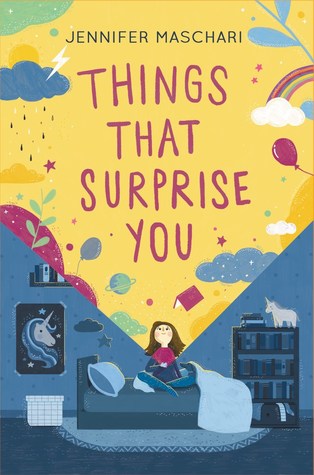
Things That Surprise You, by Jennifer Maschari, (Aug. 2017, Balzer + Bray), $16.99, ISBN: 9780062438928
Recommended for readers 10-13
Best friends Emily and Hazel are about to start middle school. They’ve done just about everything together, and Emily just wants things to stay the same. You can’t blame Emily; she’s had too much change over the last year, with her parents’ divorce and her sister , Mina, being treated for an eating disorder. But Hazel is changing. She’s already in with a new crowd at school – a crowd that isn’t into Emily at all – and she wants to be different. While Emily is still into their fandom, The Unicorn Chronicles, and crafting, Hazel is into lip gloss, clothes, and getting boys at school to notice her.
Things That Surprise You is a compulsively readable novel about growing up and moving on; negotiating change; making new friends, and most importantly, discovering oneself. Emily is so likable, you just want to defend her and comfort her. Older sister Mina is on her own painful journey; she could easily have become a bitter antagonist, but is written with care and compassion that will encourage readers to root for her, too. Their mother is doing the best she can with what she has, and their father just can’t cope, so he doesn’t. Each parent’s actions illustrate to kids that adults may not have all the answers, and that we make lousy decisions, too. I enjoyed reading about every character in this book, including the mean girls, who are vapid and awful and make us want to see Emily succeed even more.
This is a great book for discussion groups, because the subplots that support the main plot are all worthy discussion topics on their own: going with or against the crowd, eating disorders, self-acceptance, and navigating family relationships are just some of the things that come up. I’d love to see this on summer reading lists for next year. Nudge, nudge, teachers!
Jennifer Maschari is a classroom teacher and the author of The Remarkable Journey of Charlie Price and Things That Surprise You. She is hard at work on her next middle grade novel with Balzer+Bray/HarperCollins. Jennifer lives in Ohio with her husband and stinky (yet noble) English bulldogs, Oliver and Hank. To learn more, and to download a free guide, visit Jennifer’s author website.
GIVEAWAY!
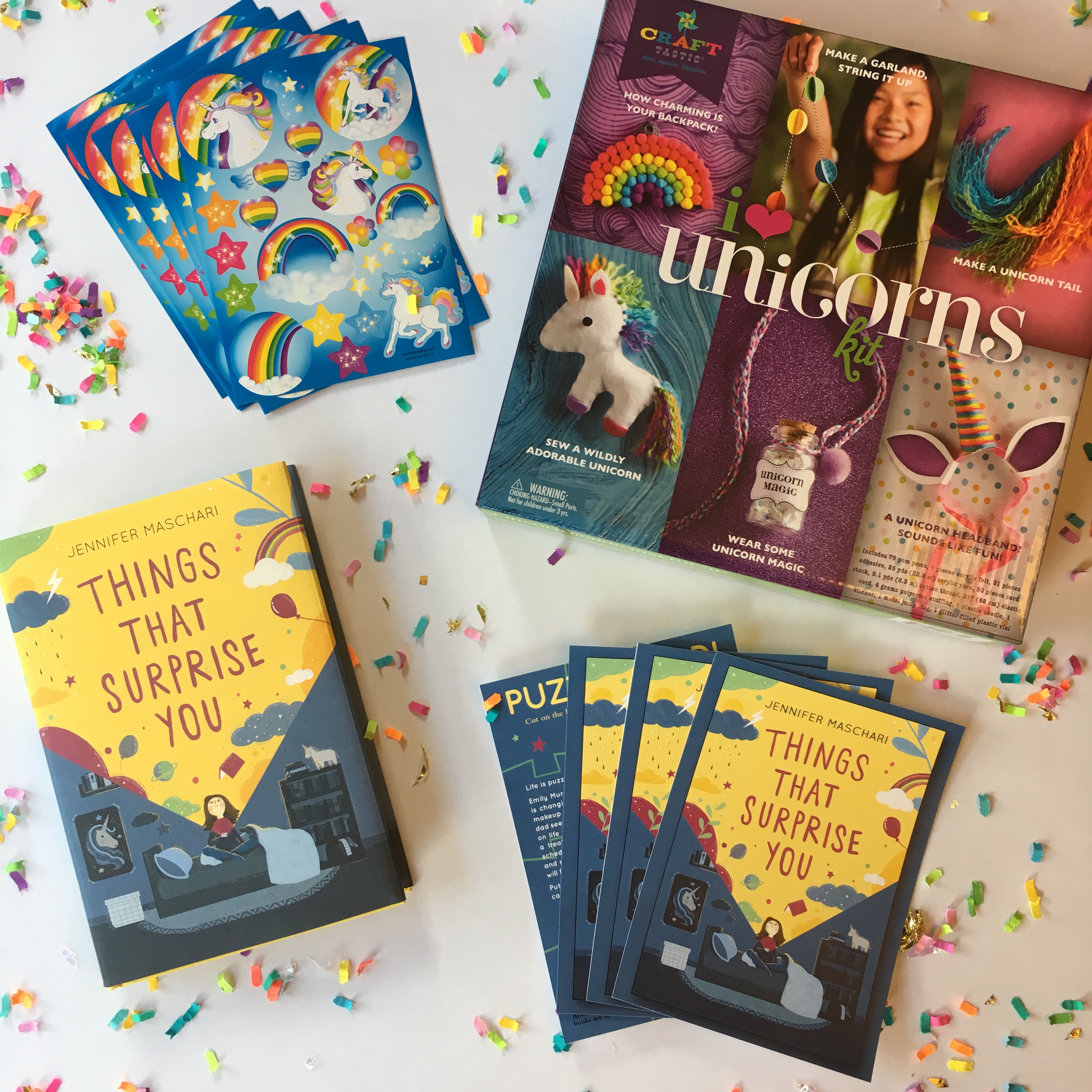
One lucky winner will receive a copy of Things That Surprise You… PLUS, one grand prize winner will receive their very own Crafty Unicorn Kit! The prize includes a fun craft kit, a copy of Things That Surprise You, unicorn stickers, and puzzle cards! Enter here – don’t miss out!
Soldier Sister, Fly Home, by Nancy Bo Flood/Illustrated by Shonto Begay, (Aug. 2016, Charlesbridge), $16.95, ISBN: 9781580897020
Recommended for ages 10+
Thirteen year-old Tess is struggling with her identity. As someone who’s part white and part Navajo, she feels too white when she’s on the rez, but she’s called “Pokey-hontas” and “squaw” at the white school she attends in Flagstaff. Her older sister, Gaby, whom she adores, has joined the military in order to get money for college; when she comes home to tell Tess that she’s being deployed – shortly after Tess and her family have attended a memorial service for Lori Piestewa, a member of their community and the first Native American woman to fall in combat – Tess is devastated. Gaby asks Tess to take care of her stallion, Blue, while she’s gone; it’s a challenge, to be sure, as Blue is semi-wild and doesn’t gel with Tess, but over the course of the summer, Tess learns more about herself from Blue than she could have imagined.
Soldier Sister, Fly Home is a quietly tender novel about family, identity, and loss. Lori Piestewa, whose memorial service opens the story, was a real-life soldier who was killed in Iraq and was a member of the Hopi tribe. From Lori’s tale, Ms. Flood spins the story of Tess and Gaby and Native American identity. Their grandfather is a veteran, a World War II Code Talker; they live in a community of proud warriors, descended from warriors. Tess is frustrated as she tries to embrace a cultural identity: but which culture to identify with? Her grandmother is a guiding force here, as is Gaby, who loves and reassures her younger sister, even from a world away. Blue, the stubborn and half-wild horse, teaches Tess patience and helps her recognize her own inner strength throughout the book.
The book includes notes and a glossary on the Navajo language, a note honoring Lori Piestewa and her service, and a reader’s group guide. Writing prompts are available through the publisher’s website, as is a link to a seven-page excerpt.
Soldier Sister, Fly Home has received a starred review from Publishers Weekly. It is a beautiful story and an important addition to all bookshelves.
Nancy Bo Flood was a research psychologist and studied brain development at the University of Minnesota and the University of London before writing books for children. Additional books include recognized and award-winning titles, such as Warriors in the Crossfire (Boyds Mills) and Cowboy Up! Ride the Navajo Rodeo (WordSong).
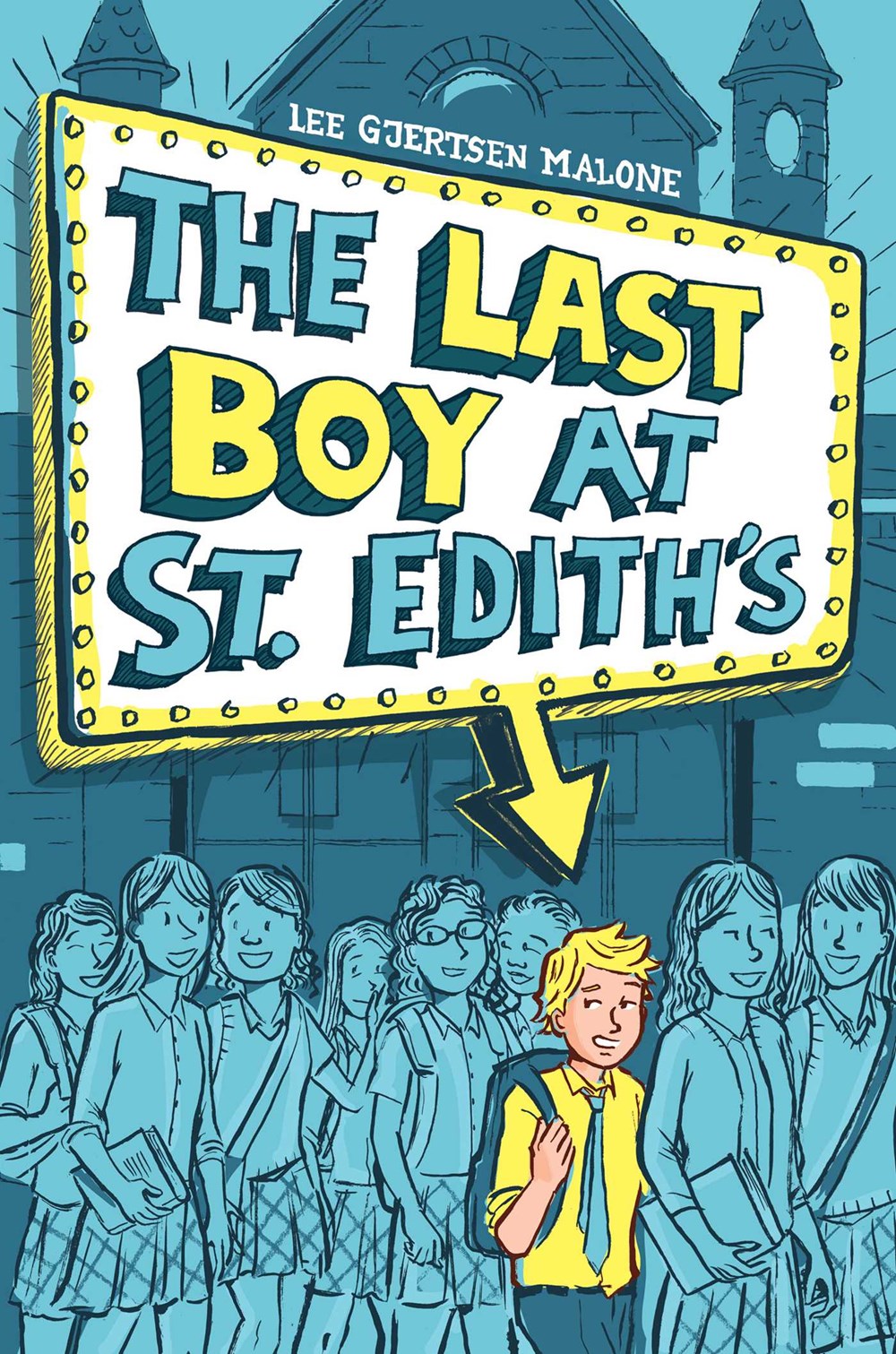
The Last Boy at St. Edith’s, by Lee Gjersten Malone (Feb. 2016, Aladdin), $16.99, ISBN: 9781481444354
Recommended for ages 8-12
Seventh-grader, Jeremy, is not thrilled. His school, St. Edith’s, was formerly an all-girls’ school that briefly admitted boys, but it never quite caught on. He’s been counting down the number of boys leaving the school, until Andrew – #2 on his list – announced he was leaving, making Jeremy the last boy at St. Edith’s. It’s embarrassing and it’s really annoying, but his mom, who works at the school so he and his sisters can go for free, will not even consider letting him go to the local public school. Desperate, Jeremy decides to take matters into his own hands: he’s going to get expelled.
Turning to his best friend, Claudia, the two come up with a series of pranks that should do the trick. Jeremy has rules: no one gets embarrassed or hurt, and no permanent damage gets done. But the mysterious prankster’s first gag gets huge laughs, and Jeremy finds himself caught in the snowballing effect of pranking; he’s got to up the ante, but things start getting out of control. How far will Jeremy go to get thrown out?
I LOVED this book. Jeremy has a distinct voice that comes through loud and clear, and he’s got some valid arguments: he’s the butt of other school’s jokes; his own school’s teachers refer to the student body as “ladies”, so he feels humiliated in his own environment; his mother, however valid her reasons are for keeping him at St. Edith’s, is too stressed out to really listen and understand Jeremy; and his flaky tree-hugging dad is not there for him at all. He still manages to keep a sense of humor about him, and he’s a likable kid. He’s a good kid from a good family who just wants one thing to go his way, and he’s got a conscience – whether he always listens to it remains to be seen.
There are plenty of social and family issues addressed in this seemingly light read: family relationships; divorce; social classes; gender roles; friendship, and consequences. The Last Boy at St. Edith’s deserves a spot on summer reading lists, for sure. I’ll be putting together some discussion questions and a booktalk to generate interest in this great debut.
The Last Boy at St. Edith’s has received a starred review from Kirkus Reviews. You can visit Ms. Malone’s author website for more information about her, including links to social media and information on school and library visits.
Beetle Boy, by M.G. Leonard (Feb. 2016, Chicken House), $16.99, ISBN: 9780545853460
Recommended for ages 8-12
Darkus Cuttle is worried about his dad, a Director of Science at the National History Museum, who disappeared over six weeks ago. He vanished from a locked room in the museum, and no one has seen or heard from him. Darkus is living with his uncle for now, but he just knows his dad is out there – he’d never leave him, and he’d certainly never kill himself, like some people are suggesting. One day, he spots the two crazy cousins next door arguing about a beetle infestation and discovers that these beetles are pretty special. Baxter, a rhino beetle that befriends him, can understand him! Soon, Darkus and his friends Virginia and Bertolt find themselves on the trail of Darkus’ dad; Darkus is about to find out some secrets about his dad, fashion icon/villainess Lucretia Cutter, and the beetles next door. Can the kids find Darkus’ dad and keep themselves safe in the meantime?
I’m an avowed bug-phobic, so the fact that I wanted to read this book so badly should be a sign of how good I thought it would be. I’m very happy to tell you I was right: Beetle Boy, the first book in a new series by debut author M.G. Leonard, is so much fun. Darkus is a bit of an outcast, but never a wimp. He falls in with two other school misfits who can match him in intelligence and bravery (even if they may need some prodding), and they plan out their rescue mission after careful observation and research. Darkus’ Uncle Max is more than just a plot device to give Darkus a place to live while the story happens around him; he’s an uncle who’s learning how to be a guardian and he’s ready to jump in and get involved when it comes to his brother’s and his nephew’s safety.
There’s adventure, excitement, genetic modification, and a battle involving flying poo that is NOT to be missed. Boys and girls with a sense of adventure are going to LOVE this story and hopefully, like me, be waiting impatiently for the next installment. We’ve got some solid science, with facts about different sorts of bugs that will please any budding entomologist.
Beetle Boy has been designated an Independent Booksellers’ Debut Pick of the Season for Spring 2016.
A great pick for middle grade collections! I love fic that mixes realistic fiction with a touch of science fiction to get kids’ attention.
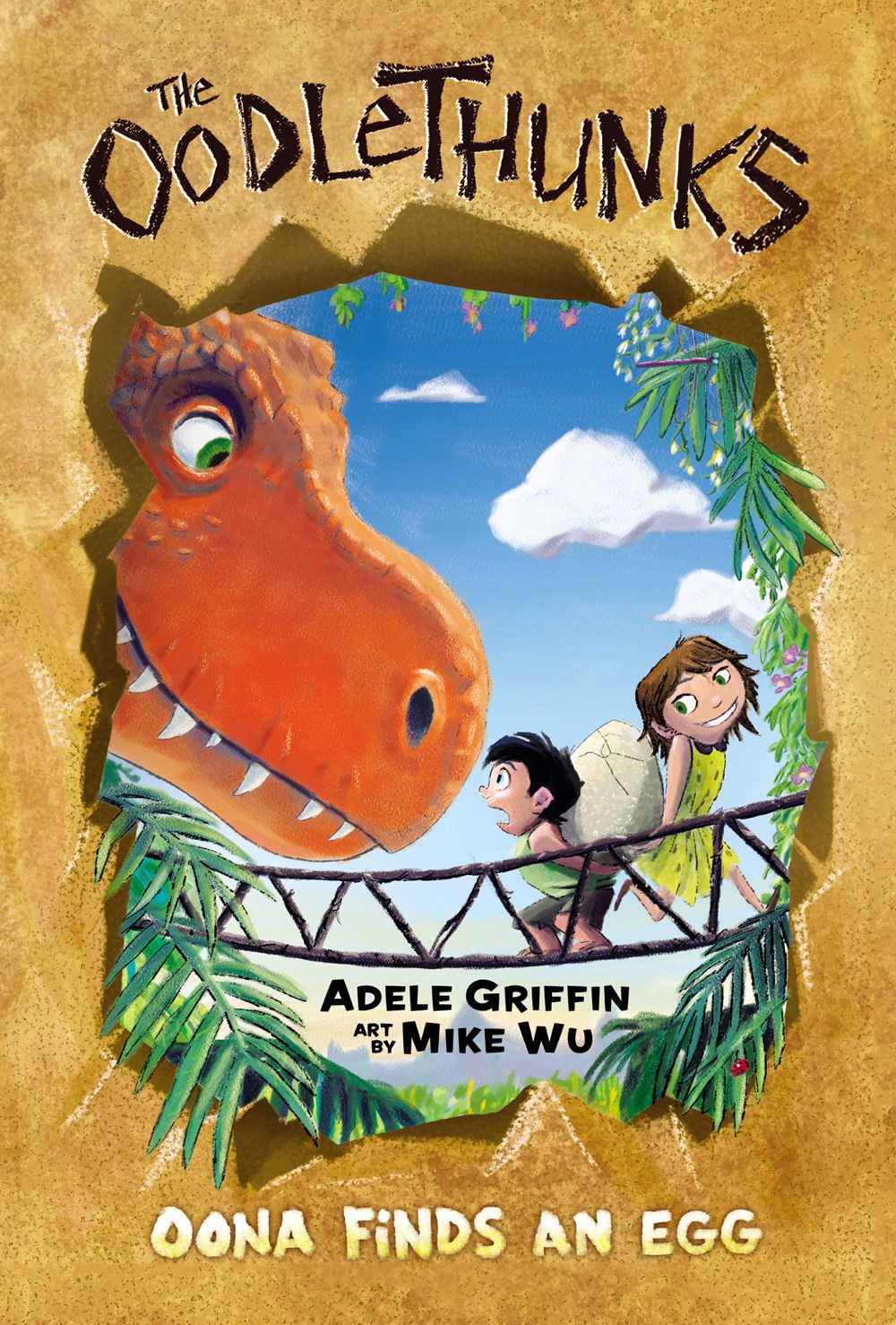
Oona Finds an Egg (The Oodlethunks, #1), by Adele Griffin/Illustrated by Mike Wu, (Jan. 2016, Scholastic), $12.99, ISBN: 9780545732796
Recommended for ages 7-10
Oona is a Stone Age girl whose father stays home and bakes kind of weird health food, like newt fingers; her mom works at an advertising agency where they’re trying to sell consumers on the wheel; and her little brother, Bonk, is just annoying. She really, really wants a pet, so when she finds an egg while she’s out wandering, she’s so excited! Her parents let her keep it until it hatches – they’re worried that she may be eaten by what’s in the egg! – but Oona is convinced that Something Cute is in that egg just waiting for Oona to love it. She cares for the egg until one day, it disappears – and Bonk is acting awfully guilty.
Oona finds an egg is a new intermediate series for readers growing out of easier chapter books like Scholastic’s Branch series, and ready to tackle a little more. Oona is a good protagonist: she loves her family, she doesn’t always get along with her little brother, and she shows,The Oodlethunks are a pretty modern stone-age family (apologies to The Flintstones), with a working mom and stay at home dad; kids will recognize the family structure and relate, either having friends with working moms, or having working moms/stay at home dads of their own.
It’s a fun new series that kids will enjoy, with prehistoric animals that kids may not have heard of before – Ms. Griffin provides an explanation on a few of them at the end of the book – and fills the gap between more challenging fiction and easy readers. There are illustrations and text, and plenty of opportunities for a good book discussion.
Grubb, the foundling chimney sweep-turned-apprentice to magician/genius Alistair Grim is back, and he’s got the whole Odditorium gang with him! The relationship between Grim and Grubb is more fully realized, but still shrouded in mystery as they try to unravel what happened to Grubb’s mother, and why she’d have abandoned her baby boy. Alistair Grim is still on the run after the events of the first book, Alistair Grim’s Odditorium, which left the general public convinced that Grim is a madman bent on destruction. The Odditorium inhabitants know that Prince Nightshade is the real villain, and Grim has a plan to bring him down. All he needs is the legendary sword, Excalibur. No big deal, right?
Alistair Grim’s Odd Aquaticum picks up right where the Odditorium leaves off: we’ve got enchanted armor, magical eggs, the legend of King Arthur’s Avalon, fairies, banshees, and enchanted samurai. It’s fantasy with a steampunk bent wrapped up with Arthurian legend and prophecy. Fantasy lovers will devour this book as quickly as they did the first, and the story leaves off with a promise that we’ll see Grubb and friends again.
The character development continues in this second installment, really concentrating on the relationship between Grim and Grubb, but extended characters enjoy some more depth, too; particularly, Cleona the Banshee and Nigel Stout. My review copy didn’t have illustrations, but if they’re anything like the first book’s, they will add to the breathtaking scope of the book. Just look at the cover – I want to see more of that!
I’ve already ordered my library’s copy of Alistair Grim’s Odd Aquaticum. Don’t make your kids wait for yours! In the meantime, check out Gregory Funaro’s author page for updates about the Odditorium and latest author news. (Psst… hey, Disney, time to give the Odditorium its own webpage.)
Dead Possums are Fair Game, by Taryn Souders (Nov. 2015, Sky Pony Press), $15.99, ISBN: 9781634501620
Recommended for ages 8-11
Fifth grader Ella is stressed out. Her math teacher has just announced that while there won’t be any more math tests for the remainder of the school year, the students will be putting on a math fair that will count as two test grades. Add to that, the fact that her awesome Aunt Willa is coming to live with her family for a month – but she’s staying in Ella’s room and brings her big, slobbery dog named Chewy (and it ain’t for Chewbacca), and you have a recipe for disaster! Ella’s a bit of a control freak who likes things in their own proper place; Willa has commandeered Ella’s bed and dresser, moved her furniture around, and taken over her bathroom. Chewy has taken over Ella’s extra mattress. Luckily, Ella’s got a great group of friends who team up with her for the math fair project, turning it into a memorial of sorts for the dead possum that became legendary during gym class. Maybe things will look up for Ella after all.
Dead Possums are Fair Game is way too much fun. Ella is a bit neurotic, which sets her up for all sorts of hilarious happenings, whether it’s being slobbered on by a big dog or stepping on a dead possum. There’s a nicely done focus on math, particularly time conversions and animal life cycles that will make teachers and parents very happy, and will hopefully show kids that math is less painful than they may think. There’s also a great discussion about how math is pretty important in every area of life; most careers require some sort of math knowledge, and it’s not a bad thing. Further information about animal lifespans at the back of the book will help English and Math teachers work together to use this book as a teaching resource.
Ms. Souders has a background in math education, and it shows not only in her ability to break down math problems to make common sense to kids, but in the interactions between kids and grownups and kids themselves. The dialogue is realistic and well-paced, and she has a neurotic kid’s inner dialogue down pat (I should know, being a former one myself). Dead Possumsis a great add to your realistic fiction collections.
 Littler Women: A Modern Retelling, by Laura Schaefer, (Sept. 2017, Simon & Schuster/Paula Wiseman Books), $16.99, ISBN: 9781481487610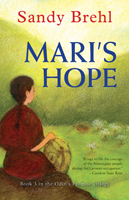


 Source: NicolTallis.com




 Mom Read It