Posted in Preschool Reads, Toddler Reads

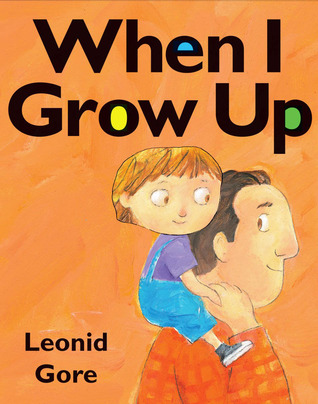
Book Review: When I Grow Up, by Leonid Gore (Scholastic Press, 2009)

0-545-08597-7Recommended for ages 2-4

A little boy asks his father what he will be when he grows up, and looks at the world around him for ideas. A raindrop tells him he could be “like me” and become the fastest river; a green sprout, the tallest tree; a caterpillar, the most colorful butterfly in the meadow. As the boy paints the images he sees around him, he ultimately makes his own decision: he will be like his dad. The artwork is a simple and soothing series of acrylics and mixed media, with a single die-cut image in each spread acting as a transition to the next spread. The die cuts may not hold up to repeated use and risk tearing, but the pages are thicker than usual and may last longer than expected with gentler use.  Books that illustrate relationships between fathers and sons are not as common as mothers and sons or mothers and daughters, making this a good book to offer the community.

This would be a great addition to a family read-aloud or a Father’s Day read-aloud, as it features a positive relationship between a father and son. There are great Father’s Day crafts that are easily made available, including Father’s Day picture frames using heavy paper, glue and scissors available on Enchanted Learning’s website. Children can bring pictures from home or can use pictures from old magazines. The author does not have a website, but his publisher has an author page with a biography and the ability to become a “fan”.
 

Posted in Toddler Reads, Uncategorized

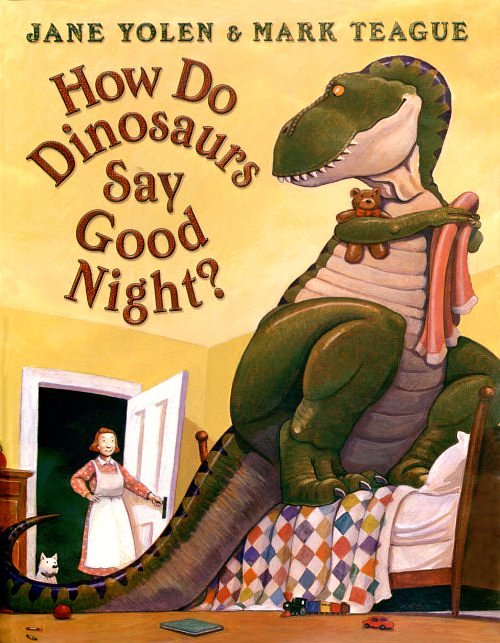
Book Review: How Do Dinosaurs Say Good Night? by Jane Yolen/Illus. Mark Teague (Blue Sky Press, 2000)

how-do-dinosaurs-say-goodnightRecommended for ages 2-5

Do dinosaurs really act up when it’s bedtime? A host of dinosaurs, acting much like preschoolers, react to bedtime and show readers how a dinosaur should say good night.

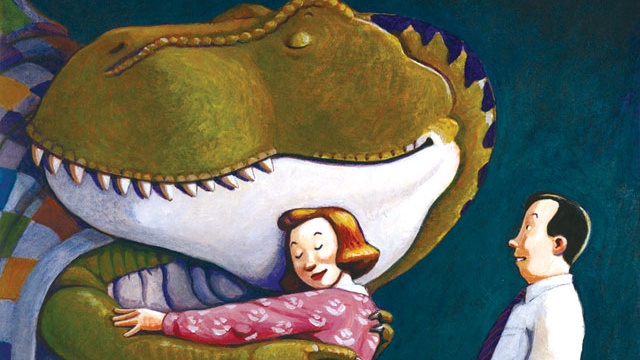
Dinosaurs are a popular topic among young audiences, and these dinosaurs, loaded with personality, will connect with young readers. Young audiences will see themselves reflected in the dinosaurs and how they approach bedtime. The earthy, colorful paintings offer varying perspectives – some dinosaurs are viewed from up high, some tower over everything around them – and multicultural families will appeal to all families. Dinosaur names are cleverly offered in each room, providing the chance for a fun name hunt. The endpapers illustrate all the dinosaurs found in the story, along with their names.

This is a great story for either a dinosaur-related read-aloud or a bedtime tale, where children and parents/guardians can talk about how they good night in their homes. There are numerous bedtime songs and fingerplays to use in conjunction with the book, and Massachusetts Honor Books offers a fun activity where children can write down “good night” in different languages, posting them on a map of the world.

The book has received numerous accolades, including the ALA Notable Children’s Books: 2001, Colorado: Children’s Book Award Nominees: 2002, Helbie Award: 2001, Maryland: Children’s Book Award Honors: 2003, Missouri: Building Block Picture Book Award Nominees: 2001, Nevada: Young Readers’ Award Nominees: 2003, Tennessee: Volunteer State Book Award Nominees: 2003, Texas: and the 2×2 Reading List: 2001.

The author’s website offers information about her other books, book trailers, and resources for teachers and storytellers. The How Do Dinosaurs series includes How Do Dinosaurs Eat Their Food?, How Do Dinosaurs Go To School?, and How Do Dinosaurs Play With Their Friends?


timthumb

Posted in Fantasy, Tween Reads

Book Review; Breadcrumbs, by Anne Ursu (Erin McGuire, ill.) (Walden Pond Press, 2011)

Recommended for ages 9-12

Fifth graders Hazel and Jack are best friends until the day Jack decides he wants to be around boys more than a girl. Hazel is miserable at the loss of her friend, but when Jack disappears, she is the only one who ventures into the mysterious woods to find him, and get him back from the White Queen – whether or not he wants to come home.

Breadcrumbs is a trip through fairy tales and middle-grade stories that many readers will be familiar with, all surrounding a retelling of the classic tale of the Snow Queen. The characters are fifth graders who actually act their age; they are fully fleshed out with backgrounds that touch on issues that many readers will be familiar with – multiculturalism, adoption, divorce and remarriage, depression, and the pain of loss and how to move past it. There is a little bit of magic in every world, and Breadcrumbs brings that to life in the form of the main characters’ imaginations and in the more literal, magical forest sense. Erin McGuire’s black and white illustrations bring the chill of the cold forest, particularly the Snow Queen, to life and enhance the text. Compulsively readable, the book also provides numerous opportunities to enhance classroom discussions on topical issues or on a fairy tale unit.

Breadcrumbs is a 2011 Cybils award nominee for Middle Grade Science Fiction/Fantasy. Author Anne Ursu’s webpage offers information about Breadcrumbs and all of Ms. Ursu’s books, plus updated news and appearance information and links to social media.

Posted in Fantasy, Fiction, Tween Reads

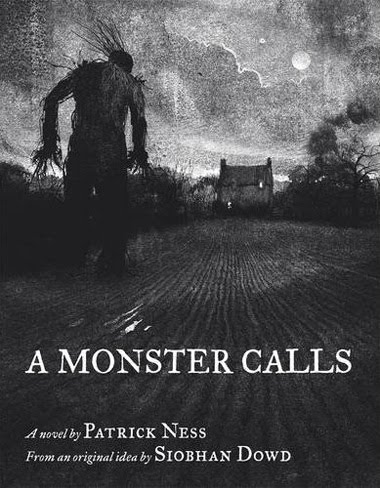
Book Review: A Monster Calls, by Patrick Ness (Candlewick, 2011)

Recommended for ages 11-13

A Monster Calls is one of those books that will tear your heart out while you’re reading it, but when you’re done, you’re glad that you went through the experience. It’s that good.

Conor is a 13-year old boy who lives in Britain with his single mother, has a strained relationship with his father, who has his own life and new family in the States, and is bullied at school. His mother is fighting a battle with cancer, and losing. Around this time, Conor starts receiving visits every night, just after midnight, from a monster in the guise of a yew tree in his backyard. The monster tells him stories – truths – whose outcomes really play with perspective, and he tells Conor that the fourth story will be Conor’s, telling the monster his own truth. It’s a truth that Conor doesn’t want to think about, but that gives him nightmares every night.

The story, originally an idea by author Siobhan Dowd, whose own life was cut short by cancer, is gorgeously written. Ness’ words bring the reader right into Conor’s fear, grief and anger at his mother’s battle, his grandmother’s fussiness, his father’s distance, and the numbness he feels as he endures the bullies at school. When the monster allows Conor’s rage an outlet, the reader feels it, viscerally. Jim Kay’s stark black and white illustations add to the moody feeling of Ness’ prose.
 
A Monster Calls has been shortlisted for several awards including the Galaxy British National Book Award, the Red House Children’s Book Award, and the Cybils Award in Middle Grade Fantasy. The author’s website features his blog, an FAQ, and information about his books and events.
Posted in Fantasy, Humor, Tween Reads

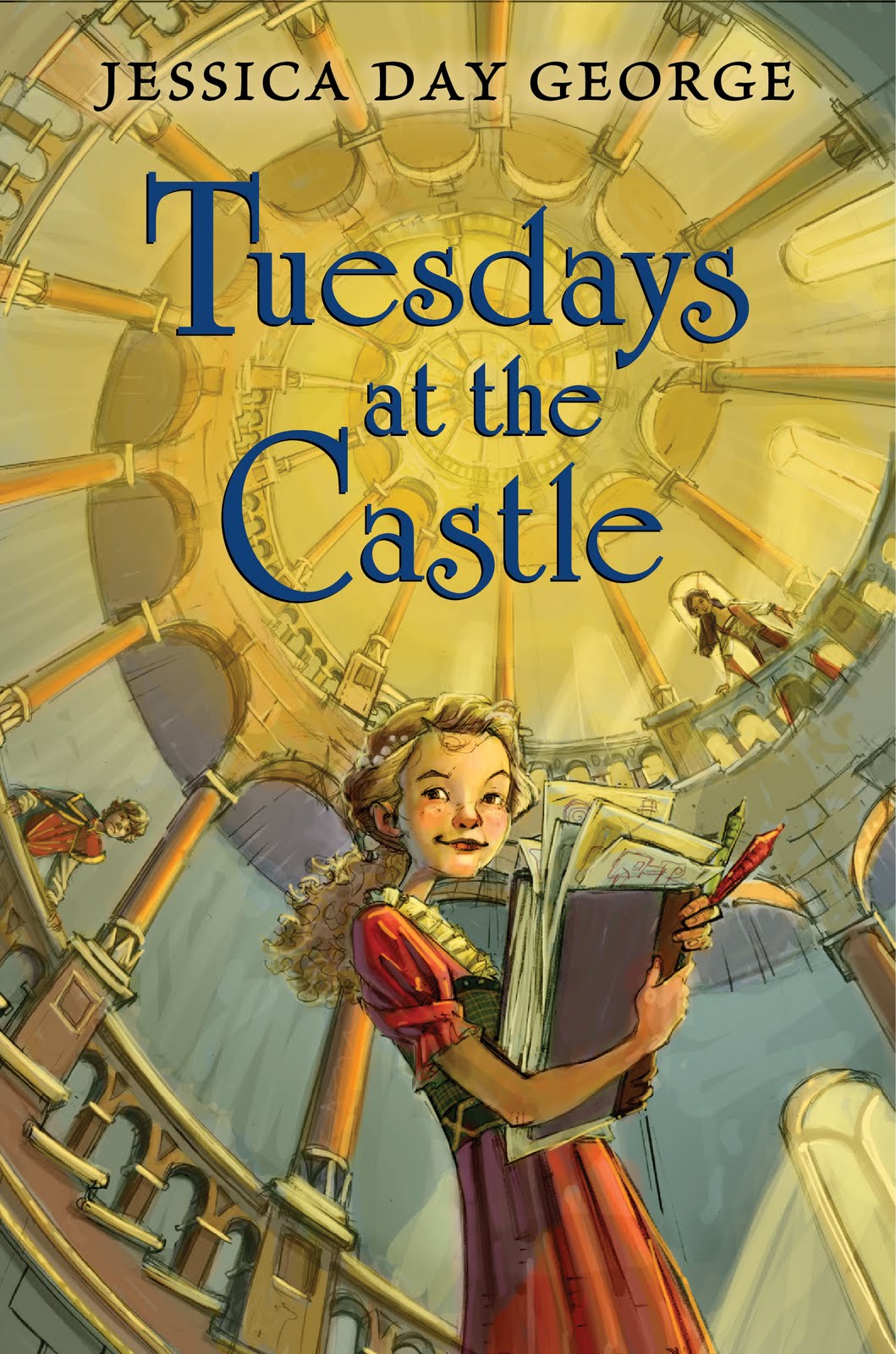
Book Review: Tuesdays at the Castle, by Jessica Day George (Bloomsbury, 2011)

Recommended for ages 9-12

Princess Celie lives with her brother, sister and parents at Castle Glower, a castle that’s alive much in the way Hogwarts is – rooms crop up when they’re needed, and new staircases and passages appear seemingly at will. When her parents, King Glower and Queen Celina leave to attend their eldest son’s graduation from wizard school and are reported missing after their carriage is attacked, Councilors and foreign dignitaries show up and start ordering Celie’s brother Rolf – the heir to the throne – around. The Glower children, the castle staff, and Castle Glower itself all sense that something’s wrong, and work together to get rid of the evil prince that’s trying to take over Castle Glower – and bring their parents home safely.

Jessica Day George is great at writing princess books without all the saccharine included- her heroines are smart, funny, and can keep their heads about them when things are going crazy. Celie is no different, nor is her older sister, Lilah, which is a pleasant change from the “one beautiful and dumb, one smart and resourceful” sister that tends to pop up in YA and ‘tween literature. Their brother, Bran, is an intelligent boy who can defend himself verbally and allies with his siblings and staff to brainstorm solutions and make things happen. Ms. George provides good character development and the action is well-paced. While mostly girls will likely gravitate to this book, there are strong male and female characters for young readers to be inspired by.

Jessica Day George’s website has a section dedicated to Tuesdays at the Castle, in addition to her other books, appearances and news.

Posted in Fantasy, Tween Reads

The Graveyard Book, by Neil Gaiman (illus. by Dave McKean) (HarperCollins, 2008)

Recommended for ages 12+

Created from an idea author Neil Gaiman had in 1985 that would create a “Jungle Book in a graveyard”, The Graveyard Book tells the story of Nobody “Bod” Owens, orphaned as a toddler and raised by the ghosts of a graveyard he wanders into after his family is murdered. His guardian, Silas, is neither dead nor alive and can navigate both worlds in order to assure Nobody’s needs are taken care of.

The problem is, Jack – the man who murdered Nobody’s family – is still at large, and he’s still looking for Bod to finish his business. He’s working for a secret society who has ordered the boy’s death, but as long as Bod stays within the confines of the graveyard, he is safe. As he gets older, though, Nobody wants to venture outside and see more of the world and have human friends.

Like Coraline and Gaiman’s other work for younger readers, The Graveyard Book is a dark fantasy, yet he manages to make the fact that a boy is raised by ghosts and the undead charming. Nobody is a sweet boy who grows up loved for and cared for by the spirits of the graveyard in which he lives, and the supernatural beings – Silas and Bod’s tutor, Miss Lupescu – who are charged with his care. Mr. Gaiman’s descriptions again let the reader’s imagination run wild, with funny and wry descriptions of everyone from the inhabitants of the graveyard to the sinister murderer, Jack Frost.

The Graveyard Book received the 2009 Newbery Medal, Hugo Award for Best Novel, and Locus Award for Best Young Adult Book; it also won the 2010 Carnegie Medal.

Posted in Fantasy, Tween Reads

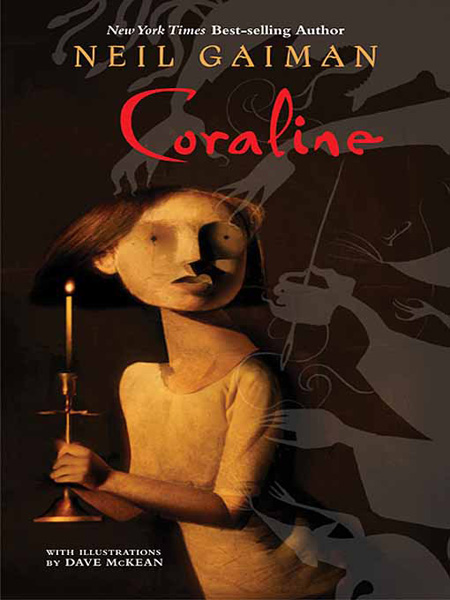
Book Review: Coraline, by Neil Gaiman (illus. by Dave McKean) (HarperCollins, 2002)

Recommended for ages 10+

Coraline is a dark fantasy created by author Neil Gaiman. It was adapated into a graphic novel (2009) and an animated feature (2009).

Coraline is a young girl who moves into a new home with her parents and feels out of place. Her parents don’t seem to have too much time for her, so she goes exploring and meets some of her odd new neighbors and the neighborhood cat. One night, she discovers a hidden doorway that leads to a parallel world; it’s here that she meets her “Other Mother”, who seems to have all of the time in the world for Coraline and always makes delicious meals. She desperately wants Coraline to stay, but there’s something… strange… about the Other Mother. As Coraline visits more often, she discovers that the Other Mother is not at all what she seems, and she’ll need the help of the neighborhood cat – who isn’t exactly what he seems, either – to save herself and her family. 

Neil Gaiman has been writing dark fantasy since the 1989, when he revived the DC Comics title The Sandman. He brings his creepy fantasy worlds to children as easily as he does to his older audience, and often makes some of his most unsettling characters adorable. His main characters often go against the grain, and Coraline is no exception – she is an independent, stubborn, curious girl who loves a good adventure; she’s also a smart heroine who can work her way out of a tight situation.
 
Mr. Gaiman creates memorable images with his words – visions of The Other Mother will stick with kids and adults alike and Coraline’s odd neighbors come with their own strange charm that smoothly made the transition from print to screen. His descriptions allow the reader’s imagination to run wild without ever worrying about going over the top – because there simply is no limit.
 
Coraline has won numerous awards, including the 2003 Hugo and Nebula Awards for Best Novella and the 2002 Bram Stoker Award for Best Work for Young Readers. Neil Gaiman’s Mouse Circus website – a Coraline reference – is geared toward his younger readers and offers information about the author, downloadable computer wallpaper, and video interviews and book trailers.
Posted in Post-apocalyptic/Dystopian, Science Fiction, Tween Reads

Book Review: The Giver, by Lois Lowry (Houghton Mifflin, 1993)

Recommended for ages 11-14

In the dystopian future, there is no more war, disease, or poverty. There are no choices, either – in 12-year old Jonas’s community, spouses are assigned to one another, children are assigned to families, and children’s milestones are pre-selected and celebrated once a year. At age seven, they receive jackets that button in the front. At the age of nine, they receive bicycles. At the age of 12, they attend the Ceremony of Twelve, where they are assigned their careers. Jonas, who has been experiencing feelings that has made him feel different from his peers, is assigned to be the Receiver of Memory – the sole repository for the collective memories of the community. He begins to work with the outgoing Receiver, now called The Giver, to receive the memories and learns disturbing truths through both the memories and the truths he begins to see in his daily life in the village.

The Giver is one of those books that sticks with you, changing the way you think about things. What price is a group willing to pay to live in a perfect, ordered society? Jonas, in receiving memories, plays the part of Adam in the Garden of Eden – he receives knowledge, and with knowledge comes confusion. Is his community right because they don’t know better? He begins to question everything around him and everything he’s ever known; when he sees his father commit an act in the course of his daily work that he finds unspeakable, the last vestiges of what he believes in are thrown into chaos.
 
The Giver is one of the most challenged books books in middle schools across America, usually for its portrayal of euthanasia (but also for what has been considered a sexual reference). Regardless of its challenges, it remains a popular and important middle-school book that speaks to the power of free will and choice. There are many lesson plans for this book on the Web, including this comprehensive one from the Mountain City Elementary School District in Tennessee. The book won the 1994 Newbery Medal and the 1996 William Allen White Children’s Book Award and has been designated an American Library Association (ALA) Best Book for Young Adults and an ALA Notable Children’s Book. The Giver is the first in a 3-book series that includes Gathering Blue and Messenger.
 
Lois Lowry is an award-winning YA author; she has received numerous awards, including two Newbery medals (for The Giver and Number the Stars). Her website lists all of the awards she’s won in addition to offering book information, a biography, her blog, her photos, and copies of her speeches.
Posted in Horror, Tween Reads

Book Review: Goosebumps: The Beast from the East, by R.L. Stine (Scholastic, 1996)

Recommended for ages 9-12

R.L. Stine is the Stephen King of kid’s horror. His Goosebumps series has been scaring the daylights out of kids for almost 20 years now, and he has branched out into other Goosebumps series (Horror Land, Hall of Horrors) and a television series based on the novels.

The Beast from the East is like reading a demented version of the old nursery song, Teddy Bear’s Picnic(also referenced in the story). Twelve year-old Ginger, her ten year-old twin brothers Nat and Pat, and their parents go on a camping trip one summer. While their father sets up the campsite, Ginger and her brothers go exploring and end up getting lost in the woods, where they come upon a group of big, blue, furry bearlike beasts that want to play a game where the winners get to live, but the losers get eaten. There are a lot of rules – can they figure them all out and get back to their parents, or will they end up as dinner?

Stine’s stories are short, creepy fun, and end with a macabre twist every time. There isn’t a lot of character development here, but there doesn’t need to be – you learn what you need to know to get through the story, because it’s really the situation that makes the book. Stine is great at describing panic and fear, giving readers the good scare they want in the safety of their own space. The twist is one last parting shot to keep you thinking after the book’s end, or until you pick up the next book.
 
Several books from the series have won Nickelodeon Kids’ Choice Awards and is one of the best-selling children’s series of all time. Scholastic has an official Goosebumps site.
Posted in Fantasy, Tween Reads

Book Review: The Summer of Moonlight Secrets, by Danette Haworth (Walker Books, 2010)

Recommended for ages 9-12

Eleven year-old Allie Jo lives with her mother and father at The Meriwether, a Florida hotel that they help manage. She doesn’t have many friends, and the mean girls at school call her a “hotel rat”. The summer of 1987 changes things for Allie Jo, though – she meets Chase, a fourteen year-old guest traveling with his journalist dad and who’s working through some issues of his own, and they both meet Tara, a mysterious girl who appears one day and says she’s run away. As Allie Jo and Chase learn more about Tara, they’re split as to what they believe – is she a troubled teen, or is her fantastic story true?

A fantasy substory taking place within a realistic fiction plot, The Summer of Moonlight Secrets is great fun with a few big issues going on – there is some minor bullying, the issue of an absentee mom, and a runaway whose stories all intertwine here. Ms. Haworth’s story is evenly paced with well-developed characters. Chapters are narrated in each of the three main characters’ voices, so the reader truly gets a glimpse into each character’s mind and point of view in addition to how each perceives the others. The big reveal is also a pleasant surprise, as Ms. Haworth almost leads to reader to one conclusion to reveal another, more interesting one. Overall, an enjoyable read about friendship that will make readers feel good when they’re done – and leave them with some interesting things to consider.

Danette Haworth’s website offers information about all of her books, her biography, and contact information.