Posted in Preschool Reads

Book Review: Ride, by Stephen Gammell (Harcourt, 2001)

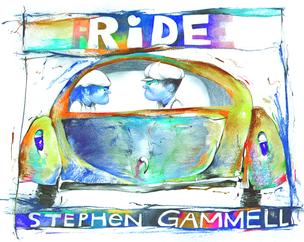
rideRecommended for ages 3-6

A mother and father decide to take their children on a Sunday ride. The siblings don’t share their parents’ enthusiasm. Once in the car, it begins. First come the insults: “You’re a poopy face.” “You have booger breath.” The argument escalates into an all-out fantasy brawl, with furniture flying, rockets blasting off, and a dinosaur showdown. Mother offers a snack, which calms things down momentarily: but for how long?

Mr. Gammell’s pastel-pencil-watercolor illustrations are bursting with color and energy. His rainbow palette is reminiscent of a Spin-Art machine, with splatters and smudges throughout each page. The text is woven into the story, as there is no narrator, only the dialogue between family members. The bold text exists in the same space as the illustration, with exaggerated sizes, colors, and splatters. The book will appeal to young audiences, especially those with siblings or other family members who can relate to being stuck in a car with someone who drives them crazy, and the imaginative tussles that the siblings create.

This would be a fun addition to a sibling read-aloud. It may also be enhanced by using puppets to act out the family’s interactions; in particular, the brother and sister, whose battle frames the book. There are songs and fingerplays about siblings available that can be easily taught to audiences, including “Here is Sister/Here is Brother”, to the tune of Frere Jacques.

Posted in Preschool Reads

Book Review: Diary of a Worm, by Doreen Cronin/illus. by Harry Bliss (Joanna Cotler Books, 2003)

diary of a worm

Recommended for ages 2-6

A young worm journals his daily life, writing about his friends, his family, and the pluses and minuses of being a worm.  His observations are often very funny, as when he talks about spending the day above ground with his family after a rainstorm, and then notes, “Hopscotch is a very dangerous game”, with illustrations from a worm’s point of view. The story includes facts about earthworm behavior that gives young audiences a fun lesson in science: earthworms dig tunnels that help the earth breathe; worms cannot walk upside down, and worms have no teeth being just a few fun factoids to take away.

The artwork adds to the appeal of the book. Mr. Bliss uses watercolor and ink illustrations to bring Worm, his family and friends to life; while not overly anthropomorphizing them, he does infuse them with personality. The worm’s-eye view of the world provides a different point of view that young audiences will appreciate, and could lead to a good post-storytime discussion of how things look different from a worm’s point view as opposed to a human’s. The text looks almost like a printed font, and the entries are dated, like a real diary would be. The endpapers are set up like a scrapbook or diary, with photos of Worm’s friends, family, and accomplishments – report cards, a web made for him by his friend, Spider, a comic strip – “taped” to the pages.

The “Ðiary Of” series includes Diary of a Fly; Diary of a Spider; and Diary of a Worm.

A Wiggling Worms/Garden read-aloud would be a fun idea for the Spring. Diary of a Worm may be a tricky read-aloud if done conventionally, as there is a lot of activity within each page. Bringing in puppets may be a fun way to accomplish a fun read-aloud, with assistants or another librarian acting out with puppets of worms, spiders, and flies, while the librarian narrates the journal entries. Amazon offers a Diary of a Worm & Friends Finger Puppet Playset that would connect the puppet show to the book even further. An after-story discussion about worms would involve children, inviting them to share what they have learned about worms after reading the book. A fun craft would let children make worms out of modeling clay, which they could take home. Scholastic has a Diary of a Worm DVD that may be fun viewing for younger audiences.

Diary of a Worm has received numerous awards and accolades since its publication, including designation as a School Library Journal Best Book for Children (2003).

Posted in Preschool Reads

Book Review: Grandparents are the Greatest Because… by Adele Aron Greenspun & Joan Schwartz (Dutton, 2003)

grandparents are the greatestRecommended for ages 4+

A photo album of grandparents and grandchildren provides readers with many reasons as to why grandparents are the best. The book features actual, hand-tinted photographs of grandparents and grandchildren in coordinating pastel frames. The phrase, “Grandparents are the greatest because” runs throughout the book, with reasons why – “They cheer you up with smooches/and big warm squeezes… elephants don’t scare them,/and neither do dinosaurs with big, sharp teeth” – running along the bottom of the photos. Embedded in the illustrated frames are quotes from either the adult or the child featured in the photo. The photos are affectionate (a grandmother hugging her grandson at what looks like a family wedding) and inspiring (a grandfather shows his grandson his army uniform as his grandson wears his hat). The endpapers feature different ways of saying grandmother and grandfather in different languages and different nicknames for them, like “Mamaw” and “Papaw”. Children will enjoy these loving photographs of grandparents and this celebration of grandparents and grandchildren alike.

This would be a great addition to a read-aloud on families, specifically grandparents. National Grandparents Day is September 8; this may be a good reason to get grandparents into the library with their grandchildren. The Perry Public Library has a Grandparents Day storytime theme that includes songs and rhymes, and the children can get up and dance with their grandparents at the conclusion, perhaps doing the Hokey Pokey or Ring Around the Rosie.

Posted in Preschool Reads

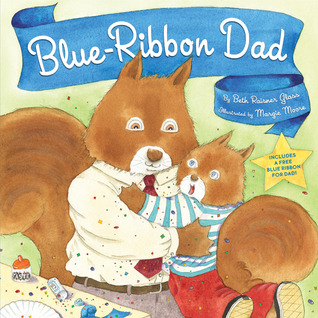
Book Review: Blue Ribbon Dad, by Beth Raisner Glass/Illus. by Margie Moore (Abrams Books for Young Readers, 2011)

blue ribbon dadRecommended for ages 2-6

The book, a love letter to dads, shows a young squirrel counting down the hours until his father gets home from work. As he works on a craft project to have ready for his father’s arrival, he thinks of all the things his dad does with him: he wakes him up in the morning, packs his lunch and brings him to school, and watches his swimming lessons. When Dad comes home, his son presents him with a blue ribbon, for being a Number 1 Dad. The story, told in rhyme, will appeal to young readers and audiences. The illustrations are made with black pen and watercolors on cold press paper and provide soft images with enough definition that the characters stand out against their backgrounds. The faces on the family members are gentle and expressive. The endpapers feature all of the craft supplies used to make the blue ribbon plus the clock, an important part of the story as the squirrel son counts each hour down until his father comes home. The book comes with a detachable blue ribbon that should probably be removed before putting circulating, rather than invite theft and damage to the book.

This would be a good addition to a Father’s Day read-aloud. The blue ribbon is an easily made storytime craft. The Perry Public Library has a Daddy storytime theme that includes songs and rhymes that would enhance any read-aloud.

Posted in Preschool Reads, Uncategorized

Book Review: Rain Romp, by Jane Kurtz/Illus. by Diana Wolcott (Greenwillow Books, 2002)

RainRompRecommended for ages 3-6

Preschoolers often deal with moods that they don’t know how to control; many will associate with this young girl who wakes up in a bad mood on a rainy day. Her parents try to boost her mood, but she wants none of it, until she decides to stomp her bad mood away in the rain. Her parents join her, and the bad mood goes away. The watercolor and gouache art is perfect to convey the both the weather and the girl’s moods, going from angry and gray, like the rain, to happy and content, as the sun peeks through the clouds. The text curves around the art and gets larger for emphasis when the girl vents her anger.  As she and her family hug, mood lifted, the text curves underneath them, allowing the reader to join in the hug.

This would be a good addition to a read-aloud on moods. There could be a discussion on what preschoolers do when they are angry, or sad, or happy. If they feel sad or mad, what makes them feel better? A good storytime craft would allow the children to draw a picture of how they deal with a bad mood, and they could receive a smiley face handstamp at the end of the storytime.

Posted in Preschool Reads

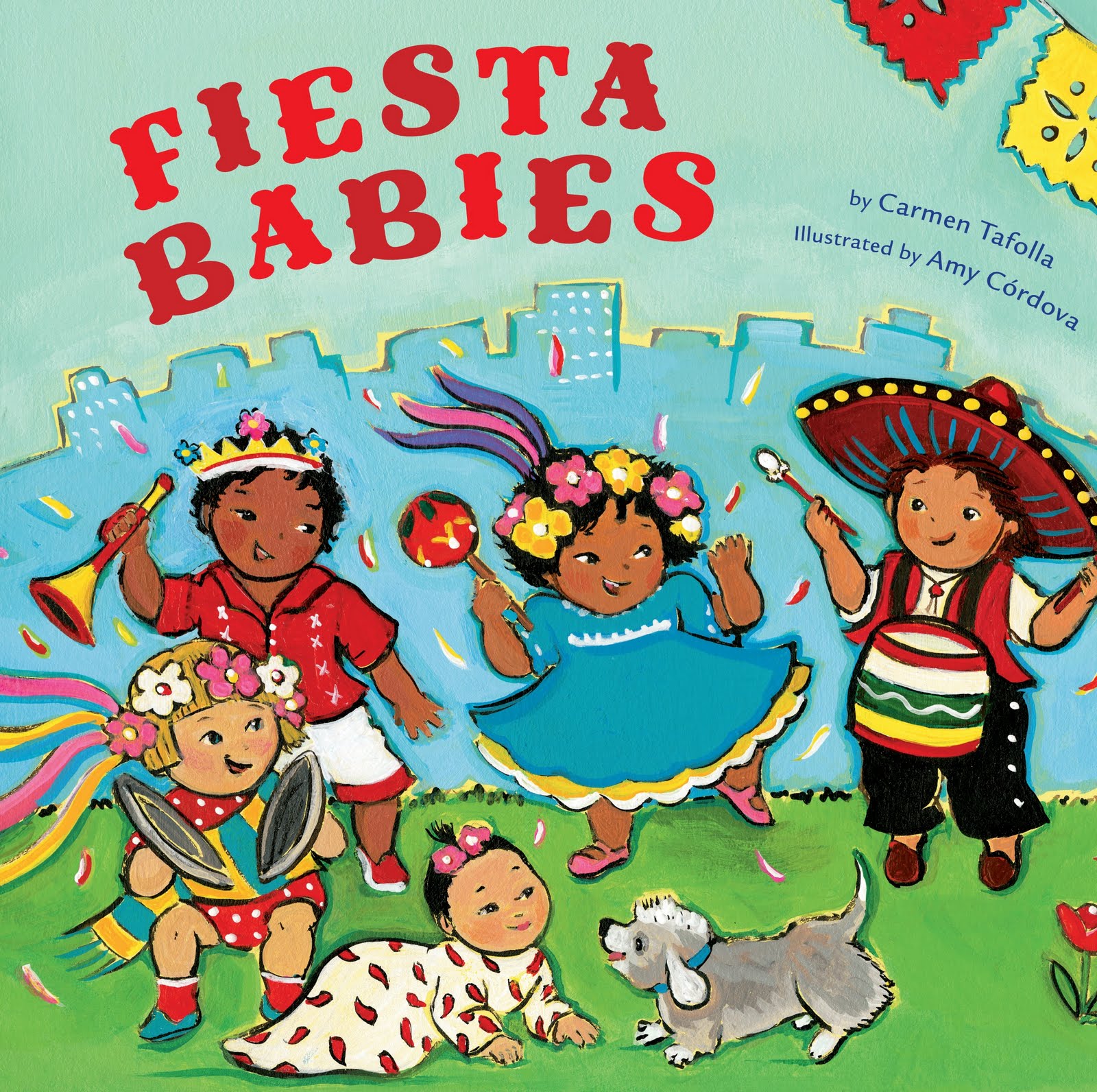
Book Review: Fiesta Babies, by Amy Cordova (Tricycle Press, 2010)

fiesta babiesRecommended for ages 2-5

A multicultural group of babies and their families take part in a cultural celebration, complete with colorful hats, dresses, foods, and dancing. The story, told in rhyme, uses English and Spanish words to bring babies of all ethnicities together in a celebration of Mexican heritage. Amy Cordova received 2011 Pura Belpre Illustration Honors for her bold acrylic colors and brushstroke paintings that bring Ms. Tafolla’s text to life. There are sombreros, serapes, salsa, and happy babies and grownups from diverse backgrounds together to celebrate a grand fiesta. The faces of the participants are joyfully expressive, spreading good feelings. A short glossary at the end of the book defines the Spanish words in simple-to-understand language for young audiences.

The book is a great read-aloud choice. The rhyming text will draw in young listeners, as will the bright colors and exciting new words, for those non-Spanish speakers. There can be a glossary handout for parents and guardians to practice the new words with children after the story time. Fiesta Babies, like Dora the Explorer, can teach children simple Spanish words; some preschoolers may recognize some of the words from Dora episodes. This would be a great multicultural language read-aloud with books like Linda Sue Park and Julia Durango’s Yum! Yuck! A Foldout Book of People Sounds, where children learn common words and phrases in a multitude of languages. There are several websites that offer Spanish language fingerplays and songs and can easily be slotted in to a bilingual story time.

Posted in Preschool Reads

My Beastly Brother, by Laura Leuck/illus. Scott Nash (HarperCollins, 2003)

beastly brotherRecommended for ages 3-6

A young monster reflects on life with his older brother, who can be  truly beastly or very kind. Ms. Leuck uses two monster brothers to illustrate the ups and downs of sibling relationships. The younger brother makes a laundry list of his older brother’s “beastly” – a double entendre here – behavior toward him: he will not allow him to play with his stuff, feed his pets, and outdoes his younger brother at everything he does, from burping to spewing spider spit. He throws his toys away, bothers him, and never lets him win.  But when he has scary dreams of humans coming after him, the younger monster learns that sometimes, his beastly brother is not so beastly after all.

Scott Nash’s cartoon illustrations bring humor to the monster family; they are not scary at all.  He turns the idea of the traditional family on its head by creating a monster nuclear family, complete with details like eyeball wallpaper and skull upholstery. The humans are the monsters in this tale; to that end, Mr. Nash illustrates the young monster’s nightmare with scary humans with frozen smiles and outstretched arms. The text is black, bold font on a stark white background, with a single image beneath the text, allowing the illustrations to take center stage. The monsters, other than being hairy, are fairly normal.  Their faces are pleasant and expressive, with large eyes and big smiles fully of pointy teeth. The boys wear jeans and t-shirts; Mom wears a pink dress with a spider print pattern, and Dad mows the lawn in shorts, a t-shirt and a baseball cap.

Laura Leuck and Scott Nash’s monsters show up again in My Creature Teacher.

This would be a fun book to incorporate into a family read-aloud. There are many family printables available for coloring on DLTK, along with family puppets, and poems.

HarperCollins offers an author webpage that allows interested readers to sign up for author updates.

Posted in Preschool Reads, Toddler Reads

Book Review: Circle Dogs, by Kevin Henkes/illus. by Dan Yaccarino (Greenwillow Books, 1998)

circle dogsRecommended for ages 2-5

Circle dogs live with their family in a square house with a square yard, eat circle snacks, and dig circle holes. Created by popular children’s author/illustrator duo Kevin Henkes and Dan Yaccarino, Circle Dogs provides a fun lesson in shapes wrapped within a story about two fun-loving dachshunds, referred to as “circle dogs” because they twist themselves into circles when they sleep. The story takes place over a day in the life of the circle dogs and their family: they wake up in the morning, along with the sun, alarm, baby and birds; kiss their family members; play; eat; nap; eat, and go to bed for the night. Dan Yaccarino’s artwork has shades of Lane Smith’s retro feel here; his brightly colored gouache pictures look like cutouts on white space and will attract a young reader’s attention with his contrasting colors. The bold text is black on lighter spaces and white against black spaces, standing out and making reading easy.

This concept book provides a great opportunity for a read-aloud on shapes. The book invites interactive reading by using repetitive sounds to communicate the dogs’ day: their tags go clink-clank, their tails flip-flap and swish, swoosh, and they eat their dog food with a kibble-clatter, kibble nibble.   Circles, squares and triangles are easily identifiable and plentiful throughout. This would be a great opportunity to use a felt board with shapes for young audiences to identify and create pictures with – a square can be a house, a sandwich, a window; a circle can be a sun, a face, or a table; a triangle can be an ice cream cone, a hat, or a dog’s ear, as in Circle Dogs. The DLTK website offer a Shapes Buddies webpage with printables including a Shapes Bingo game and Buddy Shapes to color.

The author’s webpage offers information about more of his books, plus downloadable guides and printables for parents and teachers.


Posted in Preschool Reads

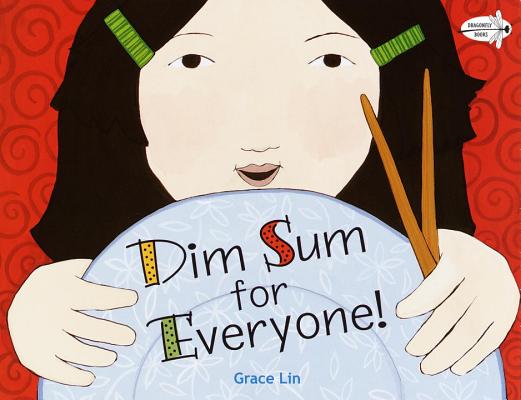
Book Review: Dim Sum for Everyone, by Grace Lin (Dell Dragonfly, 2003)

Dim-Sum-for-EveryoneRecommended for ages 2-5

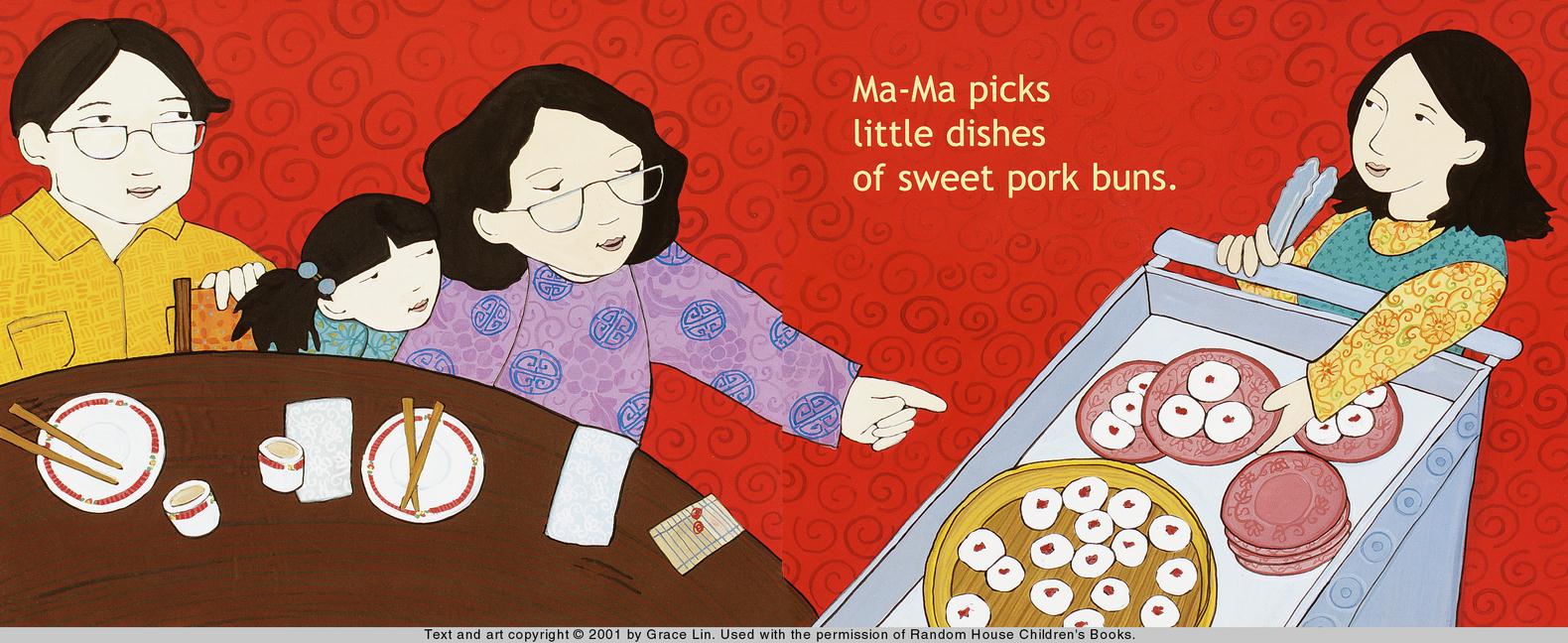
A child describes her dinner at a dim sum restaurant with her family, explaining what dim sum is – little dishes of different foods – and what each member of her family chooses from the little carts that bring food to the tables. Perspective changes to feature each family member as they choose a different food. Multicultural audiences will appreciate learning about new and different foods, and many families will identify with the experience. The illustrations are brightly colored, with the restaurant’s red carpet serving as the background for each spread; the bright silver carts and vibrantly colored foods and clothing add to the visual interest. The front endpapers feature food, condiments and tableware against a bright green background and the back endpapers illustrate almost two dozen dim sum dishes.  The bright yellow font creates a nice contrast from the red background, and occasionally, the text curves around the picture, adding to the visual appeal.

dim sum image

This would be a strong addition to a multicultural read-aloud or a Chinese New Year read-aloud. Preschoolers will be intrigued by the bright colors and names of the characters (Ma-Ma, Ba-Ba, Jie-Jie, Mei-Mei); the interesting new foods could start a fun discussion on other types of ethnic foods. If space permits and the food is available, perhaps there could be a small selection of foods available for audiences to sample. A Chinese New Year read-aloud could also offer printables of the Chinese astrological signs, with explanations for each sign.  Oriental Trading’s website offers many affordable Chinese New Year crafts for little hands, and there are free lantern crafts available online that parents/guardians could help children create.

The author’s webpage offers printables, crafts, Chinese lessons, and recipes.

Posted in Preschool Reads, Toddler Reads

Book Review: Mama Mama by Jean Marzollo/illus. by Laura Regan (HarperFestival, 1999)

mama mamaRecommended for ages 0-4

The bond between mothers and babies is strong, as illustrated by different animals. Seven different animal babies tell their mothers, in rhyme, how they love them. Each spread features a realistic illustration of an animal mother and baby – lions, leopards, chimpanzees, koalas, pandas, elephants, and sea otters – and a four-line rhyme celebrating their love: “Mama, Mama,/Nuzzle, hug,/I’m your little/golden cub”. The font is simple and black, meant for mothers to read to their children during cuddle time. The book is a sweet tribute to mothers and their babies and should be a popular board book selection in any library.

This would be a good read-aloud for a family-related lapsit or a Mother’s Day lapsit. The Perpetual Preschool website offers many Mother’s Day songs and fingerplays that would work well with this type of lapsit.

The author’s website offers free ebooks and activities using her other books. She has written a companion book to Mama Mama called Papa Papa.