Posted in Fiction, Middle School, Science Fiction, Teen, Tween Reads

Henry and the Incredibly Incorrigible, Inconveniently Intelligent Smart Human makes humans the invention.

henry and the humanHenry and the Incredibly Incorrigble, Inconveniently Intelligent Smart Human, by L.A. Messina. Tater Tot Books (2014), eBook: $3.99 ISBN: 9780984901838

Recommended for ages 10-14

Henry is a young teen robot in his 13th upgrade. He’s not the popular kid at school, and he has a faulty processor that comes from a virus that attacked his system when he was younger. When his father’s boss shows up at their home one night with a new human model to test for the market, Henry is thrilled – his own human! But this human isn’t a slack-jawed, drooling blank slate like most humans are. This one makes up words, can do things without extensively detailed commands, and doesn’t want to sleep in his box because it’s not comfortable. At first, Henry is worried – what if this human goes berserk like the one that went on a rampage in his mother’s business? – but he comes to realize that the HueManTech ETC-420- GX-2, or “E”, as Henry calls him, is a very special model.

Unfortunately, Henry’s not the only one who thinks “E” is special, which leads to a taut race to unravel the truth about E, especially when the government begins showing an interest in E and Henry’s family.

The book starts out slow as Ms. Messina establishes the drudgery of Henry’s young teen life – mocked at school, boring job at his mother’s spa, Henry is the lonely kid who takes comfort in his comic books and video games, until something exciting – E’s arrival – sparks up his life. Even then, the narrative moves at a slower pace as Henry discovers how special E really is. But once the plot kicks into motion, involving the government and the origins for both E and Henry, the story moves at a great pace that kept me turning pages and wanting to know more.

The book, available via e-book format, is a good read for tweens and young teens. It provides a wealth of opportunities to discuss what would happen in a society where robots were on the top of things and humans were the creation; it also offers chances to discuss morality and the government. It would be a good discussion group story for educators to encourage among their students and patrons.

Lynn Messina’s website offers a book trailer for Henry, along with fun extras for readers.
Posted in Graphic Novels, Middle School, Non-Fiction, Teen, Tween Reads

Smile, by Raina Telgemeier – A Graphic Memoir of Tweenhood

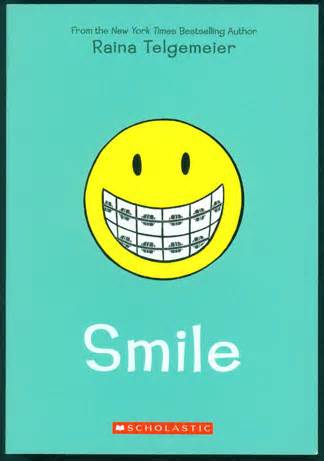
smileSmile, by Raina Telgemeier. Scholastic (2010), $21.99, ISBN: 978-0-54513205-3

Recommended for ages 10+

Raina Telgemeier’s memoir, Smile, is a coming-of-age memoir that’s framed by the night sixth-grader Raina sustained an injury to her mouth that led to a series of surgeries and orthodontia. Throughout middle school and high school, Raina endures braces, surgeries, retainers, and even headgear. She becomes a target for her friends’ teasing, which leads to her pulling away from them and embracing her love of the artistic. When she finally realizes that her friends aren’t the people she wants to surround herself with, she stands her ground and moves on.

Smile is one of those books that everyone should read, kid or adult. It’s all about fair-weather friends, enduring what feels like the end of the world, and ultimately, finding your own voice. It’s empowering, whether you’re 12 or 92, because it’s something we need to be reminded of, from time to time – “it”, whatever it is, won’t last forever, and the people you surround yourself with may not be the best for you. Dig deep down into yourself and love yourself enough to get through it.

The cartoon art makes the story even more accessible,with friendly-looking, expressive characters and warm colors throughout. The endpapers resemble a yearbook -in fact, Ms. Telgemeier used her yearbook signatures for the book – with signatures and well-wishes from friends, setting the tone for the book.

Smile has received numerous accolades – deservedly so! – including winning the Eisner Award for Best Publication for a Teen Audience (2011), the Dorothy Canfield Fisher Award (2012), and the Maine Student Book Award (2012). Smile was a finalist for the Children’s Choice Book Award (2011) and has received designation as an ALA Children’s Notable Book (2011), an honor book from the Boston Globe-Horn Book Awards (2010), a Kirkus Best Book of 2010, and a New York Times Editors’ Choice (2010).

There are lesson plans on the Web that allow educators to bring Smile into the classroom. Scholastic offers one on their site, along with a template for students to create their own graphic novels; The Graphic Classroom offers some great classroom discussion tips using the book.

A companion book to Smile, called Sisters, which will be published in August 2014 and will examine the relationship between Raina and her sister, Amara, who briefly appears in Smile.

Posted in Fiction, Humor, Middle School, Tween Reads

Desmond Pucket Makes Monster Magic and Get Laughs

desmond-pucket-makes-monster-magic_0Desmond Pucket Makes Monster Magic, by Mark Tatulli. Andrews McMeel Publishing (2013), $13.99, ISBN: 978-1-4494-3548-6

Recommended for ages 8-12

Desmond Pucket is a middle schooler who loves monster movies and special effects. He’s also a prankster who just can’t resist a good opportunity to use his special effects expertise to scare the daylights out of people, whether it’s his annoying older sister or one of the teachers. He’s been good at covering his tracks, but when he springs a prank on his older sister and her friends at a sleepover, he finds himself in hot water at school – one of his sister’s friends is the daughter of the disciplinary head at his school; he’s been waiting for Desmond to slip up, so he can transfer him to another school! Now Desmond has three chances left before he’s kicked out of school and misses the big field trip to Mountain Full of Monsters at Crab Shell Pier. Can he keep out of trouble for just a little longer?

The book is written in a similar style to Jeff Kinney’s Diary of a Wimpy Kid; it’s a first-person storyteller and illustrated, presumably by Desmond, with black and white sketches. There are even drawings that look like they’ve been sketched on torn bits of paper, to add to the realism of Desmond, and his friend Ricky’s, notes. The endpapers are green and have the appearance of crumpled paper, with more of Desmond’s drawings and notes to the reader.

I loved this book. It’s fun, light, and Desmond is – like Greg in Diary of a Wimpy Kid – a victim of his own making. He can’t stay out of trouble, but unlike Greg, he knows he’s his own worst enemy. He just can’t resist a good prank opportunity to cause mayhem. He even laments not being able to take credit for his brilliant pranks, because he knows it will get him into trouble. When he decides to pull a prank at  his sister’s sleepover, he has no idea of the trouble he’s getting himself into, and when the fallout hits, he has a major crisis on his hands – how can he stay out of trouble and still be himself?  He ultimately decides that being true to himself and owning who he is is more important than anything, including a long-awaited school trip.

Andrews McMeel has a wealth of Desmond activities and information online, especially since the second book in the series, Desmond Pucket and the Mountain Full of Monsters, will be released this August. You can read a sample chapter online at the Desmond Pucket site, follow him on Facebook, and download teacher and librarian resources on the Andrews McMeel site, including a guide to teaching with graphic resources and English/Language Arts and Science curriculum connections to work with, using the book. There are games and activities for readers both online and at the end of the book itself, where Desmond shares some notes on how to make fake blood, cool monster growl effects, a phantom knocker, a ghost, and a gelatin dessert.

I am looking forward to more Desmond books, as is my 10 year-old son, who read this book in about an hour and a half last night!

Posted in Fiction, Tween Reads, Uncategorized

Minerva Mint: The Order of the Owls

minervamintMinerva Mint: The Order of the Owls, by Elisa Puricelli Guerra/illus. by Gabo Leon Bernstein, Capstone Young Readers Group (2014), $9.95, ISBN: 9781623700386

Recommended for ages 8-10

Minerva Mint: The Order of the Owls is the first book in a new middle-grade series about an eccentric young girl named Minerva Mint, her two friends, Thomasina Crowley and Ravi Kapoor, and the mysteries that the group solves together; the most important being to find Minerva’s parents.

Minerva was found, as an infant, in a bag in Victoria Station. She lives in Lizard Manor -a large, ramshackle mansion that has seen better days – with Mrs. Flopps, the station custodian who discovered Minerva. Minerva meets Ravi and Thomasina, and the three become fast friends. Thomasina shares Minerva’s adventurous spirit and Ravi, a bit more level-headed and fearful, comes along for the ride at first because of his crush on Thomasina. He grows into himself during the group’s first adventures, but I’m pretty sure we’ll still see him as the voice of reason in the group.

This first book establishes the characters and the underlying mystery that will permeate the series – who are Minerva’s parents, and why did they leave her as an infant? There are some clues in the bag Minerva was found in, and she tries to put the pieces together. Thomasina and Ravi are sworn to help her, but Minerva is no damsel in distress; she can handle after years of fending off various long lost “parents” who come to the home in search of the valuable real estate and imagined riches in Lizard Manor.

The story is fast-paced and light, perfect for a middle-grade read about friendship with some mystery thrown in. Minerva is a quirky, fun character that will appeal to girls who want to step outside the “girly” model. Thomasina – pretty, blonde, wealthy Thomasina – is an adventurous spirit and a friendly, outgoing girl, which is a relief if you’re tired of the seemingly obligatory mean girls popping up as dramatic foils. Ravi is a shy, fearful boy who allows himself to be drawn out by the two girls. The group’s valued friendship sends a good message to younger readers about sticking together.

Gabo Leon Bernstein’s black and white illustrations are adorable and add to the story, giving us characters to bond with and creepy, fun landscapes. His illustrations advance the plot and fire up the imagination.

I look forward to more Minerva Mint books, and luckily, there are a two in progress: Merlin’s Island and The Legend of Black Bart. The publishers website offers extras, including character profiles, a book trailer, and downloadable clues sheet and a secret club contract that readers can use for their own secret societies!

Posted in Non-Fiction, Teen, Tween Reads

Daniel Stefanski Teaches Us How to Talk to An Autistic Kid

HowToTalkToAnAutisticKidHow to Talk to an Autistic Kid, by Daniel Stefanski/illustrated by Hazel Mitchell. Free Spirit Publishing (2011), $12.99, ISBN: 978-1575423654

Recommended for 8+

Daniel Stefanski, an autistic teen, wrote this book to teach other kids (and adults!) about autism from a more personal point of view. There are many guides and books out on the market, but Daniel’s personal approach and point of view, combined with Hazel Mitchell’s friendly, two-toned digital illustrations, make a greater impact. He isn’t using clinical speech and medical language, nor is he a parent taking sides in a debate. He’s a kid who wants other kids to understand him, befriend him, like him, and understand, befriend, and like other kids with autism. He explains behaviors that other kids may not understand, like flapping or humming, for instance; he discusses issues including eye contact, personal space, and most importantly, how other kids can reach out to and connect with autistic kids in their lives.

This book is only 48 pages, and can be quickly and easily read, but the information is invaluable in teaching children and adults to see things from another person’s point of view. As Stefanski himself says, “Even though my brain is different, I’m still a kid. I like to have fun and I want to have friends.” This is a book that needs to be available not only in public libraries, but in school and classroom libraries, where it is easily accessible and kids are actively encouraged to read it.

TalktoAutisticKid-800

Posted in Fantasy, Fiction, mythology, Tween Reads

Neil Gaiman’s Odd and the Frost Giants: In which Thor, Loki and Odin get into trouble AGAIN.

odd and the frost giantsOdd and the Frost Giants, by Neil Gaiman/illustrated by Brett Helquist. HarperCollins (2008), $14.99, ISBN: 978-0061671739

Recommended for ages 8-12

Neil Gaiman takes on Norse mythology with his tale of a lame young Norse boy named Odd, who encounters a bear, a fox, and an eagle in the frozen woods one day, only to discover that they are Thor, Loki, and Odin, on the run after Asgard is overrun by Frost Giants. They need Odd’s help to regain the kingdom and end the forever winter that the Frost Giants have spread throughout Midgard (and possibly, all of the realms). Is Odd smart enough to outwit the Frost Giants?

Gaiman adapts his storytelling voice for this story (as opposed to his dark fantasy voice that you can read in works like Coraline and Graveyard Book). The book is filled with his wry humor, especially in the interactions between Thor, Loki, and Odin – he gives Loki a particularly amusing voice, being the God of Mischief in the guise of a wily fox. Gaiman also excels at writing quiet, mild characters that achieve greatness through intelligence – Odd is yet another quiet Gaiman hero. Quiet kids will love how Odd uses his wits to save the day, rather than charging around Asgard swinging a war hammer and screaming for blood.

Brett Helquist’s art enhances Gaiman’s story with beautiful black and white sketches. The artwork lends a real authenticity to the Norse tale; the work could hail from a hoary, old tome, found in an old castle, it has such a wise old sense of timeliness about it.

9780061671739-oddfrosts16_zoom

I love Gaiman’s storytelling, and Odd is right there with his other work. This could enhance a unit on storytelling as easily as it could a unit on Norse mythology, and there are many activities to get kids writing that this book could inspire, including a Write Your Own Myth workshop, or asking the kids to put themselves in Odd’s place – how would they save Asgard? What would they do if they discovered three gods in the woods? Do you identify with Odd? What makes a hero heroic? There are many discussion topics that work for this book.

Posted in Graphic Novels, History, Tween Reads

Hidden: A Child’s Story of the Holocaust tells a powerful tale, gently for younger readers.

Hidden: A Child’s Story of the Holocaust, by Loic Dauvillier (First Second, 2014), ISBN: 978-1-59643-873-6, $16.99

Pub Date: April 1, 2014

hiddenRecommended for ages 8-12

Hidden is a graphic novel, tells the story of the Holocaust as it stormed through Vichy France, from a child’s eyes.

Elsa is a little girl who discovers her grandmother deep in thought one night. She curls up on her lap, and her grandmother tells her why she’s been feeling sad. Doumia, Elsa’s grandmother, has had a nightmare, and proceeds to tell Elsa about her life as a little girl.

Doumia was a happy child, living in France, going to school, and had friends and a loving family. One day, her father tells Doumia that they are to become “a sheriff’s family”, as her mother sews yellow stars on their clothing. She later learns, when her friends and her own teacher ignore her, that the yellow star is not a sheriff’s star, but the mark of being a Jew. Nazi soldiers harass people in the streets; Doumia’s father loses his job, and, fearing for her safety, Doumia leaves school to be homeschooled by her parents.

Doumia’s parents scramble to hide her when the Nazis come for them. She is discovered by a neighbor, who, with a network of the French Resistance, change her name and send her, along with her neighbor, to a farm to wait out the danger. When the War ends, we wait, as Doumia does, to learn her parent’s fate.

This is a powerful, emotional, story of the Holocaust because it is told through a survivor’s eyes, but the eyes of a child. We hear this story, as Elsa does, in the safe, warm embrace of a  grandparent, with Marc Lizano’s and Greg Salsedo’s gentle cartoon art, with subdued colors, easing younger readers into history. Where is difficult in parts, there are bright spots to keep younger readers interested and happy – Doumia living safely in the French countryside with women who care for her; the farm animals she helps care for, reunions with lost family members. It’s a safe place to talk about a horrific event.

An afterword by Hellen Kaufmann, the President of AJPN – an organization dedicated to telling the stories of rescue and solidarity during World War II – gives us an overview of Vichy France during World War II.

This is a fantastic pick for younger readers, particularly with the difficult task of finding interesting, captivating, non-fiction to fit with the Common Core Learning Standards. The book is a valuable teaching tool for parents and educators alike.

Posted in Animal Fiction, Media, Preschool Reads, Toddler Reads

In Which I Explore an An Animated Book: Hondro & Fabian

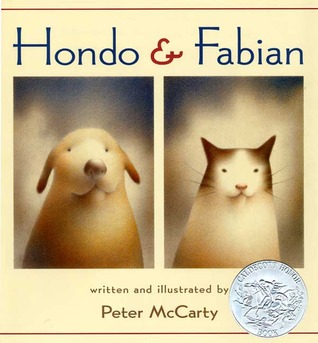
Hondo & Fabian. Written and Illustrated by Peter McCarty. 6 minutes. DVD. Weston Woods. 2006. $ 59.95 ISBN 0-439-84909-8

Suggested for ages 3-6

When I saw the animated books at my local library, I have to admit I wasn’t sure what to expect. Was I just going to be staring at a static series of pictures with a voiceover laid over the whole business? I decided to give it a shot with Peter McCarty’s Caldecott Honored-story, Hondo & Fabian. I am very happy to say I was delighted by what I watched.

hondo & fabian

Hondo & Fabian is the 2003 Caldecott Award-winning story of Hondo & Fabian, a dog and cat who live in the same household and have very different experiences one day, when one goes to the beach and one stays home with the family baby. Who has the better day?

Weston Woods produced this animated version of the book for schools and libraries, and author Peter McCarty’s soft, grey pencil on watercolor paper illustrations come to life as narrator Jeff Brooks tells the tale of the two friends who spend their day in two different ways. The illustrations are animated, allowing viewers to see Hondo’s ears blowing in the breeze as he hangs out a window, and Fabian putting his claws to work, shredding toilet paper. The story is brief, and Joel Goodman and David Bramfitt’s music adds to the beauty of the artwork, bringing with it a relaxing feeling as the story’s events unfold. Readers will enjoy viewing this story about pet friends; the option to use English subtitles will allow for new readers to read along with the narration. A study guide comes with the DVD that provides pre- and post-viewing activity ideas that can be incorporated into a storytime session, such as a discussion about pets and which animals are pets versus which are not.

This would be an interesting addition to a pet-related storytime. The DVD could break up the routine of a traditional read-aloud and attract renewed attention from attendees. The Perry Public Library’s Parade of Pets storytime theme has pet-related songs and fingerplays, and having a sing-along to an animal song-related CD, like Raffi’s Animal Songs, would make for an interactive and fun time.

The Hondo & Fabian animated book has received numerous accolades, including designation as an ALA Notable Video; Honorable Mention from the Columbus International Film & Video Festival; and was an Official Selection at the Kids First Film Festival.

The Hondo & Fabian series of books by Peter McCarty also includes Fabian Escapes.

Posted in Toddler Reads

The Bunnies Are Not in Their Beds: A Book About Not Going to Sleep.

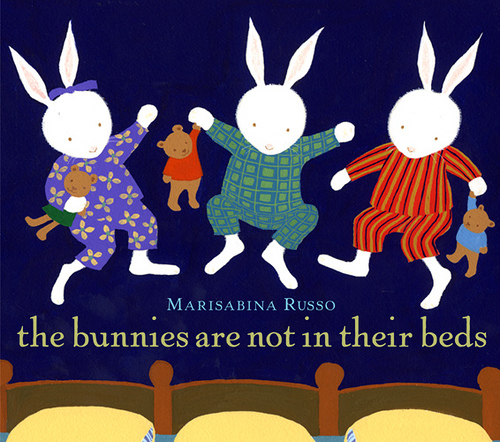
The Bunnies Are Not in Their Beds, by Marisabina Russo (Dragonfly, 2013), ISBN: 978-0307981264
Recommended for ages 3 – 7

bunnies It’s bedtime for three bunny siblings. Mama and Daddy put them to bed, and settle in to have some relaxing time together, when all sorts of noises erupt from the baby bunnies’ room! Mama and Daddy go up to check and discover that the bunnies are not in their beds – they’re playing! Will Mama and Daddy ever get the bunnies to go to sleep for the night?

The book is perfect for a preschool age group, who will identify with the young bunnies. Parents and caregivers will see themselves in the tired, near-exasperated parents, who hear a ruckus every time they put the bunnies to bed and start to relax. The story itself is perfect for a fun read-aloud; there is repetition and fun noises that make the story interactive: the parents saying, “good night, good night, sleep tight”, and the bunnies playful chaos: clips and clops, zooms and vrooms, and clashes and smashes give listeners a chance to jump up and act out the post-bedtime play.

The soft, gouache art lends itself to a relaxing atmosphere that allows the children to focus on the characters – a quiet bedtime read – and bold, big text for the bunnies play allows the reader to punch up the story for a more playful reading. Ms. Russo’s use of collage adds another dimension of fun to the artwork.

The author’s website offers contact information and information about her books.

This would be a great addition to a read-aloud about bedtime; I can see it being paired with a book like Jane Yolen’s How Do Dinosaurs Say Good Night? or Mercer Mayer’s Little Critter story, Just Go to Sleep. Allow listeners to jump around until they get themselves ready for nap time (and the caregivers will likely be grateful!). There are many songs and fingerplays about bedtime available online.

Posted in Fantasy, Preschool Reads, Uncategorized

When You Wish Upon the Moon… Randy DuBurke’s Moon Ring Takes You on a Trip

Book Review: The Moon Ring, by Randy DuBurke, Chronicle Books 2002
Recommended for ages- 4-8

the moon ring

Maxine, a young girl, sits on the porch, with her grandmother, seeking relief from the summer heat, when a magic ring seemingly falls from the blue moon. Maxine is swept away on a magic ride around the world – to the South Pole, a wild savannah, and New York City, accompanied by some new friends. But what happens when she runs out of wishes?

The book is a fun fantasy tale about magic and the moon. We always hear about wishing on a star, but the moon is the star of the show here (no pun intended). Randy DuBurke gives readers a classic fairy tale elements – granting wishes, being transported to exciting adventures and locales, and the temporary scare – the wishes have run out!

Young readers will enjoy the close relationship Maxine and her wise grandma who knows that magic is out there. Maxine is drawn with a wonderfully expressive face – it makes for fun reading, with prompts to children learning about facial expressions and emotions. The exciting, changing landscapes are beautifully rendered in pen, ink, and acrylics on cold waterpress paper. The story uses its space well, alternating between full-bleed spreads and framed panels. I read the digital version of this book, so I can’t speak to the fonts, but I’m sure a read-aloud with the actual book will work better with a young group.

The Moon Ring is a playful, fun book that makes for a good read-aloud session. This would be a great addition to a read-aloud about magic, imagination, or the moon. There are many rhymes and fingerplays about the moon that would be good companions to this book – Hey Diddle Diddle would be a fun start!