Posted in Fiction, Fiction, Intermediate, Middle Grade, Tween Reads

Bah! Humbug! is Michael Rosen’s modern-day take on Scrooge

Bah! Humbug!, by Michael Rosen/Illustrated by Tony Ross, (Sept. 2018, Walker Books), $15.99, ISBN: 9781536204797

Ages 8-12

A Christmas Carol enters a new century with Michael Rosen’s middle grade update, Bah! Humbug! Harry Gruber is so excited to be Scrooge in his school’s production of A Christmas Carol, but he wishes his father, workaholic Ray, would muster even a little bit of interest. Ray sees Harry’s event as one more thing keeping him from work, which keeps everyone in Ray’s family fed and living comfortably, and he never misses a chance to let everyone know it. The family – Harry, his sister, Eva, mom Lisa, and Ray – pile into the car and drive to school, with Ray grumbling all the way. While Harry shines on stage as Scrooge, Ray sneaks off to work – and gets some Christmas visits of his own.

Bah! Humbug! uses the school performance as a parallel to Ray’s own Christmas Carol, where he experiences some ghostly visits – after a fashion – of his own. A Christmas Carol is more relevant than ever in this 24-hour society, where we can all work nonstop and chase after the next big thing: a new PlayStation; a new car; a new vacation. The story moves between the play, letting readers relive Dickens’ holiday classic, and the present, as Harry’s heart breaks time and again over his dad’s seeming ignorance and Ray wrestles with his own demons, past and present. Kids may recognize their own families in this one, but remember: Dickens wrote the story to show readers that there’s always time to change the future.

A section called “Party Like a Fezziwig” has tasty recipes, games, jokes, and Christmas carols. There’s a note about the tradition of Victorian holiday storytelling, and a biographical note about Dickens and A Christmas Carol. Tony Ross’s black and white illustrations throughout the story keep readers engaged in the story and the school play. A nice add to your middle grade holiday collection. Read a sample chapter at Candlewick’s website.

Posted in Early Reader, Intermediate, picture books, Preschool Reads, Toddler Reads

Epic Hanukkah Books Post!

Happy Hanukkah, everyone! I’ve been browsing a lot of lists, and found some books for the season to share with you. There aren’t nearly as many Hanukkah or Kwanzaa books as there are Christmas books, so most of these are not brand spankin’ new, but I’m still excited to spread the joy of the season with everyone. Let’s dig in.
All-of-a-Kind Family Hanukkah, by Emily Jenkins & Paul O. Zelinsky, (Sept. 2018, Schwartz & Wade Books), $17.99, ISBN: 9780399554193

Ages 4-8

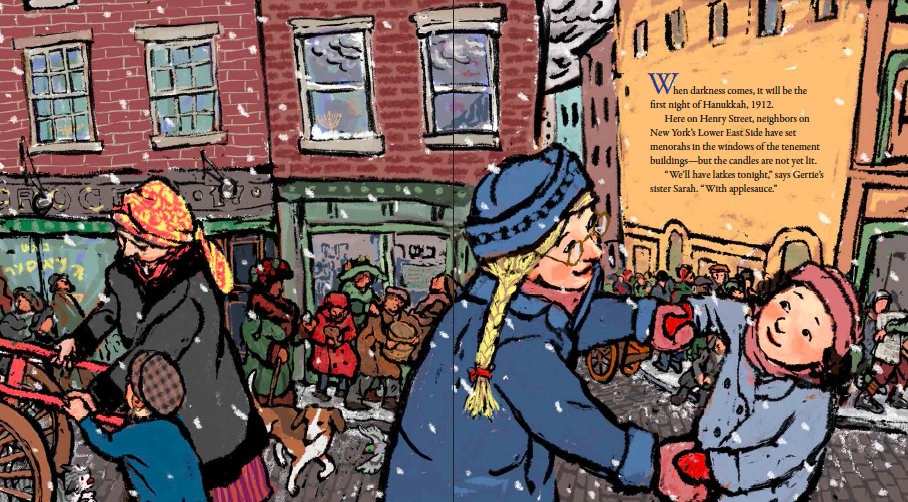
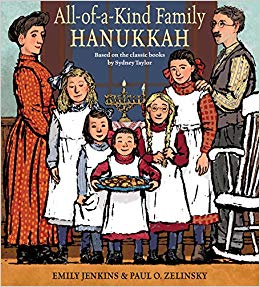
Based on the All-of-a-Kind Family series of books (1951-1958) by Sydney Taylor, All-of-a-Kind Family Hanukkah celebrates Hanukkah with the All-of-a-Kind Family in New York’s Lower East Side in the early 20th Century. Four-year old sister, Gertie, is desperate to be part of the Hanukkah preparation, but Mama says she’s just too young to help make the latkes: she can get hurt by the potato peeler, cut herself with the knife, and get splattered by the hot oil. Frustrated, Gertie yells and stomps her feet, which earns her some thinking time in the girls’ bedroom; but Papa comes home and gives Gertie a very special Hanukkah task, and the family – Ella, Henny, Sarah, Charlotte, Gertie, Papa, Mama, and Uncle Hyman – enjoy their first night of Hanukkah meal together.

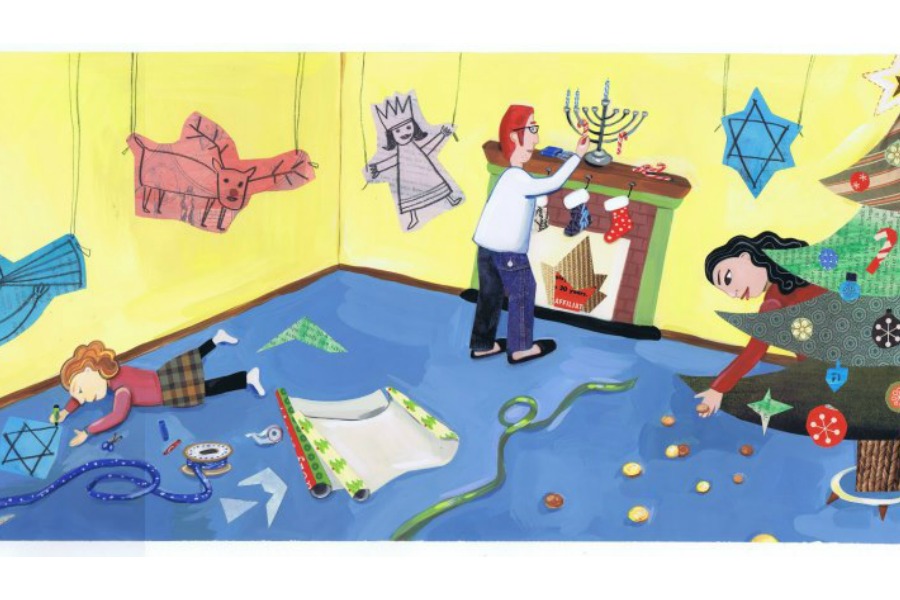
I haven’t read Sydney Taylor’s series since I was in grade school, but All-of-a-Kind Family Hanukkah brought me right back to the warm feeling of family I always had, reading these books. Paul O. Zelinsky’s artwork wonderfully sets the tone for the story, with a look at the lower east side’s crushed together tenement buildings and bustling city streets. He captures little Gertie’s spirit on every page, whether she’s dancing through the snow, placing herself in the middle of holiday preparation, or communicating her frustration at being too young to be part of the action. Bold lines and warm colors draw readers right in, and intimate family moments, like Gertie being held by her sisters or Papa holding his daughter after a long day (for both of them), bring all the love from their family to yours. I love the humorous moments, like Papa searching for Gertie as she’s hiding under the bed, asking a pillow or library book where his daughter is; it’s a sweet twist on the whole “wait ’til your father gets home!” business, and it reveals a playful nature in this family. Emily Jenkins has fully realized the family dynamic here, and Paul Zelinsky gives them life.

Back matter includes a glossary, an author note putting the story into historical context and her own relationship with Sydney Taylor’s books. An illustrator note talks about Paul Zelinsky’s deliberate decisions when making choices for the story’s artwork. There’s also a link to extra back matter, including downloadable coloring pages, educator resources, and a latke recipe.

An essential addition to your holiday collections, and a comforting storytime read. All-of-a-Kind Family Hanukkah has starred reviews from Publishers Weekly and Kirkus, and has been written up by The New York Times and the Jewish Book Council.

Grover’s Eight Nights of Light, by Jodie Shepard/Illustrated by Joe Mathieu, (Sept. 2017, Random House), $6.99, ISBN: 9781524720735

Ages 3-5

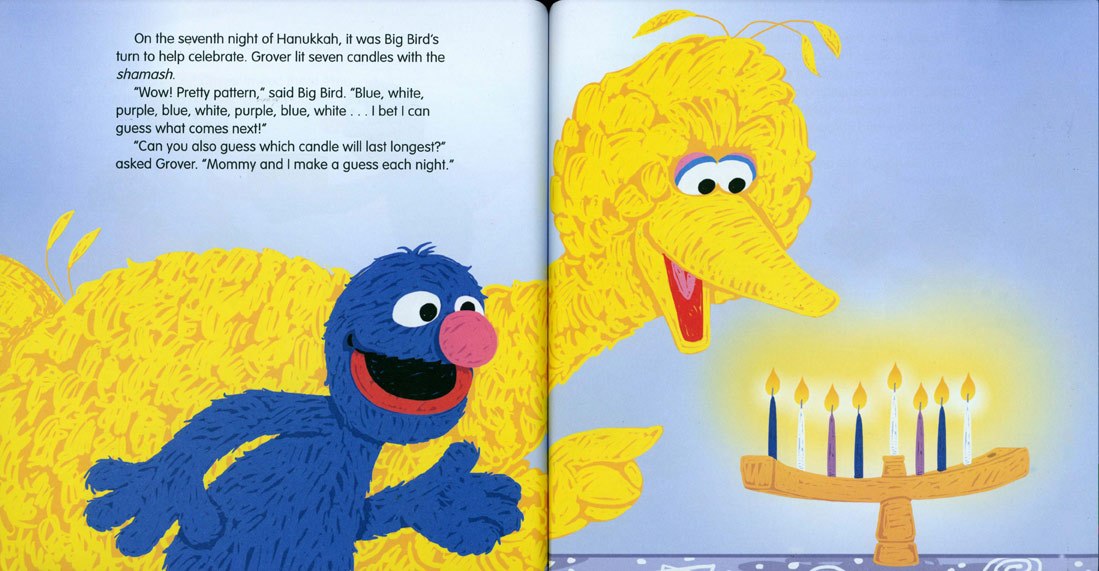
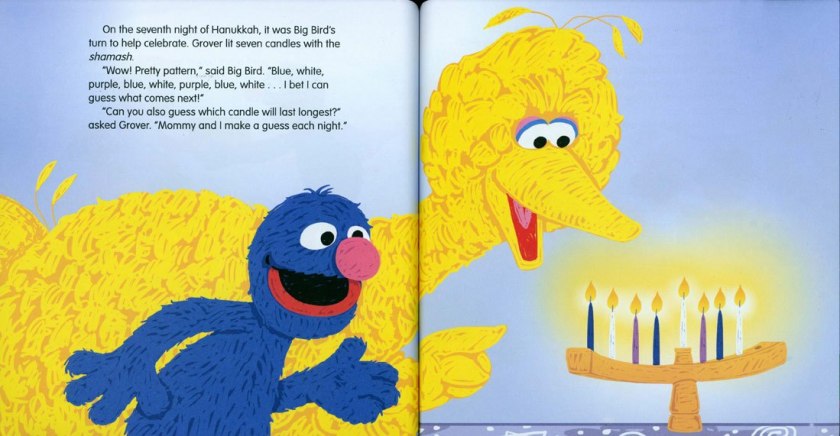
Hanukkah is coming to Sesame Street, and Grover is so excited! He and his Mommy decorate their home and open it up to their friends for the next eight days and nights. Grover’s Eight Nights of Light explains Hanukkah rituals to younger readers, from the shamash candle (the helper candle that lights the candles in the menorah) to the story of Judah Maccabee and the Hanukkah miracle. Some big Sesame Street names pop up here: Cookie Monster shows up and discovers that latkes are the same shape as cookies: what could be wrong with that?; Oscar the Grouch likes watching the dreidel fall over; Elmo and Abby arrive with gifts, the Bear family drops by to celebrate and trade gifts, Prairie Dawn sings a song with Grover, and Bert and Ernie accompany Grover and his mom to the food pantry on tzedakah night, when they perform an act of charity. Big Bird and Grover talk patterns of color candles in the menorah, and what would an 8-night holiday be without Count von Count? On the last night of Hanukkah, Grover and his Mommy have a party for everyone, and readers are invited to throw their own: the book includes stickers and a poster for a Pin the Candle on the Menorah game.

Sesame Street is synonymous with diversity and representation, and Grover’s Eight Nights of Light is a fun book that informs with love. The kids’ favorite characters are here, and present the history of Hanukkah in a child-friendly, accessible way. If you’ve got PBS/Sesame fans in your life, this is a great little gift to tuck into your gift bag for one of those eight nights. (Librarians, save the stickers and poster for programs; your book will last a little longer that way, too.)
From Joe Mathieu’s webpage


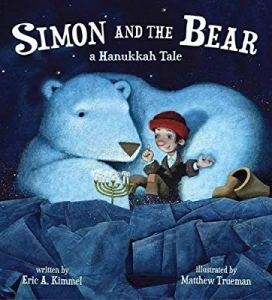
Simon and the Bear: A Hanukkah Tale, by Eric A. Kimmel/Illustrated by Matthew Trueman, (Sept. 2014, Disney/Hyperion), $16.99, ISBN: 9781423143550

Ages 4-8

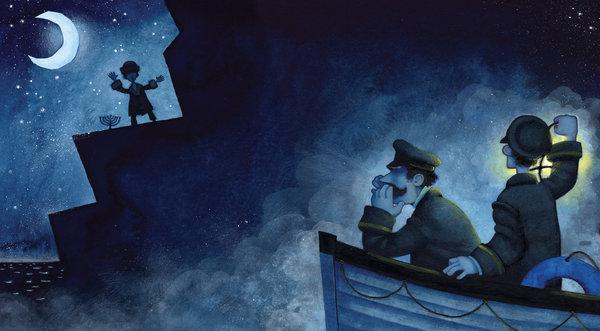
A tale of miracles follows Simon, a Russian boy, who leaves home and heads to America in search of a better life. Once he secures a job, he’ll send for his mother, brothers, and sisters. But the ship hits and iceberg, and Simon saves a man’s life by switching places in a lifeboat with him. He’s marooned on an iceberg on the first night of Hanukkah, with only his menorah, candles, matches, and some food, which he shares with a polar bear who happens by. Over the next few days, Simon and the bear shares freshly caught fish with him and keeps him warm at night, while he lights Hanukkah candles and tells her stories. He reflects on the seven miracles he’s experienced so far, and prays for just one more: to be rescued and make it to America. Simon’s optimism pays off, and he’s rescued; reunited with the man whose life he saved, he discovers that there’s one extra Hanukkah miracle in store for him – just like the menorah has one extra candle.

Simon and the Bear pairs historical storytelling with a touch of holiday magic: and isn’t that the best kind? Matthew Trueman’s artwork, a combination of collage, crushed paper cutouts and acrylics, creates a textured story that comes to life as readers turn the pages. Icy blue shades add a little bit of chill to Simon’s marooning, but his ever-present knit red hat and the warm glow of the Hanukkah candles adds the optimism and warmth we all need. His family wears traditional Russian clothing for the time period, all in warm colors, really bringing the family together. Endpapers show a cold, clear, starry sky.

A cheerful story about optimism and the power of a good deed, and a nice addition to shelves and collections. An author’s note offers a brief explanation of the holiday. Simon and the Bear has a starred review from Kirkus.
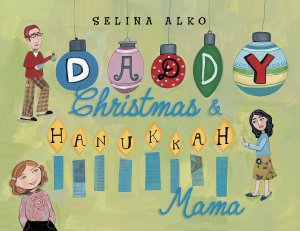
 

Daddy Christmas and Hanukkah Mama, by Selina Alko, (Sept. 2012, Alfred A. Knopf), $16.99, ISBN: 9780375860935

Ages 3-7

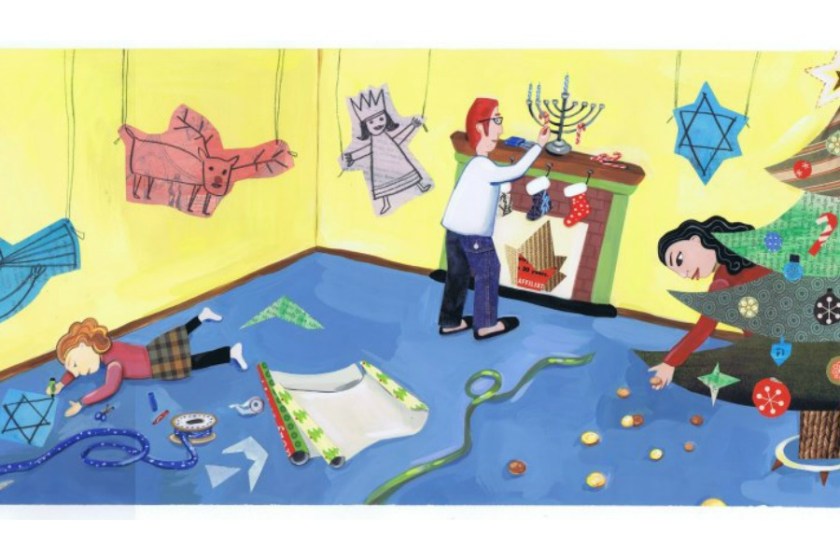
A little girl has the best of both worlds: she’s a “mix of two traditions. From Daddy Christmas and Hanukkah Mama”, in this lovable story about blending holiday traditions. Little Sadie and her family decorate their home for the holidays, leaving latkes out for Santa and hanging candy canes on the menorah, and sing Christmas carols and Hanukkah songs as they go caroling. The last night of Hanukkah is a big night, as Daddy stuffs a turkey with cranberry kugle and Mama makes sweet jelly donuts and fruitcakes for dessert. The families celebrate together, retelling the stories of both the miracle of the oil and the birth in the manger: “Wide-eyed, we listen to these traditional tales, which link us together today”. When everyone’s gone home, the family relaxes together and shares final gifts, getting ready to do it all again next year.

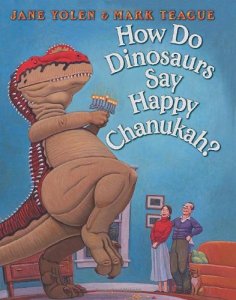
Selina Alko evokes big holiday feelings and childhood excitement here. Her gouache, collage, and colored pencil on watercolor paper artwork is bold and colorful, contributing to the excitement and anticipation of the holidays, and she brings Judeo-Christian traditions together with fun and childlike joy. A timeline at the end of the story illustrates all the holidays Sadie and her family celebrate together, from Hanukkah/Christmas (Kwanzaa gets a mention, but the family here is white) through to Easter and Passover, and Thanksgiving. Endpapers are colorful portraits of Sadie and her parents, and include icons for each holiday: a dreidel and a menorah, a tree and an angel. Inspired by the author and her husband’s decision to integrate each of their religious backgrounds into their home for the holidays, Daddy Christmas & Hanukkah Mama is a lovely addition to holiday collections and storytimes.How Do Dinosaurs Say Happy Chanukah?, by Jane Yolen/Illustrated by Mark Teague, (Sept. 2012, Blue Sky Press), $16.99, ISBN: 978-0545416771
Ages 3-6

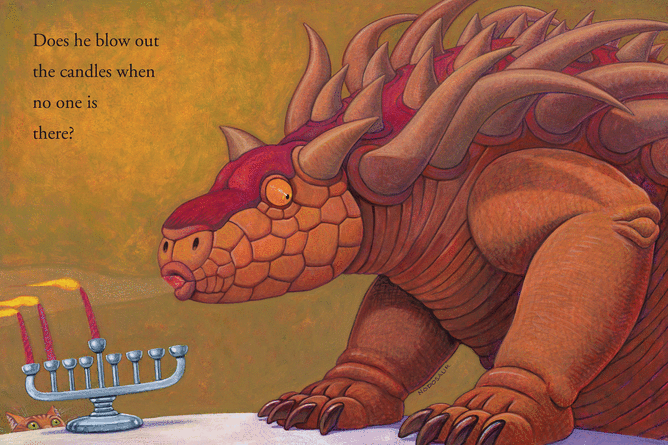
Those misbehaving dinosaurs are here to demonstrate what to do – and what NOT to do – during Chanukah! We see Rugops fuss through prayer and Nodosaurs blow out menorah lights while Ichtyostega writes his own name on everyone’s gift cards and Chirostenotes grabs all the gelt, all while horrified parents bear witness. But we know that’s not really what dinosaurs do when they celebrate Hanukkah. Camarasaurus shows readers that dinosaurs sing every prayer, and Chirostenotes is sharing the gelt and taking turns with the dreidel. Dinosaurs give Bubbie and Zaida holiday kisses, and then head off to bed.

I remember reading the first book in this series – How Do Dinosaurs Say Goodnight (2000) – when my eldest was barely a year old; these books have become a touchstone in kids’ lives, with books to celebrate everything from managing emotions to table manners. Having Dinosaurs celebrate the holidays is just a natural addition to this series. The rhyming pattern is soothing and consistent through each book, and the dinosaurs are always drawn as larger-than-life goofballs having larger-than-life emotions: which is kind of what it’s like, being a kid. Different facets of the holiday get the spotlight, including latkes, gifts, lighting menorahs, and prayers.

Plus, kids love dinosaurs. So, home run. This series does well wherever it lives, so why not add to it?
 

Happy Hanukkah, Curious George, by H.A. Rey and Margret Rey, (Sept. 2012, HMH Books for Young Readers), $7.99, ISBN: 9780547757315

Ages 2-5

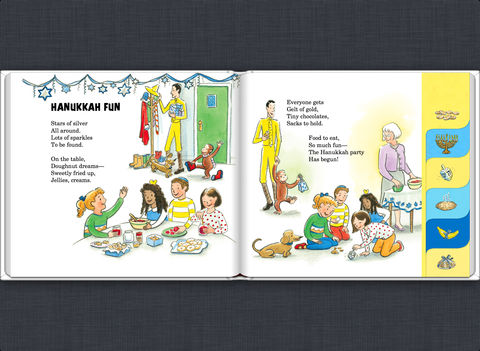
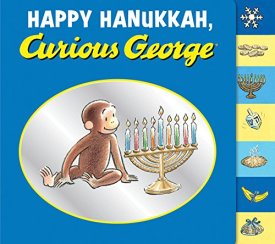
Six short rhyming stories show readers how Curious George and the Man with the Yellow Hat celebrate Hanukkah with friends. Each story, tabbed for little fingers to turn quickly to, looks at a different moment in the eighth night celebration: George and his friend wrap gifts and head out visiting; they arrive and the party begins; the Man in the Yellow Hat (with his hat respectfully off) lights the menorah, George and the children spin the dreidel, George tries to help makes latkes; George and the kids play; and finally, George does a mitzvah by cleaning up and packing up some latkes to take to a sick friend.

Illustrated in the classic Curious George style we all know and love, and with a shiny, silver foil cover, Happy Hanukkah, Curious George is a good add to toddler holiday collections. The book and tabs are in shades of blue and yellow, with colorful Hanukkah symbols on each tab, and Curious George is one of the most recognizable children’s icons in literature. His familiarity will draw in readers, and the rhyming cadence is perfect for storytime reading.

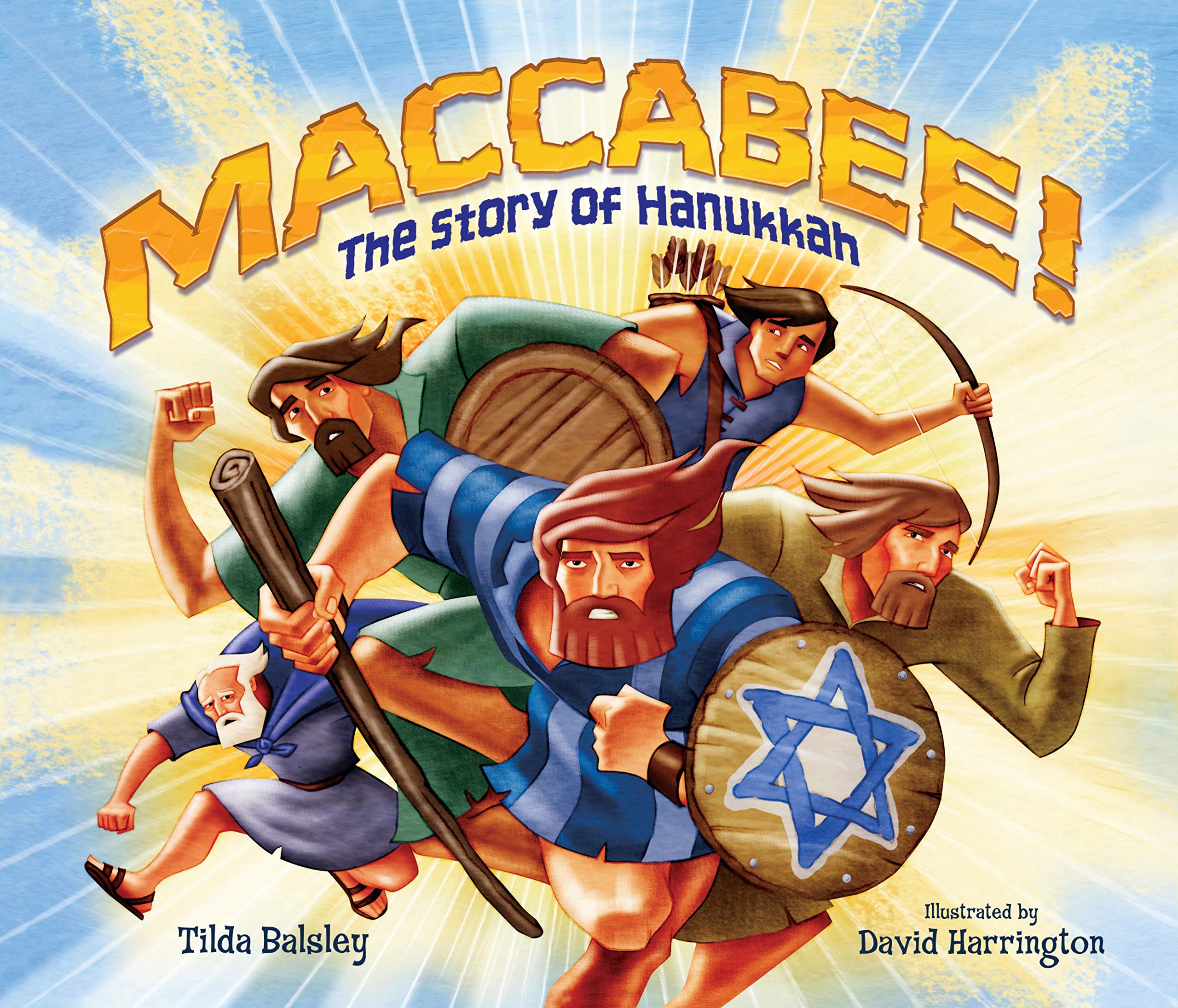
Maccabee! The Story of Hanukkah, by Tilda Balsley/Illustrated by David Harrington, (Sept. 2010, Kar-Ben Publishing), $7.95, ISBN: 9780761345077

Ages 3-7

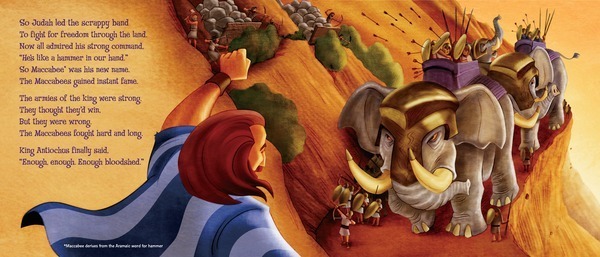
Maccabee! is the historical Hanukkah story, made into a rhyming epic tale for younger readers. The polytheist Greeks and their leader, King Antiochus, weren’t happy that the Jews refused to bow to their gods, and decided to desecrate their holy ground, raise statues of their gods, and force the people into worship. Mattathias, an elder, turned to his sons, his son Judah, in particular, for support in raising a resistance. Judah led his army of Maccabees against Antiochus’ armies until they won, and then lead his people in rebuilding their civilization, devastated by war. An epilogue asks readers what Judah would do if he were alive today, and posits that he’d be pretty happy that his people are still thriving.

This is a very readable, child-friendly history of the struggle behind the celebration of Hanukkah. The rhyme scheme is simple and easily falls into pattern for a readaloud. A repeated phrase, “Sometimes it only takes a few, Who know what’s right, and do it, too”, brings home the message embodied by the Maccabees: see the need to do the right thing, and do it. It takes bravery, it takes strength, and it takes determination; here, the Maccabees model the behavior and inspire readers.

The artwork is bright, with a realistic cartoon feel: think of Judah Maccabee like a buff superhero. The spreads are full-bleed and colorful, with movement across the pages to keep little eyes engaged. Back matter includes a brief backgrounder on the festival of Hanukkah. This one’s a fun addition to holiday collections; it’s more history-based, yet still includes the focus on family that is central to the celebration.

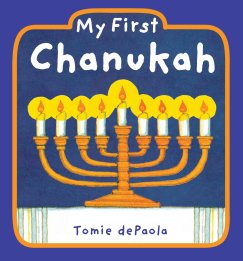
 

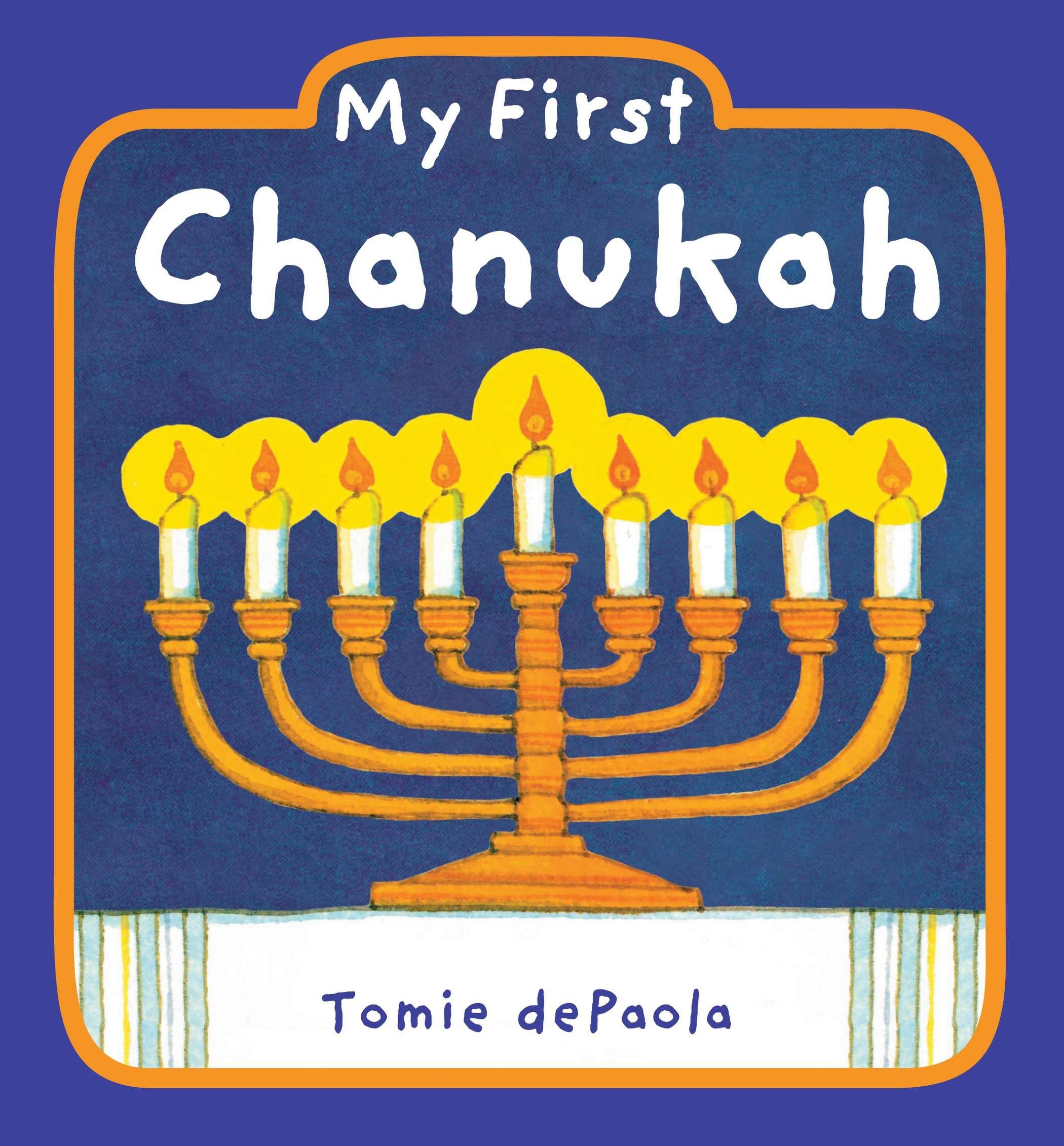
My First Chanukah, by Tomie DePaola, (Sept. 2008, Grosset & Dunlap), $5.99, ISBN: 9780448448596

Ages 2-5

Tomie DePaola has a sweet board book that uses simple language and his immediately recognizable watercolor artwork to explain Chanukah to babies and toddlers. My First Chanukah simply and eloquently explains why families light candles (“to remember Judah Maccabee and his brothers”) and how the menorah is lit each night; he makes sure to cover latkes (“delicious potato pancakes”) and the dreidel, gelt, presents, and songs and prayers. He closes, reminding readers that they’ll celebrate again next year.

My First Chanukah covers the kid-friendly parts of Hanukkah: food, family, goodies, and together time. His illustrations are warm and intimate, with a welcoming glow from the menorahs and a smiley baby with its family. It’s a great pick to have in your board book collections, and a perfect storytime choice for the holiday.


That’s it for my first Hanukkah round-up! I’ve got a few more holds waiting to come in, so I hope to have at least one more post before the holiday is over. Happy Hanukkah, everyone!

Posted in Fantasy, Fiction, Fiction, Intermediate, Middle Grade

More Moomins! The Moomins and the Great Flood

The Moomins and the Great Flood, by Tove Jansson, (July 2018, Drawn and Quarterly), $16.95, ISBN: 9781770463288

Ages 7-12

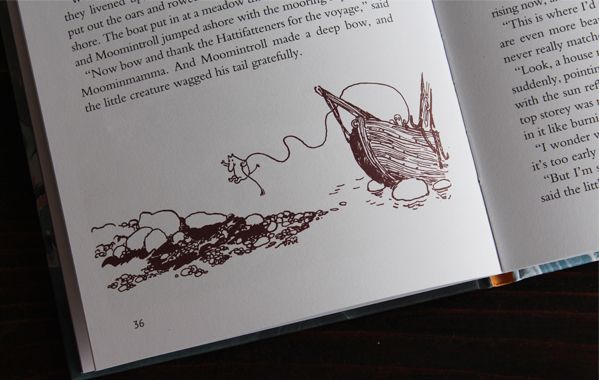
This Moomin tale is an illustated novel, rather than a picture book or graphic novel, and gives us a bit of a Moomin origin story. Moominmama and little Moomintroll are in search of a winter home, and in search of Moominpapa, whose restless nature led him to wander off with the Hattifatteners. As they wander through a precariously dark forest, they meet a small creature who joins their journey, despite being a bit cranky; they also meet a beautiful, blue-haired girl who lives in a tulip. Throughout the arduous journey, Moominmama and Moomintroll face each adventure with courage and kindness, helping every creature they meet, always hoping that maybe… just maybe… their journey will reunite them with Moominpapa.

Originally written during the 1939-1940 Finnish-Soviet Union conflict, The Moomins and the Great Flood was author Tove Jansson’s escape from the horrors of war. She uses a catastrophic flood to unite her characters, who could even be seen as refugees, all experiencing some kind of loss, displacement, or danger from the flood. The sepia and white artwork lends an old-world feel to the artwork, and the prose reads like adventure stories I read growing up. The book is relentlessly optimistic, with moments of near despair; it illustrates perseverance and the strength of family units when facing adversity. I’ll booktalk this with picture books like Nicola Davies’ The Day War Came and the Children in Our World book series.

Posted in Fantasy, Fiction, Humor, Intermediate

The Goblin Princess: Dust that house, and untrain your dragon!

Originally published in the UK, The Goblin Princess is a sweet chapter book series perfect for kids who are ready to branch out from easy readers. Let’s meet The Goblin Princess and her family.

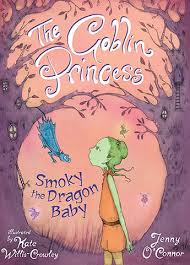
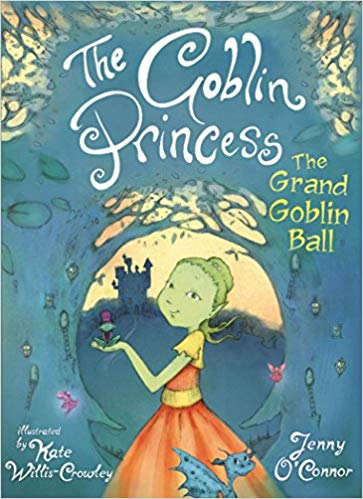
The Goblin Princess: Smoky the Dragon Baby, by Jenny O’Connor/Illustrated by Kate Willis-Crowley, (Oct. 2018, Faber & Faber), $8.95, ISBN: 9780571316588

Ages 7-10

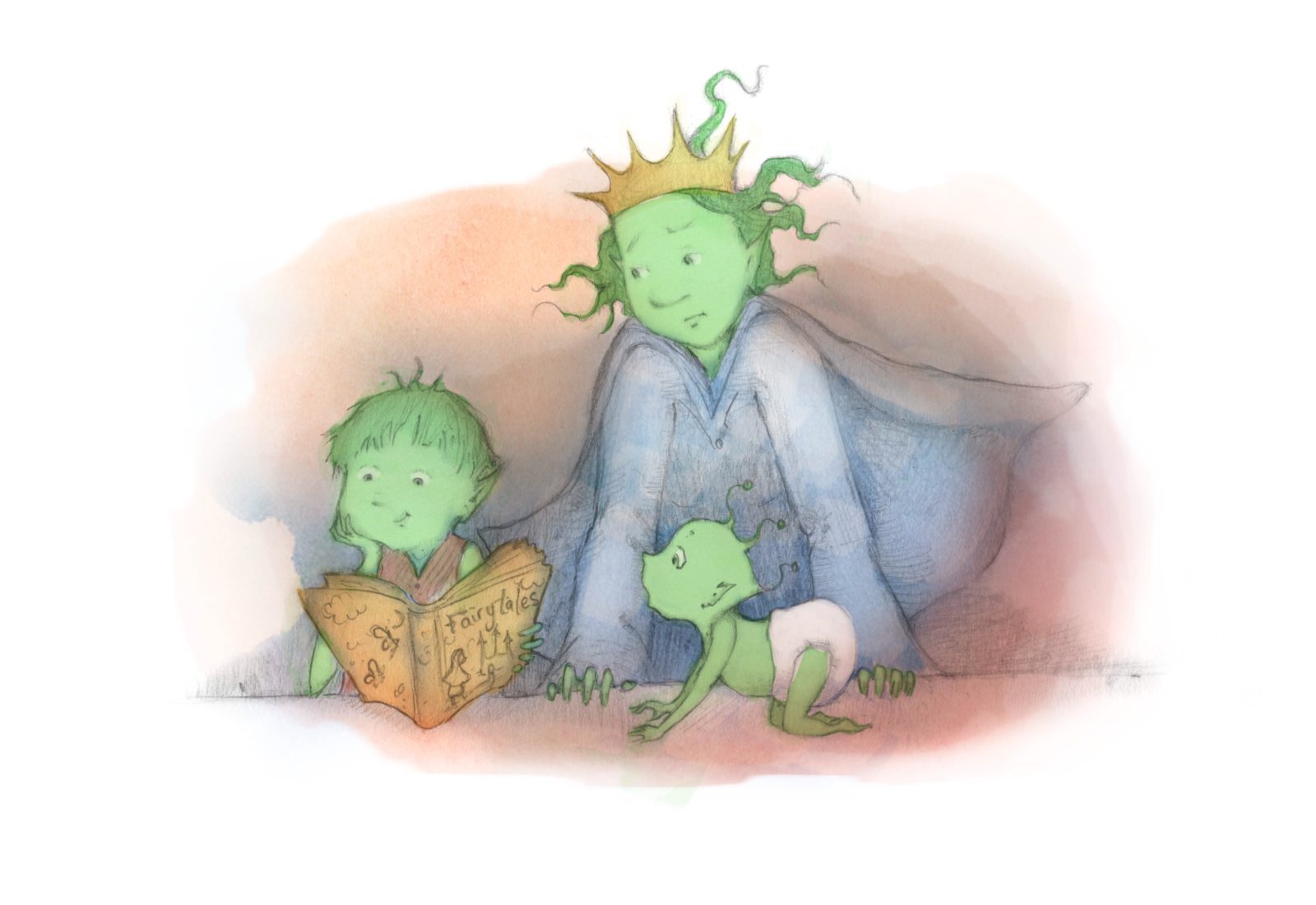
Matty is a goblin princess, but she’s also the odd goblin out in her family. She’s always being told to untidy her room, and eat up her slug porridge; her family – like most goblins – is also terrified of pretty things, like kittens and butterflies, and reading fairy tales are sure to give them nightmares, but Matty just doesn’t fit in. When the family dragon, Sparks, lays an egg and a sweet little blue dragon emerges, Matty falls in love. But little Smoky is polite and sweet, and the untraining her father, the Goblin King, calls for doesn’t quite take. Luckily for Matty, little Smoky finds some talent in burning the toast (a goblin delicacy)! When Matty and her family go on a goblin family picnic at the Dragon Lagoon, Matty and Smoky have a little side adventure of their own, meeting nasty hobgoblins and kind Forest Fairies (who aren’t at all terrifying) – and maybe Matty can convince her family that she and Smoky are just naughty enough after all!

The Goblin Princess: The Grand Goblin Ball, by Jenny O’Connor/Illustrated by Kate Willis-Crowley, (Oct. 2018, Faber & Faber), $8.95, ISBN: 9780571316601

Ages 7-10

The next book in the Goblin Princess series picks up fresh off the heels of Smoky the Dragon Baby. The royal Goblin Family is preparing for the Grand Goblin Ball, but there’s trouble afoot: the hobgoblins are planning to crash the party and CLEAN! And PAINT! And worst of all, they’re planning to capture Smoky! Luckily, some of the Forest Fairies overheard the plot and warned Matty in time. Matty and Smoky join forces with their new friend, Dave – a Frog of Mystery and Magic – to beat the hobgoblins and save the party! Recipes for Scary Potato Faces, Ghoulish Goblin Drinks, and Peppermint Cream Bugs let readers plan a Goblin Ball of their very own!

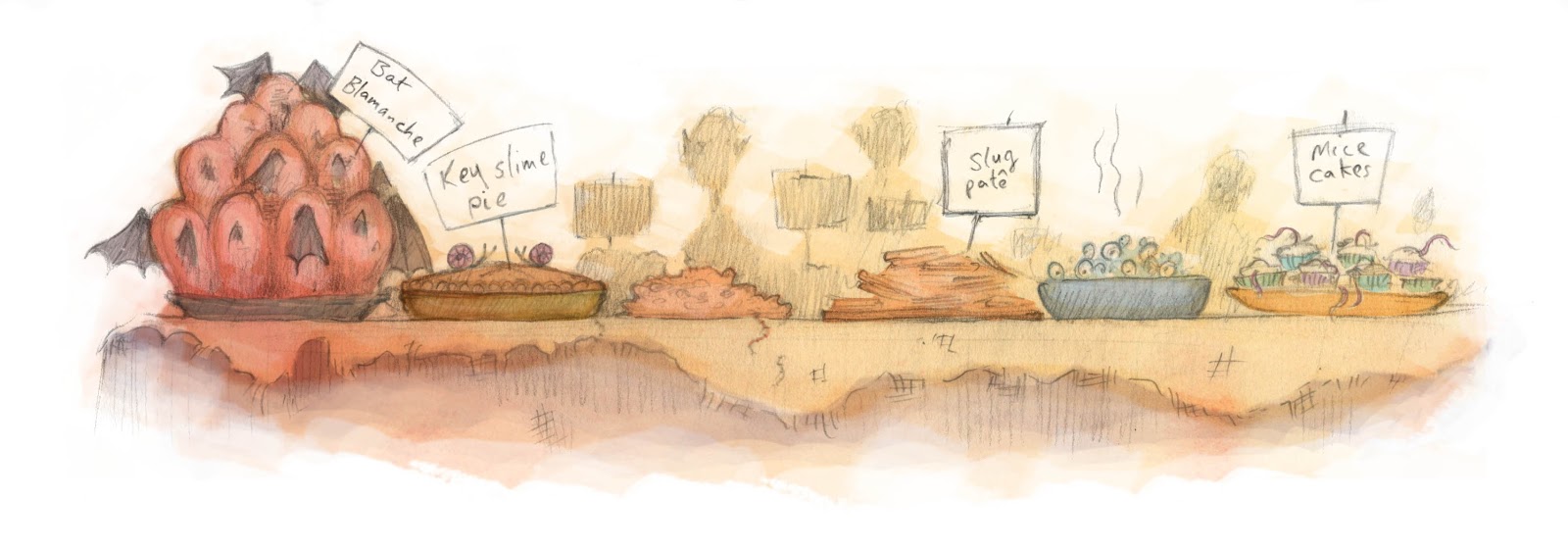
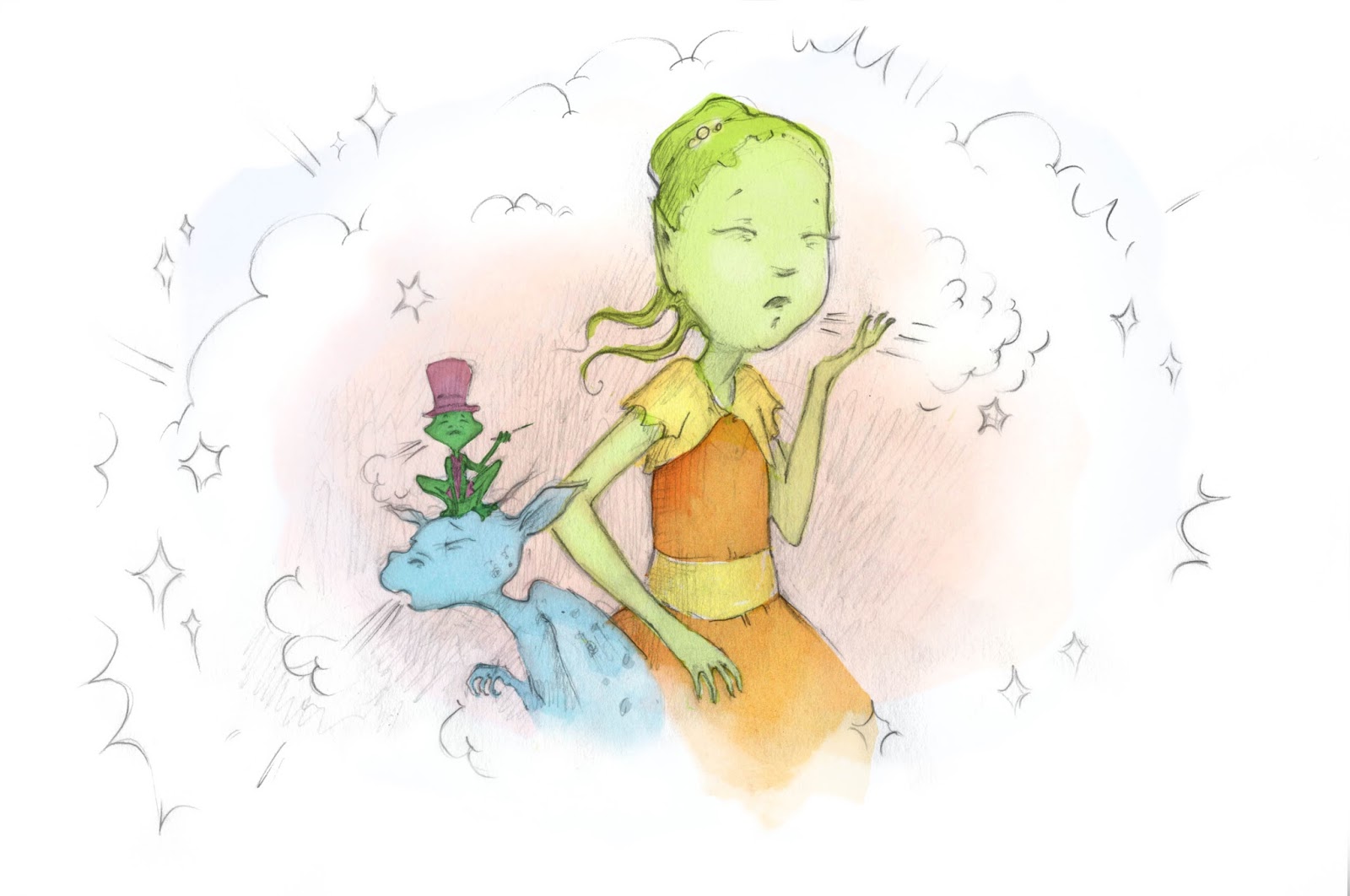
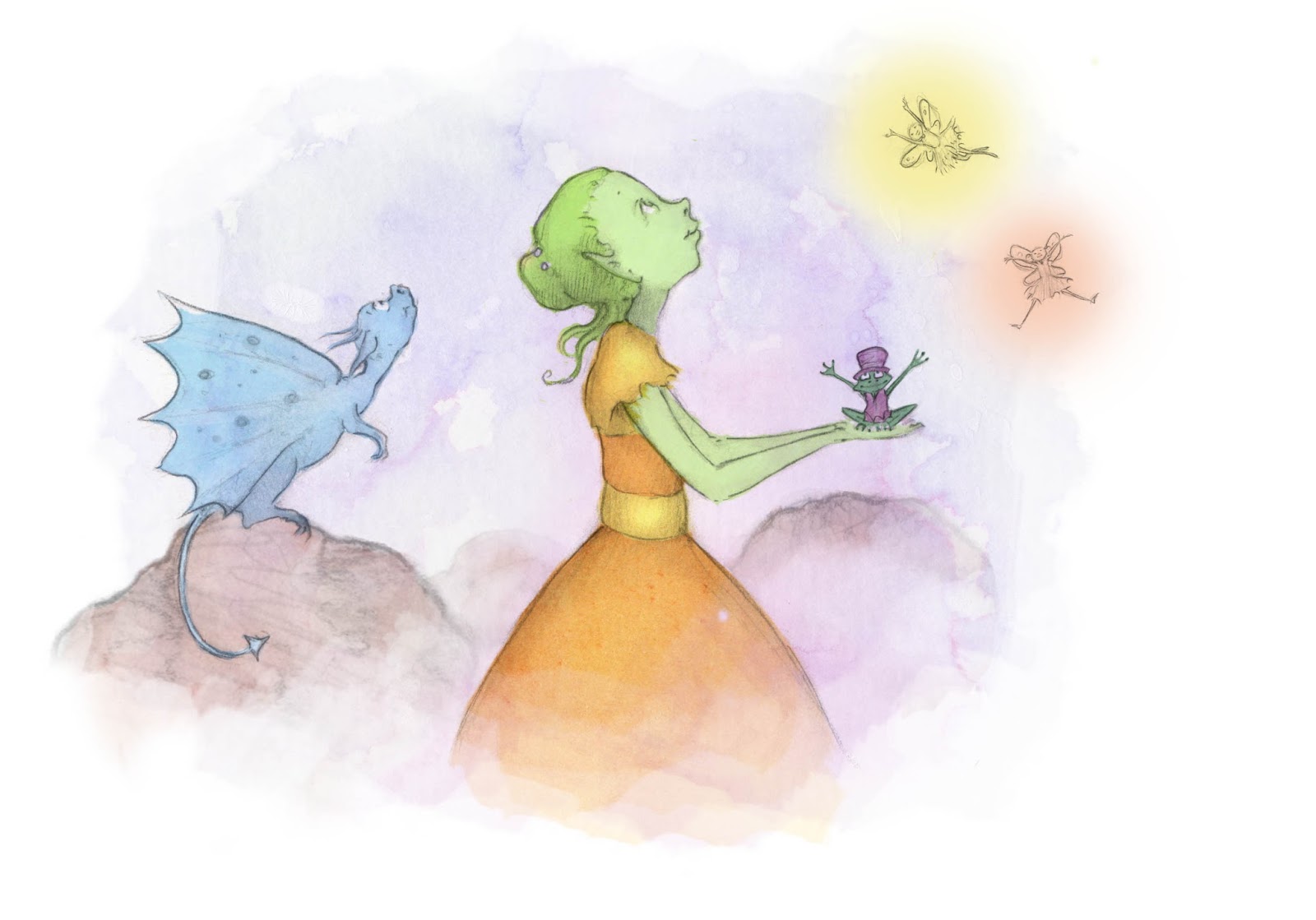
The Goblin Princess books are sweet, entertaining, and upbeat. Kids are going to get a kick out of the backwards world that the goblins live in: messing up your room? Eating sloppily and having food fights? Untraining your dragon and being an irresponsible pet owner? It sounds awesome, right? Which makes poor Matty and Smoky outsiders in their worlds, and sets the stage for some hilarious happenings. Kate Willis-Crowley’s watercolor artwork adds an incredible cute factor to the storytelling, with adorable characters like Smoky the Dragon and Matty the Goblin, and great visuals for events like the Goblin buffet, complete with Key Slime Pie and Mice Cakes.

Pictures all come from Kate Willis-Crowley’s blog.

I enjoyed the first two Goblin Princess stories, and look forward to the third one, The Snow Fairy (it looks like it was just published in the UK… can we get a copy stateside soon?) Readers who love enjoy fantasy will enjoy the close friendship between Smoky and Matty, and get a kick out of Smoky’s baby talk. The bad guys aren’t terribly bad. The hobgoblins, for instance, really just want Smoky around to warm up their food; nothing truly nefarious (unless you count cleaning and painting the Goblin castle: that’s just horrible). Give this to your Unicorn Princesses/Hamster Princess/Princess in Black fans.

Posted in Fiction, Intermediate, picture books

Dad’s Camera explains Alzheimer’s to children

Dad’s Camera, by Ross Watkins/Illustrated by Liz Anelli, (Oct. 2018, Candlewick Press), $16.99, ISBN: 9781536201383

Ages 5-10

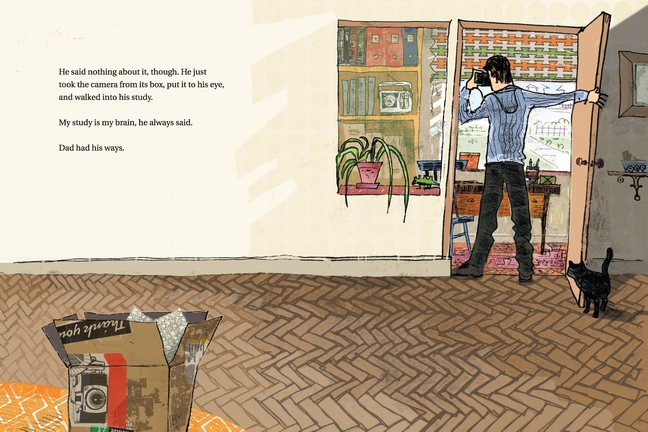
A boy’s father comes home one day with “one of those old cameras, the kind that uses film”, and starts taking pictures of the world around him. The boy and his mother don’t think much of it at first – Dad is doing funny things, like putting tools in the fridge, and milk in the cupboard; it’s what the doctor says will continue happening. As Dad continues photographing everyday objects, the boy and his mother wonder why he’s not taking pictures of them: aren’t they worth remembering, too? Dad just looks puzzled, and makes collages of his developed photos, sticking them on a window. When Dad passes, a package arrives for the boy and his mother: it’s the camera, with one photo left to be developed. The boy and his mother discover a final photo from Dad: a family portrait.

Dad’s Camera is a heartbreaking conversation about a young family struggling with Alzheimer’s, inspired by the author’s father-in-law, who developed the disease when his daughter was a tween. An author’s note explains that Ross Watkins wrote Dad’s Camera to “create a way for children and adults to talk about the confusion often surrounding Alzheimer’s, but also to celebrate the tenderness and small surprises of such difficult times”. Mission accomplished: Dad’s Camera is a series of poignant, small moments that are tender and loving; a bright spot in a family’s dark time. It’s a moving, bittersweet story of loss, grief, and the joy of memory and is a smart addition to your collections. It begins a conversation that is normally reserved for grandparents and elder family members, and provides a comforting strength for families.


Liz Anelli’s incorporates collage, watercolor, mono print, acrylic, and digital color to create a sedate atmosphere for the story, always mindful of details that readers will discover through multiple reads. A bus runs a camera film ad on its side in one spread; in the next spread, the camera arrives in a box with the same photo on the side. The colors are warm, homey, and yet, infused with a sadness and a yearning.

Dad’s Camera was originally published in the UK as One Photo (2016).

Posted in Fiction, Fiction, Intermediate, Middle Grade, Realistic Fiction

Saving Winslow is another hit for Sharon Creech

Saving Winslow, by Sharon Creech, (Sept. 2018, Harper Collins Children’s Books), $16.99, ISBN: 978-0-06-257073-4

Ages 7-12

Louie is a gentle 10-year-old boy with a horrible history of caring for animals: worms, lightning bugs, goldfish, and several bigger animals have all perished or escaped under his care, but when his father brings home a baby donkey, orphaned at birth, from Louie’s uncle’s farm – to care for it until, “you know – until it dies”, Louie accepts the mission. He’s going to save this donkey. You see, Louie was a preemie at birth, and his parents weren’t sure he’d make it, either. Love and determination kept Louie going, and he’s sure that it will keep Winslow – the name he gives the donkey – going. And it does. Winslow struggles, but thrives under Louie’s care, to everyone’s surprise. His new neighbor, Nora, a girl grieving the losses of both her premature baby brother and her dog, is amazed, but pessimistic, warning Louie that Winslow is going to die, and not to get too attached. Louie puts everything into saving Winslow, wishing he could speak to his older brother, Gus, who’s serving in the military, about Winslow, but letters from Gus come few and far between these days, and are always signed “remember me”. As Louie saves Winslow, Winslow may save everyone around him.

Full disclosure: this is my first Sharon Creech novel. Now I get it. I get why she’s a force in kidlit, a multiple award winner, and why her books are always on my library kids’ summer reading lists. She masters feeling and emotion through eloquent, brief prose. I was hers from the opening lines in the book, and I was with her until the last phrase closed the story. I told a friend of mine that Saving Winslow broke me apart and put me back together in the way that Charlotte’s Web did when I read it the first time as a child. Sharon Creech invests readers in every single character in this book, from the baby donkey, to the pessimistic neighbor kid, to the crabby next door neighbor, but we are always focused on Louie and his story. Saving Winslow is a story of hope and perseverance, and it’s a story about the need to believe in the positive. Every library needs a copy of this book – let’s get this one on the summer reading lists, please! – and kids with gentle hearts and sad souls alike will find comfort in it. An absolute must-have, must-read.

Saving Winslow has starred reviews from School Library Journal, Publisher’s Weekly, Kirkus, and Horn Book. Sharon Creech has a Newbery Medal for Walk Two Moons (1995), and received Newbery Honors for The Wanderer (2001). Her book, Ruby Holler (2002), is a Carnegie Medal winner. Her author website offers information and links to her social media, and downloadable reading guides for most of her books.

Posted in Fiction, Middle Grade, Realistic Fiction

Astrid the Unstoppable gives #kidlit a new fiery redheaded heroine

Astrid the Unstoppable, by Maria Parr, (Nov. 2018, Candlewick), $16.99, ISBN: 9781536200171

Ages 7-11

“The Little Thunderbolt”, as she’s nicknamed, Astrid is a 9-year-old girl who lives in the town of Glimmerdal, Norway, with her farmer father and her marine scientist mother, who’s often away on research adventures. She spends most of her days with her best friend, Gunnvald, who also happens to be her 70-something year-old godfather; she also spends quite a bit of time aggravating the mean old Mr. Hagen, who runs a resort – ADULTS ONLY! – nearby, but Astrid can’t be bothered to be upset when he yells at her: she’s got too much living to do! She’s a fun, spunky, free spirit, until Gunnvald has a terrible fall that lands him in the hospital. Secrets are revealed that send Astrid into a tizzy, but not for long: she relies on her new friends to help her set things right.

Astrid the Unstoppable is like the books I read when I was a kid. Classics like Heidi (a book which also plays a part in Astrid), Pippi Longstocking, and Caddie Woodlawn, all seem to have inspired Maria Parr and her beloved Astrid. She’s smart, yet not afraid to be vulnerable; she’s got a wonderfully upbeat personality and view of the world, and she’s not afraid to speak her mind, whether it’s to another child, or an adult who’s behaving badly. She’s got great relationships with most of the adults in the book, and even the ones she doesn’t see eye-to-eye with can’t stay too mad at her. She’s got an infectious personality, in all the best ways.

Astrid the Unstoppable is kidlit done right, and Astrid herself will be a character kids will be reading about in school and on reading lists for years to come. Make sure to add this one to your to-buy lists, and talk up our classic female characters, too: don’t let anyone be left out! Perfect for your more sensitive readers. The book has been translated into 19 languages and adapted for the stage (so why not look into some reader’s theatre with your copies?)


Posted in Fiction, Middle Grade, Science Fiction, Tween Reads

Otherwood mixes time, reality, and a darned good story.

Otherwood, by Pete Hautman, (Sept. 2018, Candlewick), $16.99, ISBN: 9780763690717

Ages 9-14

Stuey is going on 9 and lives with his widowed mom and grandfather, who’s his best friend. His grandfather has such incredible stories to tell about his father; a bootlegger who bought land to create a golf course and who disappeared without a trace one night. Grandpa Zach dies during an awful storm, and Mom locks away the pages of the book he was writing. There are family secrets that Zach is desperate to know about, but he puts that on hold when he meets Elly Rose, a girl his age who’s new to his town. School’s out, and his friends don’t live nearby, so Elly and her amazing imagination sustain Zach – until something happens between their mothers; something neither of them want to discuss. Zach and Elly meet in secret in the woods, at Elly’s “Castle Rose”, where they share stories. One day, though, the unbelievable happens, and reality splits between the friends. Stuey and Elly Rose separately work to find one another and make things right again.

Candlewick’s authors are bringing it this Fall! I’ve been making my way through their Fall list and have been consumed with each book on it. Otherwood is a fantastic story of friendship, secrets, and loss. We have two narratives that work readers through each main character’s struggle to understand what’s going on and how to fix things while peeling away the layers of secrets that engulf their families. There’s some quantum physics and discussion on alternate reality that will interest science and fantasy fans, and the frustration of fighting against ingrained, linear thinking (i.e., adult thinking) will resonate with readers. Can forgiveness bring two worlds back together? Only one way to find out. Otherwood is a compulsively readable novel with likable characters and an incredible story. A definite must-add to middle grade collections, and a great book to give to your fantasy fans that want something a little more based in reality. Or that uses reality as a jumping-off point. This one’s going on my Mock Newbery list. Booktalk this one with your When You Reach Me (Rebecca Stead) fans.

Pete Hautman is a National Book Award winner whose website has links to his author blog, teacher guides, and writing tips. Otherwood has starred reviews from Publisher’s Weekly and Kirkus.


Posted in Uncategorized

Rick Riordan Presents: The Storm Runner, and the Mayan Pantheon!

The Storm Runner, by JC Cervantes, (Sept. 2018, Disney-Hyperion), $16.99, ISBN: 9781368016346

Ages 8-13

The next Rick Riordan Presents book is out! The next Rick Riordan Presents book is out!! I’m as excited as my library kids are, because The Storm Runner has got the GOODS.

Middle schooler Zane Obispo is an ordinary kid. Kinda. I mean, he’s being raised by his single mom, hangs out with his pro wrestling-loving uncle, and loves exploring with his 3-legged dog, Rosie. But he also has his own volcano – there’s a dormant volcano right near his New Mexico home – and he tries to avoid the jerks at school who make fun of him, because one leg is shorter than the other. When a new girl named Brooks shows up at school and tells him he’s destined to release an evil god from the underworld, he thinks she’s crazy: until it really happens. Brooks is a shapeshifter than can turn into a hawk, Rosie is lost to the underworld while trying to protect Zane from a Mayan god who smells like puke, and Zane? He’s the son of another Mayan god. And now, with Ah-Puch unleashed, there’s a war brewing between the gods, including Zane’s father. Zane’s the only one who can put things right, but all he wants to do is save Rosie and leave them to it.

The Storm Runner is SO. GOOD. It’s a brilliant introduction to the Mayan pantheon, for starters. Narrated by Zane, we get some real talk about the awesomeness of a people that worshiped a goddess of chocolate (Ixcacao) and a Mayan giant who likes to tinker and invent things that would make the As Seen on TV people drool. There’s action and adventure, and a strong bonds of family and friendship that run through the book. The worldbuilding is fantastic, with delightfully gross descriptions of gooey, oozing gods and poisoned meatballs. There are key elements that fantasy fans will look for and love: the bonds of family and friendship, a strong sense of humor, and a disabled character who discovers the true nature of his disability as a source of power. (In Percy Jackson, kids with ADHD were descended from the Greek gods. Here, Zane’s leg is directly linked to his heritage, and the reveal is outrageous and fantastic.) There’s a glossary of Mayan terms, including pronunciation help.

Look at Irvin Rodriguez’s cover! That artwork is incredible! Want a program-in-a-book idea? Scholastic has some good activities; there are Mayan gods coloring pages. and The British Museum has good ideas. Spice up your library programming or ELA/History lessons!

This trend of exploring cultures through different pantheons is such fun and such a great learning experience. Give this to your Percy Jackson/Kane Chronicles/all the Riordan fans; your Aru Shah fans, your Serpent’s Secret fans – all your action, adventure, and fantasy fans. See what else is coming from Rick Riordan Presents here, and check out award-winning novelist JC Cervantes’ website here. The Storm Runner has starred reviews from Booklist and School Library Journal.

Posted in Intermediate, picture books

The Day War Came, by Nicola Davies and Rebecca Cobb

The Day War Came, by Nicola Davies/Illustrated by Rebecca Cobb, (Sept. 2018, Candlewick), $16.99, ISBN: 9781536201734

Ages 6-9

A brown-skinned girl with black hair has breakfast with her parents and baby brother, sits at her desk at school, singing songs about tadpoles and learning about volcanoes, when war comes to her world. In an instant, everything she knows, everything she loves, is gone. She begins an arduous journey on foot, by truck, by bus, and by boat to a strange, new place; searching for a place where war can’t reach, she only encounters closed doors and hard faces. Even a school turns her away, telling her there are no chairs for her. As she loses hope, a boy finds her and brings her a chair so that she can come to school; his friends have brought chairs, too, so all children can come to school. Together, the children provide support for our protagonist, “pushing back the war with every step”.

This book is heartbreaking. The artwork, so childlike in itself, makes it even more powerful: the hunched over girl at her desk, braids blown back and artwork flying off her desk as the giant gray-black cloud envelops the facing page; the girl on her knees at the rubble of her home; the girl huddled under a blanket in an empty hut, turned away from a school for want of a chair. the our realization that she is the only survivor of that happy family eating breakfast together is almost too much to take. The pencil and watercolor art is stunning, using grays and blacks to communicate the horror. Orange flames compete with orange flowers in a destroyed city landscape. And the quiet gift from one child to another brings with it new color: green seats, red seats, blue and white striped seats. Color becomes hope.

The Day War Came is a poem Nicola Davies wrote after reading about a refugee child denied entry to a school because there was no chair for her. This gave birth to the #3000chairs movement, where thousands of people posted photos of empty chairs in solidarity with these children who had lost everything, including a chance at education. Nicola Davies’ poem is eloquent, heartbreaking, and ultimately, hopeful. Writing in the child’s voice brings home the impact of war on children.

She never names the child, nor does she name the child’s country of origin. The child is any refugee child from any number of countries where children are forced out of childhood far too soon. As the author says in her 3000 Chairs blog post, “In an ideal world there wouldn’t be children without parents. In an ideal world hospitals wouldn’t be bombed because they looked a bit like something else. In an ideal world everything would be sweet and smooth and we could all afford to be as selfish as we liked and it wouldn’t matter.”

An important addition to all collections. The Day War Came has a starred review from Booklist. There is a downloadable free discussion guide available through the publisher.