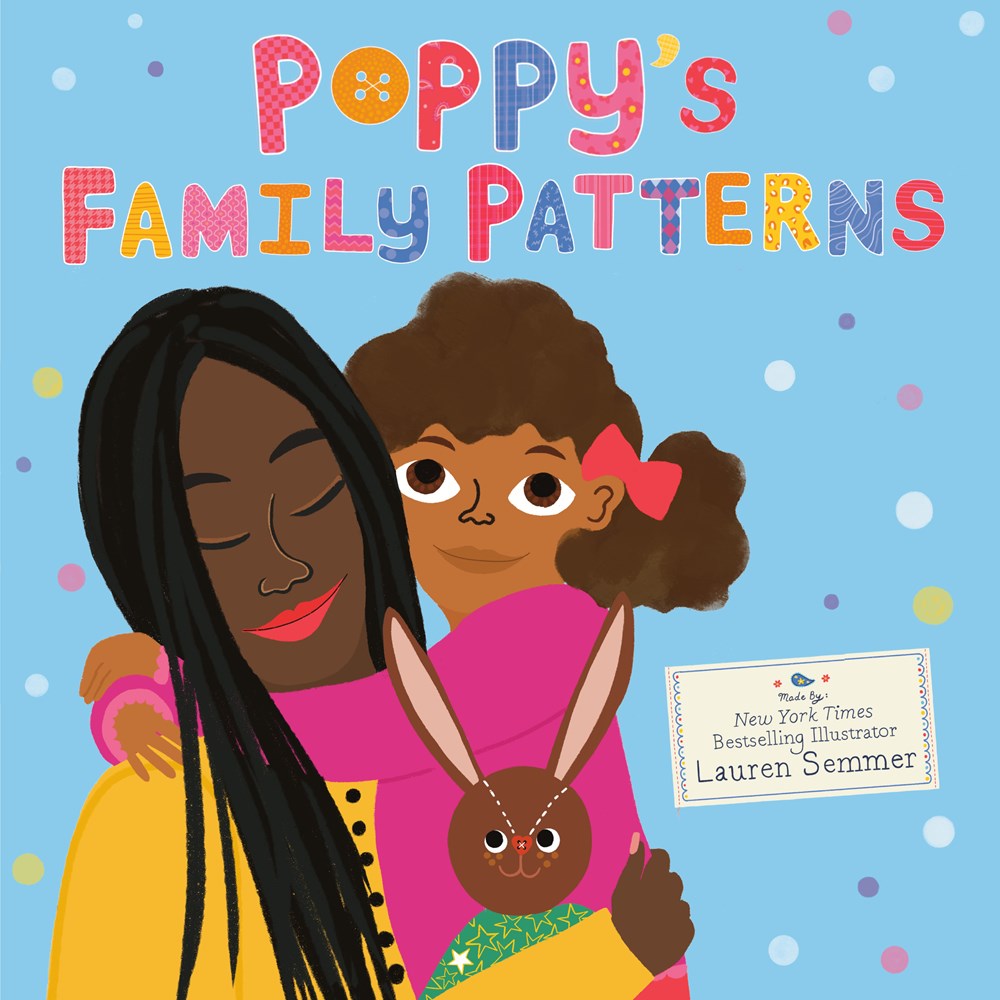
 Poppy’s Family Patterns, by Lauren Semmer, (June 2024, Crown Books for Young Readers), $18.99, ISBN: 9780593710609
Ages 4-8
A little girl learns about the patterns connecting her family when her doll’s dress tears during playtime. Poppy is distraught when Bunny’s dress is torn, but Mom has a cache of fabric scraps ready for the rescue. Going through the scraps, she tells Poppy about a special memory attached to each: a piece of Poppy’s grandfather’s tie; a swatch of Poppy’s father’s t-shirt; even a bit of Poppy’s mother’s wedding veil! As Mom recalls her happy memories, Poppy remembers, too; through the fabrics, Poppy thinks of how fabric patterns come together, just like her family. Mom has a special project for both Poppy and Bunny, bringing everything full circle. By illustrating that tactile memories are just as substantial as, say, browsing a photo album, Semmer tells an intergenerational story of family and connectedness. Memories encompass all the senses, as Poppy recalls the smell of cherry tomatoes in her grandmother’s garden, the fuzziness of chevrons in her aunt’s scarf. Readers can spot each pattern within the memory, like dancing inside a paisley curl with her grandfather or the gate of her grandmother’s garden maching her grandmother’s dress. Semmer also addresses throwaway culture by focusing on repairing Bunny’s dress; by having a box of swatches with which to create and repair clothing, rather than discarding something for being torn. Digital collage illustrations look quiltlike, pieced together with vibrant colors and bold lines. Endpapers show a variety of sewing materials and a pieced together quilt; back matter includes a pattern library with labeled fabrics and an author’s note. Poppy and her family are brown-skinned, with different pigmentations. Under the book jacket, the hard cover shows a series of Poppy’s memories. A moving story about time well spent and memory.
Visit Lauren Semmer’s author website for free downloadable goodies, and more information about her books.

 Mom Read It