Posted in Espionage, Middle Grade, Non-fiction, Tween Reads

Can You Crack the Code? makes codebreakers out of your readers

Can You Crack the Code? A Fascinating History of Ciphers and Cryptography, by Ella Schwartz/Illustrated by Lily Williams, (March 2019, Bloomsbury USA), $21.99, ISBN: 9781681195148

Ages 10-13

Three years ago, I held a great, week-long Spy program at my library for Summer Reading. The kids went berserk for it; I had a blast planning and running it, and books like Can You Crack the Code? make me think it might be time to hold a program like that again. Ella Schwartz has come up with a nice history of codes, code names, and cryptography for middle graders, with loads of pictures, informative sidebars, and activities to keep readers on their toes. Famous moments in cryptography history include the Caesar Cipher, invented by Julius Caesar, the Arnold Cipher, used by the infamous Benedict Arnold, and the Enigma machine, used by the Germans during World War II; the machine that gave them the upper hand until a team of British codebreakers at Bletchley Park finally broke the code (shout-out to computer scientist and codebreaker Alan Turing). Want to know why you have to generate a strong password, obnoxious as it may be? Check out the “Can You Hack the Bank?” activity and you’ll be changing all of your passwords. A final challenge has readers going through the book to solve one last cipher. There’s a comprehensive bibliography and the book is indexed, making this a nice volume to have on your shelves.

Display this with the Book Scavenger series, the Mr. Lemoncello’s Library books, the Secret Coders graphic novels, and – naturally! – the Girls Who Code books, both fiction and nonfiction. Brightly has a good post on fiction with puzzles and codes.

Now, if you’ll excuse me, it’s time to revisit some of my old Summer Reading plans… I know this year’s theme is A Universe of Stories; maybe I’ll just use some codes to send them into space! Great escape room ideas in here, too. All around fun for your brain-teaser-loving readers.
Posted in Middle Grade, Non-Fiction, Non-fiction, Tween Reads

Makers… Get Tinkering!

Forgive the stretch between updates, all; I’m home this week, with my little guy, who’s on Midwinter Recess. He’s currently got a Lego stronghold of army men fighting across two rooms, so I used the break to get some writing in.

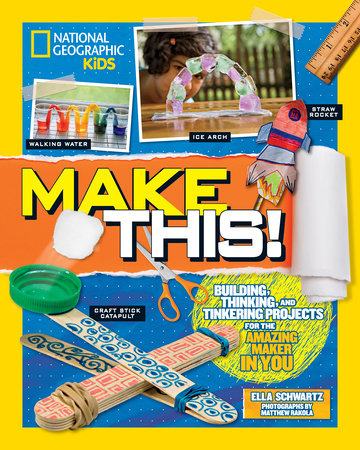
Did you know that this week is National Engineers Week? It is, and with many of us facing looming Science Fair deadlines, I’ve got a book for you. NatGeo, lifesaving publisher of all the things my own kids and library kids have needed for reports and projects, now has a book called Make This! Building, Thinking, and Tinkering Projects for the Amazing Maker in You

Make This! Building, Thinking, and Tinkering Projects for the Amazing Maker in You,
by Ella Schwartz/Photos by Matthew Rakola,
(Feb. 2019, National Geographic Kids), $16.99, ISBN: 9781426333248
Ages 8-12

This is a perfect book to start off a basic maker program, or a book to add to an already robust program. Most of the materials needed are already in your home: I did three projects today with my first grader! (Pencil Pusher, Silly Noisemaker, and Kazoo, if you’re curious.) The basics of tinkering are here; you can take all of these projects to different levels with questions about the process of making and considering results (we talked briefly about the scientific method as we made predictions about using pencils as wheels, for instance, to propel a pile of books across a table).

Projects are broken down into 8 areas: Simple Machines; Materials; Systes; Optics; Energy; Acoustics; Forces; and Motion. Each area has a spread explaining the concept, followed by several projects further exploring each area. There are questions to consider, fast facts, a list of materials, and a step-by-step of what to do to complete your project. Each project also has a difficulty level and maximum number of people to work on each project.

A foreword explains the nature of making, and sections on makers and makerspaces assure every kid that there is no “maker profile”: you make something, you’re a maker! There are some handy suggestions on materials to keep handy if you want making to be a regular activity in your home, library, or classroom, and there are some spreads dedicated on using the book and starting with a toy challenge. Safety is always paramount, so there’s cautionary messages about having an adult nearby to help out; really, we’re just window dressing, though: kids can easily make these great projects. Afterwords have some info on more complex, advanced making (3-d printers and robotics), and introduce readers to real-life makers: scientists, conservationists, and photographers are makers, too!

This one is yet another win for my Science Projects section and a guaranteed “program in a book” add to my STEM shelf.