Posted in picture books, Preschool Reads

Interrupting Chicken discovers The Elephant of Surprise!

Interrupting Chicken and the Elephant of Surprise, by David Ezra Stein, (Sept. 2018, Candlewick), $16.99, ISBN: 9780763688424

Ages 4-8

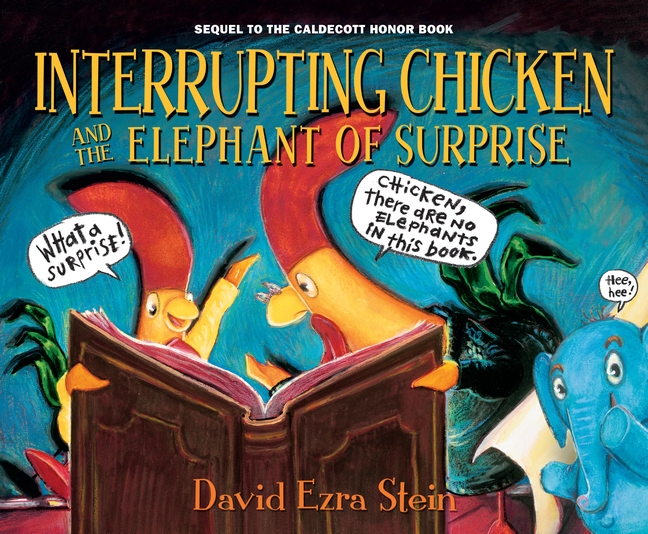
The current storytime favorite in my home is the newest one from David Ezra Stein! Interrupting Chicken and the Elephant of Surprise is the follow-up to 2011’s Caldecott Medal winner, Interrupting Chicken, and reunites readers with the dynamic duo of Chicken and his dad. In this outing, Chicken has learned about a valuable literary tool: the elephant of surprise. Papa tries to correct him, telling him that he must be referring to the element of surprise, but Chicken knows what he heard. He and Papa turn to the books for proof, and sure enough, through three classic fairy tales and one of Papa’s own stories – drawn by Chicken, naturally – darned if that elephant doesn’t show up at the most hilarious moments!

Interrupting Chicken and the Elephant of Surprise is laugh-out-loud hilarious. My 6-year-old and I cackle through each reading, especially when the delicious moment of suspense arises. We read the fairy tale excerpt. I give him the side eye as I linger over the page. He giggles uncontrollably, turns the page with me, and…

Just like that.


There’s everything to love about this story: the so-familiar feel of the dialogue between caregiver and child (especially when that child is convinced they are right), the fun of playing with language and following a kid’s thought pattern through storytelling, and the vibrant, fun artwork throughout the book, especially the handwriting dialogue fonts and the drawn-in, colorful elephant inserting itself right into those fusty, bland-colored classics.

Add this one to your shelves, right next to its companion book, Interrupting Chicken. It’s essential bedtime, storytime, anytime reading for kids, and would make a fun surprise guest in a creative writing program or ELA class. I think I may have to add this one to my Mock Caldecott list for 2018.

Interrupting Chicken and the Elephant of Surprise has starred reviews from Publisher’s Weekly, School Library Journal, and Booklist.

Posted in Teen, Young Adult/New Adult

When Elephants Fly digs deeply into trauma and healing

When Elephants Fly, by Nancy Richardson Fischer, (Sept. 2018, Harlequin TEEN), $18.99, ISBN: 9781335012364

Ages 14+

Lily is a high school senior with a plan: she’s going to avoid stress, drugs, booze, and romantic entanglements; anything that can trigger a stressful episode. She’s in a race against time, because the odds are against her: her mother, and women in her family, have all developed schizophrenia. Schizophrenia most commonly manifests between the ages of 18 and 30, so for the next 12 years, Lily’s on guard. She even has her best friend, Sawyer, give her psych quizzes to catch any developing symptoms. Lily’s mother stopped taking her meds when Lily was a child, and during one episode, tried to kill Lily; she later committed suicide in prison, and Lily, who’s still dealing with the trauma, is getting no help from her father, who won’t discuss Lily’s mother or the incident.

Lily’s on a journalism internship when she witnesses the birth of a new elephant calf at the local zoo. When the calf’s mother tries to kill her calf, and a story goes out with Lily’s byline, she’s stuck with the story – and the fallout. A traveling circus enacts a claim on the calf, and the zoo director is furious with Lily’s betrayal. Swifty bonds with Lily, but the calf’s grief puts her health at risk. Lily’s determination to save Swifty is at odds with her resolve to stay away from stressful situations, but she’s committed to the calf.

Nancy Richardson Fischer brings together a fantastic amount of elements to create When Elephants Fly: trauma; mental illness; the animal captivity debate, and journalistic integrity, for starters. Lily is a fascinating and complex character; she may not always be sympathetic, but she is empathetic. She’s not always likable – she’ll admit it – but readers will always feel for her, because she’s facing down a very real monster and fighting it every step of the way. Swifty is as a strong supporting character in the book, too; she brings out the vulnerable, human side of Lily that she tries to push down. Before Swifty, Lily seems determined to barrel through the next 12 years as mildly and quietly as possible: Swifty makes her engage with her surroundings and with people other than Sawyer.

When Elephants Fly is a strong, moving story that allows for big discussions. A must-add to YA collections; a must-read for caregivers and educators that know tweens and teens dealing with trauma.

Posted in Animal Fiction, Early Reader, Fiction, Preschool Reads

Sugar and Spice and everything… Candy Pink?

candy-pink-coverCandy Pink, by Adela Turin/Illustrated by Nella Bosnia, (Nov. 2016, NubeOcho), $15.95, ISBN: 978-84-944446-7-8

Recommended for ages 5-8

A classic written 40 years ago with the goal to promote equality between boys and girls arrives in the United States for the first time. Candy Pink is written in the style of a folk tale, explaining how elephant all became gray. You see, male elephants were always gray, but female elephants were candy pink. To get that color, they ate only peonies and anemones, wore bibs and shoes, and stayed together in a little walled garden, while the boy elephants playing in the mud, eating yummy grass, and sleeping beneath trees. When one little elephant named Daisy doesn’t turn pink, her father is harsh and cruel, her mother, sad. They pressure her to eat more pink food and threaten her by telling her no one will want to marry her. When they finally give up, the girl elephant embraces her freedom, sheds her bib and shoes, and enjoys life – something that doesn’t go unnoticed by the other female elephants. And, well… you can’t tell the difference between boy and girl elephants anymore, can you?

I was taken aback the first time I read Candy Pink, because it seems harsh on a young girl: the emphasis on appearance and girlish pursuits, Daisy’s parents’ terrible reaction to her inability to fit their mold for her. A second reading put more in perspective for me – the little elephant embraced her uniqueness and wasn’t ostracized for it – the other female elephants flocked to her, and made a huge change that exists to this day. It’s a powerful little story for school-age kids that lends itself to some pretty big ideas. Originally published in Italian in 1976 with the title Rosaconfetto, Adela Turin tackled gender identity and the pressure society puts on appearances by using a parable that everyone could understand and that young girls could relate to. Forty years later, Candy Pink is just as relevant.

Award-winning illustrator Nella Bosnia’s artwork is beautiful. She uses shades of gray and pink against muted background colors for the world of the story; primarily greens, blues, and yellows for the assorted flora and fauna. The bibs, shoes, and bows on the elephants tails are frilly and exaggerated, even pinker than the pale pink elephants; against Daisy’s natural gray, it’s a true contrast.

An interesting and still-timely look at gender, society, and the expectations parents put on their own children. A good addition to bookshelves. Booktalk and display with self-esteem boosters like Karen Beaumont’s I Like Myself!, Peter Reynolds’ Ish, and Todd Parr’s It’s Okay to Be Different. Want another elephant fairy tale? Emma Dodd’s Cinderelephant is a light-hearted, fun take on the classic fairy tale.

Posted in Intermediate, Non-Fiction

This Fall, Natumi Takes the Lead!

natumiNatumi Takes the Lead, by Gerry Ellis with Amy Novesky, (Nov. 2016, National Geographic Kids), $16.99, ISBN: 978-1-4263-2562-5

Recommended for ages 4-8

I completely dropped the ball on World Elephant Day last week; I was away with Husband and my brain was on vacation. I’m so sorry, because in addition to my loving elephants, I wanted to let you all know about a great book that’s coming out from NatGeo Kids in early November.

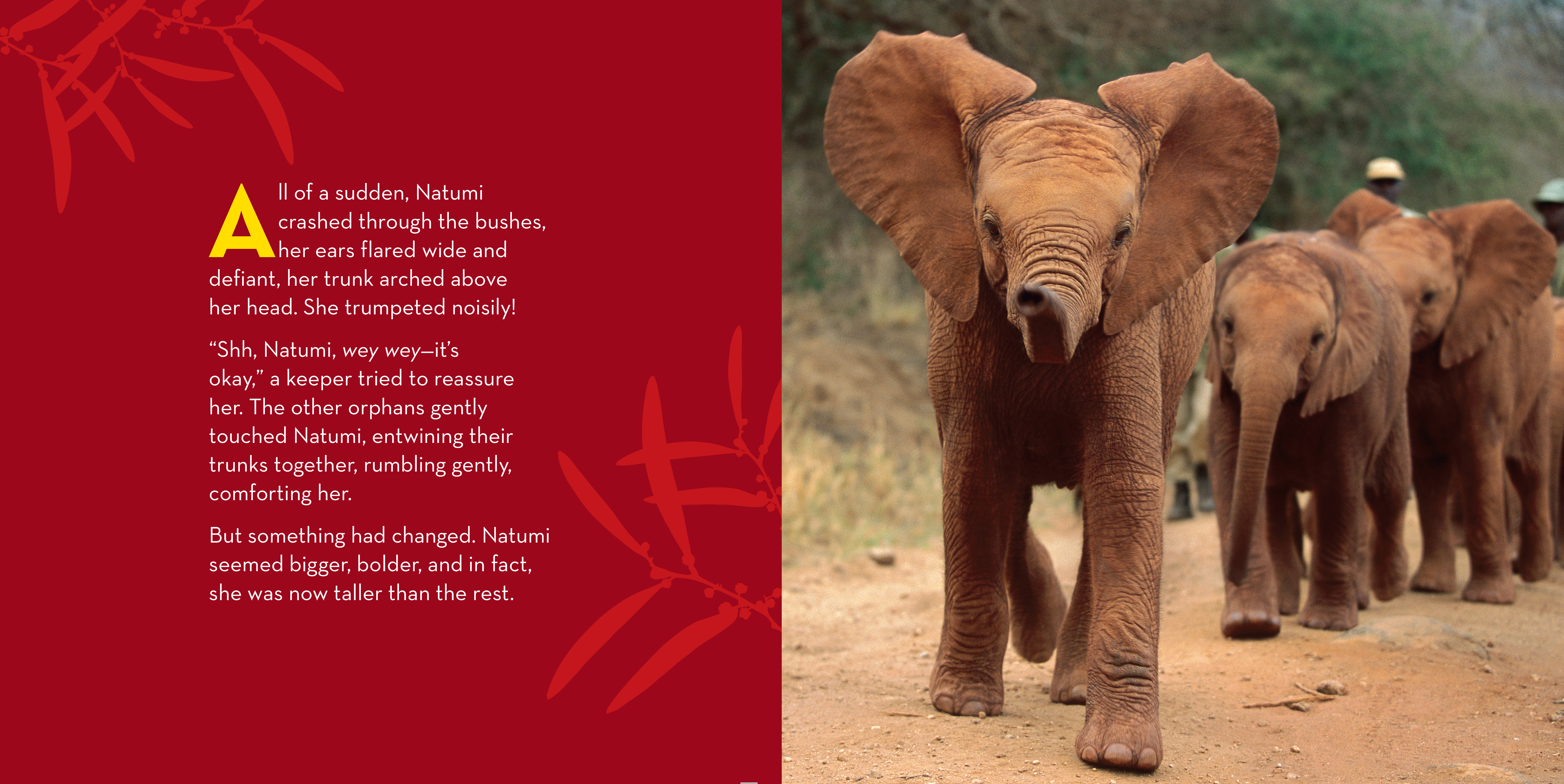
Natumi Takes the Lead is the true story of a young elephant who was orphaned, rescued by a farmer and sent to an orphanage. Sounds like a Disney film, right? But it’s so much  more than that, because this story happens too often. Poachers and hunters still slaughter elephants for their ivory tusks or for big game trophies, leaving young elephants, like Natumi, to fend for themselves.

Pages 3-4

Natumi is also a powerful story of a shy elephant who gains the confidence to become the leader of her new little family group. With the love and nurturing she receives from her rescuers at the orphanage, she gains confidence and takes the lead in bringing her new family back to the wild: a protected African preserve.

Pages 20-21

I first discovered Natumi at PLA earlier this year, and fell in love with the beautiful photos and the elephant’s story. NatGeo has a way of making these animals more realistic than any animated movie character. NatGeo, through beautiful, empathetic writing and photography, brings out the personalities of the world’s animals, and their stories motivate readers to take action. The best part is that NatGeo tells kids HOW they can take action: by learning more about their world, and providing resources to help kids do just that.

Resources at the end of the book include a map of Natumi’s home and where the elephant’s live in Africa; lists of organizations, websites, and books; facts about elephants, and an infographic on elephant growth, to give readers a frame of reference about Natumi’s age and size when she was orphaned and where she’ll be as she ages.

Natumi isn’t due out until November, but it’s a great addition to your younger nonfiction sections, and a great book for young animal lovers.