New Dark Ages, by Warren Kinsella, (Dec. 2018, Dundurn), $14.99, ISBN: 9781459742154
Ages 16+
The second book in Warren Kinsella’s X-Gang series, while set in the ’80s, sees the rise of a candidate that’s eerily familiar: Earl Turner is an all-American guy running for President on a “White is Right” platform, and the country seems to be eating it up. His numbers are going up, his rallies are teeming with supporters, and, most distressing to Kurt Blank and the rest of the X Gang, their former drummer, Danny Hate, is right smack in the middle of it. He went “conservative” after incidents from the first novel (Recipe for Hate, 2017), but to be showing up at political rallies as Earl Turner’s right-hand man? Meanwhile, dead punks are being discovered in cities right after the Nasties’ – the X Gang’s band – shows, and Kurt’s drug habit is starting to become a problem.
Set in the ’80s, New Dark Ages is a reminder that we haven’t come as far – or is it fallen as far? – as we thought we may have. Earl Turner has that jock appeal that went over so well at the time, with the current administration’s open malice for anyone not like him. The narrative tends to jump around a bit, though, and while there’s some good punk culture fiction happening here, along with potentially interesting political intrigue, there are too many balls in the air to keep a cohesive storyline in play.
Is New Dark Ages YA? Not necessarily, but it’s got crossover potential. The characters are in the age range, and confronting issues that will most definitely affect their futures. It’s an additional purchase if you’ve got readers interested in punk culture (including us Gen X readers who were around at the time) and politically charged fiction.
One great thing about being able to have my own little corner of the blogosphere is discovering all these great, smaller publishers I may never have discovered before. I hope that by sharing these books, authors, and publishers with you,that you enjoy discovering them, too.
Everton Miles is Stranger Than Me is the sequel to 2014’s The Strange Gift of GwendolynGolden. It’s the continuing story of a teenage girl who discovers that she’s got an incredible gift – but there are always strings attached, and being able to fly comes with some pretty big strings. It’s a fun tale of magical realism, family, and friendship, and you don’t need to have read the first one to pick up the second; the book fills you in on the basics that you need to know to enjoy the story. I enjoyed visiting Gwendolyn, Everton and their friends; they’re characters you genuinely like and want to see good things happen for them. The supporting characters are all strong and empathetic; I especially love Gwendolyn’s headstrong younger sister, Christine.
If you’ve got readers who enjoy a little bit of magic in their daily lives – Rebecca Stead’s When You Reach Me is a great read-alike here – add the Night Flyers series to your bookshelves.
Everton Miles is Stranger Than Me, by Philippa Dowding, (Oct. 2016, Dundurn Press), $9.99, ISBN: 9781459735286
Recommended for ages 10-14
I was lucky enough to have author Philippa Dowding put together a fun Q&A for this post. Read and enjoy!
The 5 Questions No One Has Asked Me About This Book – Yet!, by Philippa Dowding
1. What’s your new book about? Everton Miles is Stranger than Me (Dundurn Press), is a sequel to my 2014 title, The Strange Gift of Gwendolyn Golden, which was nominated for the OLA Red Maple award in 2015. In the first book, Gwendolyn, my 14-year-old protagonist, wakes up one morning on the ceiling of her bedroom, which is odd, but doesn’t particularly shock her. Floating around is just another weird thing that seems to be happening to her during puberty. As the story develops, however, she realizes she’s part of a larger community of Night Flyers, and that her dead father was a Night Flyer, too.
In the new sequel, I pick up where we left off: Gwendolyn has one year to decide whether or not she will become a Night Flyer forever. As she enters grade nine, she has all the problems of a regular teenager, PLUS she’s also part of this magical community of Night Flyers, which imbues everything with a sense of wonder, and a little darkness too, frankly. Everton Miles shows up at the beginning of school, a grade older, much cooler than her, and surprise, surprise … he’s a Night Flyer, too! The two mismatched teenagers are thrown together, and as Gwendolyn discovers more about the death of her father, she and Everton have to face Abilith, a fallen Rogue Spirit Flyer, kidnap, and the unspeakable horror of the Shade, together. Gwen discovers that with the help of Everton Miles, her community, and The Night Flyer’s Handbook, she might actually survive grade nine!
2. The series is called The Night Flyer’s Handbook. Why did you choose that as a series name?
Part of the new story is built around an 800-page book, The Night Flyer’s Handbook, that Gwendolyn’s mentor, Mrs. Forest, hands her. It’s quite hilariously the exact opposite of the flimsy 3-page brochure for the Less-than-Willing-Reader that Gwen received in book 1, (which ended up being entirely unhelpful). The much larger Handbook is intended to help her understand her new life as a Night Flyer, if she chooses to become one forever. Gwen isn’t a great reader, and finds the book daunting just to look at, but she does slowly read it, as the story progresses.
I’ve been both an academic and a copywriter in my life, and have written probably thousands of brochures, as well as a few academic papers in university. I thought it would be fun to introduce a tiny taste of academic-style writing into the story, since it couldn’t be more different from the useless 3-page brochure Gwen gets in book one. The Handbook has hilariously earnest chapter headings, like “Enemies and Entities,” or “History and Hysteria.”
Here’s a sample: “There appears to have been spirited rejection of the medieval European Night Flyer population, and as Professor Gertrude L. Lisquith (N.F., PhD, Oxford), concludes in her lengthy and definitive 1963 study, The Dialectic Presented by the Earliest Records of Night Flying/Non-Witch Identified Populations in Medieval England, France, Germany and Belgium, (Oxford University Press, pp. 816–865), although Night Flyers most likely existed before 1437, we have virtually no written record of them…”
Gwen finds it mystifying, but she doesn’t give up. The Handbook also has illustrations by a mythical 15th century illustrator, “T. Bosch,” who is a fictional, lesser-known relative to Hieronymus Bosch. As Gwen’s story progresses, and she eventually finishes the enormous Handbook, she realizes that it actually does help her, and is a valuable tome about her Night Flyer community. The message? You can still find the answers to life’s questions in books!
3. The teenagers in the story build a beautiful bottle garden with thousands of recycled glass bottles. Where did you get the idea for a bottle garden?
I was reading an article about wind catchers. There’s a low-tech wind-maker people create, using plastic bottles with the ends cut off, poked neck-first into plywood, which catches the breeze. This led to more reading about what to do with bottles, and I was astonished to discover the beauty of glass bottle garden sculptures.
One of the characters in both books, Mr. McGillies, is an old bottle collector. He has a fairly large role in Everton Miles is Stranger than Me, so I wanted to do something useful with all the bottles he hoarded on his property, plus I wanted to show that teenagers are remarkably resourceful, and beauty can pop up in the most unusual ways. I also wanted a tip of the hat to recycling.
Search “glass bottle sculpture” on the web, you’ll be amazed!
4. You HAVE to choose a favourite character from the book. Who is it, and why?
Abilith the Rogue, hands down. He was fascinating to write, and who doesn’t love creating a brilliant, powerful, menacing sociopathic antagonist, a fallen outcast from a race of immortals? For more about Abilith the Rogue, you can follow my blog tour this week, the schedule is on my blog: http://www.phdowding.blogspot.ca
5. What are you publishing next?
I have a middle-grade series with Dundurn Press called Weird Stories Gone Wrong, so I am currently expanding on those three books, hopefully there will be two more in the next year. I’m also considering a third book in The Night Flyer’s Handbook series, so stay tuned on that!
Enjoy a book trailer for The Strange Gift of Gwendolyn Golden right here!
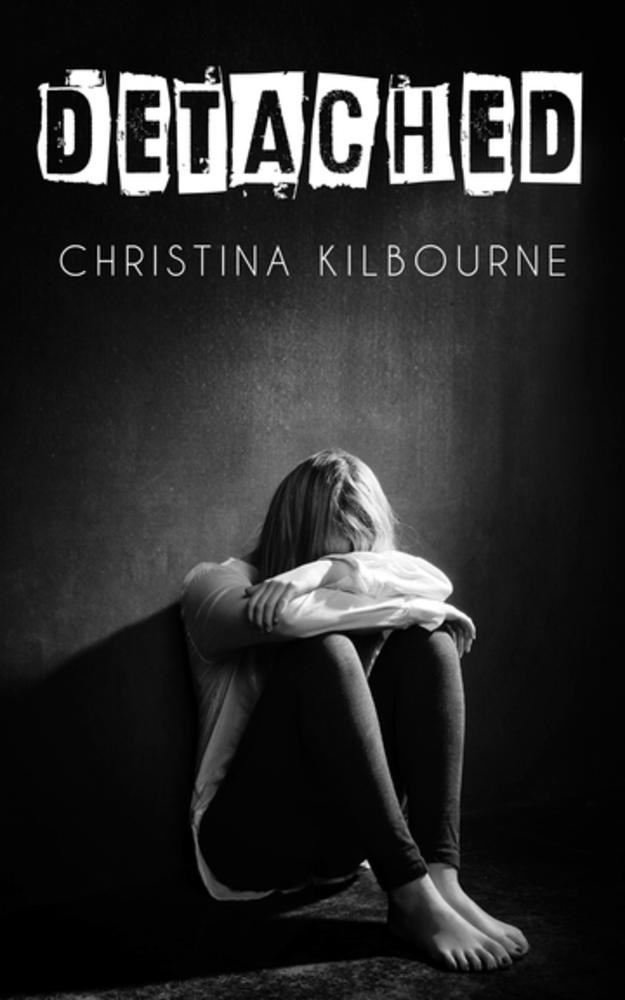
Detached, by Christina Kilbourne, (Sept. 2016, Dundurn), $12.99, ISBN: 9781459734319
Recommended for ages 13+
Anna is a high school student who doesn’t feel like she fits in. She’s got friends and family who love her, and she’s a talented artist; she seems to have everything going for her, but she doesn’t feel anymore. She’s detached from everything around her; she’s just going through the motions. She doesn’t want to live like this any longer, but she doesn’t want to hurt the people she leaves behind. She’s got plans written out, and finally, once her parents are out for the night, she overdoses on painkillers. A neighbor discovers her and gets medical intervention in time, but now the journey back to life begins, not just for Anna, but for everyone whose lives she touches.
Detached is a painful and accurate look at depression and how it affects everyone. Chapters alternate between Anna’s, her mother’s, and her best friend’s points of view, all told in the first person. Aliya, Anna’s best friend, notices Anna acting strangely, but is worried that saying something will alienate Anna. Anna’s mother, still grieving her own mother’s death, worries about her daughter, but doesn’t seem to grasp the gravity of Anna’s situation until it’s almost too late – and then, we read how Anna’s journey out of the black hole of depression affects a parent. It’s achingly real and it’s scary because it’s something we see in the headlines every day. Are we bad parents if we intervene? Are we bad parents if we don’t? I’d love to see parents and kids read this together and see how the other half thinks.
One of the most important messages coming out of Detached is this: depression is not the sufferer’s fault. It’s not a parent’s fault. It is an illness, just like any other, and it needs to be treated without stigma, with medication, therapy, love, understanding, and care. No one asks for depression to hit. This isn’t a gift, and sometimes, it’s just not possible to find the voice to ask for help. This is the power of Detached: to be that plea for help, for understanding, and to start dialogues that will shed light on an insidious disease.
Detached is an important addition to YA collections, particularly because it does talk so openly about a subject people are often uncomfortable addressing. Display and booktalk with Jay Asher’s 13 Reasons Why (which also has a very good companion website) and Julie Anne Peters’ By the Time You Read This, I’ll Be Dead.
 New Dark Ages, by Warren Kinsella, (Dec. 2018, Dundurn), $14.99, ISBN: 9781459742154

 Mom Read It