Posted in picture books, Preschool Reads

A walk through the evening: Dark on Light

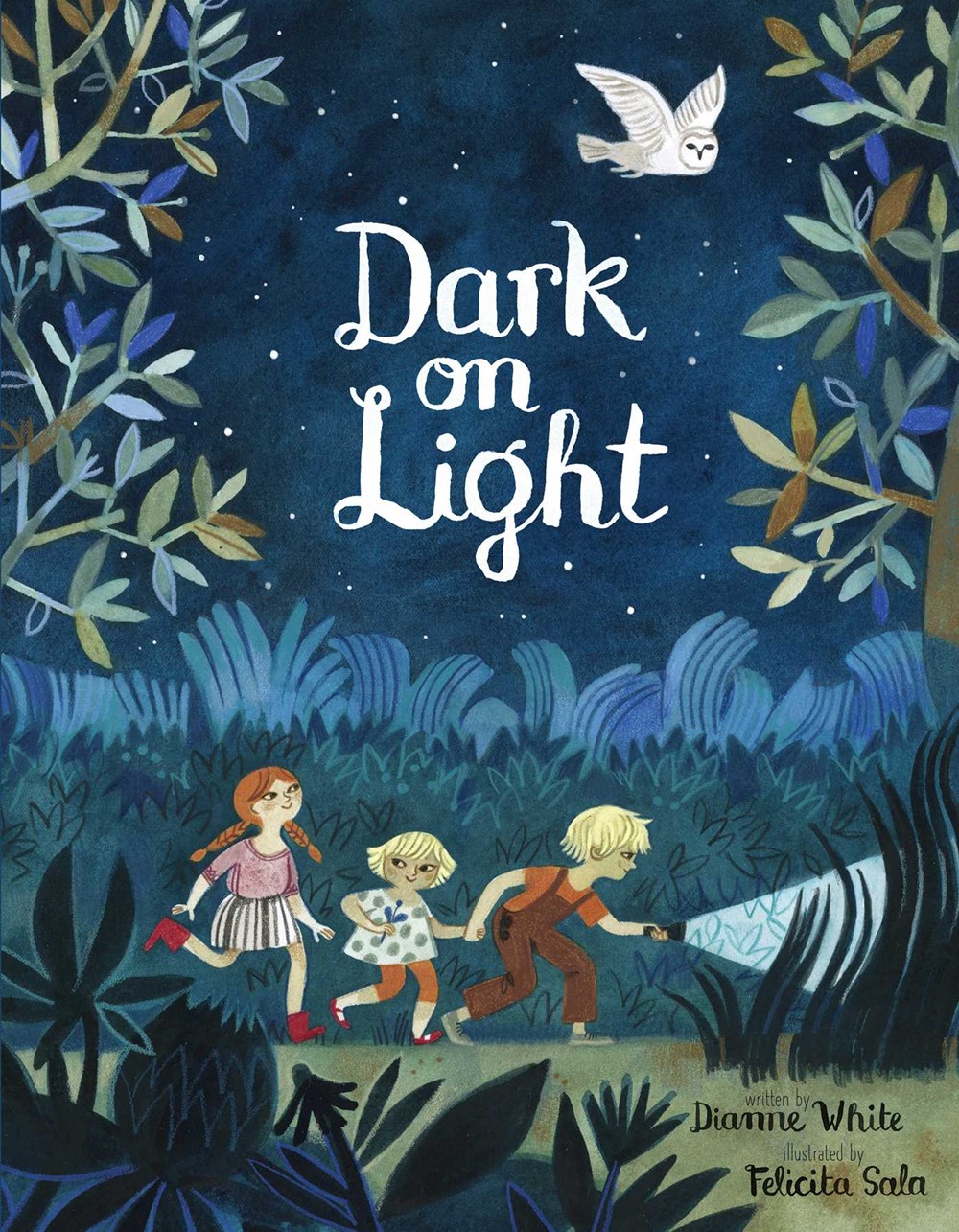
Dark on Light, by Dianne White/Illustrated by Felicia Sala, (Dec. 2022, Beach Lane Books), $18.99, ISBN: 9781534487895

Ages 3-8

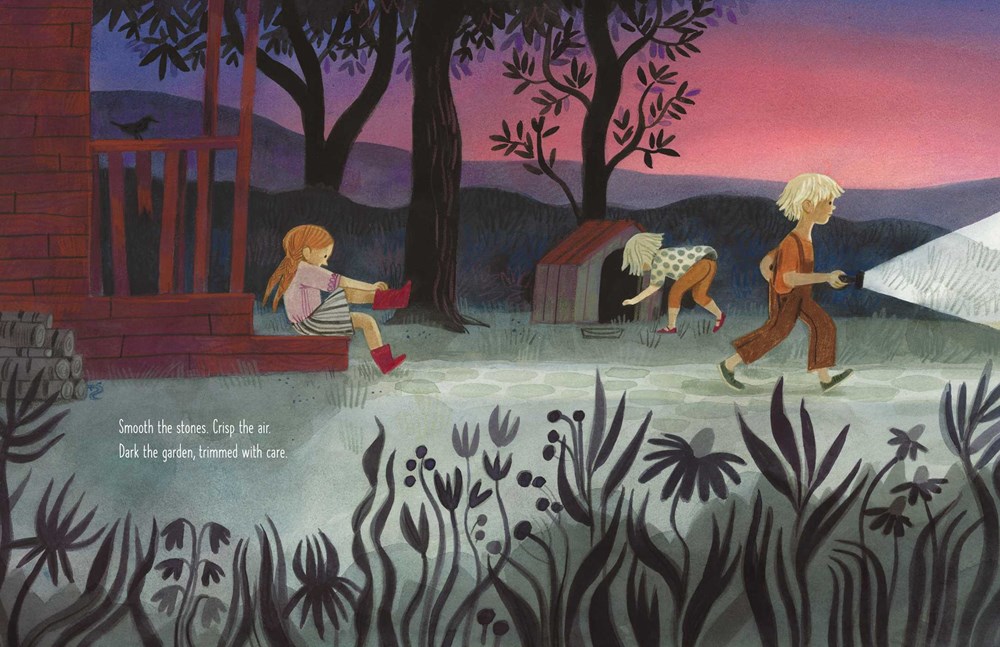
Three siblings pull on their boots and grab a flashlight to go exploring in this quiet and lovely meditation on the nighttime world, written as a verse that makes for a wonderful readaloud. The siblings encounter the quiet beauty of a sleepy world awakening as they observe a mother deer and her fawn, lavender blooms, moss on trees underneath a dark sky, and nocturnal animals going about their evening. Returning home to their loving parents, they settle down for the night. The verse is delightfully spare and lyrical: “Inviting the trail. Timid the fawn. / Dark the hedge that borders the lawn”; “Silent the owl. Still the night. / Dark the meadow beneath his flight”. Watercolor, gouache, and colored pencil illustrations are sedate, moving from the deep reds and oranges of dusk and twilight to the midnight blues and deep greens of night The colorful surroundings never detract from the evening setting, keeping the reader in the story throughout. Night sky endpapers set the sleepy tone for the story. A very good addition to storytime collections. Display and booktalk with Lizi Boyd’s Flashlight.

Dark on Light has starred reviews from Kirkus and Publisher’s Weekly.


“This is a book capable of banishing nighttime fears, showing the night to be a time of wonder, exploration, and even comfort… Lilting, haunting, rhyming, and as unforgettable as a dream the daylight just can’t quite erase.”
— Kirkus Reviews, *STARRED REVIEW*, 9/15/2022

“Closing bedtime scenes in a shared bedroom embody warmth and security… in this quiet celebration of chiaroscuro in the natural world.”
— Publishers Weekly, *STARRED REVIEW*, 10/24/2022
 

Dianne White lives in Gilbert, Arizona, with her family. She is the author of Who Eats Orange?Blue on BlueGreen on Green, and Dark on Light.

Felicita Sala is a self-taught illustrator and painter. She has a degree in philosophy from the University of Western Australia. She now lives and works in Rome. She draws inspiration from nature, children, mid-century illustration, folk art, and architecture.

Posted in Early Reader, Fiction, Non-Fiction, picture books

Science for Kindergarteners!

I’m always looking for ways to get more science in my kids’ days: my QBH Kids and my own Kindergartener alike. I’ve had some great successes and some that fell a little flat. At my previous library, I had a phenomenal early learning assistant who helped create amazing Science Storytimes, using popular storybooks to demonstrate simple science concepts for little ones: using Ellen Stoll Walsh’s Balancing Act to teach balance, while showing them a simple balance board that kids were invited to place small objects on and discover what balanced, and what tipped the sides.

I also look to fellow librarian and teacher bloggers for hints. Pinterest is a great resources, as is Education.com and Teachers Pay Teachers. Science In Storytime is one of my more recent go-tos, with loads a great book and activity ideas, and The Show Me Librarian has some fantastic programming for Pre-K and elementary programs.

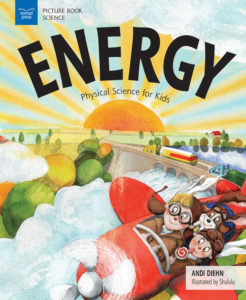
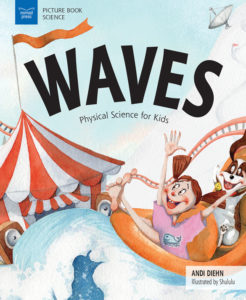
I’ve just received some new books from Nomad Press’ Picture Book Science series, too. These are a lot of fun: color artwork on every page, a fun poem to kick off each book, and my favorite part: an explanation of the scientific term, with all the uses of the term. Take, for instance, the book Waves: it starts off with the simplest interpretation of the word; a way to say hello. The book goes on to include ocean waves in that explanation, then the motion of a wave, and finally, a discussion of waves: energy, light, sound, all using questions to provoke thought, discussion, and understanding. Each book “Try This!” boxes, with simple activities kids can easily do at home or in the classroom (or during Science Storytime). Glossaries are handy to define terms that come up. There are currently four books in the Picture Book Science series: Waves, Forces, Matter, and Energy, all written by Andi Diehn and illustrated by Shululu; at $9.95 each, it’s a good and reasonable investment for our home, school, and public shelves. (Waves: 978-1-61930-635-6; Forces: 978-1-61930-638-7; Matter: 978-1-61930-644-8; Energy: 978-1-61930-641-7)


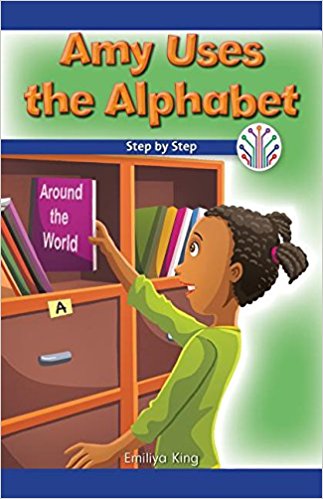
Rosen Classroom has a new series of easy readers called Computer Science for the Real World. They’re not attempting to teach Python or Scratch to the little ones (yet): these readers break the concepts needed to study computer science down for beginning readers. The three readers I received use everyday concepts – morning routines, alphabetizing books, building a birdhouse – to introduce activities that will help learn computer science; in this case, repetition and doing things step by step.


The books are leveled and contain instructional guides with include new vocabulary words, background knowledge for the specified concept, and text-dependent questions. There are independent and class activities to help kids learn through experience, and are available in English and Spanish. I really like these readers; there aren’t that many “just right books” (as my son’s school calls them) explaining science like this, and I’d love to have them in my library, but this is more of a Central library purchase, at least in my system, because you’re going to want to buy these by the collection; you can certainly buy them as single books, but having a whole set will better benefit your readers. The pricing is pretty reasonable, so I’ll be slipping this into an interoffice envelope bound for my collection development department tomorrow morning.