Posted in Preschool Reads, Toddler Reads

So Many Cuddles: Reading time is cuddle time!

So Many Cuddles, by Ruth Austin/Illustrated by Clare Owen, (June 2017, Compendium), $16.95, ISBN:  978-1-943200-49-8

Good for readers ages 3-6

So Many Cuddles is an adorable look at the many different types of cuddles: rise and shine cuddles, bear-sized cuddles for being extra brave, tickly, giggly, wriggly cuddles – one of my personal favorites – and more, all illustrated by a young girl, her cat, her dog, and her doll. Each spread is a new type of cuddle; one page for text, one for illustration, giving each picture space to breathe and for kids to explore details like the textured rug in the girl’s room, or her sneakers, kicked to the floor when the friends are cuddling on the couch. It’s a great bedtime story – the cuddling winds down with “feeling very tired cuddles/let’s be cozy in bed cuddles” – or a great anytime story. This went over fabulously with my toddler storytime! Parents cuddled their little ones, and I had soft toys out for the kids to cuddle. It’s a soothing, loving story that encourages affection – what’s more perfect than that? The kids also loved the textured cover – I passed it around for everyone to love!

So Many Cuddles is a sweet celebration of cuddling. I love it, the kiddos here at my library love it, and my 5 year-old and I loved reading it while cuddling on the couch. Clare Owen’s soft, sweet art immediately gets readers’ attention, and the different kinds of cuddles helps explain different moods and feelings – something toddlers are still working on verbalizing.

Posted in Intermediate, Non-Fiction, Non-Fiction, Women's History

The Girl Who Ran: The Story of Bobbi Gibb

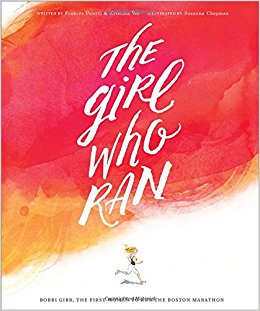
The Girl Who Ran: Bobbi Gibb, The First Woman to Run the Boston Marathon, by Frances Poletti & Kristina Yee/Illustrated by Susanna Chapman, (June 2017, Compendium), $16.99, ISBN:  978-1-943200-47-4

Recommended for readers 5-12

Believe it or not, there was a time not too long ago when women weren’t allowed to run marathons. The Boston Athletic Association, in fact, said women were “incapable” of running 26.2 miles. (But we can carry and give birth to children. That makes sense.) Bobbi Gibb set out to prove them wrong in 1966 – told you it wasn’t that long ago – and The Girl Who Ran, by Frances Poletti and Kristina Yee, tells her story in beautiful inks, prose, and poetry.

Starting with Bobbi’s childhood, we learn how she loved to run, as kids do. But one day, all of her friends stopped, and she kept going. Her father took her to see the Boston Marathon when she was older, and she was determined to do it. Susanna Chapman’s art is incredible, creating swirling tornadoes of negative words each time Bobbi is told why she can’t run: “girls can’t run marathons”, “what a strange idea”, “what if you injure yourself?”, and “rules are there for a reason”. Each time, Bobbi physically pushes those words away and endures; she trains where her parents can’t see her, running cross-country; she dresses in baggy clothes to hide her gender, and joins the Marathon, where she finds an outpouring of support for her fellow runners. When she reveals herself, the support reaches a crescendo, illustrated with vibrant reds and oranges. Wellesley girls support her with cheers and signs, and as she nears her last steps, the book opens into a gatefold to welcome Bobbi to the finishing line. After the race, Bobbi wonders what else could be proven wrong? And that, my friends, is the question we still need to ask.

Photos of Bobbi Gibb, with a brief biography and illustrated timeline of the Boston Marathon complete this gorgeous book. I’m always on the lookout for biographies that go beyond the usual names on our shelves; this is certainly one I want my Queensboro Kids to see. This fits in with the Build a Better World summer reading theme, too: ask your kids what else can be proven wrong as they look around their world today; and how did Bobbi Gibb contribute to building a better world in 1966 and beyond? Bring up Title IX, a federal law passed in 1972 which prevents gender discrimination in education programs and activities, and led the way to girls competing in school sports. Did Bobbi Gibb contribute to this landmark decision?

There’s a Bobbi Gibb website, and ESPN has a good article discussing Bobbi Gibb’s place in history and a statue that’s underway commemorating her historic run. The Girl Who Ran received a starred review from Kirkus and is an Amelia Bloomer Project nominee. It’s a strong addition to biographical, sports, and feminist collections.