Posted in Fiction, Historical Fiction, Middle Grade, Realistic Fiction, Tween Reads

My Year in the Middle: Relevant then, relevant now

My Year in the Middle, by Lila Quintero Weaver, (July 2018, Candlewick), $15.99, ISBN: 9780763692315

Ages 8-11

Sixth-grader Lu Olivera and her Latin American family find themselves in the middle of a civil rights struggle in their Red Grove, Alabama neighborhood one hot summer in 1970. The tensions run high in her integrated school: black kids sit on one side of the room, white kids on the other; she sits in the middle row. She’s in the the middle child, smack dab between her older, activist sister and younger twin siblings; she’s in the middle when it comes to local politics: many of the white families want to re-elect segregationist governor George Wallace, while Lu and her family support incumbent Albert Brewer. Many of her classmates are leaving their school to go to a private, white school. When Lu befriends fellow track runner Belinda Gresham, an African-American girl, and her classmates turn on her, she decides it’s time to take a stand.

Inspired by the author’s Alabama childhood, My Year in the Middle is a story of civil rights and finding one’s voice. Lu puts up with the passive racism in her community, with remarks like, “she’s from South America, she doesn’t mind going to school with Negroes”. But seeing how her African-American friends are treated by her fellow classmates, and by the general public in her town, pushes her buttons. Lu is a character who stands out: she’s a character of color stuck in the middle of the Civil Rights Movement, but because she’s not African-American, she’s tolerated: until she digs in her heels and says, “No more”. She gives and receives support from her black classmates and from Sam, her classmate and crush, a white preacher’s son who is bullied for his civil rights stance.

Lu is at once relatable and a mirror for our society today. We’re still divided, and more and more people are forced from the middle to take a stand. Readers may recognize recent political speeches and attitudes in George Wallace’s condescending stumping and the racial tension that permeates Lu’s classroom. My Year in the Middle is a solid work of historical fiction that provides excellent discussion topics for readers on civil rights, social justice, and where we’ve gone versus where we are.

Posted in Non-Fiction, picture books

Activists, Musicians: Biographies

If you’re looking for some biographies on musicians who worked to change the world, here’s a starter list.


Muddy: The Story of Blues Legend Muddy Waters, by Michael Mahin/Illustrated by Evan Turk, (Sept. 2017, Athenum), $17.99, ISNB:  978-1481443494  It’s a good thing Muddy Waters wasn’t good at doing what he was told. Everyone from his grandma to record producers said no one wanted to hear the blues, but Muddy just kept playing, from family picnics to smoky juke joints, until he finally got to Chicago, and recorded his music.

Mahalia Jackson: Walking With Kings and Queens, by Nina Nolan/Illustrated by John Holyfield, (2015, Amistad/HarperCollins),$17.99, ISBN: 978-0-06-087944-0  Mahalia Jackson had a voice that could make you stop whatever you were doing in listen. Walking with Kings and Queens tells her story, from her New Orleans childhood to her performance at the March on Washington.

When the Beat Was Born: DJ Kool Herc and the Creation of Hip Hop, by Laban Carrick Hill/Illustrated by Theodore Taylor III, (Aug. 2013, Roaring Brook Press), $17.99, ISBN: 9781596435407  In 1973, music changed forever when Clive Campbell – you may know him as DJ Kook Herc – created a new way of playing music to make the beats last longer, letting you dance longer. It caught on. Kids started breakdancing rather than fighting; a culture arose that influences music, style, and language to this day.


Nina: Jazz Legend and Civil-Rights Activist Nina Simone, by Alice Brière-Haquet/Illustrated by Bruno Liance, (Dec. 2017, Charlesbridge), $16.99, ISBN: 9781580898270  Singer and activist Nina Simone grew up listening to music made by “important men in powdered wigs from past centuries” and faced down systemic racism to shine as a classical, jazz, blues, folk, R&B, gospel, and pop vocalist and activist.

Listen – How Pete Seeger Got America Singing, by Leda Schubert/Illustrated by Raúl Colón, (June 2017, Roaring Brook Press), $17.99, ISBN: 9781626722507  Folk artist Pete Seeger led by example, be it through song or through activism. He said that participation would save the human race, and encouraged it through actions: he supported unions, protested war, and marched for civil rights, and he was vocal about environmentalism.

When Paul Met Artie: The Story of Simon & Garfunkel, by G. Neri/Illustrated by David Litchfield,
(March 2018, Candlewick), $17.99, ISBN: 9780763681746  The story of music duo Simon & Garfunkel, told in verse, takes the artists from their childhood in Queens, New York, through their mutual love of music and discovery of ’60s social change, and through their early musical career.


Posted in Middle Grade, Non-Fiction, Non-fiction, Tween Reads

Black History Month: Heroes of Black History – Spotlight on Barack Obama

Heroes of Black History: Biographies of Four Great Americans, (Dec. 2017, Time for Kids), $9.99, ISBN: 978-1-68330-776-1

Recommended for readers 8-12

This Time for Kids collection highlights the life stories of four great African-Americans: Harriet Tubman, who led slaves to freedom; Jackie Robinson, the groundbreaking athlete and first African-American baseball player to play for the major leagues; Rosa Parks, the civil rights pioneer who refused to give up her seat on the bus; and Barack Obama, the first African-American President of the United States.

With photos and artwork, fast facts and timelines throughout the book, this is a great book to have on hand in homes, classrooms and libraries for help with homework and reports and is essential reading for everyone. Civil Rights activist and NPR correspondent Charlayne Hunter-Gault’s introduction discusses how Black history provided her with the “invisible armor”  she needed to meet life’s challenges.

Spotlight On: Barack Obama

As part of the Heroes of Black History Book Tour, I’m spotlighting Barack Obama’s biography. The 40-page spotlight on our 44th President’s life is loaded with photos and a timeline, and covers his life from his birth in Hawaii to his 2017 farewell speech as he left office. The profile covers his relationship with his mother and grandmother; his mother’s remarriage and their subsequent move to Jakarta, Indonesia, and his return to Hawaii to live with his parents at the age of 10. We read about his marriage to Michelle Obama and births of his daughters, Malia and Sasha, and the story of his political rise from Senator to the White House. I was happy to read about the 2004 Democratic National Convention; the convention where Obama’s moving speech made Americans sit up and take notice – I still remember a coworker at the time coming to work the next day and telling me, “That man is going to be our next President.”

An appendix includes 19 additional Heroes profiles, from W.E.B. DuBois to John Lewis, a glossary and full index to round out this great reference. You can find a free curriculum guide and downloadable Fast Facts sheets on each icon.


Posted in Fiction, Intermediate, picture books, Realistic Fiction

Black History Month: As Fast as Words Could Fly

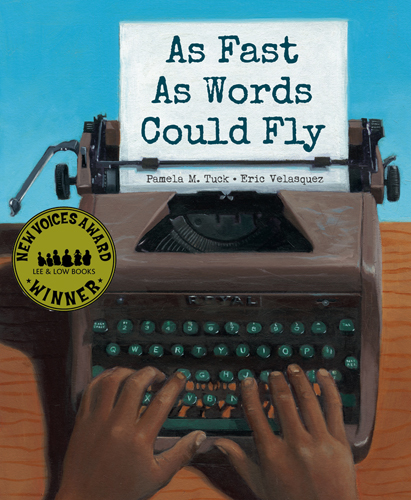
As Fast As Words Could Fly, by Pamela M. Tuck/Illustrated by Eric Velasquez, (Apr. 2013, Lee and Low), $18.95, ISBN: 9781600603488

Recommended for readers 6-10

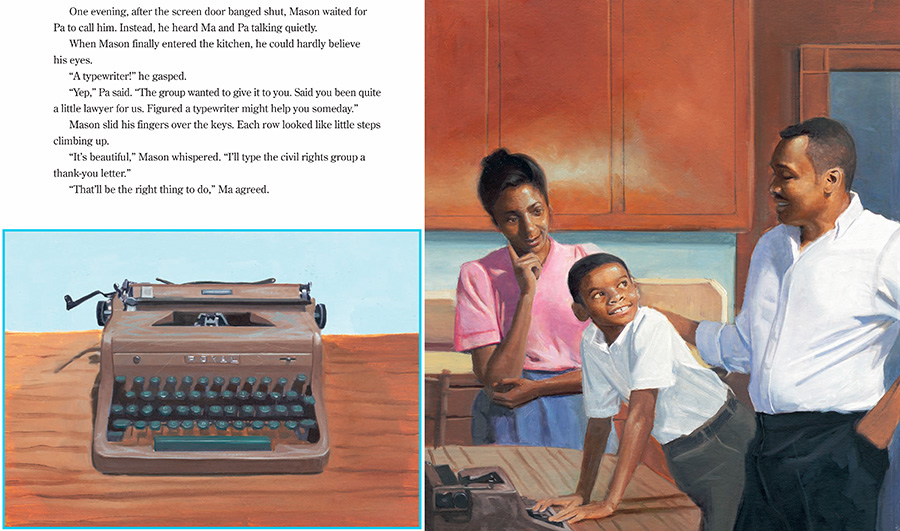
I had to start my Black History Month reviews off with this gorgeous book by Pamela M. Tuck. As Fast As Words Could Fly is inspired by Ms. Tuck’s father, who – along with his brothers – integrated a North Carolina school, and by her grandfather, who was active in the Civil Rights movement. Mason Steele is a 14 year-old who helps his father’s civil rights group by writing letters for them, shining light on injustices. Mason’s father brings home a manual typewriter, transforming Mason’s life and letting his words fly across the pages. At the same time as Mason receives his typewriter, his father tells him and his brothers that they will integrate the local high school rather than continue busing to one twelve miles away. Integration is tough on Mason and his brothers: buses drive right by them and teachers and students alike make it known that the boys aren’t welcome there, but Mason endures and uses his typewriter to increase his skill and earn some money. He also uses his typewriter to make a change: he defies racism to keep his job at the local library and to represent his school in a typing contest. For Mason, the words on the paper speak loud and clear.

This was Pam Tuck’s first published story, which won the Lee & Low New Voices Winner. I was lucky enough to see her speak about her experience, and her family’s experience, at KidLitCon back in November, and I got my own copy of As Fast As Words Could Fly signed for my kiddo. Pam’s voice comes through so clearly in her story; I can hear her, even now, telling me about her grandfather and father’s story. I mentioned that I was a fan of her illustrator, Eric Velasquez, and she sat with me; as we went through the book together, she pointed out her favorite pieces of artwork. I mentioned that I loved Mr. Velasquez’s books, Grandma’s Records and Grandma’s Gift, and his talent for creating warm, loving family artwork, and she told me that the spread where Mason’s father tells his boys that they are going to a new school was perfectly recreated: she pointed out areas of her grandparents’ kitchen that she remembered, and said that Pa’s posture and hands were spot-on; the artist had given life to her grandfather.

As Fast As Words Could Fly is a strong story about a family during the Civil Rights movement, and it’s the story of a young man who was determined to make a change on his own terms. I love this story, and would love to see it on more bookshelves. Find a teacher’s guide and interviews on the Lee & Low website, and learn more about Pamela Tuck here. See more of award-winning illustrator Eric Velasquez’s artwork at his website.

Posted in Non-Fiction

Write to Me: Letters from Japanese American Children to the Librarian They left Behind

Write to Me: Letters from Japanese American Children to the Librarian They left Behind, by Cynthia Grady/Illustrated by Amiko Hirao, (Jan. 2018, Charlesbridge), $16.99, ISBN: 9781580896887

Recommended for readers 5-10

Inspired by a true story, Write to Me tells the story of Clara Breed, a children’s librarian who corresponded with her Japanese American patrons when they were sent to internment camps during World War II. She gave them postcards to let her know where they were; she visited them, wrote to them, and sent them books and crafts to help ease their minds during their confinement. She advocated for those children by writing articles and attending rallies, advocating for her kids. When the kids came home, she was waiting for them – and they came to her. She was comfort in a cruel time. Write to me tells the story of Clara Breed through conversations with her library kids; muted pencil art illustrates life in the prison camps, with excerpts from actual letters on each page to show the passage of time. Endpapers display photos from the period, including family arrivals at the camps and evacuation notices for Japanese Americans. An author’s note features a photo of Clara Breed and two of her patrons, taken at a reunion in 1991. There’s a timeline of Clara Breed’s life, including links to her articles on the war, relocation, civil liberties, and human rights, and a selected history of the Japanese People in the United States. Source notes, bibliography, and further reading are available. A touching book about a woman who touched lives, and a nice addition to biography collections.


Posted in Graphic Novels, History

Two families find common ground during the Civil Rights era: The Silence of Our Friends

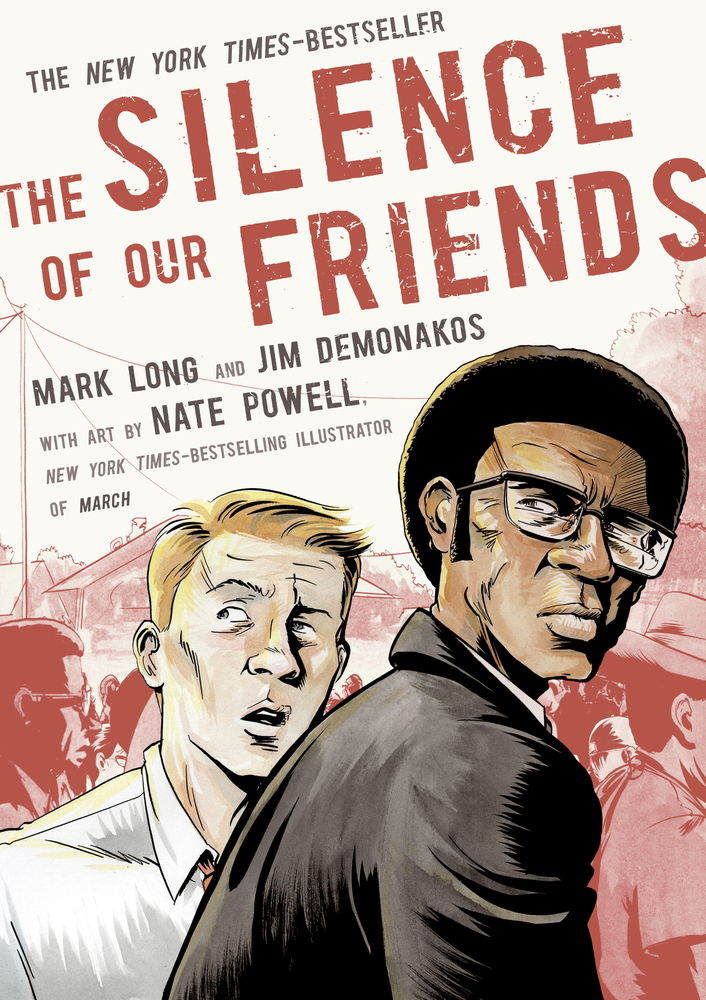
The Silence of Our Friends, by Mark Long and Jim Demonakos/Illustrated by Nate Powell, (Jan. 2018, First Second), $9.99, ISBN: 9781250164988

Recommended for readers 12+

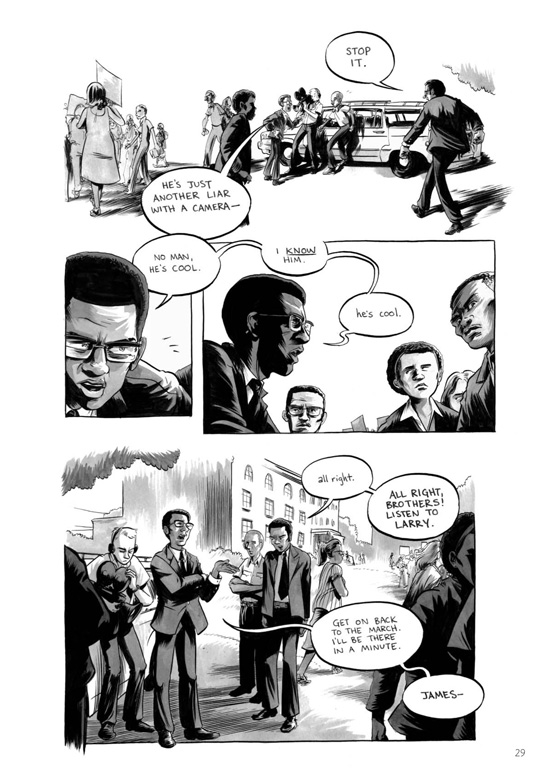
Originally published in 2012, The Silence of Our Friends is getting a re-release next week.Set in 1968 Texas, The Silence of Our Friends tells the story of two families – a black family and a white family – who come together as the civil rights struggle comes to a boil. It’s a memoir of Mark Long’s childhood in a virulently racist Texan suburb; it’s the story of his journalist father, Jack, and his friendship with African-American professor at Texas Southern University professor, Larry Thompson; and it’s the story of a lesser-known event in civil rights history: a series of student protests at Texas Southern University, culminating in police brutality and shots fired at unarmed African-American students in a university dorm. Those same students were imprisoned and put on trial for the death of a police officer who was killed by a fellow officer’s misfire.

The Silence of Our Friends is taken from the Martin Luther King quote, “In the end, we will remember not the words of our enemies but the silence of our friends.” It’s a powerful quote given powerful illustration in Long’s story. Jack Long is a journalist trying to do the right thing, but his racist boss wants a pro-white narrative in the press. Jack’s silence can kill.

Artist Nate Powell, who beautifully illustrated John Lewis’ March trilogy, creates strong, stark images here, using black and white artwork to create imposing shadows and menacing crowds and idyllic homes with tension thrumming throughout. The Silence of Our Friends is an ally’s story and a good additional title in civil rights collections.

Posted in Intermediate

Nina introduces a new generation to Nina Simone

Nina: Jazz Legend and Civil-Rights Activist Nina Simone, by Alice Brière-Haquet/Illustrated by Bruno Liance, (Dec. 2017, Charlesbridge), $16.99, ISBN: 9781580898270

Recommended for readers 6-10

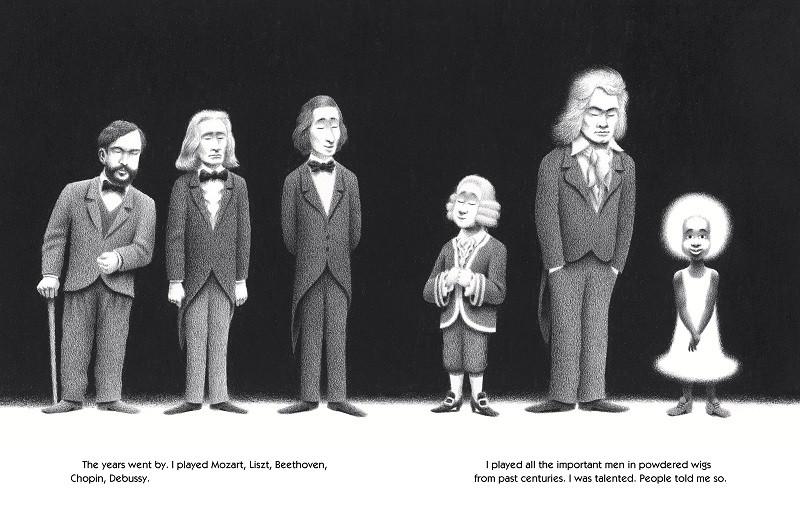
She is a legend in music and civil rights history. Author Alice Brière-Haquet and illustrator Bruno Liance introduce Nina Simone to new audiences with this beautifully written and illustrated book. Written as a story to Simone’s daughter, who’s having trouble falling asleep, Alice Brière-Haquet weaves a tale of achievement in the face of racism, using stunning imagery: the 52 white teeth “trapping” the 36 black teeth in the keyboard, and the white keys being whole notes while the black keys are half notes: “White was whole. Black was half. It was that way everywhere and for everyone.” Music was made by “important men in powdered wigs from past centuries”. Simone recalls her anger during a recital, when her mother was expected to give up her seat in the front, to white people who came to see her play; Simone refused to play until her mother resumed her rightful spot in the front row. She speaks of Martin Luther King, and his dream being her symphony – but the dream is fragile.

This book is gorgeous. The words are beautiful and strong, and using piano keys as an illustration of endemic racism is simply brilliant. Bruno Liance’s black and white illustrations are soft, dreamlike, beautiful. This spread is my absolute favorite; I’d love to give this print as a baby shower gift.

“Dream, my baby, dream, until you spread your wings…” (from Bruno Liance’s website)

Do kids know who Nina Simone is? Probably not, unless their parents are fans. Does that matter? Absolutely not – this is a gorgeous introduction to Nina Simone, and to activism, for all ages. This book is going on my shelves, in my storytimes, and in displays for social conscience, activism, and African-American history. If you’re so inclined, you can play Simone’s lullaby, “Hush Little Baby“, in your storytime or for your little one.

Nina was originally published in France in 2015. You can find more of Bruno Liance’s artwork at his (French/English) website, Pirate des Caramels, and you can follow Alice Brière-Haquet at her (French) blog, Alice in Wonderblog. Nina has starred reviews from Foreword Reviews and Booklist.

Posted in History, Non-Fiction, Teen, Tween Reads

The Last Civil Rights March of the 60s: The March Against Fear

The March Against Fear: The Last Great Walk of the Civil Rights Movement and the Emergence of Black Power, by Ann Bausum, (Jan. 2017, National Geographic), $18.99, 978-1-4263-2665-3

Recommended for readers 12+

In June 1966, activist James Meredith set out to walk from Memphis to Jackson, Mississippi. He called it his Walk Against Fear; he wanted to conquer his own fears of walking through his home state; he wanted to encourage fellow African Americans to become voters: the Voter Registration Act had passed the year before, but the majority of African Americans had not yet registered, still living in fear of consequences they faced. Two days into his walk, James Meredith was shot in an assassination attempt. While Meredith recuperated, his cause was taken up by civil rights leaders of the day: Martin Luther King and Stokely Carmichael, and the ensuing March Against Fear became an historic march that included 15,000 people, resulted in 4,000 black voter registrations in Mississippi, and saw the rise of the Black Power movement.

Author Ann Bausum, who has connections to this history, captures the strife in Mississippi as whites and blacks clashed over civil rights. She looks at Meredith’s frustration at how his private stand grew into a full-scale movement, and at the discord between Stokely Carmichael and Martin Luther King: Carmichael’s desire for Black Power frightened whites who saw the movement as a possible militant uprising; King wanted to promote a nonviolent, peaceful march. Bausum also looks at why this march, of all marches, seems to have disappeared from history books – I certainly never learned about this one in school – and how we are still “trying to establish the essential truth that Black Lives Matter”.

An essential read for everyone. An essential addition to history classes in high school and college.

For more information about The March Against Fear, check PBS’ American Experience page on the Civil Rights Movement and the National Archives webpage on James Meredith and March Against Fear.

The March Against Fear received starred reviews from Kirkus, School Library Journal, and Publisher’s Weekly.

Posted in Intermediate, Non-Fiction, Non-Fiction

Black History Month: The Youngest Marcher, by Cynthia Levinson

youngest-marcherThe Youngest Marcher: The Story of Audrey Faye Hendricks, a Young Civil Rights Activist, by Cynthia Levinson/illustrated by Vanessa Brantley Newton, (Jan. 2017, Atheneum Books for Young Readers), $17.99, ISBN: 9781481400701

Recommended for ages 5-10

In May 1963, children in Birmingham, Alabama, trained in peaceful, civil disobedience, marched to protest segregation. Nine year-old Audrey Faye Hendricks was the youngest marcher, fully invested in civil rights and aware that she would likely go to jail. She spent a week in juvenile hall with flimsy blankets and no toothbrush, but she persevered and made history. Nonfiction author Cynthia Levinson tells the story of the youngest marcher, with illustrations by Vanessa Brantley Newton, here for younger audiences, assuring children that no one is too small, too young, to make a difference in the world.

I’ve been handing this book to kids coming in, looking for African-American biographies for their Black History Month reports for just this reason. I want children to see that they are important. They count. At a time when many feel marginalized, books like The Youngest Marcher, with its powerful words and images, offer representation and affirmation. Children have a voice, and with support and encouragement, they can use them and be heard.

Cynthia Levinson’s author website offers links to further resources, including curriculum guides and videos. Illustrator Vanessa Brantley-Newton was spotlighted by the WeNeedDiverseBooks initiative, for which she also created original artwork. For more information about the 1963 Birmingham Children’s Crusade, visit Biography.com or the Zinn Education Project, offering information about the award-winning documentary, Mighty Times.


Posted in Fiction, Middle Grade, Realistic Fiction, Tween Reads, Uncategorized

A Blind Guide to Stinkville is a must-read!

61608104724460LA Blind Guide to Stinkville, by Beth Vrabel (October 2015, Sky Pony Press), $16.99, ISBN: 9781634501576

Recommended for ages 8-12

Twelve year-old Alice’s family has moved her from Seattle, across the country, to Stinkville – that is, Sinkville, South Carolina. It’s a paper mill town, her dad’s the new paper mill manager, and he seems to be the only one settling into their new life. Her mother is depressed, her brother is angry, and Alice sticks out like a sore thumb. Alice is an albino who needs to slather on the sunblock and wear hats so her sensitive skin doesn’t burn, and she’s legally blind – but she’ll be the first to tell you that she’s not that blind.  She can see, but things have to be really close for her to see them.

Alice’s parents start talking about sending her to a school for the blind when school starts in the Fall, and Alice is furious – she’s always been in public school! She’s determined to start doing things for herself, whether it’s finding her way to the library or doing the laundry at home. She even enters the Sinkville essay contest and decides to tell the stories of some of the locals she’s met; and that’s when she learns that Stinkville may not stink so much after all.

This is a little book that tackles some pretty big issues: the Civil Rights movement, depression, special needs, for starters. Told in the first person from Alice’s perspective, A Blind Guide to Stinkville tells the story of a family and a town with humor and sensitivity. Alice is a normal tween: she wants to fit in, but she’s got something that makes her stand out. She wants to be independent, and her family drives her nuts. Most of all, she’s a new kid in a new town and she missed her friends – her best friend, who is moving forward with her life. It’s a lot for any kid to handle, and Alice’s sense of humor is her best defense – that, and her determination to advocate for herself.

Importantly, for me at least, it also provides a glimpse into parental depression and the effect it has on the rest of the family, and how the fight to “get better” is not that easy. Alice’s mom has good days, then a bad day will hit. It happens, and Alice’s brother James doesn’t always understand. It’s a realistic portrayal of the helplessness felt by parent and child, and there are no answers, just getting through as best as possible while sticking together as a family unit.

Readers will appreciate this book for its good story and likable characters.  Parents and educators will appreciate how it promotes deeper understanding of different special needs – and how a kid is a kid is a kid at heart, really – and the subplot telling the story of the Civil Rights movement in the South. Great for discussion groups.

Beth Vrabel is the author of the 2015 Cybils-nominated book, Pack of Dorks, also from Sky Pony. The sequel, Camp Dork, will be coming in May 2016. Her author website offers a study guide for Pack of Dorks, an FAQ, and links to her blog and published writing.