Posted in picture books

Saying Farewell to Summer Reading with How to Be on The Moon

How to Be on the Moon, by Viviane Schwarz, (June 2019, Candlewick Press), $16.99, ISBN: 9781536205459

Ages 4-7

A little girl and her best crocodile friend decide to go to the moon. They ready their math skills, practice having patience, and pack travel games and sandwiches, then take off for a jaunt on the moon.

This is the second Anna and Crocodile adventure from Viviane Schwarz (the first, How to Find Gold, was published in 2016), and it is a celebration of friendship and imagination. The illustrations are pencil, crayon, and watercolor, giving the scenery different textures; it’s like taking a peek into an imaginary landscape. The moonscape is amazing, and looks like aluminum foil (more on that in a minute) against a colorful rocketship and blue-black spacescape. The book is upbeat, with an overall sense of playful fun, that makes this a book I’ll return to again and again at storytime and science time.

Speaking of science time, I’m finishing up my summer reading programs this week, and will be reading How to Be on the Moon when the kids and I make aluminum foil moons. It’s a simple enough craft that I can open it up to all ages, and I think it will be a fun way to bid summer reading goodbye for another year.

Author/illustrator Viviane Schwarz has fun, free downloadables and activities on her author webpage. Check them out!

I look forward to seeing where Anna and Crocodile go on their next trek!

Posted in Fiction, Graphic Novels, Intermediate, picture books, Preschool Reads

Cats, Cats, Cats!

Call it the librarian in me, but I love cats, and stories about cats are the perfect mix of cuddly, funny, and just plain sweet. Here are a few new and coming-soon books featuring some favorite furry friends.

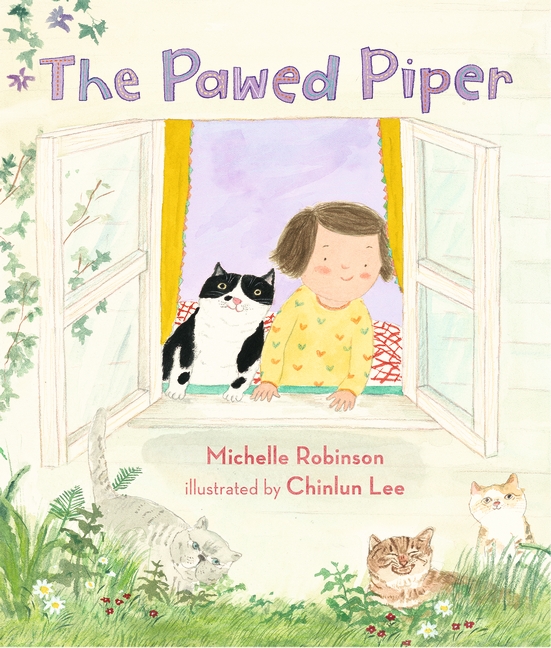
The Pawed Piper, by Michelle Robinson/Illustrated by Chinlun Lee, (July 2019, Candlewick Press), $16.99, ISBN: 978-1-5362-0165-9

Ages 3-7

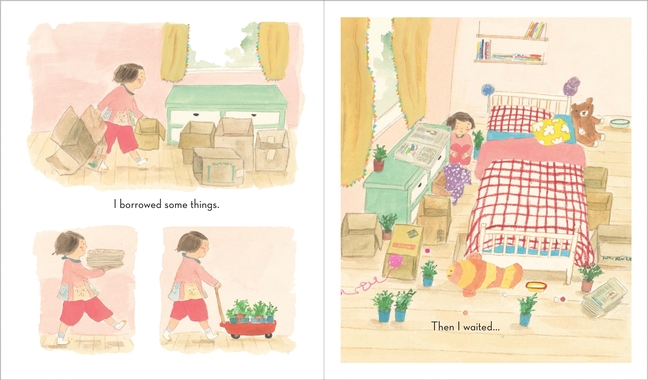
A girl wants a cat to cuddle, so she sets to work, creating a trail for a potential new pet to follow, with all sorts of cat-friendly stuff, like yarn, soft cushions, boxes, and catnip. At first, her grandmother’s cat, Hector, shows up to visit, but wait! Hector’s brought friends! Many, many friends – in fact, it appears that Hector has brought all the cats to the girl’s house! The girl is thrilled at first, but feels awful and guilty when she notices all the missing cat posters going up around her neighborhood. She didn’t want to take anyone else’s cat, after all; she just wanted one of her own. After she returns all the cats to their homes, she discovers a happy surprise: one cat has been hiding in her drawer, and has given birth to kittens! Those cats get homes, too, except for one little one: that one is just for the little girl.

The Pawed Piper is a sweet “I want a pet” story that kids will love and laugh along with. The endpapers get in on the fun, plastered with Missing! cat posters across the front endpapers; the same posters stamped “Found!” across the back endpapers. The watercolor and pencil artwork makes for a soothing, enjoyable setting to a fun story. A fun addition to pet storytimes, and for cat and pet fans.

Big Cat, by Emma Lazell, (July 2019, Pavilion Children’s Books), $16.95, ISBN: 978-1843654292

Ages 3-7

I laughed out loud at this sight gag-heavy story. A girl named Isobel tries to help her grandmother find her lost glasses (the kids will find them easily – ask them!) when they come across a giant cat. It’s a friendly cat, and Gran welcomes the cat in, with all of her other cats. Gran, who still can’t find her glasses, doesn’t seem to notice that she’s inadvertently adopted a tiger, but the other cats sure do! He’s eating their food, he’s taking up all their space, and making life very inconvenient. Thank goodness Big Cat’s mother and father show up – with Gran’s glasses! – to take their son home. Gran’s reaction when she finally realizes that she’s been letting a tiger live with her is laugh-out-loud funny; her housecats’ reaction to the tiger living with them is even funnier; their protest signs and facial expressions are kidlit comedy gold. Big Cat is going into my regular storytime rotation for sure. My 7-year-old and I read it last night and decided that we need to read this very, very often, because it just made us feel happy.

Big Cat was originally published in the UK, and is Emma Lazell’s debut picture book. I’m already looking forward to her next one, That Dog!, which looks like it’s being published in the US next spring. This is one of those books where text and art come together perfectly to create sight gags, with perfectly innocent text wandering around the artwork. The artwork is bold and bright, with hilariously expressive eyes. There are such sweet moments in here, too, like the giant hug that Mother and Father Tiger give their son when they finally discover him at Gran’s. It’s just a great book filled with wonderful moments and I can’t wait to read it again and again. There’s a free, downloadable activity kit, too, with mazes, coloring sheets, and a Missing! poster (that you could probably use with The Pawed Piper, too…).

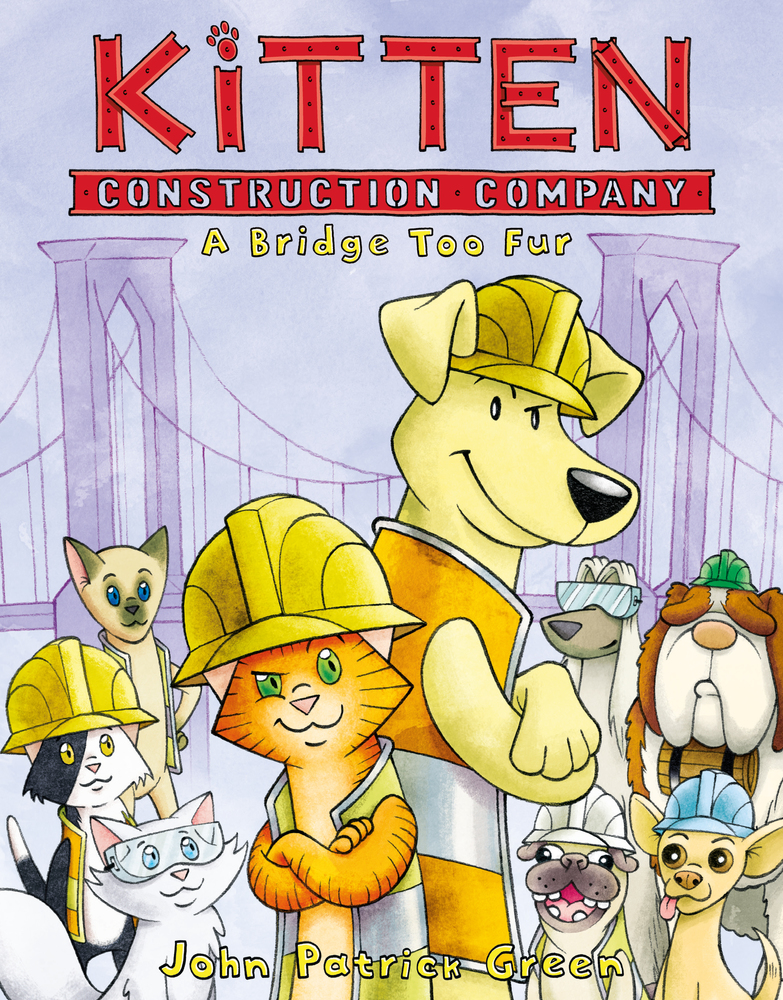
Kitten Construction Company: A Bridge Too Fur, by John Patrick Green, (Oct. 2019, First Second), $17.99, ISBN: 9781626728318

Ages 7-9

The follow-up to last year’s Meet the House Kittens, this latest in the Kitten Construction Company series has Marmalade and friends facing a new construction project – building the new Mewburg Bridge! But Marmalade is afraid of water, and what do bridges cross? WATER! The kittens figure out a workaround, and they have to call subcontractors in to help with the demolition work. When the Demo Doggos show up to the site, though, Marmalade’s biased feelings about dogs stand in the way of true teamwork. Everyone is going to have to learn to work together to get the bridge done!

John Patrick Green creates stories that make me happy. Hippopotamister is all about a hippo finding his purpose; the first Kitten Construction Company story was about being taken seriously; and now, A Bridge Too Fur is about overcoming fears and biases, and embracing teamwork to make one’s corner of the world a better place. He tells big stories in a small space, with adorable artwork and situations that appeal to young readers while teaching them how to be a positive force in the world. That is good stuff, and that is the kind of book that flies off my shelves here at the library. Kids come for the cute animals, stay for the positive messages. There’s some fun humor on the down-low that sharp-eyed readers will catch, like references to a possum street artist named “Panksy”, and Marmalade knocking a mic off the podium when he goes to speak (because, that’s what cats do). A “How to Draw Kittens” section teaches readers to draw some of the characters in the story.

You simply can’t go wrong with a John Patrick Green graphic novel. The Kitten Construction Company is such a good series for intermediate readers; add this one to your collections.

Posted in Fantasy, Fiction, Middle Grade, Teen, Tween Reads

Folk and Fairy Tales from Across the Pond: Between Worlds

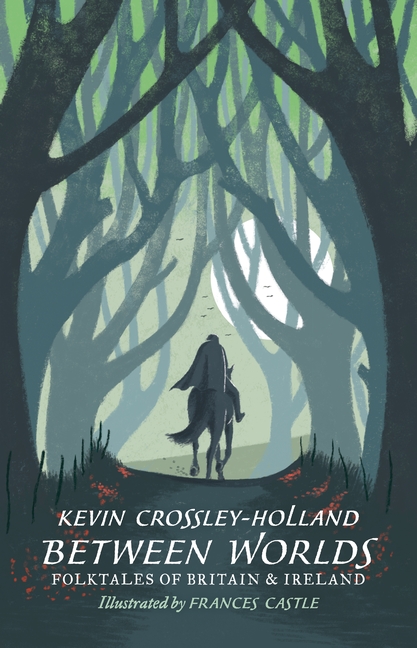
Between Worlds: Folktales of Britain and Ireland, by Kevin Crossley-Holland/Illustrated by Frances Castle, (Oct. 2019, Candlewick Press), $17.99, ISBN: 9781536209419

Ages 10+

Forty-eight folk and fairy tales from Britain and Ireland; some you’ve heard before, most will be new to you. The tales are organized by Magic and Wonder; Adventures and Legends; Power, Passion, and Love; Wits, Tricks, and Laughter; and Ghosts. This is a wonderful tome for your fantasy and fairy/folk tale collections; especially, if, like me, you love having a collection of tales from all over the world. Some are short enough to read aloud, others are longer and invite readers to sit down, have a nice cup of hot chocolate, and imagine a storyteller leading you back through time for  stories about fairy rings, boggarts, and changelings. Frances Castle’s stark black-and-white illustrations set a mood for each story and each section. An afterword on “Why Everyone Needs to Be Able to Tell a Story” is told as a final folktale, infusing the entire volume with a bit of magic. Comprehensive source notes identify each story’s source(s) and original titles, if any.

A definite add to your folk and fairy tale shelves, and a gorgeous gift for readers. Keep a copy at your Reference desk, too, if you have it in the budget.


Posted in Fantasy, Fiction, Middle Grade, Tween Reads

The Malamander welcomes you to Eerie-on-Sea with a HUGE GIVEAWAY!

Malamander, by Thomas Taylor/Illustrated by Tom Booth, (Sept. 2019, Walker Books US), $16.99, ISBN: 9781536207224

Ages 9-13

Winter comes to the sleepy town of Eerie-on-Sea, and Herbert Lemon – the 12-year-old Lost and Founder for the Grand Nautilus Hotel – discovers a girl about his age hiding, in his Lost and Found room, from a very angry man with a hook for a hand. Violet Parma was found abandoned as an infant in the Grand Nautilus Hotel, and she’s come back, determined to learn what would have taken her parents away from her. Is the Eerie legend of the Malamander – a part-fish, part-human creature – tied into the mystery? Everyone in town seems to know more about Herbert and Violet – and the Malamander – than they’re letting on.

I could not get enough of this first Legends of Eerie-on-the-Sea adventure! It’s got a very period feel – very British (the book was originally published in the UK), almost steampunk, but takes place in the modern day. There’s delightfully creepy, creaky worldbuilding; the Malamander itself shows up, wreathed in fog, but is far from mild-mannered, attacking if it feels threatened. There’s a fantastically oddball Book Dispensary, where selections are chosen by a mechanical mermonkey, and a cast of quirky, instantly memorable characters like the mysterious hotel proprietress, Lady Kraken; Mrs. Fossil, the eccentric beachcomber, and Jenny Hanniver, who works in the Book Dispensary. Everyone’s got a backstory, and the world-building is weird and wonderful. Kirkus calls it “H.P. Lovecraft crossed with John Bellairs”, and really, that’s the most spot-on quick take I’ve read. My advanced reader copy only had some of the illustrations in place, but from what I’ve seen, Tom Booth’s black and white artwork lends great shadow and mist to a shadowy, misty, seaside mystery; the characters have exaggerated, bold facial expressions and angular shapes, and every chapter is heralded with a load of tentacles to draw readers in. In other words, it all comes together perfectly.

I loved visiting Eerie-on-Sea, and can’t wait to take my kids (both library and the ones in my family) there for a stay. Malamander is the first in a planned trilogy, so pardon me, while I sit and wait.

Malamander is out in September, but you can read an interview with author Thomas Taylor here. You can read an excerpt and check out some postcards Herbie’s received at the Lost and Found, at the Eerie on Sea website. And I’d be remiss if I didn’t mention that GeekDad gives five reasons to read Malamander, and they’re all very good reasons.

Malamander has a starred review from Booklist.


Candlewick has offered a great giveaway for MomReadIt and Malamander. THREE readers will win a Malamander gift set, containing an advanced reader copy of the book and a Malamander tote bag! U.S. addresses only, please, and no P.O. boxes. Check out the Rafflecopter giveaway and enter!

Posted in picture books, Preschool Reads

Buggy Books!

It’s summer, and there are bugs. Why not talk about a couple of great bug books that have hit shelves recently?

Firefly Home, by Jane Clarke/Illustrated by Britta Teckentrup, (June 2019, Nosy Crow), $14.99, ISBN: 978-1-5362-0587-9

Ages 3-6

This book is ADORABLE. It’s also perfect for a storytime readaloud, as it’s very interactive. Little Florence Firefly is lost, and there are so many bright lights around her will she ever get home? That’s up to you and your readers, because this sweet little story is loaded with reader prompts to help Florence: flapping hands to show Florence how to fly fast, turning pages, making wishes are just a few of the ways readers can help Florence get back to her home. The text is made up of short sentences, with questions on each page, inviting readers to get involved. This is just too much fun to read out loud! Brita Teckentrup’s artwork is always a pleasure to enjoy; here, her digital artwork creates a sweet little firefly with a bright yellow light, with deep nighttime blues and muted colorful flowers and leaves throughout. House, train, and streetlights are bright and bold, matching our little firefly’s light.

This one is a must-buy, must-read. Let your kids make a firefly craft with this template, and use yellow tissue paper for the tail!


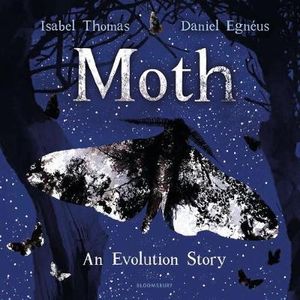
Moth: An Evolution Story, by Isabel Thomas/Illustrated by Daniel Egnéus, (June 2019, Bloomsbury Children’s Books), $18.99, ISBN: 978-1-5476-0020-5

Ages 5-8

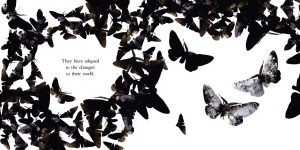
This stunning book tells the story of the peppered moth and its evolution, and humanity’s intervention in the process. Originally, peppered moths emerged as light with dark speckling; dark moths were easier to spot against trees and were easy prey. But as humans created factories and machines, spewing pollution into the air, the branches moths sought out became blackened with soot, putting light peppered moths at the mercy of birds, bats, and other predators. But wait! We’ve gotten better! We’ve cleaned up our world, and the trees and surroundings have gotten cleaner again! The moths adapted once again, passing their speckled wings onto new generations. Moth is a powerful story of change and hope for the future, seen through the evolution of a single species directly affected by us.

This is one of the most visually stunning books I’ve read this year. Mixed media illustrations create gorgeous texture, and the moths seem to emerge from the pages in an almost dreamlike fashion. The factories and towers look menacing, silhouetted against grey and black skies; as humanity works to heal the earth, hopeful blue skies break through the gloom. The art and text together create a dramatic, emotionally powerful experience. Originally released in the UK last year, Moth has just hit U.S. shelves and is perfect to supplement a unit on evolution, environmentalism, and conservation.

Posted in Animal Fiction, picture books, Preschool Reads

Picture Book Roundup: Cats and Dogs, Bears, Birds, and Dinosaurs!

I’m still going through my BookExpo bags (okay, I’ve moved them from one area of my room to another), but in the meantime, I’ve got picture books to talk about! Some are available, some are up-and-coming, all are a pleasure to read. Let’s take a look at what’s good!

SumoKitty, by David Biedrzycki, (Aug. 2019, Charlesbridge), $18.99, ISBN: 9781580896825

Ages 5-9

A stray cat hangs around a sumo training center, hoping for some food. He’s about to be thrown out by the manager when one of the sumo shrieks: a mouse! Looks like the kitty has a new job and a new home, which he quickly becomes accustomed to. But the good life makes him lose his edge: he’s gained weight and the mice come back with a vengeance. Tossed back out into nature, Kumo, a kind sumo, lets the cat back in, but levels with him: the mice have humbled the cat like the sumo’s main opponent, the yokozuna, has humbled him. From there, SumoKitty starts a faithful training routine, inspired by Kuna’s disciplined regiment. When a mouse dares show up in the dojo next time, SumoKitty is there, pushing and tossing the mouse and his friends around until they clear out for good. He’s rewarded by not only being welcomed back to the dojo, but he’s given a sweet topknot haircut, too. He also gets a front row seat at the next sumo tournament, where he watches his friend Kumo face his own demons and takes on his longtime opponent.

A sweet story about overcoming challenges, SumoKitty is loaded with Japanese sumo terms and wise observations like “Fall down seven times; get up eight” and “Even monkeys fall from trees”. Adorable SumoKitty is cartoonish with large, expressive eyes and exaggerated facial expressions, while the sumo artwork appears inspired by Japanese woodblock paintings. The black and white endpapers give readers a before-and-after glimpse into the story, with a mouse running in a Zen garden as someone maintains the area; later, SumoKitty is fast asleep on a rock in the same Zen garden, no maintainer, and no mouse present. It’s a sweet peek into sumo culture and an all-around fun read. Jon J. Muth’s Zen Shorts, Zen Ties, and Zen Happiness are nice readalikes to SumoKitty; for a good giggle and a more madcap take on sumo, you can’t go wrong with David Wisniewski’s Sumo Mouse, which has been a favorite in my home since my eldest (now 20) was in Kindergarten and continues to be required reading with my first grader.

 

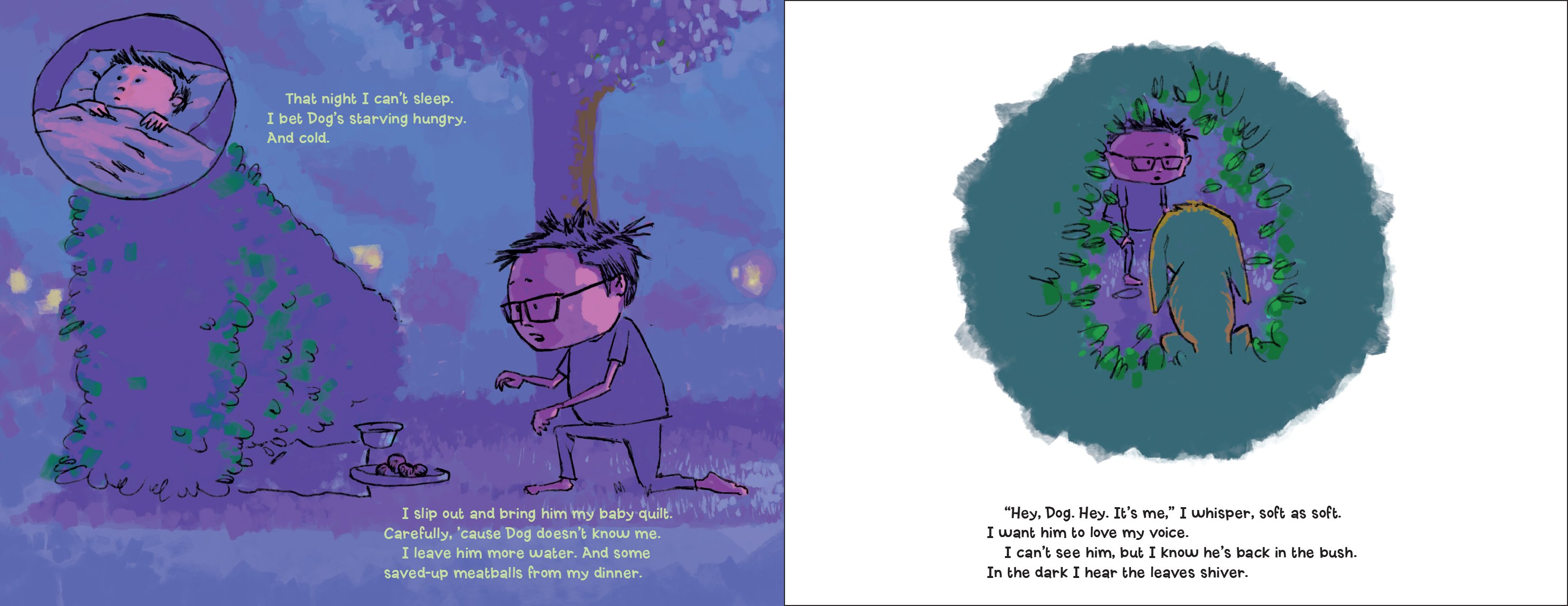
Hey, Dog, by Tony Johnson/Illustrated by Jonathan Nelson, (June 2019, Charlesbridge), $16.99, ISBN: 9781580898775

Ages 4-8

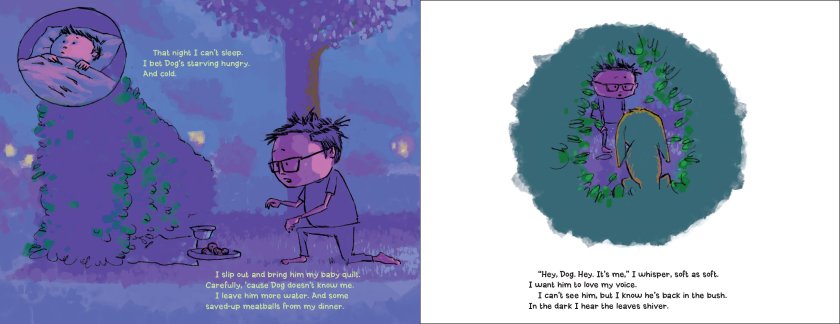
A boy finds a dog hiding in a bush. The dog is afraid, runs, but the boy returns, time and again, to care for the dog, leaving him food, water, even an umbrella propped up to cover him in the rain. The boy confides in his mother that the dog is skinny and has scars; he refuses to give up on Dog, determined if not to earn his trust, then to care for him.

Hey, Dog crushed me. It’s just gorgeous writing that packs an emotional punch. The boy’s relationship with his mother, who is nervous – her son is trying to care for a strange dog that could very well bite him, right? – but supports her empathetic child, helping him in any way she can and the boy’s quiet resilience in the face of Dog’s fear and mistrust will make you have hope for people after all. The boy is written so wonderfully, whether he’s asking a shopkeeper if his dog food “is the most luscious” or when he drops to his knees, tears “warming his face”, as he tries to comprehend how anyone could have it in them to hurt an animal. Dog is illustrated to provoke another emotional gut punch; his cringing and reticence come through so viscerally, it’ll bring tears to your eyes. Seeing this poor pup, single paw raised, ribs poking through his coat, and trusting once more to lick the boy’s hand make this story a powerful, must-have book for you collection. Read this, hand this to kids, talk about the need for empathy in our world.
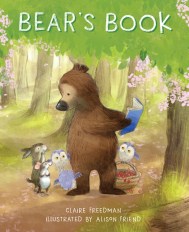


Bear’s Book, by Claire Freedman/Illustrated by Alison Friend, (May 2019, Templar Books), $16.99, ISBN: 9781536205718

Ages 4-8

Bear loves to read, but his favorite book of stories has been read to bits! He decides to create his own story, but holy writer’s block, he can’t think of anything! He decides to go for a stroll and see if inspiration hits, and meets several friends along the way. When he returns home and goes over his day, he realizes that the best inspiration comes from one’s own adventures!

This is an adorable story of inspiration and friendship, and fits nicely with Small Moments writing prompts. Bear’s adventure is a series of small moments, pulled together to create a lovely adventure. He’s inspired by his friends, and they have all enjoyed their friend’s company for a day. A fold-out spread publishes Bear’s story for his friends – and our – enjoyment. Mixed media illustrations are gently rendered with soft earth tones.  This one is a sweet storytime pick, and good inspiration for a Summer Reading creative writing program.


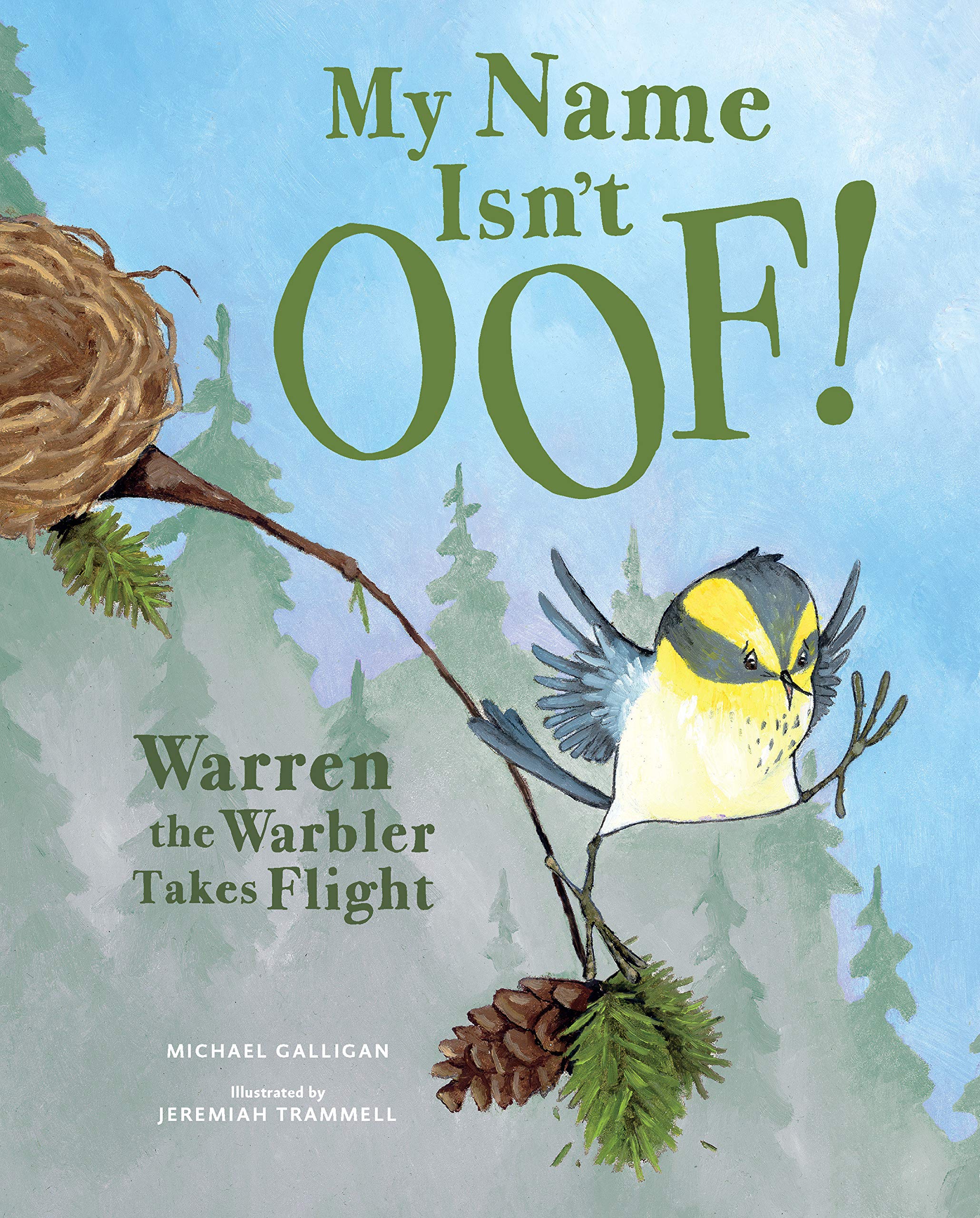
My Name Isn’t Oof!: Warren the Warbler Takes Flight, by Michael Galligan/Illustrated by Jeremiah Tramell, (May 2019, Little Bigfoot), $17.99, ISBN: 9781632171931

Ages 4-8

A little bird tries to fly after watching his siblings take off, but he falls, landing with a giant, “Oof!” Naturally, every animal in the forest has an opinion, and to add insult to injury, they all call him “Oof”! The chipmunk says he forgot to jump; the Mouse says he needs to spread his wings; Squirrel says he has to flap. While they all have feedback aplenty on Warren’s flying prowess, they manage to bonk, push, and trip one another up, but Warren – who keeps protesting this new nickname – finally takes to the sky, to everyone’s cheering!

A cute story of perseverance with some hilarious physical comedy, My Name Isn’t Oof! will have younger readers giggling during a read-aloud, especially if you move around and act out the story. The repeated phrase, “My name isn’t Oof!” is a good discussion point to get kids talking about how unwanted nicknames can stick; you can also point out that while all the animals jump to find fault with Warren’s first flight, they’re just as clumsy as he is: no one is perfect! Back matter includes a paragraph on the Townsend Warbler, the kind of bird our star Warren is, and what readers can do if they find a baby bird fallen from a nest. Suggest Charlie Alder’s Daredevil Duck as a readalike for more humorous stories of overcoming obstacles.


How To Take Care of Your Dinosaur, by Jason Cockcroft, (May 2019, Nosy Crow), $15.99, ISBN: 9781536205688

Ages 3-6

Taking care of your very own dinosaur is a very big job! How to Take Care of Your Dinosaur is here to help. Written similar to a handy-dandy manual, the book takes a look at some of the more light-hearted moments in pet parenting a dinosaur. Taking your dino for a walk? Bring a bucket and a shovel, there’s no pooper scooper that’s built for this job. Dinos can be a little tough on sharing, so make sure to get them around new people and encourage them to make friends! The book stresses the importance of routine when caring for your dinosaur; something parents and caregivers will appreciate!

Digital illustrations are adorable and feature soft colors. The endpapers add to the fun: the front endpapers show a mailman struggling under the weight of a gigantic package (the egg); the back endpapers show a brick wall, papered with “Dino Sale” flyers, and feature the poor mailman laboring with two giant packages this time.

A fun storytime addition. Pair with Dragons Get Colds, Too for a fun, wacky pet-related storytime.


Posted in Fiction, Graphic Novels, Historical Fiction, Middle Grade, Teen, Tween Reads

Queen of the Sea: Re-imagined History

Queen of the Sea, by Dylan Meconis, (June 2019, Candlewick Press), $24.99, ISBN: 9781536204988

Ages 10-14

Inspired by Queen Elizabeth’s exile when her sister Mary I ascended the throne, Queen of the Sea begins with the banishment of Queen Eleanor, a young monarch of an embattled kingdom, to an island where nuns live, pray, garden, and sew. Margaret is a young girl who has spent her entire life on the island in the care of the nuns and finds herself drawn to Eleanor. Margaret learns about the island and the reasons behind her presence there, and quietly begins planning with Eleanor and a mysterious man who washes up on the island one stormy night.

Queen of the Sea is gorgeously created historical fiction with fully realized characters and a solidly constructed plot filled with intrigue; revelations; world-building, even light romance. Dylan Meconis’ pen, ink, and gouache artwork will appeal to Raina Telgemeier and Victoria Jamieson fans; the characters are softly realistic with period costuming and soothing earth and sea colors. I particularly love the back-and-forth between present moment storytelling and Margaret’s narration of history and myth, rendered to appear as stone or stained glass. The character growth is a joy to witness: Eleanor, from a taciturn exile to an embattled young woman embracing her feelings, and Margaret, a naïve child to a young woman coming into herself and her own intelligence make this a wonderful read. An author’s note discusses Elizabeth I’s inspiration of Eleanor. Graphic novel gold.

Queen of the Sea has starred reviews from Kirkus, Publisher’s Weekly, Booklist, and School Library Journal. You can read an excerpt at Candlewick’s website.

Posted in Uncategorized

Two picture books about summer… and life

Waiting for Chicken Smith, by David Mackintosh, (May 2019, Candlewick Press), $16.99, ISBN: 9781536207712

Ages 4-8

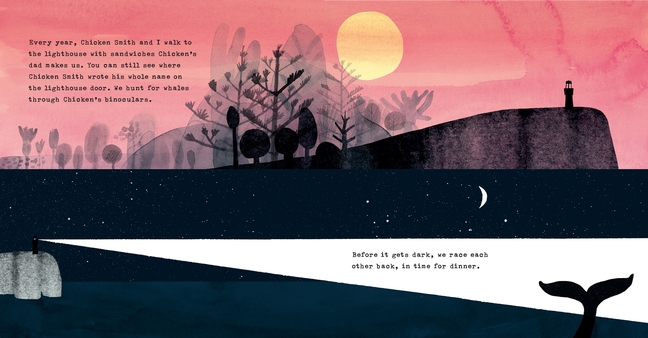
A young boy waits for his friend to show up at the family’s summer rental in this story about summer, relationships, and change. The boy, a child of color, narrates the story as he waits for Chicken Smith to show up. The boy talks about Chicken Smith, his dog, Jelly, and the fun summers the two friends have had in the past as he waits, holding a “crazy shell from the gas-station shop” as a gift. Where the heck is his friend? Readers know; in the beautifully detailed pages, we see an empty cabin with a “Summer Rental” sign. The boy’s sister finally manages to get his attention, and the two glimpse a whale: something he and Chicken Smith have never been able to catch together, not even with binoculars. The boy and his sister head back to the cabin and enjoy their evening together, and he wonders if he’ll see Chicken Smith next year.

Originally published in the U.K., Chicken Smith is a story about change and summer friendships. Readers feel the boy’s longing as he waits for his friend; it’s in his voice as he recalls summers past, the cool shell he found for him, and the fact that he’s so focused on waiting for Chicken Smith that he ignores just about everything going on around him. His sister is finally able to get through to him through sheer persistence, and that’s when the Chicken Smith spell is broken: there’s a whale to watch. The story is almost achingly sad at points; when the boy askis, “What is taking Chicken Smith so long, anyway? We’re missing out on everything”, we just know he won’t be there this year – and sure enough, the next page shows an empty cabin, and the boy describes the windows being shut and seeing a cobweb with a fly in it. David Mackintosh pulls readers and the narrator back from the brink by giving us a new relationship to discover: the relationship between the boy and his sister, brought together by the whale. The two go back to their cabin and look at his whale book, then make plans to go on a shell hunt. The boy ends on an optimistic tone, hoping he’ll see Chicken Smith next year, but deciding to enjoy his sister’s company for this year. The pen, pencil, ink, watercolor, and kraft paper artwork come together to create a child’s scrapbook-like feel for summer memories.

Waiting for Chicken Smith has a starred review from Kirkus.


Sea Glass Summer, by Michelle Houts/Illustrated by Bagram Ibatoulline, (May 2019, Candlewick Press), $16.99, ISBN: 9780763684433

Ages 5-8

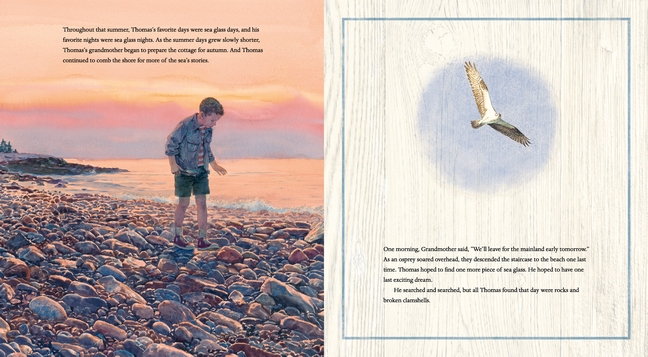
A boy named Thomas explores the beach by his grandmother’s seaside cottage. Using his grandfather’s magnifying glass, he discovers the complex beauty in nature: grains of sand look as big as rocks, and clamshells have swirls of color. But the discovery of sea glass is what really fascinates Thomas. Learning how sea glass is made – a piece of glass, dropped into the sea, becomes worn smooth and cloudy over time – and that his grandfather said that “every piece of sea glass has a story all its own” fuels his imagination; he finds himself dreaming of ship christenings and ships caught in storms; stories that could give rise to the found glass on the beach. When he and his grandmother head back to the mainland, the magnifying glass shatters, and he tosses the glass into the sea. Years later, a girl named Annie discovers sea glass on the beach, and brings her discovery to her grandfather, an older man she calls Papaw Tom.

Sea Glass Summer is a moving inter-generational story that beautifully recreates the feel of summer: warm, lazy days on the beach; the smell of the sea air, the grains of sand, rough against your fingertips, the smooth sea glass in the palm of your hand. In between these cozy summer memories, there’s a story that reaches across decades, linking a grandfather and his granddaughter, in a story that stirs the imagination and tugs at the heartstrings. An author’s note notes that sea glass was more common in the days before recycling awareness.

I loved Sea Glass Summer. This one is a summer classic.

Sea Glass Summer has a starred review from Kirkus.

Posted in Intermediate, Middle Grade, Non-fiction, Non-Fiction

New York City gets a park: A Green Place to Be

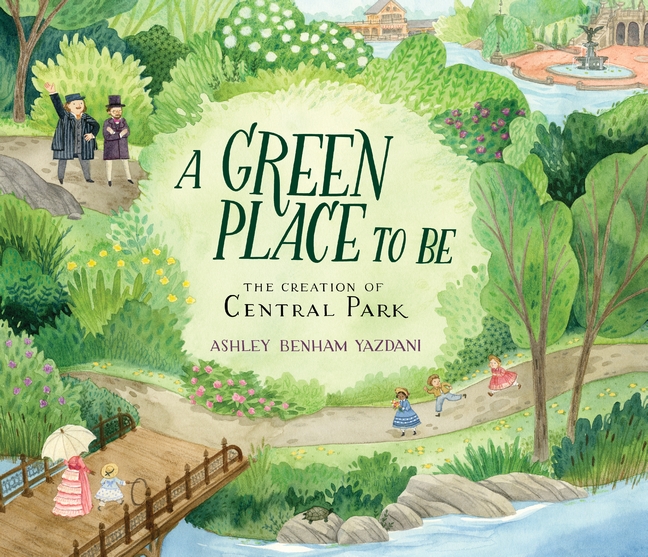
A Green Place to Be: The Creation of Central Park, by Ashley Benham Yazdani, (March 2019, Candlewick Press), $17.99, ISBN: 9780763696955

Ages 7-10

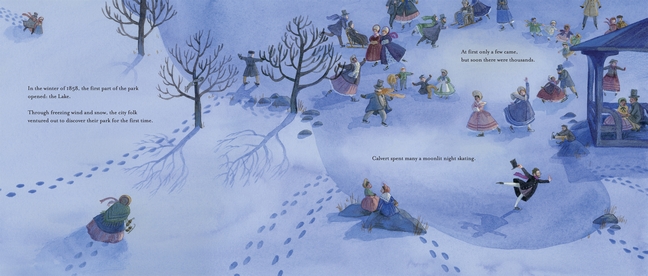
This beautiful and lushly illustrated history of Central Park starts with the land’s beginnings, as a barren area where farm animals and industrial waste left much to be desired, and the design contest devised by architect Calvert Vaux – a contest that he also entered with every intention of winning. A Green Place to Be follows Vaux’s and park superintendent Frederick Law Olmsted’s vision, focusing on their planning, execution, and invitation to artists to join in the effort. The winter of 1858 saw the first park of the park, the Lake, open for visitors; in the summer of 1859, the woodsy Ramble joined the landscape, followed by the Children’s District.

Illustrated in watercolor and pencil, this is a loving tribute to an iconic green space and the men and women who created it. Back matter includes profiles of both Olmstead and Vaux, and a Q&A on spaces within the park. Sharp-eyed readers will love returning to the illustrations again and again to find squirrels, bridges, and other affectionately placed details. There is an author’s note and bibliography for further reading.

A Green Place to Be is a love letter to New York’s green spaces and creativity. Central Park’s website has extensive information about the park, including a calendar of events and links to social media. Planetizen has a good article on teaching urban planning to preschoolers; this could be a fun activity where kids can learn and create their own green spaces! National Geographic has a fun Design a Park activity for middle grade kids, and the STAR Library Network has a printable Design a Park activity that will work with large groups of kids. It’s a fun springtime program!

Posted in Intermediate, Middle Grade, Non-fiction, Non-Fiction

To Infinity and Beyond! The Day the Universe Exploded My Head

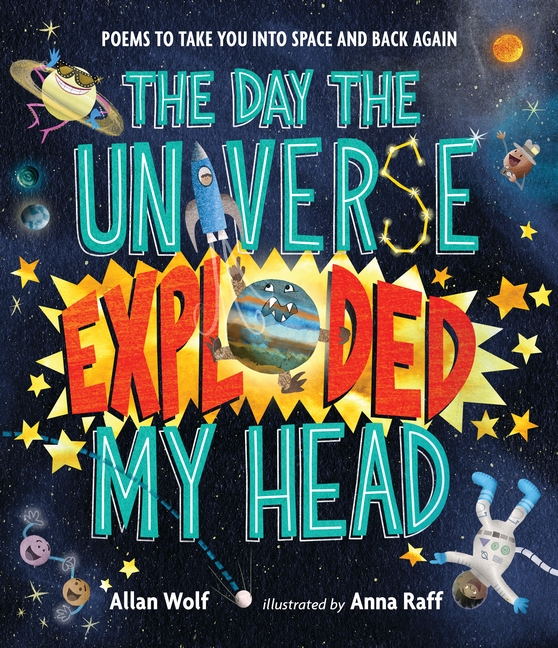
The Day the Universe Exploded My Head: Poems to Take You Into Space and Back Again, by Allan Wolf/Illustrated by Anna Raff, (March 2019, Candlewick Press), $17.99, ISBN: 9780763680251

Ages 7-12

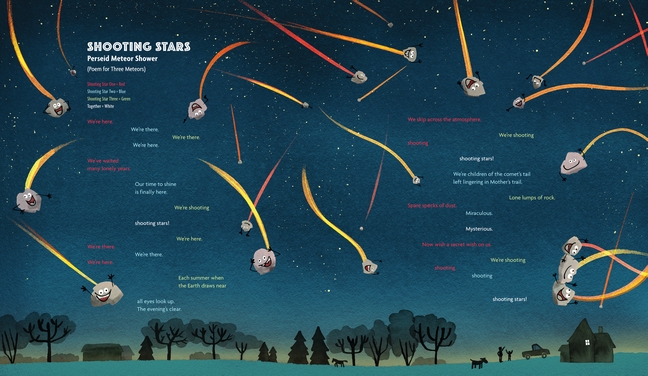
This is one of the best kids’ poetry books I’ve come across in a while! The Day the Universe Exploded My Head contains 29 poems, all about the wonder of space. Each planet gets a poem here, as do the outliers (Planet X, Charon, Pluto). There are nods to pivotal moments in space history (the 2013 meteorite over Cheylabinsk, Sputnik) natural phenomena (black holes, lunar and solar eclipses), and notable scientists (Ivan Ivanovich, Children of Astronomy). The poems are upbeat, factual, and, quite often, very funny, as with the poem, “Planet X”: “I’m one part supercilious/Another part mysterious/One part you-can’t-be-serious/They call me Planet X”. There are a wealth of poems for readers to read out loud, too: “Going the Distance” is a rap for two voices, color-coded for each speaker. The artwork: digitally assembled color collage, made from sumi ink washes, salt, pen, and pencil, explode off the page, with texture that will entice kids to see the swirls of light curling off a star and a fuzzy rings of moons around Neptune.

Non-fiction that informs and excites is aces with me, and The Day the Universe Exploded My Head is a great way to kick off and conclude a space storytime, a STEM program, or a fun read-aloud. Have some printable space coloring sheets ready to hand out, or check out illustrator Anna Raff’s webpage for super-cool activities (I like the Little Card printable for a library visit). Author Allan Wolf’s webpage also has activities, including poetry jokes.

The Day the Universe Exploded My Head has starred reviews from Kirkus and Booklist.