Posted in Non-Fiction, picture books, Preschool Reads

Three great books about space!

The Summer Reading theme for this year is all about Space, and I am psyched. I love outer space, and I’ve got a growing list of books to add to my own readers advisory lists (I’ll put that together in the next week or two for a post). Meanwhile, Sourcebooks and Barefoot Books have three great books about space that are staggered throughout the year, and perfect for your space-faring STEM fans. Let’s check them out, shall we?
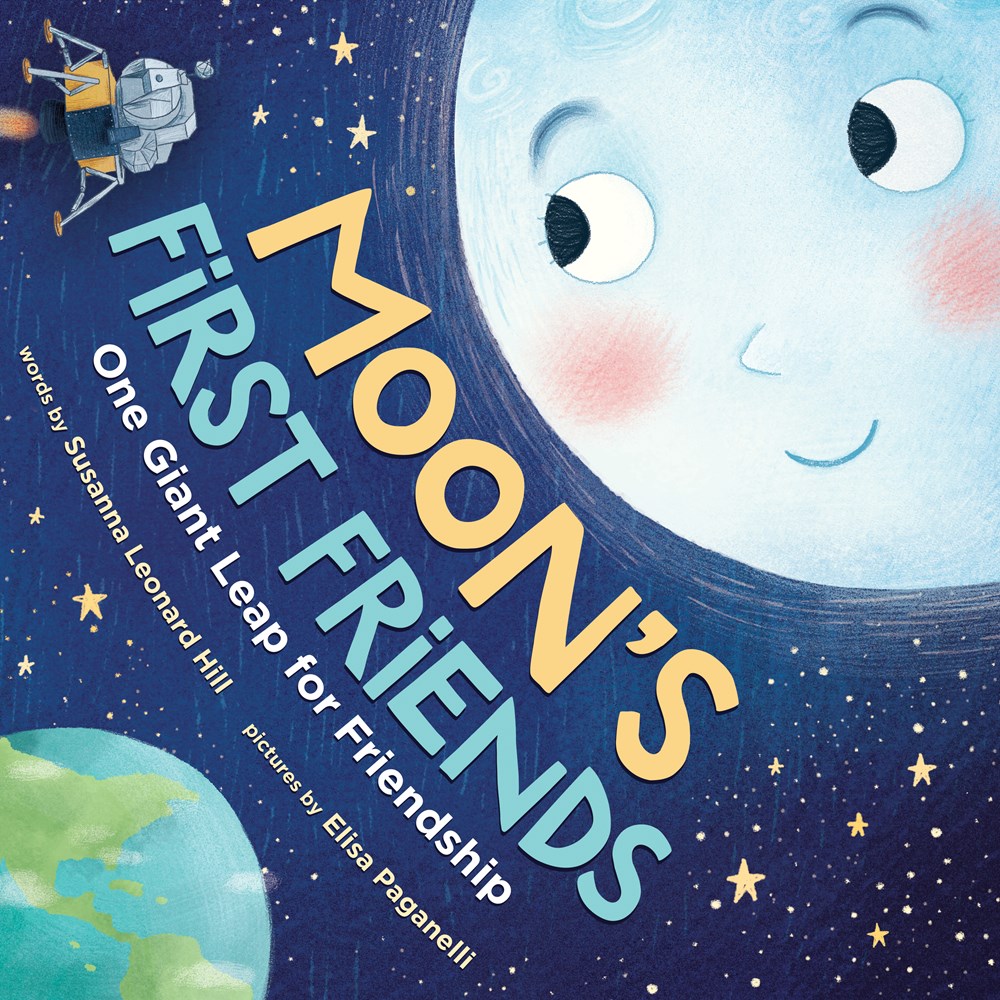
 

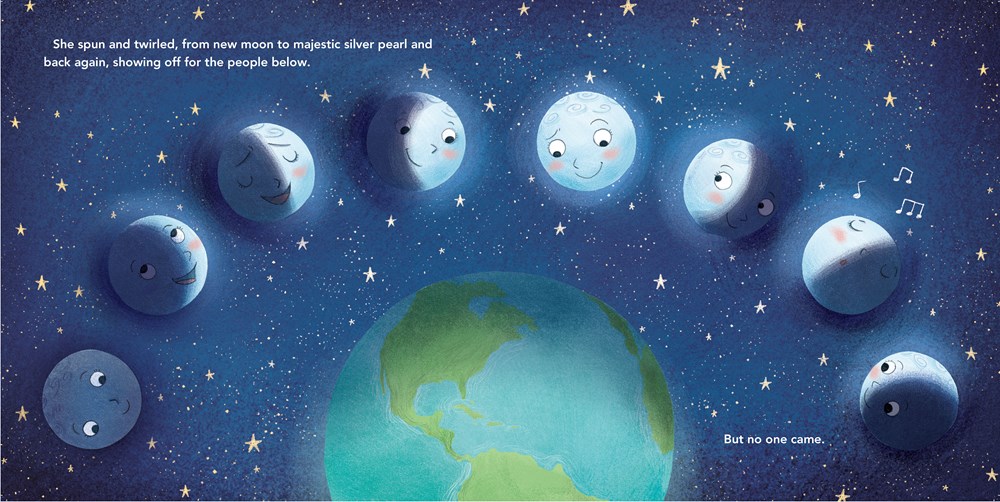
Moon’s First Friends: One Giant Leap for Friendship, by Susanna Leonard Hill/Illustrated by Elisa Paganelli, (June 2019, Sourcebooks Wonderland), $17.99, ISBN: 9781492656807

Ages 4-8

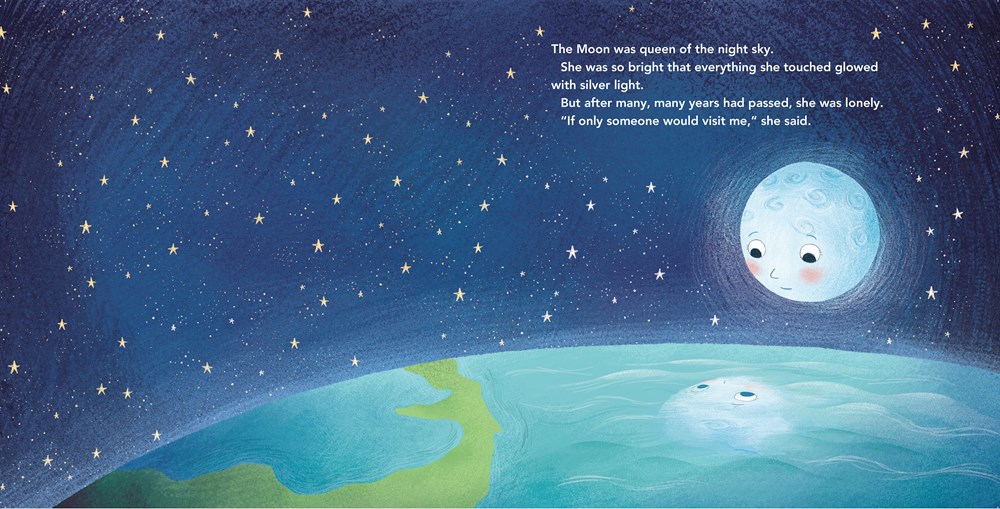
The Moon was so lonely, up in the night sky by herself. When she sees life developing on Earth, she patiently waits for someone to notice and visit her. It takes a while: the dinosaurs don’t notice; early people build pyramids and structures that just aren’t high enough. Eventually, though, she gets some visitors, and she is thrilled! She gives them presents of rocks and dust to take back to Earth, and they give her a beautiful flag and a plaque. Now, Moon is in the sky, happy and waiting for more visitors. Will you be her next guest?

This is the sweetest story I’ve read yet on the Apollo 11 mission to the Moon. The Moon is illustrated as a softly shining, opalescent sphere with kind eyes, rosy cheeks, and a sweet smile; readers are treated to a quick history of Earth’s development as the Moon quietly observes, waiting for a friend to reach out – or up – and say hello. She even dances around the planet, showing off her phases! The actual Apollo mission takes up a brief part of the story, making this sweet book about a lonely satellite who just wants a friend an adorable storytime read for younger kids, and a fun book with solid facts for school-age kids. There’s a brief bibliography on the verso page, and back matter includes several pages dedicated to Mission Moon, the Apollo 11 voyage; moon facts, and moon phases, along with a running timeline of Earth’s formation and development. Endpapers are starry nights, where kids can imagine sailing through the stars to visit their favorite moon. Readers can also scan a QR code to hear Neil Armstrong’s historic first words from the 1969 moon landing. Gentle storytelling and adorable illustration make this a great Summer Reading addition! Display and booktalk with Stacey McAnulty’s Moon, Earth, and Sun trilogy.
 

There Was a Black Hole That Swallowed the Universe, by Chris Ferrie/Illustrated by Susan Batori, (Sept. 2019, Sourcebooks Explore), $17.99, ISBN: 9781492680772

Ages 3-8

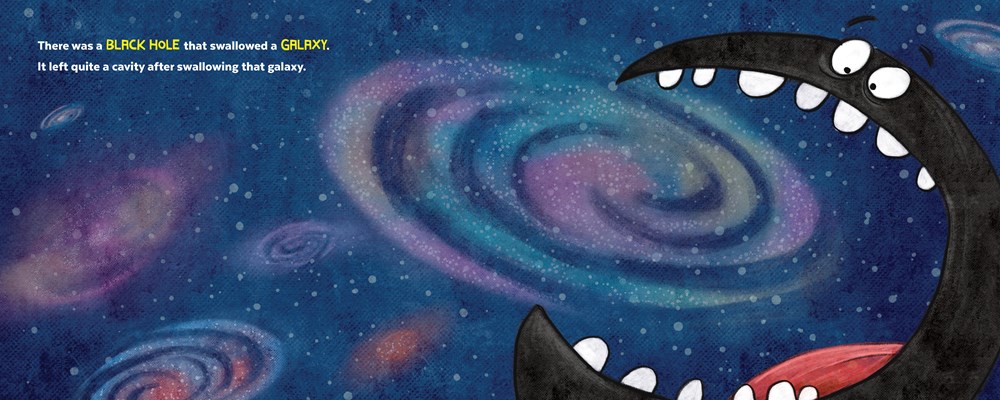
You know if Chris Ferrie is writing a book, I’m reading it. This STEM-errific take on There Was an Old Lady Who Swallowed a Fly is about a giant black hole that swallows… well, everything. He starts with a universe… it couldn’t get worse! But oh, it does: the black hole swallows planets, stars, galaxies, and atoms, molecules, and quarks along with it. Yikes!

I read this to my first grader this morning and he immediately smiled and said, “This is like The Old Lady story!”, so kids familiar with the classic tale (and all of its spin-offs) will immediately jump in and know what’s coming; how the story will progress. With each chomping, the black hole gets bigger, and the planets and heavenly bodies look hilariously terrified as they try to get away from its maw. The storytelling is fun and loaded with humor; it’s cumulative and rhyming storytelling at its scientific funniest. The illustrations are goofy, with exaggerated facial expressions that make the storytelling more dramatic and humorous as you go. Bone up on your keyword knowledge for kids who will ask during the story (neutrons, atoms, quarks, oh my!). Scientific terms are highlighted in bold yellow, and capitalized to stand out and give your readers a nice working STEM vocabulary. Shine a blacklight on the pages from back to front, and you’ll reveal a super-cool, hidden history of the universe’s creation!

Absolute fun and a must-get for your storytime collections. Be a rock star at Science Storytime! Pair this with The Universe Ate My Homework by David Zelster for more black hole-related fun.

 

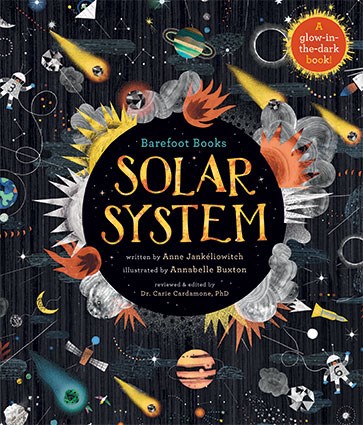
Barefoot Books Solar System, by Anne Jankéliowitch/Illustrated by Annabelle Buxton, Translated by Lisa Rosinsky, $19.99, ISBN: 9781782858232

Ages 8-12

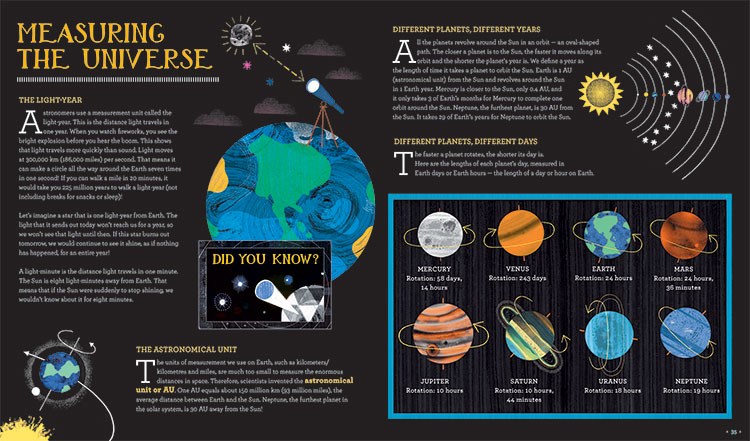
Riding high on the post-Summer Reading wave, middle grade kids can go back school and check out Barefoot Books Solar System, a glow-in-the-dark, interactive guide to our Milky Way, complete with lift the flap booklets, a pull-out map, and beautiful artwork. Originally published in French, the book has been reviewed, edited, and updated by Dr. Carie Cardamone, professor of STEM education and Boston Museum of Science teacher and educator. The text is written with a tongue-in-cheek sense of humor while delivering solid nonfiction goods to middle graders. The book covers each planet, with nicknames like :Saturn: The Space Diva”, and “Uranus and Neptune: The Icy Sisters”; the asteroid belt; differences between solid and gas planets; measuring the universe, and famous outer space voyages. The artwork is bright and bold, seeming to explode off the black pages to grab the reader’s attention.

In keeping with Barefoot’s mission of diversity and inclusivity, there is information about space exploration from around the world, making this a truly global effort. Back matter includes a comprehensive glossary of scientific terms and a note on the units of measurement used in the book. Don’t pass this one up; your 520s will shine a little brighter with Barefoot Books Solar System on your shelf.

Posted in Intermediate, Middle Grade, Non-Fiction, Non-fiction, Non-Fiction, picture books, Preschool Reads, Tween Reads

Space… The Final Frontier…

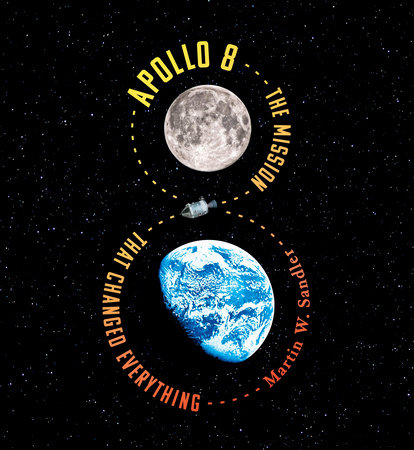
…these are the voyages of the starship Bibliomaniac. My continuing mission: to bring you the coolest books about space, while butchering a beloved TV show’s intro. This post has a books that should appeal to fiction and non-fiction lovers alike. Because it’s SPACE! Planets! Stars! Rocket ships! So whaddaya say? Join me! After all… Stardust Explores the Solar System (Stardust Science), by Bailey and Douglas Harris, (Apr. 2018, StoryBook Genius Publishing), $10.95, ISBN: 9781941434918 Ages 5-9 Stardust Science is a kids’ nonfiction series from a small-press publisher that I’ve just been turned onto. Bailey and Douglas Harris are a daughter-father team who write some pretty fun books starring a girl who loves science and is named named Stardust. Stardust Explores the Solar System is the second Stardust book, and here, Stardust takes readers on a tour of our solar system and its formation, and a trip to each planet. Spreads have a brief, informative paragraph and artwork placing Stardust on each planet, whether she’s driving an exploration craft across Venus or freezing atop Uranus. Extra fun facts focus on the possibility of extraterrestrial life, the Kuiper belt and dwarf planets, and the asteroid belt. Stardust Explores the Solar System was a successful 2017 Kickstarter (which is where I found the internal artwork for this post), and there’s a current Kickstarter for the next book, Stardust Explores Earth’s Wonders. You can pick up copies of My Name is Stardust and Stardust Explores the Solar System from the Stardust Science webpage. It’s a fun book, co-written by a 12-year old Neil DeGrasse Tyson fan, so how can you go wrong? It’s a nice additional book to big collections, and a sweet way to empower your younger readers. My 6-year-old loves this one and says he’s ready to write his own book.   The Universe Ate My Homework, by David Zeltser/Illustrated by Ayesha L. Rubio, (Aug. 2018, Carolrhoda Books), $17.99, ISBN: 978-1512417982 Ages 6-8 Abby’s a little girl who has homework to do, but UGH. She’d rather be stargazing with her dog, Cosmo, or talking to her physicist dad. He’s been thinking about universes, and how to make a baby universe, which gets Abby thinking. She sneaks into her dad’s study and works on making her own black holeout of the dreaded homework! It takes a lot of squeezing and a lot of energy, but Abby and Cosmo have done it! But what happens when a black hole’s gravity kicks in? HELP! This is an absolute fun way to explain the science of black holes to kiddos. What better way to get rid of your homework than by turning it into an actual science experiment? Kids will be squeezing the daylights out of their looseleaf for weeks to come, waiting for their own wee Big Bang. The artwork is too much fun, with something to see in every spread: the John Coltrane album and record player in the family living room; Dad’s study is loaded with things to see, including a framed picture of Marie Curie, family photo, Abby’s family drawing, and a postcard depicting a scene from  Georges Méliès’s 1902 A Trip to the Moon. The mini galaxy Abby creates unfolds for readers, starting first with swirls and stars, then with planets. It’s a fun book that makes for a great storytime, and a teacher’s note to Abby (you didn’t forget about the homework, did you?) at the story’s end will leave kids and adults alike laughing out loud. An author’s note gives a little more information about black holes and baby universes. Add this one to your collections and get your little ones contemplating astrophysics! Apollo 8: The Mission That Changed Everything, by Martin W. Sandler, (Oct. 2018, Candlewick), $24.99, ISBN: 978-0-7636-9489-0 Ages 10+ It was 1968, and the U.S. was about to make a huge gamble. America was deep into the Cold War with the USSR, and the country was fraying at the seams after the assassinations of Martin Luther King Jr. and Robert F. Kennedy; it was a country where the civil rights movement and the Vietnam War caused violent clashes. We needed something to unite us. Russia had already launched the first man-made satellite to orbit Earth, Sputnik I – in 1957, but now, they were getting ready to go to the moon. America was determined to get there first. But first, we had to get into space. Apollo 8: The Mission That Changed Everything is a brilliantly written chronicle of NASA’s mission to put a craft into orbit around the earth. Loaded with black and white and color archival photos and written by one of the most well-known names in children’s and young adult nonfiction, this is a must-have for your middle grade and middle school collections. With the 50th anniversary celebration of the Apollo 8 mission falling in December of this year, this is going to be an in-demand title in classrooms and libraries. Martin W. Sandler is an award-winning writer – a two-time Pulitzer nominee, five-time Emmy winner, and Boston Globe-Horn Book Honor winner – who makes nonfiction read as compulsively as solid fiction; There are extensive source notes and a bibliography for further reading and research.
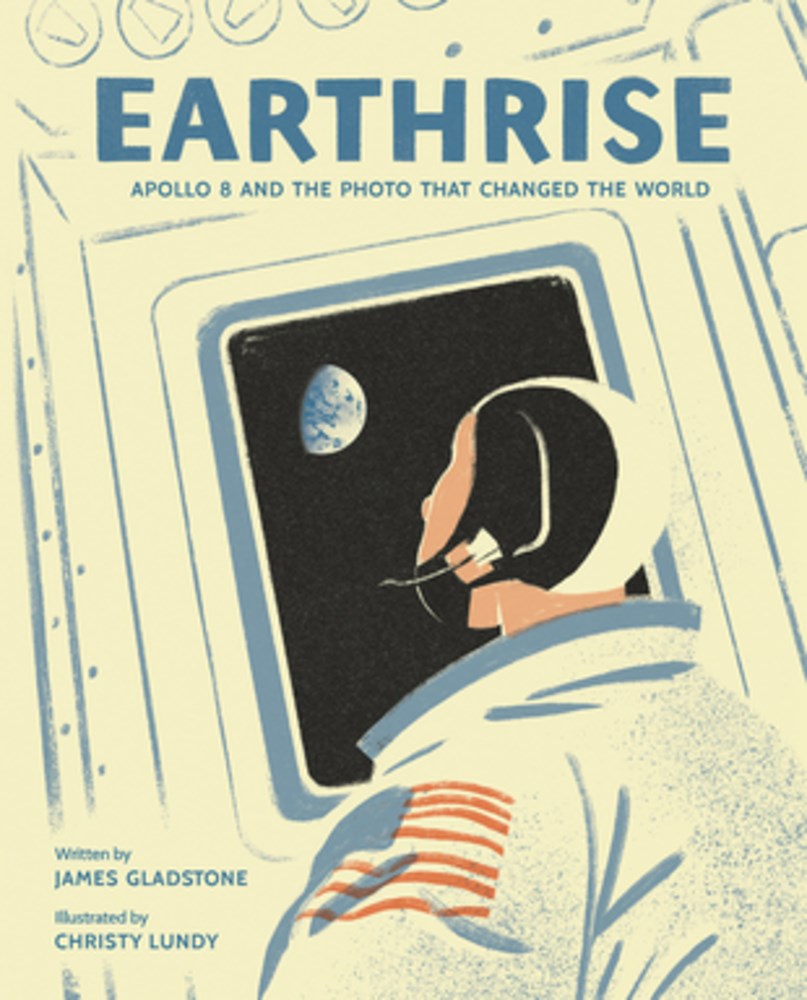
Earthrise: Apollo 8 and the Photo That Changed the World, by James Gladstone/Illustrated by Christy Lundy, (Oct. 2018, OwlKids Books), $16.95, ISBN: 9781771473163
Ages 4-8
This is the year for Apollo 8 books! Earthrise is a gorgeous picture book that tells that story of Earthrise, the history-making photo of Earth, taken from lunar orbit, taken by astronaut Bill Anders. The story shows readers how this single photo took us from a planet full of conflict to a global community – if only for a moment. We see the story from shifting perspectives: the crowds gathered in anticipation, the men in Mission Control, and an African-American family, with a little girl who dreams of being an astronaut one day.
The text is just beautiful. James Gladstone creates a mood of wonder as he writes lines like, “Now the craft was coasting on a human dream, speeding the crew off to another world”, and “The astronauts saw the whole turning Earth – no countries, no borders – floating in the vastness of space”. Back matter includes a piece on how the Earthrise photo changed the world, and an invitation to readers to share what Earthrise means to them. It’s the perfect program in a book! Show the original Apollo 8 launch broadcast, this NASA Apollo 8 documentary, and/or the broadcast Apollo 8 Christmas Eve message and ask kids to talk about what seeing the Earthrise makes them feel, 50 years later. Paired with Christy Lundy’s vintage-inspired artwork, Earthrise is a necessity in your nonfiction collections. Earthrise has a starred review from Kirkus.
To the Moon and Back, by Buzz Aldrin with Marianne J. Dyson/Paper engineering by Bruce Foster, (Oct. 2018, National Geographic), $32, ISBN: 978-1-4263-3249-4
Ages 6+
How much fun is a pop-up book about SPACE? With ROCKETS?! Buzz Aldrin, Marianne J. Dyson, and Bruce Foster take readers on a trip through “humanity’s greatest adventure”. Learn Buzz Aldrin’s nickname on the mission; read about the launch and landing; souvenirs left on the lunar surface, and the astronauts’ return, all accompanied by amazing paper engineering: pop-up rockets, fold-out lunar landings, and side flaps that offer even greater information – and a few laughs. If you’re getting this for a library or classroom collection, put it in reference; it will get beaten up pretty quickly. The book also comes with a paper Apollo 11 lunar module kids can engineer on their own. (We haven’t built that one yet.) Want to make a space fan happy? Put this on your holiday and special occasion shopping lists. Read more about the 1969 Moon Landing on NatGeo’s webpage.
Whew! Okay, that’s all I’ve got for now, go forth and explore!