Posted in Fiction, Middle Grade, Middle School, Realistic Fiction, Tween Reads

Grief and conflict collide in The Girl with More Than One Heart

The Girl with More Than One Heart, by Laura Geringer Bass, (Apr. 2018, Amulet), $16.99, ISBN: 9781419728822

Ages 10+

Briana is starting her eighth grade year when her father dies of a sudden heart problem. Her mother spirals into grief, leaving Briana with the responsibility of caring for her 5-year-old brother, Aaron, who’s on the autism spectrum. Briana thought of her father as “her” parent and her mother as “Aaron’s parent”, which introduces frustration and resentment on top of her own grief. Briana feels a “second heart” form in her stomach, which communicates to her in her father’s voice, telling her to “find” her mother, and to “let go”.

Told in the first person in Briana’s voice, this novel is a touching, sensitive look at the complicated grief process: it’s messy, frustrating, and filled with mixed emotions, especially when thrown into the volatile mix of adolescent emotions. The writing is so believable, so real, that I felt overwhelmed by both Briana’s and her mother’s grief at points. Readers receive a wealth of information through Briana’s “Before Aaron” flashbacks, back to when her mother had as much time for her as her father; back when they were a cohesive, whole family. This process also helps Briana become a more present sibling to Aaron, and to reach out to new friends when the opportunities present themselves. We get a glimpse of what grief can do to a parent, and the effect of that grief on a child, and we see how the extended family – in this case, Briana’s grandfather – have to take on roles that they may be unprepared for.

The Girl with More Than One Heart is a must-add to your realistic fiction collections, and keep this one in your booktalking pocket for books on grief and loss.


Readalikes:


Never That Far, by Carol Lynch Williams: Twelve-year-old Libby and her father work through their grief after her grandfather dies.

Ms. Bixby’s Last Day, by John David Anderson: Three school friends give their dying teacher the best day ever.

A Monster Calls, by Patrick Ness: Thirteen-year-old Conor’s mother is fighting cancer and losing; at the same time, a yew tree tells Conor stories and expects him to tell his.

The Haunted House Project, by Tricia Clasen: Andie tries to hold onto her mother’s memory by having her “haunt” the family home.

Counting by 7s, by Holly Goldberg Sloan: Twelve-year-old Willow loses both parents in a car accident, leaving her to find her place in the world.

Teen Librarian Toolbox and Pragmatic Mom have additional choices, all excellent reading.

Posted in Fantasy, Fiction, Graphic Novels, Middle Grade

Mighty Jack and The Goblin King: An incredible re-imagining of a classic tale!

Mighty Jack and the Goblin King, by Ben Hatke, (Sept. 2017, :01First Second), $14.99, ISBN: v

Recommended for readers 8-12

It’s here! The sequel to Mighty Jack (2016) is here! And the best part? It’s AMAZING.

Mighty Jack introduced us to Jack, his autistic sister, Maddy, and neighbor, Lilly. The trio discovered a magical garden that got a little out of control; Maddy was kidnapped, and Jack and Lilly set off through a portal, determined to bring her back. Mighty Jack and the Goblin King picks up with Jack and Lilly arriving in a way station of sorts; a crossroads between worlds. Lilly is injured, forcing Jack to continue alone, where he discovers the giants’ plan for his sister: to feed her to a mechanical “beast” that will grind her bones into dust, and eat her, securing their ability to rule until the next time the beast needs to be fed! Lilly, meanwhile, has been rescued and is being cared for by goblins, who plan to marry her to their goblin king.

Spoiler alert: It’s not David Bowie.


Posted in Fantasy, Fiction, Graphic Novels, Middle Grade, Tween Reads

Mighty Jack is a new twist on a beloved fable

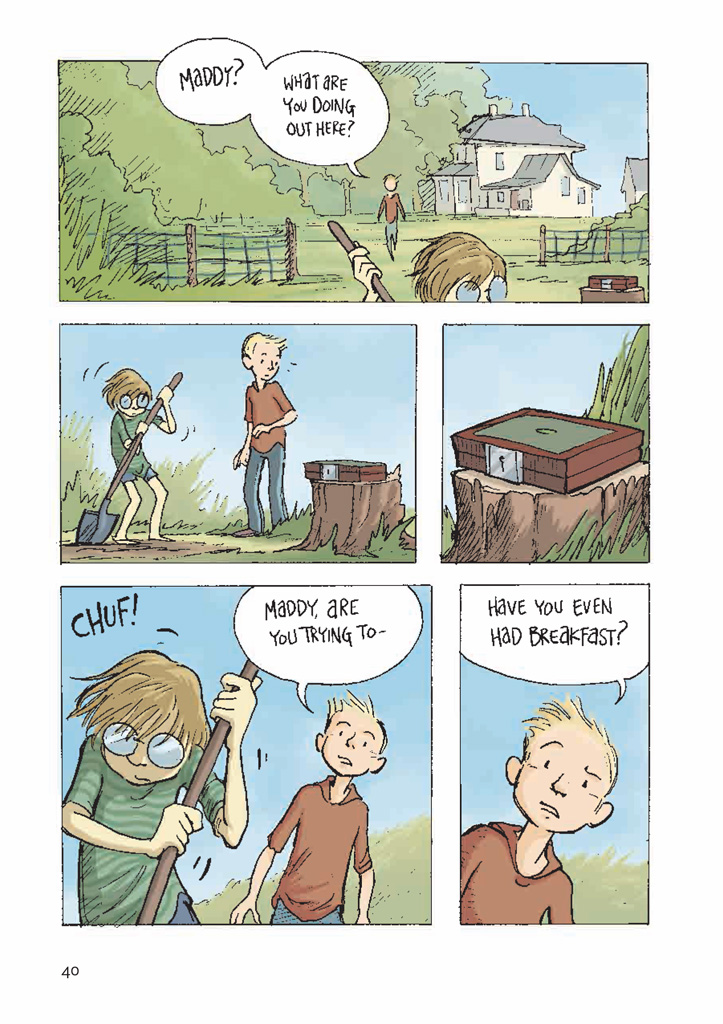
mightyjack_1Mighty Jack, by Ben Hatke (Sept. 2016, First Second), $22.99, ISBN: 9781626722651

Recommended for ages 9+

Jack is home for the summer, taking care of his autistic sister, Maddy, while his mom works two jobs to make ends meet. Maddy doesn’t talk often, but when she does, it’s about something that she’s passionate about – and she’s passionate about the box of seeds she discovers at a flea market. Before Jack knows what he’s agreed to, he’s traded his mom’s car for the seeds. Maddy’s happy, but Mom is not.

The seeds are planted, and a magical garden grows, delighting Maddy and their neighbor, Lilly, until things get a little out of hand. When a dragon appears one night, telling Jack that there’s evil in the heart of the garden, Jack is faced with tough decisions and their consequences.

I’ve said it before, and I’ll say it again: I love Ben Hatke’s books. From Zita the Spacegirl to Little Robot, to his storybooks (Julia’s House for Lost Creatures and Nobody Likes a Goblin), I love his very human characters – even when they’re a little something other than human. He brings the magical garden to life with vibrant greens, reds, yellows and purples, and his dragon is beautiful and menacing, all at once. Hatke weaves a very real story about a struggling family into his fantasy tale, and that’s where his strength lies: making the everyday extraordinary.

This is a definite add to your graphic novel bookshelf, and you’ll find yourself wondering when the next volume is due out. Because there has to be one, right? After that ending? Don’t leave me hanging, Ben!

Take a look at some more of Mighty Jack:

mightyjack_2mightyjack_3


Posted in Historical Fiction, Realistic Fiction, Teen, Young Adult/New Adult

Play Ball! Welcome to the Show takes us to Boston!

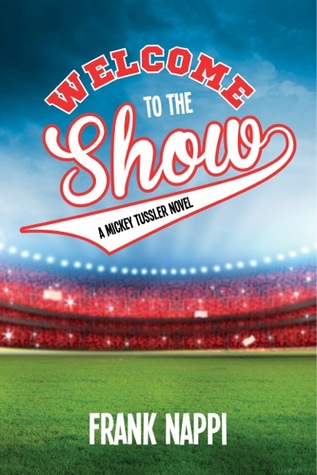
welcome to the showWelcome to the Show (A Mickey Tussler novel, book 3), by Frank Nappi (Apr. 2016, Sky Pony Press), $9.99, ISBN: 9781634508292

Recommended for ages 13+

In the third book of Frank Nappi’s baseball series, it’s 1950 and Mickey Tussler, a pitching wunderkind with autism, Lester, his friend and fellow ballplayer, up from the Negro Leagues, and coach (and stepdad) Murph are playing for the big leagues now. They’re in Boston, playing for the Boston Braves, and Murph is managing the team, who’s not thrilled with the new leadership or their two newest players. At home, things are rough, too: Molly, Mickey’s mom, is not settling into life in Boston and feels increasingly isolated. She wants to go back to Milwaukee, but Murph, terrified that he’s about to lose everything he’s worked so hard for, begs her to give Boston a chance.

Mickey’s finding himself the darling of the crowds as they see what he can do, but the press is quick to pry and capitalize on his challenges, whether it be pushing too deeply into his personal life or misinterpreting his words. Mickey’s struggling with his memories and forming new relationships, with the game – and his newfound celebrity – presenting new challenges. It’s a game of balance, as Mickey, Murph, and Molly all have to figure out where they stand with regard to one another, the game, and everyone around them.

This is my first Mickey Tussler book, but I found myself able to quickly get myself up to speed, thanks to Frank Nappi’s excellent exposition; he lays out past events clearly enough that you have enough of an idea of what’s going on to dive right in. I’m normally not a sports fiction reader, but Nappi’s descriptions of the games, layered with inner monologue and wordless interplay between players on the field, kept me interested and wanting to see more. I’ve heard stories of pitchers and batters getting into it with one another on the field, with pitches buzzing ears (or more), and there’s plenty of that here. ‘Lots of axes to grind between teams makes for some good baseball, and we even get a bench-clearing brawl at one point. Beyond the baseball, we have a deep story about a family meeting challenges. All of the characters in Welcome to the Show are remarkably fleshed out: Mickey, Lester, Molly, and Murph have had two other novels to develop, but the supporting characters: Jolene and her brother, Mickey’s teammate, Ozmore, for instance, have interesting individual stories that make me want to know more. Mickey’s frustration and confusion radiates from the page, and does Murph’s feelings of frustration and helplessness give him greater depth.

I’d suggest this as more of a new adult book than a young teen book for some language and overall story; while Mickey is 17 in the first book of the series, by now, he’s a young man in his early 20s. Add this to collections where sports fiction is popular, and booktalk it to teens who loved Mike Lupica’s middle grade books and are ready to move up.

The first book in the series, A Mile in His Shoes, was made into a TV movie, starring Dean Cain, in 2011.   You can read an excerpt from Welcome to the Show here and watch the book trailer below:

Posted in Non-Fiction, Teen, Tween Reads

Daniel Stefanski Teaches Us How to Talk to An Autistic Kid

HowToTalkToAnAutisticKidHow to Talk to an Autistic Kid, by Daniel Stefanski/illustrated by Hazel Mitchell. Free Spirit Publishing (2011), $12.99, ISBN: 978-1575423654

Recommended for 8+

Daniel Stefanski, an autistic teen, wrote this book to teach other kids (and adults!) about autism from a more personal point of view. There are many guides and books out on the market, but Daniel’s personal approach and point of view, combined with Hazel Mitchell’s friendly, two-toned digital illustrations, make a greater impact. He isn’t using clinical speech and medical language, nor is he a parent taking sides in a debate. He’s a kid who wants other kids to understand him, befriend him, like him, and understand, befriend, and like other kids with autism. He explains behaviors that other kids may not understand, like flapping or humming, for instance; he discusses issues including eye contact, personal space, and most importantly, how other kids can reach out to and connect with autistic kids in their lives.

This book is only 48 pages, and can be quickly and easily read, but the information is invaluable in teaching children and adults to see things from another person’s point of view. As Stefanski himself says, “Even though my brain is different, I’m still a kid. I like to have fun and I want to have friends.” This is a book that needs to be available not only in public libraries, but in school and classroom libraries, where it is easily accessible and kids are actively encouraged to read it.

TalktoAutisticKid-800