Posted in Uncategorized

A haunting across decades: A Promise Stitched in Time

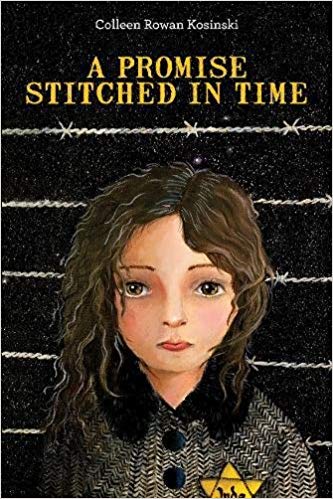
A Promise Stitched in Time, by Colleen Rowan Kosinski, (Sept. 2018, Schiffer Publishing), $12.99, ISBN: 978-0-7643-5554-7

Ages 10-13

Eighth grader Maggie McConnell is still grieving the loss of her father to cancer. The budding artist is agonizing over a project that will get her into the prestigious Peabody Academy; it was a promise she made to her father and herself. When she discovers a an old coat at her local thrift store, she’s drawn to it and buys it on the spot. Immediately, she begins having hallucinations about starving, burning chimneys, cruel voices and beatings, and terrifying dogs waiting to attack. She sees visions of a girl wearing the coat and reminding her of a promise made to a girl named Gittel. Turning to her friend Taj for help, the two try to unravel the source of the haunting. Meanwhile, Maggie is at odds with her popularity-obsessed sister, Patty, who doesn’t agree with Maggie’s choice in clothing or friends. As Maggie works toward the heart of the mystery, she discovers that Mrs. Berk, an elderly resident at a nursing home where Maggie teaches art, plays a key role.

A Promise Stitched in Time has an interesting main story that gets lost in its attempt to create a paranormal story. Having a coat haunted by a spirit of its former owner – a girl who died at Auschwitz – is an interesting concept on its own. Maggie’s father’s story seems to be more of a plot device that gets in the way, and the story’s resolution felt rushed, overcrowded in an already full narrative. It starts off strong, but ultimately left me wanting more.

Posted in Historical Fiction, Teen, Young Adult/New Adult

The Red Ribbon finds hope in the heart of despair

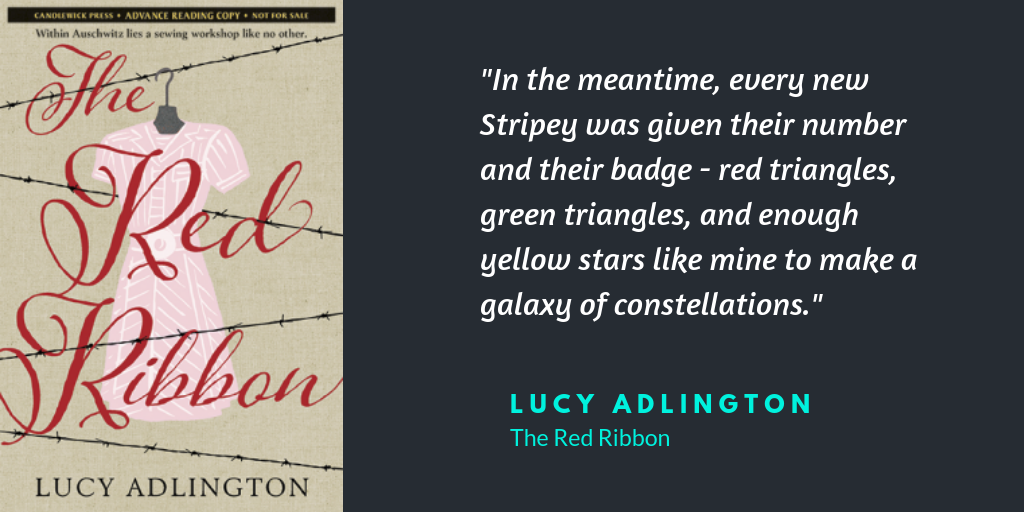
The Red Ribbon, by Lucy Adlington, (Sept. 2018, Candlewick Press), $17.99, ISBN: 9781536201048

Ages 12+

Ella is a 14-year-old young woman who lands in Auschwitz-Birkenau after being picked up on the way home from school. She lies about her age to be placed in the Upper Tailoring Studio; a dressmaking studio within the camp, where the skeletal women Ella calls “Stripeys”, referring to the prisoners’ striped uniforms, make dresses for their clients: the wives and girlfriends of the SS officers, and the female SS officers themselves. Ella has dreams of being a dressmaker and finds herself more than up to the task, but her friend Rose points out that there’s a fine line between doing what’s necessary for survival and collaborating with the enemy, no matter where one’s true passion lies.

The Red Ribbon looks at some big issues taking place during the Holocaust: there really was a dressmaking studio, where prisoners repurposed clothing taken from the arriving prisoners to make clothing for the SS wives, girlfriends, and officers. There were prisoners who acted as “prominents”: they oversaw other inmates and could be almost as cruel and demanding as their jailers. Ella’s talent for dressmaking gains her notice from one SS officer, an 18-year-old named Carla, who leaves her small gifts for trade and invites her to share birthday cake with her one time and viciously beats her another, calling her inhuman. Rose acts as Ella’s conscience, seeing through the illusion Ella desperately wants to create: an illusion where her grandmother is still safe at home and waiting to hear from her; an illusion where her dressmaking talent is valued, and the Auschwitz “Department Store” is a kind of thrift store and not a pile of stolen goods from stolen lives. Ella’s desperation to hone her dressmaking talent borders on collaboration, but she refuses to acknowledge it until a heartbreaking moment when her beloved grandmother’s sewing machine lands in front of her in the Studio. It smashes Ella’s naivete, but she and Rose bolster one another, and the women around them as they pray and wait for liberation.

There are some devastating moments in this story, and Lucy Adlington’s words weave beautiful, terrible visions. Prisoners tell each other to “Look down at your sewing, not up at the chimneys”. One prisoner is so desperate for news about her children that she asks about an SS officer’s son: “Tell us about the little boy –  how old?  My son was three when they took us.”

The book equally captures desperation and determination; hope and despair. It’s a good add where collections need YA fiction that discusses The Holocaust. Display and booktalk with Antonio Iturbe’s The Librarian of Auschwitz, The Diary of Anne Frank and John Boyne’s The Boy in the Striped Pajamas (I’ve seen this title in both Juvenile and YA collections); Elie Wiesel’s Night and Tatiana de Rosnay’s Sarah’s Key, and Art Spiegelman’s Maus. The Jewish Book Council has an excellent list of Holocaust-related YA books. There is a creative writing resource available for free download from The Hay Festival.