Posted in Preschool Reads, Toddler Reads

Book Review: Is Everyone Ready for Fun? by Jan Thomas (Beach Lane Books, 2011)

is everyone ready for funRecommended for ages 2-5

A group of rowdy cows want to have fun on a chicken’s sofa. The chicken does not share their enthusiasm.

The repetitive story follows three cows who want to have fun – jumping, dancing, wiggling fun – on Chicken’s sofa. Chicken is not at all happy about this. Reminiscent of another Jan Thomas’ story, “What Will Fat Cat Sit On?”, the cartoon illustrations use exaggerated expressions for the cows and the Chicken. The colors are bright but not overwhelming; the page backgrounds are either bright blue, green, or lime green, and the characters are boldly outlined in black. The story begins and ends with the endpapers, and Thomas uses the margins to denote offscreen action, most notably when the Chicken’s head appears to look in on the madness. Communicated in speech bubbles, the text allows young readers and listeners to imagine different voices for each of the speakers – and allows the storytime reader to affect different voices during the reading.

The book allows for a great deal of interactivity and falls into a comfortable pattern that younger readers and listeners can catch on to right away. The title phrase – “Is everyone ready for fun?” begins the series, followed by the Chicken’s protest, the cows’ latest attack on the sofa, and the Chicken’s growing aggravation. Storytime participants can get up and jump, dance, and wiggle along.

The author’s website offers links to other books and printable activities, several of which include recognizable characters from Is Everyone Ready for Fun? The activities can enhance a storytime, as can farm animal-related songs and fingerplays.

Posted in Toddler Reads

Book Review: Who Hops, by Katie Davis (Harcourt, 2001)

who hopsRecommended for ages 0-4

Who Hops takes a funny look at animals who hop, swim, fly or crawl – and which animals do not.  Asking the opening question, “Who hops?”, the book teaches children about the animal world. We learn that frogs hop, as do rabbits, kangaroos and cows – wait, cows? Even the cow appears distressed! The author quickly corrects herself, noting that “Cows moo and give milk, but they don’t hop!”

The questions continue, asking who flies, who slithers, who swims and who crawls, with similar groupings of animals that do and one animal that doesn’t, with hilarious responses. The exaggerated facial expressions on the odd animals out are laugh-out-loud funny, and the day-glo artwork, outlined in bold black outlines, assures that all readers will be able to see and enjoy the book. The artwork is simple – line drawings, filled in with fluorescent colors – and the text is in bold, black font.

The book is a good companion to Jan Thomas’ What Will Fat Cat Sit On? and can be read as part of a silly animal read-aloud. Readers can participate by calling out when the story reaches the animal that doesn’t hop, fly, slither, swim or crawl. The author’s website features a printable matching game, where readers can match the animal to his activity. There are also songs and fingerplays about animals and how they move that would make for a fun read-aloud.

The book has received the Oppenheim Toy Portfolio Platinum Award, National Parenting Publications Honors, and designation as a Book Sense 76 Pick.


Posted in Animal Fiction, lift-the-flap, Toddler Reads

Book Review: Where’s Spot? by Eric Hill (G.P. Putnam’s Sons, 1980)

where's spot

Recommended for ages 0-4

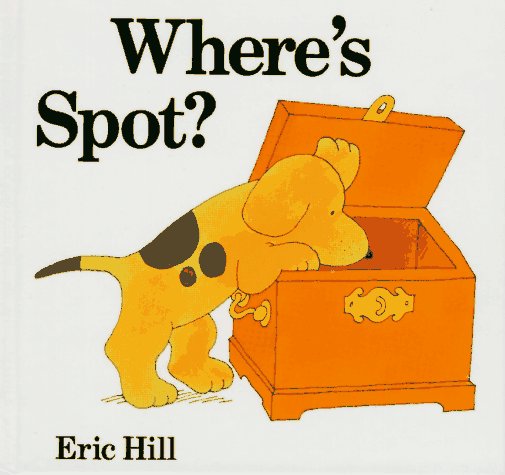
It’s supper time, and Sally the Dog is looking for her puppy, Spot. She looks for him behind doors, under stairs, inside clocks, and other hiding spots and encounters his friends on her search. But where’s Spot?

Part of the popular “Spot” series of books by Eric Hill, Where’s Spot? offers toddlers and preschoolers familiar characters and cartoon-like art with bold, black lettering for sight-word learners.  For printables and online games, parents can point their browsers to http://www.funwithspot.com/us/.  For the youngest Spot fans, make sure to check out his board books!


Posted in Animal Fiction, Fantasy, Historical Fiction, Humor, Tween Reads

The Cheshire Cheese Cat: A Dickens of a Tale, by Carmen Agra Deedy & Randall Wright (Barry Moser, ill.) (Peachtree Publishers, 2011)

Recommended for ages 9-12

Skilley is a street cat who finds himself hired by Ye Olde Cheshire Cheese, a pub in Victorian London where writers like Charles Dickens find themselves inspired to write. Ye Olde Cheshire Cheese makes some of the best cheese in the kingdom, and they’ve got a bit of a mouse problem. It should be a dream job for Skilley, but he has a secret – he doesn’t like to eat mice. He prefers cheese, truth be told. Skilley and the mice of Ye Olde Cheshire Cheese, led by young Pip, work out an arrangement that should keep the staff at the Cheese fooled and Skilley’s belly fed until Pinch – a nasty street cat who’s had run-ins with Skilley before – shows up. Afraid that Pinch will discover his secret, Skilley finds his friendship with Pip at risk and Maldwyn, another guest of the Cheshire, in danger.

The Cheshire Cheese Cat is one of those stories that is just a fun, great read. The authors managed to create a morality tale and a story of friendship that has appeal to a huge age range. It would be a great read-aloud to younger grades, with anthropomorphic characters to keep them interested, and older readers will appreciate the dilemmas Skilley finds himself confronted with: unlikely friendships and looking “cool” in front of one’s peers among them. The characters, human and animal alike, are fleshed out and their interactions have depth. Inserting historical characters like Charles Dickens, who finds himself interested in the goings-on at the Cheese – goings-on that human patrons seem to miss – make the tale more fun, as does the visit from the “surprise guest” teased at the beginning of the book. Black and white illustations by Barry Moser add to the enjoyment and give the readers a little more grease for the imagination’s wheels.

The Cheshire Cheese Cat website offers information about Victorian London, Charles Dickens, The Cheshire Cheese, and more historical references found in the book. A fun page on Cheshire Cheese, thought to be the oldest cheese in England,  provides the history of the cheese and recipes and would be a fun addition to any classes reading the book. Author Carmen Agra Deedy maintains a blog where she also maintains a list of events and appearances, awards and nominations, and her other books.

Posted in Fantasy, Humor, mythology, Tween Reads

Book Review: Thor’s Wedding Day, by Bruce Coville (Harcourt, 2005)

Recommended for ages 8-12

Based on the humorous Norse tale about the theft of Thor’s hammer, Bruce Coville fleshes the story out with other pieces of Norse mythology to give readers this amusing story of cross-dressing gods, talking goats, and dopey giants.

Told by Thor’s goat boy Thialfi, Thor’s Wedding Daybegins with Thor discovering his mighty hammer, Mjolnir, missing. His trickster brother Loki discovers that their enemies, the giants, have somehow gotten hold of the hammer and refuse to give it back unless their sister, Freya, marries Thrym, king of the giants and Thor’s enemy. Freya refuses, and Loki concocts a scheme to dress Thor up as Freya and get his hammer back. Loki agrees to accompany Thor as a bridesmaid and Thialfi must dress up to be Thor’s goat girl. While in the company of the giants, Thialfi discovers that their plan goes far deeper than just handing Mjolnir back to “Freya” after the wedding, and he finds himself in the position of saving Asgard.

Bruce Coville can tell a funny story, and Thor’s Wedding Day is no exception. He stays true to the tale that inspired him and to make it accessible to new, younger audiences. It’s downright silly in some parts with a touch of adventure and intrigue – a good combination to keep more reluctant readers interested.
 
Bruce Coville’s website offers information about this and other Coville titles. For readers interested in learning more about Norse mythology, there are a variety of resources available on the Web.
Posted in Middle School, Post-apocalyptic/Dystopian, Science Fiction, Tween Reads

Book Review: The Boy at the End of the World, by Greg Van Eekhout (Bloomsbury Children’s Books, 2011)

Recommended for ages 9-12

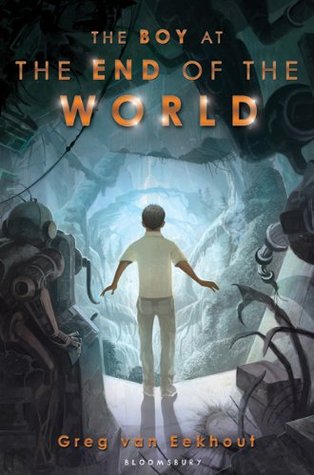
A preteen boy (we are led to guess), wakes up in a pod in a devastated shelter. Destruction lies all around him; he sees being similar to himself lying dead in pods similar to his. The only other functional being is a robot, who calls out to him. The boy runs, but the robot catches up to him and reveals the boy’s name, Fisher, to him. Fisher learns that he is the only survivor of the human race.

It’s the usual post-apocalyptic story: Humans ruined the earth and nature took back her planet. Humans genetically engineered animals and more humans, putting them in gel-filled pods, with robots to oversee their care, until the time when conditions allowed for them to awake and rebuild society. The humans were individually programmed with specific survival skills to help create communities. Fisher is programmed to be a fisherman. Click, the name he gives his robot companion, tells Fisher that he has been tasked with helping Fisher “continue existing”, and the two set off to search for more humans in another Ark – the facilities were humans and animals were engineered and kept in hibernation.

Born a blank slate, Fisher learns and adapts through the story’s progression, developing not only intelligence outside of his initial programming but emotional depth. The characters they meet are not cute and cuddly woodland creatures: they’re often chilling. There are groundhogs who blame humanity for the planet’s destruction and hold a grudge; there is a robot who takes his task of preserving the human race  permanently – these characters bring a new dimension to the story of a boy and his robot. This is a survivalist tale.

It is difficult to write a postapocalyptic tale without sounding like hundreds of similar books on the market, and the “humans and technology bad, nature good” call to action beats the reader over the head throughout the book. Humans bring the planet to the brink of environmental collapse, so they leave the rest of the planet to deal with it while they go into hiding until the coast is clear. The technology that humans created to save them ultimately turns on them and brings the race to the point of near-extinction, further painting us as hapless ne’er do wells.

That said, the YA market in post-apocalyptic fiction isn’t as saturated as the adult market is yet, so perhaps a younger audience will read this story through different eyes. That said, this is a generation that has been fed this storyline since they were babies: think of Happy Feet, a movie that deceptively sold us a cute story about a penguin who didn’t fit in, and gave us a Greenpeace horror movie halfway through the picture. Think of Wall-E, where we were drowning our society in junk, so we had to go into space to get away from it.

I don’t want it to sound like I didn’t like this book, because I did. I think older middle grade readers, starting with 10-11 year olds, will see Fisher as a hero they can identify with as a young boy who needs to learn to survive, and whose robot companion acts as a friend and parent. Kids can also relate to the marriage of technology and environmental awareness contained in the book’s message.

Greg Van Eekhout knows how to write for kids – he has a Masters in Education and spent ten years developing online curricula for K-12 and college students. He is kid- and teacher-accessible, offering teachers tips on having author events at schools (and libraries), and providing his e-mail address to be contacted about school visits. He offers two presentations that he follows in his appearances. His website is geared toward grownups who are interested in reading his reviews, about his books, and where he’ll be next.

Posted in Animal Fiction, Fantasy, Tween Reads

Book Review: The Guardians of Ga’Hoole Book One: The Capture by Kathryn Lasky (Scholastic, June 2003)

Recommended for ages 9-12

Newbery Award winning author Kathryn Lasky’s Guardians of Ga’Hoole series has been hugely popular since the publication of the first book in the series, The Capture. In 2010, Warner Brothers released a movie based on the first three books in the series and its companion website offers quizzes, games and book facts. A Guardians of Ga’Hoole wiki offers exhaustive information about characters and storylines. The series has taken on a life of its own in many ways, similar to such literary touchstones as Harry Potter and The Lord of the Rings.
The book begins with Soren, a young barn owl born into a loving family in the forest of Tyto. He has a cruel older brother, Kludd, a sweet younger sister, Eglantine, and a beloved snake nursemaid, Mrs. Plithiver. One day, Soren falls out of his nest and is kidnapped, taken to the St. Aegolius Academy for Orphaned Owls, where he meets Gylfie, a small Elf Owlet.

St. Aggie’s, as the Academy is referred to, is a thinly veiled deprogramming center/work camp for owls where they are subjected to sleep deprivation and corporal punishment in order to break them down and create a blank slate upon which the St. Aggie’s owls can build and create an army for owl domination. By sticking together and focusing on their families, each other, and the mythical stories of the Ga’Hoole, the guardians of owlkind, Soren and Gylfie defy the odds and retain their individuality. They ultimately escape St. Aggie’s with some help on the inside and head out in search of the Great Ga’Hoole Tree, where they hope to find help to save the owls from the St. Aggie’s army. They meet two other escapees, Digger and Twilight, who join them in their search.

I found myself having trouble enjoying The Capture. I vacillated between being taken aback at the brutality of a book written for a relatively young audience and just not connecting with the story. The book is graphic in its depiction of the punishment heaped on the younger owls and Lasky does not shy away from writing about murder and cruelty. The terror of losing one’s own identity, coupled with cold-blooded murder, make for a potentially terrifying read to some readers on the younger half of the age range, and I’d recommend parents reading the book with their children to address any fears that may come up. The book speaks to the fear of being taken, the terror of not knowing how to get back to one’s family, and the sense of hopelessness that can overpower someone in that situation.
Other times, I was frustrated with the use of owl jargon – the owls have their own phrases and terms, and it appeared haphazard in its usage – and bored with some of the more plodding scenes at St. Aggie’s. I wanted more from the book than it was ready to give me – perhaps reading further into the series will help me connect at a later point.

Kathryn Lasky has written over 100 books for children and has a great website that offers video messages for her fans, a section detailing her awards and information about her upcoming books. Naturally, there is a section devoted to the Guardians series, and she even features fan art dedicated to the series. I really liked that Lasky, who exhaustively researches both her fiction and nonfiction writing, shares her research and links for books she’s working on.

Posted in Animal Fiction, Humor, Tween Reads

Book Review: Dragonbreath, by Ursula Vernon (Dial Books, 2009)

Book Review: Dragonbreath, by Ursula Vernon (Dial Books, 2009)
 
Recommended for ages 8-12

Ursula Vernon’s first book in her Dragonbreath series introduces readers to Danny Dragonbreath, a young dragon who happens to be the only mythical creature in a school filled with reptiles and amphibians. He’s a little rebellious, not a fan of schoolwork, and really wants to be able to breathe fire (if for no other reason, than to stop hearing his father’s motivational speeches). His best friend, Wendell, is an iguana who finds himself sucked into Danny’s crazy schemes when he’d rather be doing something safer, like getting Danny to do his homework.

In Dragonbreath, Danny flunks his paper on the ocean after writing it the morning it’s due and making it up from his own imagination. Luckily for him, he’s got a sea monster cousin named Edward, who he can visit and from whom he can get an ocean tour, so off he goes, dragging Wendell along with him. Can they survive the deep ocean, where giant squids are known to show up without notice? Will Danny pass his Science paper?
 
Dragonbreath is a great book for younger readers that are still getting used to chapter books; the book is written in a half-chapter, half-graphic novel format that readers will find user-friendly, and Vernon provides a copious amount of nonfiction information about ocean life through Danny’s and Wendell’s eyes that will show the kids that learning can be fun.
 
Vernon’s website provides summaries of all the Dragonbreath novels as well as her other titles, as well as updates on author appearances and her artwork.
Posted in Animal Fiction, Fantasy, Fiction, Tween Reads

Book Review: The Tale of Desperaux, by Kate DiCamillo (Candlewick, 2008)

Recommended for ages 9-12

I picked this book up post-hype and after not really watching more than about 10 minutes of the movie (there really is something to be said for the movie-going experience over the at-home one). My expectations were tempered with the worry that comes when a book has been so talked about and featured in the media as Desperaux, but I needn’t have worried.

Desperaux is a story with many layers. It’s a cute animal fable with an adorable hero. It’s a love story between our hero and a princess. It’s a story that addresses hate and it addresses the darker side of nature, and how even the darkest creatures can crave the light. I wasn’t expecting the depth of character that DiCamillo invested in her characters, and I wanted to keep reading.

Desperaux is the only surviving mouse in his mother’s final litter. Born small and with his eyes open, his mother and father both write him off, but he survives. He’s tinier than his siblings and is different from the start, preferring to read books rather than eat them. He falls in love with the Princess Pea. She is enchanted with the tiny mouse, but her father, who hates rats – and equates all rodents with them – chases him away. For allowing himself to be seen by and talk to humans, the mouse council – members of whom include Desperaux’s own father and brother – decide to punish him with a death sentence, and they send him to the dungeon, ruled in darkness by the rats.

In the basement, we meet Chiaroscuro, a rat who loves the light but is forced to live in the darkness after a brief trip up to the castle living area ended with a terrible accident. He seethes and plans his revenge in the darkness, using a slow-witted servant girl with her own tragic past as a pawn in his game.

This book won the Newbery Award in 2004, and as you delve into the book, you can see why. For a children’s book, the characters’ backgrounds are incredible in their detail and complexity. I was amazed at DiCamillo’s ability to create characters with such depth and yet still make them accessible to children. The story moved along at a pace that kept me turning pages; I wanted to know what was going to happen next. Timothy Basil Ering’s illustrations were stark and beautiful, adding more depth to the story by adding to the vision the author’s words painted in my imagination.

There are some very good teaching guides for Desperaux available. Candlewick Press offers an illustrated discussion guide. Scholastic’s reader’s guide considers the movie and includes some illustrations from the animated feature. Reading is Fundamental (RIF) also has a free, downloadable Teacher’s Guide.