Posted in Preschool Reads

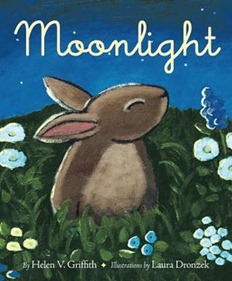
Book Review: Moonlight, by Helen V. Griffith/Illus. by Laura Dronzek (Greenwillow Books, 2012)

moonlightRecommended for ages 2-6

Told in rhyme, Moonlight tells the story of a rabbit that is so sleepy, he cannot wait for the moon to come out from behind the clouds, and heads to his burrow to sleep. When the moonlight emerges from behind the clouds, it coats everything it touches in a “butter trace”. It even reaches into Rabbit’s burrow and into his dreams, waking him up.

The illustrations, done in deeply saturated acrylics, set a drowsy, sleepy tone as readers see the moon lazily “butter” everything in its path with its light. The stars and comets look almost like Van Gogh’s Starry Night; the animals bathed in its light all sleep peacefully, and the landscapes  – mountains, trees, and  streams  – all seem soft, relaxed. The brief text itself seems quiet and relaxed, showing up unobtrusively on each spread and without punctuation to halt the eye or the mind.

This would be a wonderful addition to a bedtime read-aloud. Audiences can attend in their pajamas with a favorite stuffed animal, and serving milk and cookies would add to the storytime atmosphere. There are many bedtime rhymes and songs that can fit in with this theme. Using a flannel board may add to young audiences’ appreciation of the story.

Posted in Preschool Reads

Book Review: Roar! A Noisy Counting Book, by Pamela Edwards Duncan/Illus. by Henry Cole (HarperCollins, 2000)

roarRecommended for ages 2-5

A little lion cub wants to play, but his roar scares other animals away, from one red monkey to eight brown gazelles – but then, he discovers nine other lion cubs.

This counting book has a story attached to it, and is good for older audiences who are about to enter Kindergarten and could use a brush-up on their counting and colors. A little lion cub wanders away from his pride, looking for some fun, and encounters different animals across the African savanna – from one red monkey to eight brown gazelles – who all run from his roar. He finally comes across a group of nine little yellow lion cubs, just like him, who aren’t afraid of him. The cartoon illustrations, done in acrylics and colored pencil, bring the savannah and the animals to life, from a group of lions lying lazily in the sun to a stampede of animals running from the group of little lions, to the little lion cub, curled up with his mother, asleep as the sun sets on the savanna. The animals’ facial expressions convey fear on the parts of the animals the lion confronts, confusion, frustration and despair, as the little lion searches for a new friend and finds none, and finally, happiness when he meets friends just like him. The book provides a fun lesson in numbers and colors in rhyme.

This would be a great opportunity to use a flannel board to depict the animals that the little yellow lion cub encounters on his trip across the savanna. Getting stuffed animals for each of the groups of animals depicted into the story area would allow for a fun playtime before or after the story. This could be part of a jungle animal read-aloud, with hand stamps of an animal for children to have as a memento of their storytime.

Roar! was a Buckaroo Book Award Nominee (Wyoming, 2003).

Posted in Preschool Reads

Book Review: I Want My Hat Back, by Jon Klassen (Candlewick Press, 2011)

i want my hat backRecommended for ages 4-8

Bear has lost his favorite hat and searches the forest, politely asking different animals he encounters if they have seen it. Just as he begins to despair ever seeing his hat again, Deer comes by and jolts his memory – he HAS seen his hat. The resolution is understated and sly, and adults will pick up on it right away; perhaps even before the children do. The book has won awards and accolades, including the Theodore Seuss Geisel Honor, but caregivers have voiced concerns over the implied ending being potentially disturbing or inappropriate for young children.

The Chinese ink illustrations are understated, as are the sandy hued backgrounds. Red is used to set off the color of Bear’s hat, and a change in emotion both in text and background. The endpapers set the mood for the story, with illustrations of the Bear and the animals featured in the story set on a dark brown background.

The book allows for a fun (and no doubt entertaining) discussion about the book’s ending. There are I Want My Hat Back-related activities on Candlewick’s website, including a printable world-building activity and a shape-identifying activity. There is also a Make Your Own Hat activity sheet that allows attendees to decorate, cut and tape together their own hat. For a bear-related read-aloud, decorate the reading area with toy bears of all sorts and encourage playtime afterwards.

Among the award and honors I Want My Hat Back has received are designation as an ALA Notable Children’s Books (2012), Colorado: Children’s Book Award Nominees (2013), Horn Book Fanfare (2011), Indies Choice Book Award for Picture Book (2012), Irma S. & James H. Black Picture Book Honor (2012), NY Times Best Illustrated Books (2011), NY Times Notable Children’s Books (2011), Publisher’s Weekly Best Children’s Books (2011), Texas: 2×2 Reading List (2012), Theodore Seuss Geisel Honor (2012), and Virginia: Readers’ Choice Award Nominees (2013).

Posted in Preschool Reads, Toddler Reads

Book Review: Moo, Baa, La La La by Sandra Boynton (Little Simon, 1984)

moobaalalalaRecommended for ages 0-4

Children learn about animal sounds through fun rhymes with author and illustrator Sandra Boynton in Moo, Baa La La La! Ms. Boynton uses her popular cartoon-style animals and lettering to draw both children and adults in to her story about the silly sounds animals make, including rhinoceroses snorting and snuffing, and horses neighing. Illustrations are drawn in lighter colors featured on pastel backgrounds, soothing to babies who are learning to make sounds and toddlers who are relating animal sounds with the animals that make them.

The book would make for a fun read-aloud, encouraging children and parents/guardians to chime in and call out the animal sounds. The book ends with the author asking the audience what they say, which is a perfect time to get story time participants to say hello and wave or cheer. Story time can be animal-related, with photocopies of animal pictures to color. Songs and fingerplays could include animal-related songs like Old McDonald, which also teaches children about animal sounds.

Posted in Preschool Reads, Toddler Reads

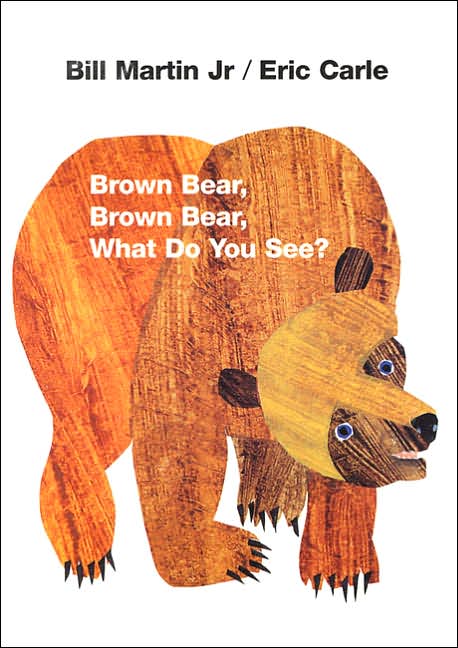
Book Review: Brown Bear, Brown Bear, What Do You See? by Bill Martin, Jr./illus. by Eric Carle (Holt, Rinehart & Winston, 1967)

brown bear Recommended for ages 0-5

Brown Bear, Brown Bear, What Do You See? is a children’s literature classic. An unseen narrator asks different animals what they see; the animals respond that another animal is looking at them, repeating the process throughout the book. The animals are described in terms of color: a brown bear, a red bird, a yellow duck, a blue horse. The endpapers lead readers into this study in color, with the colors named in the book appearing, striped, across them.

Bill Martin’s repetitive question-and-answer rhyme format, coupled with Eric Carle’s signature hand-painted and layered collage technique, appeals to toddlers and preschoolers alike, giving the animals a textured appearance that makes them stand out on the white background of the page. The font is a simple, black font; the question appears on the left hand page of each spread, and the response on the right. The rhythm of the book is comfortably repetitive, so children know what to expect on each spread. There is a board book version available that is perfect for the tiniest hands.

This is a great book to add to a read-aloud on color and would translate well to a felt board. DLTK’s website offers printable pictures of animals named in the book, complete with instructions on how to use the sheets as felt board characters and can provide an enjoyable, post-story coloring craft. Attendees may enjoy getting a hand stamp with one of the animals named in the book, to have as a memento of the storytime, and a guide to the book on the Macmillan website features a printable matching game where readers can connect the color to the animal mentioned in the book.

Bill Martin Jr. and Eric Carle collaborated on other children’s classics, Polar Bear, Polar  Bear, What Do You Hear?, Panda Bear, Panda Bear, What  Do You See? and Baby Bear, Baby Bear, What Do You See? that fall into the same cadence and predictive text, providing opportunities for additional read-alouds.

The author’s website offers information on school visits and the Bill Martin model for reading, which is valuable reading for anyone who reads to young children.

Posted in Preschool Reads, Toddler Reads

Book Review: Good Night, Gorilla, by Peggy Rathmann (Putnam, 1994 edition)

GoodnightGorilla1Recommended for ages 1-5

A zookeeper is followed home by all of the animals he thinks he’s locked up at the zoo for the night. The story begins with the zookeeper locking each of the animals’ cages for the night, wishing each of them a good night. He doesn’t realize that the gorilla has taken his keys and is leading a menagerie back to the zookeeper’s house! When his wife realizes that her house is full of animals, she leads them all back and goes home – but someone may have followed her back. The art appears to be watercolor, with bright colors against sparse white backgrounds. The endpapers lead readers into and out of the story, with the gorilla showing up and holding what we presume to be the zookeeper’s keys as he bounces around the book cover’s frame.

The book is sparsely worded, which makes for great interactive storytime potential as the leader can ask children things like, “What’s happening now?” “What do you think will happen next?” Each animal is identified as the zookeeper says good night, reinforcing different animal names for younger readers. Young audiences may also connect with the animals who resist both their bedtimes and being left in their rooms all night. The animals even have toys in their cages – a fun storytime task could involve asking the children to point out the toys in each animal’s cage. The book is also available as a board book, and would be good to have on hand for the littlest users to be able to see and enjoy.

This book could be part of either a zoo-focused read-aloud or a bedtime stories read-aloud. For a zoo-focused read-aloud, it would be great to bring in some toys – Fisher-Price’s Little People have zoo and animal sets that are easily washable and would be  great fun for little hands to play with and act out the story. There are Fisher-Price Little People school buses that could bring “students” on a school trip to the zoo! Decorating the storytime area with plush zoo animals, even small Beanie Babies, would add to the fun atmosphere. There are many fun fingerplays and songs that can be incorporated into the storytime as well.

Good Night, Gorilla has received numerous awards and accolades, including designation as an ALA Notable Children’s Book (1994); Bulletin Blue Ribbon (1994); Horn Book Fanfare Selection (1995); Parenting Magazine Best Children’s Book of 1994, and New York Public Library’s Children’s Books: 100 Titles for Reading and Sharing (1995).

The author’s webpage provides award and review information about Good Night, Gorilla and her other books.

Posted in Preschool Reads, Toddler Reads

Book Review: If You Take a Mouse to School, by Laura Numeroff/illus. by Felicia Bond (HarperCollins, 2002)

if you take a mouse to schoolRecommended for ages 2-4

A mouse accompanies his human friend to school, and things snowball from there. The Mouse, first introduced in Ms. Numeroff’s If You Give a Mouse a Cookie, is back, and he is still pushing his boundaries with his human friend; this time in school. Mouse discovers new friends and activities, which include writing a book, playing basketball, riding a skateboard, and performing a science experiment. Visual cues link If You Take a Mouse to School to the original story: there are chocolate chip cookies on the boy’s pajamas; they show up in a lunch box, and as a refrigerator magnet. Felicia Bond’s watercolors are bright and crisp and stand out against the stark white background, inviting readers to look closely at the action featured on every page. There is a lot of action to see, too; Mouse is in constant motion, popping up in a lunchbox, kicking a soccer ball, or running with a group of children. Preschoolers will enjoy imagining a fun day at school with a tiny visitor of their own.

This would be a fun read-aloud for preschoolers preparing for Kindergarten. There are many back-to-school songs to sing in a school-related read-aloud. There is also a Mouse plush doll available; a fun read-aloud could include Mouse “sitting” with attendees, and asking each attendee how they would spend a school day with Mouse.

The Mouse series includes If You Give a Mouse a Cookie, which is the first Mouse story, and If You Take a Mouse to the Movies. The books are part of the larger “If You…” series, which includes titles such as If You Give a Moose a MuffinIf You Give a Pig a Pancake; and If You Give a Cat a Cupcake.

The author’s website offers coloring pages and resources for teachers and parents.


Posted in Preschool Reads, Toddler Reads

Book Review: Mama Mama by Jean Marzollo/illus. by Laura Regan (HarperFestival, 1999)

mama mamaRecommended for ages 0-4

The bond between mothers and babies is strong, as illustrated by different animals. Seven different animal babies tell their mothers, in rhyme, how they love them. Each spread features a realistic illustration of an animal mother and baby – lions, leopards, chimpanzees, koalas, pandas, elephants, and sea otters – and a four-line rhyme celebrating their love: “Mama, Mama,/Nuzzle, hug,/I’m your little/golden cub”. The font is simple and black, meant for mothers to read to their children during cuddle time. The book is a sweet tribute to mothers and their babies and should be a popular board book selection in any library.

This would be a good read-aloud for a family-related lapsit or a Mother’s Day lapsit. The Perpetual Preschool website offers many Mother’s Day songs and fingerplays that would work well with this type of lapsit.

The author’s website offers free ebooks and activities using her other books. She has written a companion book to Mama Mama called Papa Papa.

Posted in Preschool Reads, Toddler Reads

Book Review: Duck Sock Hop, by Jane Kohuth/illus. by Kane Porter (Dial Books for Children, 2012)

ducksockhopRecommended for ages 2-4

Once a week, ducks grab a bunch of socks from the sock box and head over to dance at the sock hop. They dance and wear all sorts of fun socks that they get from the sock box. Naturally, the party gets a little out of control, but it all ends well, and the ducks get ready for the next sock hop.

The illustrations are fun; cartoon-style and outlined in black with textured with hand-printed patterns on both the socks and the ducks are interesting to look at, and younger readers get a little lesson in shapes as the story describes the exciting socks found in the sock box: socks with squares, dots, moons, cars and spoons! The story is told in rhyme and allows for a fun, movement-oriented read-aloud once the sock hop gets underway as the ducks teeter, tumble, twist and trip their way through the dance. The story font is a bold, rounded font that curves around the pictures, creating further interest.

 This would be a great addition to a movement-oriented storytime. Books like Karen Katz’s Shake it Up, Baby! and Helen Oxenbury’s Clap Hands are good additions to this type of storytime. The Perry Public Library has great Move Your Body storytime suggestions, including fun songs like “Head, Shoulders Knees and Toes” and “If You’re Happy and You Know It”. The author’s website also offers Duck Sock Hop activities, including a Duck Sock Hop Kit that allows you to create your own sock hop – attendees could bring a pair of fun socks to donate to the sock box!

Posted in Preschool Reads, Toddler Reads

Book Review: In the Small, Small Pond by Denise Fleming (Henry Holt & Company, 1993)

In-the-Small-Small-Pond-9780805059830Recommended for ages 2-4

Denise Fleming’s In the Small, Small Pond gives readers get a glimpse of life among the animals living in a small pond as the seasons change. A child – who could be either a boy or a girl – watches life in a small pond change throughout the seasons. Beginning in the spring, tadpoles wiggle and jiggle and baby geese waddle and wade; as the seasons progress, we see turtles doze, minnows scatter, muskrats stack, and finally, a frog – a presence throughout the book – burrow under the mud as winter sets in, waiting for spring.

The artwork uses color to take readers through the seasons: the bright greens and yellows of spring, the blue and green laziness of a hot summer day, the brown and yellow of fall setting in,  and the cool blues and whites of the winter. Ms. Fleming gives life to her story by using collages created by poured cotton pulp through hand-cut stencils onto handmade paper, giving her illustrations a beautiful, handmade feel that will attract the attention of children and adult audiences. The rhythm of the rhyming text will appeal to young readers. The text is bold and black, with few words to a page; more often than not, the text blends with the background, but this is a book meant to be read-aloud; this will not be a distraction to participants. This is a companion book to the author’s In The Tall, Tall Grass, which uses the same type of artwork and storytelling.

In the Small, Small Pond received Caldecott Honors in 1994 and a Child Study Children’s Book Committee award in 1995.

The book would be a great addition to a read-aloud on seasons or it can be part of a read-aloud on pond life: frogs, birds, fish, or turtles, for instance. There are many ideas on seasonal read-alouds and read-alouds related to pond animals on the Web that can be used for free. The author’s website offers a printable “finish the picture” coloring page where children can create their own pond scene, and there is also a match-up game for older audiences where the children match the animal with the verb (i.e., geese waddle, turtles doze).