 Recommended for ages 12+
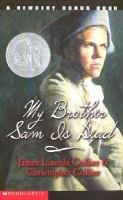
My Brother Sam is Dead is a look at the Revolutionary War that readers don’t normally get: like the Civil War, this war divided families. We also see a side of the American soldiers that we don’t usually hear about in History class – “our” soldiers weren’t always acting like the good guys, especially to their own countrymen if they weren’t supporters of the cause.
We hear about the Tories and they are demonized. We laugh at stories of them being tarred and feathered, but what My Brother Sam brings home is that Tories were the same Americans that the Revolutionaries were, but they just believed in a different ideal. To the Tories, there was no reason to split with Mother England, who provided for them and protected them. Taxes were a fact of life. Quartering soldiers was a fact of life. To rebel was treason and it was just wrong. When looking at the acts of the Revolutionaries – stealing from, kidnapping and murdering fellow Americans who were Tories – it is difficult to say anyone involved was 100 percent right or wrong. We learn that the Revolution was a black and white issue; My Brother Sam goes beyond that thinking and shows readers that the War was made up of many, many shades of grey.
Tim Meeker is the son of a Connecticut tavern owner whose older brother, Sam, joins the Revolutionary Army under Benedict Arnold while away at college. The relationship between Sam and their father appears to have been conflicted to begin with, as both are stubborn men with strong opinions, and this act leads to a schism within the family that leaves Tim wondering who’s right and who’s wrong Torn between his love for his brother and his love and loyalty to his family, he finds himself stuck in the middle of a far larger conflict when he’s asked to keep secrets about Sam and when his battalion is in the area. Tim sees firsthand the brutality of the American soldiers to his Tory neighbors and he sees the cruelty of the British soldiers. Is there a right or wrong?
My Brother Sam is Dead won the 1975 Newbery Honor and was nominated for a National Book Award that same year. It has also been designated as an ALA Notable Children’s book and was the twelfth most frequently challenged book from 1990-2000 (ALA).
The History of Redding website has extensive information about the novel; Redding, Connecticut is the setting for the story. A 2005 Scholastic edition of the book has an AfterWords bonus feature which includes an interview with the authors, where they compare their story to fellow Newbery winner and Revolutionary War story Johnny Tremain, and discuss parallels between their work, written after the VietNam conflict, and Johnny Tremain, written after World War II.

 Mom Read It