Posted in picture books, Preschool Reads, Toddler Reads

Concept Fun: Big Box, Little Box… perfect for a cat box!

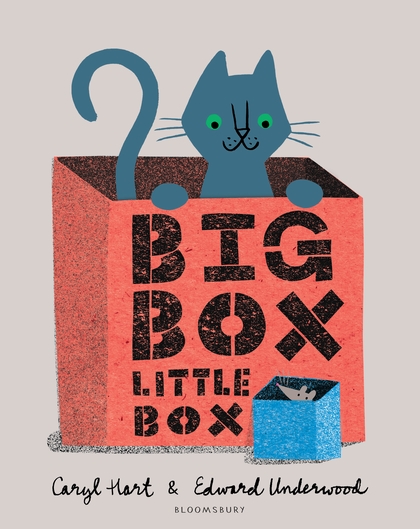
Big Box Little Box, by Caryl Hart/Illustrated by Edward Underwood, (July 2018, Bloomsbury USA), $17.99, ISBN: 9781681197869

Ages 2-6

What’s the best way to illustrate the many words to describe a box? Put a cat in the story! Big Box Little Box stars a curious cat who investigates all sorts of boxes: big and little boxes; brown and blue. The descriptive words take a fun turn when the cat stands on a box (cat box?), which immediately squashes under its weight (flat box), or when human hands designate “my box” versus “YOUR box”. As our inquisitive friend wanders through the boxes, it spies a hole in a box – and a mouse! The two run and play together, providing readers with some more fun words like “tickle”, “purr”, and “warm fur”. The endpapers show a cat and mouse romp through all sorts of boxes.

This book is a fun way to introduce adjectives to beginning readers, and ways to explore objects with younger readers. The pencil, ink, and computer-assisted collage work makes for fun, angular art, vividly colored and textured, almost inviting readers to feel the rough cardboard of the boxes under their fingertips. Lois Ehlert fans will find some similarities to the artwork, and the text is repetitive with occasional rhyme, inviting interaction.

Originally released in the UK, Big Box Little Box is a companion to Hart and Underwood’s upcoming One Shoe Two Shoes, and a fun addition to toddler and preschooler collections and concept bookshelves.

Posted in Animal Fiction, Fiction, Preschool Reads

Ten Birds Meet a Monster teaches us to count and describe things around us.

tenbirds meet amonsterTen Birds Meet a Monster, by Cybèle Young. Kids Can Press (2014), $18.95, ISBN: 9781554539550

Recommended for ages 4-8

Ten little birds discover a scary shadow outside their door – what can they do? One by one, the birds rally together to create different beasts using the clothes in the closet, each shape becoming more amorphous than the last, with increasingly wild names to accompany their shapes: we have Vicious Polka-dactyls, a Gnashing Grapplesaurus, a Frightening Vipper-Snapper, and more. Will the monster be more scared of them than they are of him and leave the birds alone?

Ten Birds is a concept book meant for a slightly older child, due to the more elevated language. We go beyond counting here, althoug counting from one to ten is certainly the basis for the story, and delve into adjectives and wordplay. Every bird is described with an adjective as he or she jumps in to help: “always resourceful”; “always diligent”; “always creative”. Each concoction the birds come up with is also defined with an adjective, allowing the opportunity for a good discussion about adjectives and describing words. This would be a fun enhancement to an English lesson in addition to a Math lesson.

The story is repetitive,which appeals to younger readers. The black and white ink and paper artwork is spare and beautiful, with beautiful detailing on the birds’ faces and bodies. The white background and framed pages make this an art book almost as much as it is a concept book for children. The font is a simple, black font on the white background, giving the sign that this is a read-aloud book – no fancy or fun fonts to distract the reader or the audience.

Ms. Young has written and illustrated an earlier Ten Birds book – Ten Birds – where the birds encounter a problem and have to solve it with their own wits, much like they do in Ten Birds Meet a Monster. Ten Birds received the 2011 Governor General’s Award for Illustration. The Birds series is a good one for young readers and I look forward to seeing what other predicaments Ms. Young can find for these birds. Maybe a board book for little hands and minds next?