Posted in Uncategorized

It’s Everyday Advocacy Challenge time again!

everyday-advocacy

It’s Everyday Advocacy time again! I joined the ALSC’s Winter Challenge, because one of my professional goals this year is to increase my advocacy efforts. This first week’s challenge is to craft another elevator speech – a quick response to “what do you do?” that gets the point across and hopefully, generates some interest that could lead to some help, be it with donations of books, materials, or funding. This time, though, the elevator speech is aimed more at the folks involved in the decision process: an alderman, mayor, local government staff members – you get the drift.

I decided to address the 30 million word gap in my speech. That’s the difference in the number of words that children from lower-income families are exposed to, versus children from high-income families. This isn’t over the stretch of a lifetime, either. This isn’t even before Kindergarten. This is by AGE 3. Thirty million words. This is why reading to your kids, singing with your kids, TALKING to your kids, is crucial. Don’t know what to sing? Hell, I started singing ’80s ballads to my eldest when I ran blank on lullabies and nursery rhymes. Sing anything. Talk lovingly. Play. It matters.

So here’s my little elevator speech: “Hi there! I’m Rosemary, and I’m one of the children’s librarians at Queens Library. My colleagues and I are working toward closing that 30 million word gap by providing a chance for babies, toddlers, and their caregivers to sing, talk, play, and listen to stories together. Want to visit one of my storytimes?”

I’m hoping that the mention of a 30 million word gap will get whoever I’m speaking with to want to hear more. If I’ve only got 10 seconds, I want that in the other person’s head, so they can look it up, learn, and act.

Go read to your kids! Read to the neighbor’s kids! Just read!

Posted in Uncategorized

Operation 451

451

We live in interesting times, to paraphrase the Chinese curse. We’re in an age of fake news, an adversarial relationship between elected officials and the media, and attacks on our right to free speech. Sarah Houghton, whose Librarian in Black blog I’ve followed for several years now, and Andy Woodworth, of the Agnostic, Maybe blog, have joined forces to bring us Operation 451 (a nice reference to Ray Bradbury’s Fahrenheit 451). Operation 451 directly opposes intolerance and ignorance and is here to remind librarians of our values, our Bill of Rights, the Five Laws of Library Science, and the First Amendment to the U.S. Constitution.

This year, I’m adding my voice to the dialogue. I’m taking part in 451 and promise to keep working at advocacy for the right to read, increasing information access for my patrons – and helping them learn the difference between valid and “fake” information sources, and working to keep my library a safe space for everyone. Period.

This will always be a book review/reader’s advisory blog, because that’s what I created this site for. I hope to make it more of an active library site, too; I hope to talk about more of my programs, conferences I attend, and my advocacy. Please stick around for the voyage.

Posted in Animal Fiction, Fiction, Middle School, Realistic Fiction, Tween Reads

When activism goes too far? Flip the Bird, by Kym Brunner

flip-the-birdFlip the Bird, by Kym Brunner, (Noc. 2016, HMH Books for Young Readers), $17.99, ISBN: 9780544800854

Recommended for ages 11+

Issues with hunting, falconry, and animal rights activism all come together in Kym Brunner’s Flip the Bird. Fourteen year-old Mercer Buddie wants two things out of life right now: he wants a girlfriend, and he wants to be a falconer, like his father and brother. He’s training as an apprentice to his father, a master falconer, but feels like his dad favors his jock of an older brother and is too critical of him. He captures a red-tailed hawk that he names Flip – to show his dad that falconry doesn’t always have to be a Very Serious Business – and has a few short weeks to train him for the big falconry meet; he’s got his eye on the Best Apprentice Award. Then he meets Lucy, who’s gorgeous and has a great personality and seems to be just as interested in him; the only problem is that she and her family are part of a fanatical animal rights organization called HALT. Mercer tries to play both sides to stay in Lucy’s and his family’s good graces, but sooner or later, the two halves of his life are going to converge. His mother is a scientist at a university lab doing medical research, and his father has a raptor rehabilitation center in addition to being a falconer – which means, a hunter. There are a lot of difficult choices in Mercer’s immediate future.

Flip the Bird brings together a lot of hot button topics to create a moving story about family and going with the crowd. Told in the first person by Mercer, the narrative is humorous while discussing the frustrations of being the little brother; the struggle to be treated like a responsible young adult, and the difficulty in making decisions that may be unpopular with the people you want to impress the most. To impress Lucy, Mercer joins the HALT collective she forms at school, but this puts him at direct odds with his family, and they let him know it. There are consequences to his actions, and we see Mercer grow as he faces those consequences. There’s interesting information about falconry and raptor rescue here, which will appeal to fans of animal fiction and birds. While the author gives a shout-out to some of her research sources in her acknowledgements, and does emphasize the extreme commitment that falconry requires, I’d have liked to see links to information about raptor rescue at the end of the book. I did some quick searching and came up with a quick list for anyone interested: The Raptor Trust, Wild Bird Fund, and A Place Called Hope. PBS’ Falconer’s Memoir page offers a map of states permitting falconry and links to classroom activities for using “A Falconer’s Memoir” in the classroom. The World Wildlife Fund is an organization that works with wildlife conservation and endangered species, and most large zoological preserves pioneer conservation and rehabilitation practices for animals in the wild. Kym Brunner is also a seventh grade teacher, and her author website offers presentations that you can use in the classroom.

I enjoyed the book and the characters. I’ll be adding this to my shelf; if you’ve know realistic fiction, animal fiction, or middle schoolers looking for something new and different to read, add this one to your shelves and shopping lists.

Posted in Early Reader, Fiction, Fiction, Historical Fiction, Intermediate, Realistic Fiction

Mother Jones is on her way to Oyster Bay – join the march!

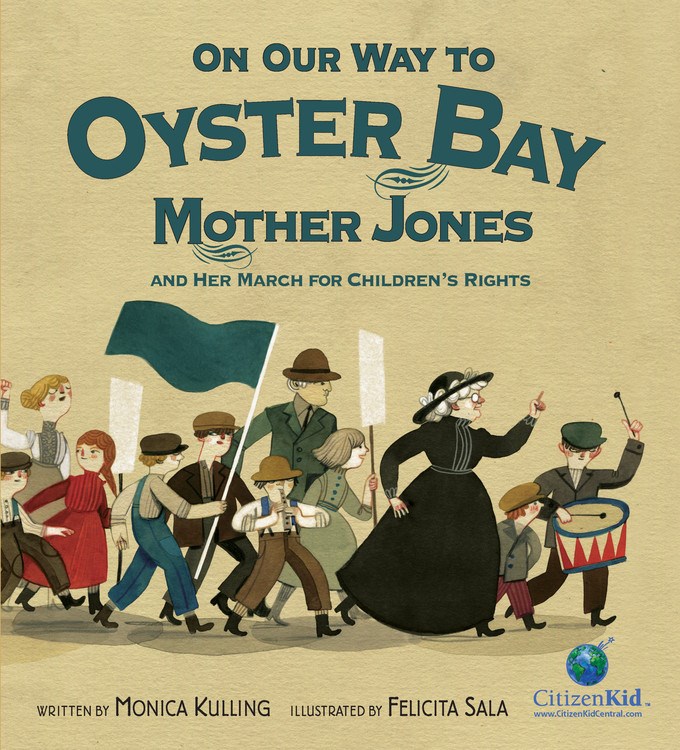
on our wayOn Our Way to Oyster Bay: Mother Jones and Her March for Children’s Rights, by Monica Kulling/Illustrated by Felicita Sata (Sept. 2015, Kids Can Press), $17.95, ISBN: 9781771383257

Recommended for ages 7-11

Eight year old Aidan and his friend, Gussie, want to go to school, but they have to work instead, to help their families. When the millworkers go on strike, Aidan and Gussie join the picket line; that’s when they meet Mother Jones, a feisty activist who wants to take action against child labor. She organizes a children’s march that will take them all the way to President Theodore Roosevelt’s summer home in Oyster Bay, New York!

In 1903, child labor was a harsh reality for many children like Aidan and Gussie. Instead of going to school, children toiled for up to 12 hours a day, six days a week, in factories; they experienced unsafe conditions and many were injured, disfigured, or even died doing their work. On Our Way to Oyster Bay is a fictionalized account of the very real story of activist Mother Jones’ March of the Mill Children, beginning in Pennsylvania and going all the way through the streets of Manhattan, ending up on President Roosevelt’s Oyster Bay lawn. While the President refused to meet with Mother Jones and her brigade, the march raised awareness of child labor, leading to the 1904 formation of the National Child Labor Committee.

On Our Way to Oyster Bay is a great story for younger kids about a period in history that doesn’t get as much love as it should. If you ask any given kid you encounter whether or not they know Mother Jones, you’re likely to get a blank stare, and that needs to be remedied. We still work in a world where child labor is a reality for many – I constantly remind kids that kids have fought and died for the right to go to school and do the same things they complain about every day – and a book like this lends itself to some important discussions about our own history of child labor and unsafe conditions, as well as the chance to brainstorm some ideas about what kids can do to help other kids around the world. Being a CitizenKid book – an imprint I love – there’s loads of information about child labor, suggestions for getting involved, and discussion points. Kids Can Press has a winner with this imprint; the books bearing the CitizenKid stamp empower kids to learn about the world around them and to take action, just like the kids in their books do. These books give them the information and the tools to take action, putting the power in their hands.

The artwork is vibrant, with movement coursing through the illustrations. The march through Manhattan thrums with activity, and I found myself bouncing up and down on my seat as Mother Jones made things happen! This is great for a read-aloud or a read-alone, but it needs to be read. Add this to your collections, read it to your kids, and make things happen. Talk about social justice, everyday activism, and being a good citizen, globally and locally.


Posted in Animal Fiction, Early Reader, Fiction, Fiction

Moon’s Messenger carries a beautiful and powerful message.

Moon is a young girl, sitting on the beach, when a sea turtle approaches her, beckoning her to join him in a journey through our planet. He quietly shows her the havoc people have wreaked on our environment: extinction, oil spills and pollution, global warming among a mere few of the methods. A message of hope and rebirth infuses Moon with purpose and action to protect the environment, and just as importantly, the living creatures we share it with.

moons messenger

Moon’s Messenger, by Virginia Kroll/Illustrated by Zusanna Celej (March 2016, Cuento de Luz), $16.95, ISBN: 9788416147205.
Recommended for ages 5-10

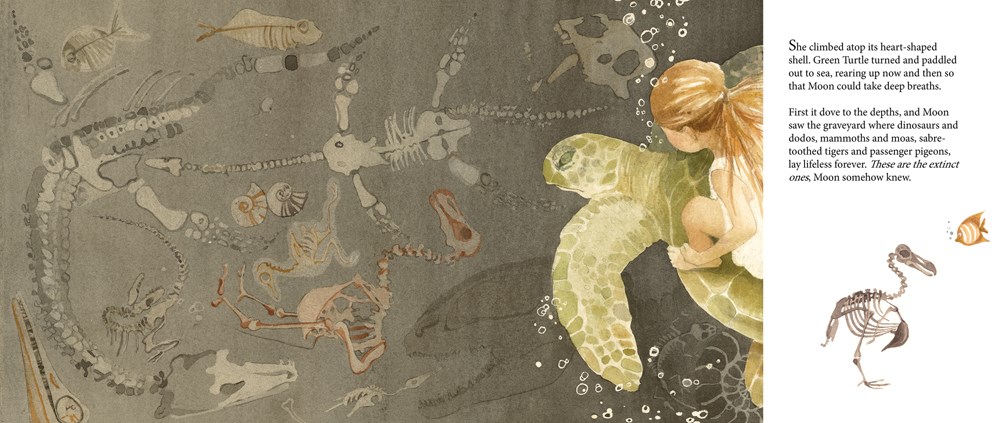
Moon’s Messenger is a powerful tale about conservation and activism, relying on watercolor images that are as heartbreaking as they are beautiful: a tired polar bear, trying to find an iceberg to rest on; local wildlife, deer and raccoons, ransacking residential garbage because their habitats are disappearing, giving way to more and more homes for people; sea life covered in oil and suffocating. And then, the turtle lays its eggs, and it’s beautiful again. There’s hope in the world, because there’s life, and now, one child knows what she has to do.

moons messenger_1

The text and images are not subtle – the author and artist are not hiding their message, and they are appealing to our next generation. Endpapers alternately draw you in and warn you about what you’re going to read – an ocean floor with the skeletons of extinct animals to bring you in, and to lead you out, the same image, but with information about green sea turtles, the dangers they face in our environment, and a call to action to readers: What will you do to help?

I loved this book, I loved the message, and I’m going to make sure it’s an Earth Day (April 22) storytime for my little ones. The small, black font takes nothing away from the images, and reading this aloud may be a bit of a challenge unless you’ve familiarized yourself with the story a couple of times. The text and ideas are better for a Kindergarten – Grade 2 audience, and pairing a reading with a reduce/reuse/recycling activity will let kids see how they can contribute to making the world a better place with their own two hands. Teach the kids in your life to respect nature, respect biodiversity, and respect our planet, and use this book as a valuable guide. I’d love to see an educators’ guide to this book with further resources and exercises for younger kids.

moons messenger_3

Posted in History, Middle Grade, Non-fiction, Tween Reads, Women's History

For the Right to Learn tells Malala’s story for younger readers

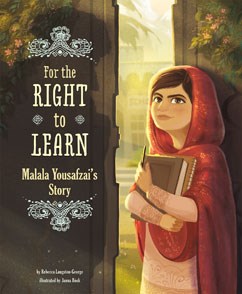
malalaFor the Right to Learn: Malala Yousafzai’s Story, by Rebecca Langston-George/Illus. by Janna Bock (Sept. 2015, Capstone), $15.95, ISBN: 9781623704261

Recommended for ages 9-14

There are some great books available on Malala Yousafzai, the Pakistani teenager that defied the Taliban by demanding education for girls and young women, and was shot for her activism. I have most of them in my library – I buy every book I can on Malala, because I want boys and girls alike to know her story and understand that education is a right that not every child enjoys in this world, and the lengths that children will go to in order to have that right.

Rebecca Langston-George’s book For the Right to Learn: Malala Yousafzai’s Story, illustrated by Janna Bock, is nonfiction that reads like fiction. We’ve seen Malala’s photos at the UN, of Malala in the hospital, Malala with her family, but illustrating a book on Malala allows us to see the events in her life that led to the present. Digitally created images, like Malala writing science formulas on her hands when other girls drew flowers are powerful and beautiful. The fear in her eyes and her friends’ eyes when a Taliban soldier boards her school bus, looking for her, grips readers who know what will happen – the drops of blood on a fallen book, set against a stark white background with the words, “Three shots shattered the silence”, is incredibly effective.

For visual middle grade learners, this is a great companion to any social studies/current events discussions. There is a glossary and an index in the back of the book, and there’s a great blog with Web resources that can round out any lesson plan on Malala.

Posted in Non-Fiction, Tween Reads

Change the World Before Bedtime – Proof that everyone can affect positive change!

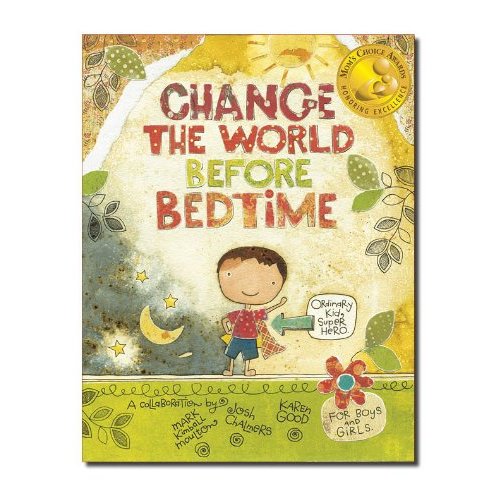
change the world before bedtimeChange the World Before Bedtime, a collaboration by Mark Kimball Moulton, Josh Chalmers, and Karen Good (Schiffer Publishing, 2012). $16.99, ISBN: 978-0764342387

Recommended for ages 4-8

For all the kids out there tired of being told that they’re too young to affect change, Change the World Before Bedtime is a primer on everything anyone, big or small, can do to bring about positive change in their world. The book takes place over the course of a day, with a group of children making positive decisions and taking positive actions to brighten the world around them. By tying on their “hero capes” and eating a healthy breakfast, they prepare for a  day of random good deeds, like picking up litter, visiting a sick friend or family member, donating clothing, toys, and food to the needy, and just thinking and saying happy thoughts and words.

The book features multicultural images and the artwork incorporates some great collage work. The images remind me of Joan Walsh Anglund’s illustrations that I loved, growing up. The rhyming text makes this a fun read-aloud, particularly to 5-6 year olds who may have a better grasp on activism. Positive messages, like “recycle” and “one beautiful world”, are emphasized throughout the book, as are images including composting, teamwork, manners, and environmental awareness. The last page of the book asks the children to write their “bright ideas to change the world before bedtime”, and the endpapers look like pieces of looseleaf paper, encouraging the children to keep writing.

The book’s optimistic tone and beautiful imagery will motivate children and adults alike to do something right away! There’s no need to wait for Earth Day to come around again – there’s always something to do to change the world.

Change the World Before Bedtime received the 2012 Gold Medal Award from the Mom’s Choice Awards.