Posted in Animal Fiction, Fiction, Graphic Novels, Humor, Middle Grade, Tween Reads

It’s Sweater Weather! (the graphic novel, not the forecast)

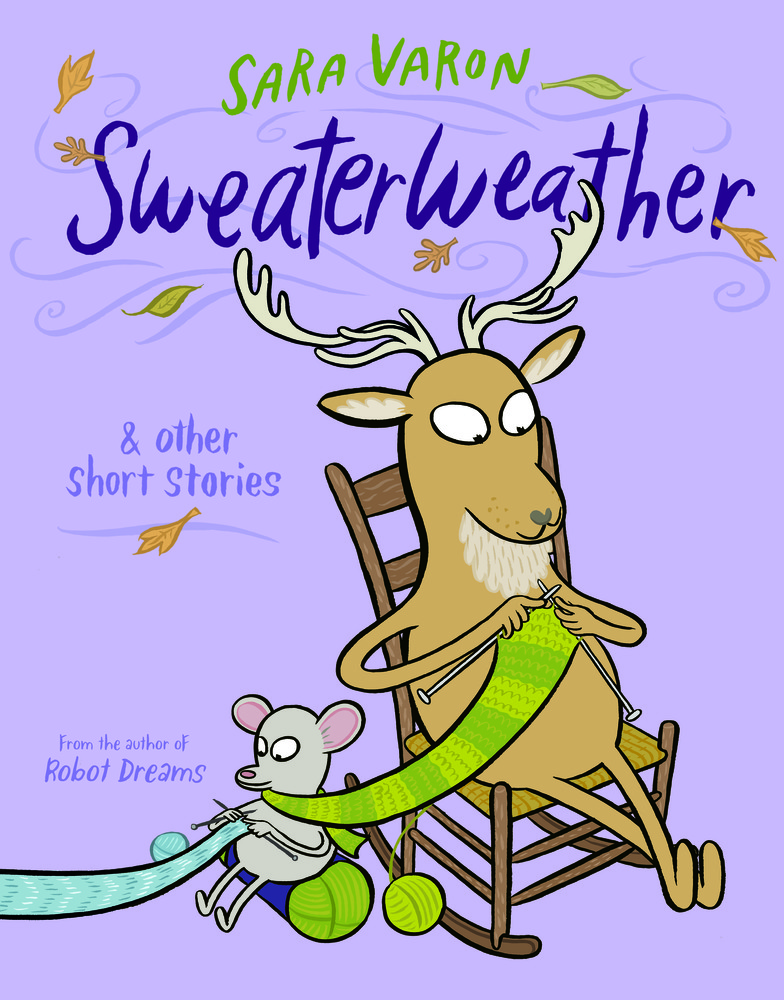
sweater weatherSweaterweather, by Sara Varon (Feb. 2016, First Second), $19.99, ISBN: 9781626721180

Recommended for ages 10+

You may have seen Sara Varon’s work before – she’s given us fun, all-ages graphic novels like Bake Sale, Chicken & Cat, and Odd Duck, and we’ll also be getting President Squid this year (review coming). She draws friendly, fun animals (and squids) in a cartoon style that makes you just want to curl up with these characters, have a cup of tea, and chat.

Sweaterweather is a re-issue of the original 2003 version, with extra stories and content. It’s done in two-color, and is part graphic novel story collection, part peek into Sara Varon’s creative brain. We have stories, essays, and journal entries existing together, an invite for kids and teens to take a load off and enjoy socially awkward animals wandering around Brooklyn and hey, while you’re here, see what goes on in the mind of a creative person!

Kids who love graphic novels and animal fiction will enjoy Sweaterweather for the stories. Creative kids will appreciate the big picture Sara Varon displays for them, and maybe, get them journaling and doodling on their own.

Sara Varon’s author website is great for burgeoning artists and fans. There are sections devoted to her books and illustrations, updates, and links to pages for her favorite illustrators and designers. She’s also an award-winning author/illustrator: Odd Duck was selected by Kirkus Reviews as one of the Best Children’s Books of 2013, Bake Sale was named a YALSA Great Graphic Novel for 2012, and Robot Dreams was on Oprah’s Kids’ Reading List in 2008. In 2013, Sara Varon was a Maurice Sendak Fellowship recipient.

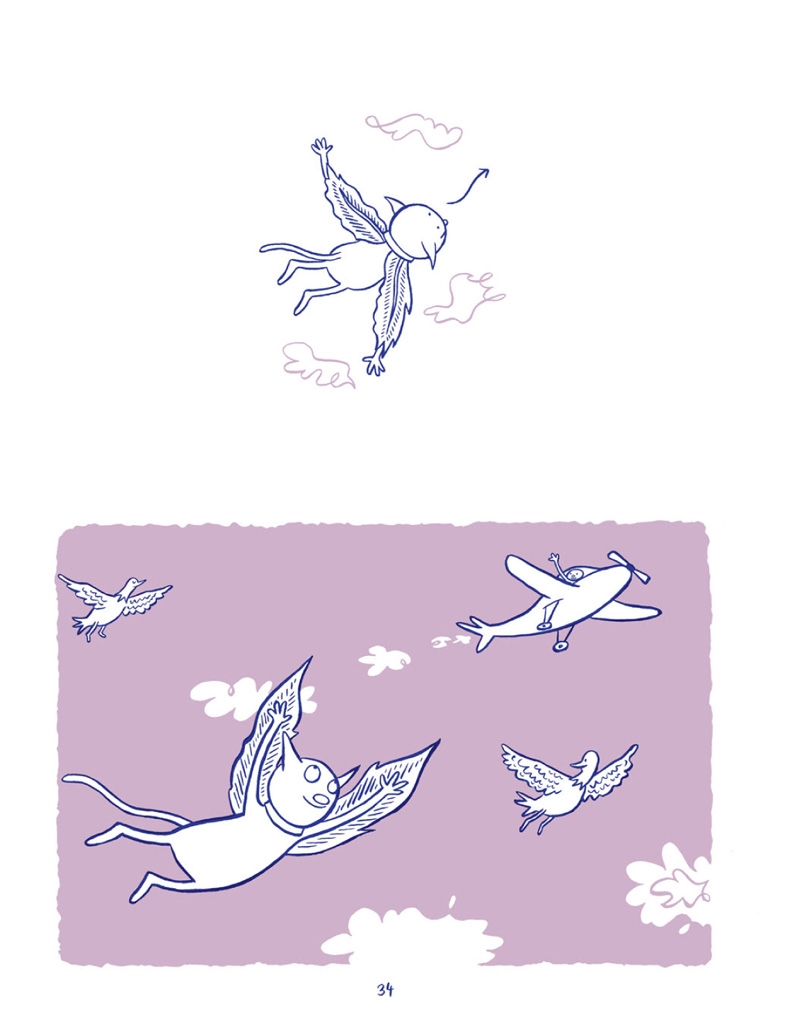
Here’s a sneak peek at some of the artwork from Sweaterweather.

sweater weather_7sweater weather_8


Posted in Fiction, Graphic Novels, Humor, Intermediate, Science Fiction

The Glorkian Warrior returns, and he’s eating adventure pie!

glorkianThe Glorkian Warrior Eats Adventure Pie, by James Kochalka (March 2015, :01First Second), $12.99, ISBN: 9781626720213

Recommended for ages 5+

The Glorkian Warrior is back! When we last encountered him, he was on a quest to deliver a pizza; this time, he’s at odds with his rival, Buster Glark. As usual, Warrior’s trusty backpack is the brains of the operation, and the Warrior’s buddy, Gonk, is along for the ride.

The Glorkian Warrior Eats Adventure Pie is even more surreal and random than The Glorkian Warrior Orders a Pizza. Kids are going to love it – it’s just goofy, cartoony fun with a lot of moments where you’re giggling and can’t really explain why. There are space snakes, genius elbows, a lovable, brain-sucking alien, and some pretty hilarious fart-related humor. There’s even a bonus comic after the story ends.

Steer some of your reluctant readers and your younger readers toward the Glorkian Warrior books. The cartoony art will catch their attention, and the silly storytelling and goofy characters will appeal to everyone’s sense of humor.

Posted in Fiction, Graphic Novels, Tween Reads

Princess Decomposia and Count Spatula – A story of family, food, and standing up for yourself!

princess decomposia Princess Decomposia & Count Spatula, by Andi Watson (Feb. 2015, :01 First Second), $14.99, ISBN: 9781626721494

Recommended for ages 10+

Princess Decomposia is a princess with way too much stress in her life. She’s stuck running the kingdom while her father lays in bed, playing sick, and demanding crazy health food fads be served to him – most of which he sends back with a complaint. When he fires the latest chef, hiring a new chef is just one more thing on Princess Decomposia’s plate, until she meets the sweet, shy Count Spatula.

Spatula brings some light into the frustration of Decomposia’s world. He makes gorgeous, sweet-laden creations that ease diplomatic relations and make Decomposia smile. The two become friends – and it doesn’t escape the staff’s notice. But the king still wants things done his way, and it’s pushing Decomposia to stand her ground.

I love this sweet story. We’ve got a spunky, independent heroine who is frustrated and buckling under a pile of responsibilities; an adorable friendship/budding romance with a sweet chef who just wants to make tasty, exciting desserts and make the princess happy; and a parent who has a lesson or two to learn in responsibility. Some will call it quirky, but for kids like me, who grew up with The Addams Family and The Munsters, this hit the spot. It’s a great story of friendship and family, with fun black and white art that will appeal to tween readers and older.

Princess Decomposia and Count Spatula hits shelves on February 24th – get it for the growing goth in your life.

Posted in Graphic Novels, Science Fiction, Teen, Tween Reads, Uncategorized

A Heroine Shall Rise – The Rise of Aurora West

cover49413-mediumThe Rise of Aurora West, by Paul Pope & J.T. Petty/illus. by David Rubin (First Second, Sept. 2014).  $9.99, ISBN:  9781626720091

Recommended for ages 12+

The city of Acropolis is overrun with supernatural monsters that grab children off the streets. In a city plagued by corruption and fear, one man, scientist Haggard West, fights to end the monsters’ reign. He’s a scientist and a superhero – Clark Kent with test tubes and microscopes.

West is fighting heartbreak, too – his wife is a casualty of the monsters (hence, his motivation to end them) and his 14 year-old daughter, Aurora West, keenly feels her loss. Haggard has taught Aurora how to fight and kill monsters, and she often goes on patrol with him. One night, she discovers something from her past that could unlock memories of her past, her mother, and most importantly, the origin of the monsters.

Not being familiar with Battling Boy – writer Paul Pope’s first book in this series – I jumped in with Aurora West, which serves as a prequel to Battling Boy, giving us background on both Aurora and her father, Haggard West. While I didn’t have the benefit of knowing who the main players were, I found the story easy to get into and the characters and their backstories quickly drew me in. Aurora West is a great hero for tween and teen girls and boys alike – she’s smart, brave, and has an independent spirit and curiosity that propels her.  She’s a dutiful daughter who struggles to be her own person.

Bottom line: you don’t need to have read Battling Boy to enjoy The Rise of Aurora West, but take the time to check them both out. Paul Pope is a multiple Eisner Award winner (for Batman: Year 100 and Solo, both from DC Comics) I thoroughly enjoyed the story, the art, and have already put Battling Boy on hold at my library, so I can read it and become more immersed in this world.

The Rise of Aurora West hits shelves on September 30, so check your bookstores, comic stores, and libraries. It’ll be on my shelves (barring backorders) in the next couple of weeks!

Posted in Fantasy, geek culture, Graphic Novels, roleplaying, Science Fiction, Teen, Tween Reads, Uncategorized

In Real Life: Where online worlds cross over to reality.

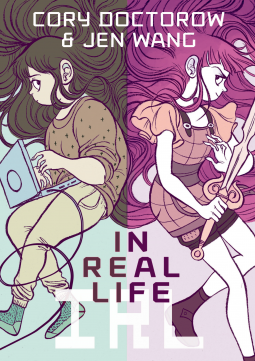
in real lifeIn Real Life, by Cory Doctorow/Illustrated by Jen Wang (:01 First Second, Oct. 2014). $17.99, ISBN: 9781596436589

Recommended for ages 13+

I’m a Cory Doctorow fan. I loved Little Brother, and I was fascinated by For the Win, which examines the lives of “gold farmers” – people whose job it is – in real life – to acquire gold and magic/rare items in games, and sell them to players for real-world currency. The gamers – which include children – are from poor families in third-world countries: India, China, and Singapore, working in deplorable conditions, and exploited by sweatshop bosses who pay pitiful wages.

In Real Life is a graphic novel about a girl named Anda, who loves playing a MMORPG (Massively Multiplayer Online Role-Playing Game) named Coarsegold. She makes friends in the gamespace, ultimately falling in with Lucy, a more experienced gamer who takes Anda under her wing. They stalk and “kill” the “gold farmers” they encounter, believing them to be cheating by selling gold and rare items to fellow gamers. The farmers look small, almost childlike, and Anda – despite doing this in the gamespace – feels guilty. She strikes up a friendship with one of the farmers, a Chinese teenager named Raymond, who tells her about his life and his job – laboring under sweatshop conditions to farm so that he can help support his family – and Anda decides that something needs to be done.

The story is similar to Doctorow’s plot in For the Win, but without delving into the global politics and economics involved in the novel. I loved this graphic novel, which could be an introduction or supplement to For the Win. We get to see positive representations of female gamers, teenagers, and we have a moral central character who is forced to understand that even morals don’t come solely in black and white. At the same time, In Real Life calls attention to a form of human rights violation taking place all over the world, yet located in our homes, our libraries, and anywhere we game.

Jen Wang’s art is perfect for Doctorow’s story. She’s got a manga style that works for me. Her use of color works to as a soft contrast to the tech storyline, and brings out the humanity at the tale’s core.

In Real Life publishes in October of this year, and I can’t wait to get it on my shelves. It’s going to be a great addition to any graphic novel collection, and a must-read for older tweens and teens, especially those who game. Social Studies courses could get some great discussions by adding this book to their curriculum.

Posted in Animal Fiction, Graphic Novels, Humor, Tween Reads

The Stratford Zoo brings Shakespeare to younger readers!

Stratford ZooThe Stratford Zoo Midnight Revue Presents Macbeth, by Ian Lendler/illus. by Zack Giallongo (:01 First Second, Sept. 2014). $12.99, ISBN: 9781596439153

Recommended for ages 8-12

The Stratford Zoo looks your ordinary, everyday zoo – until the Zoo closes for business and the animals gather for some downtime. This particular evening, the Midnight Revue is putting on a play – Shakespeare’s Macbeth – with the lion, naturally, playing the part of the Dane King. What follows is an wildly funny graphic novel that offers younger readers the chance to enjoy the story of Macbeth, where Macbeth must eat the king, and where blood is replaced by ketchup (you can’t eat a king – or a host of people that stand in your way to the throne – without some kind of condiment, right?).

The story is just plain fun, with bits and pieces of Shakespeare thrown in for good effect. The play is presented, with an intermission when the zookeeper walks her rounds. There’s audience commentary and heckling. There are panels and splash pages, and the colors are bright and engaging. I loved this book, and can’t wait to get it on my shelves. It’s a great addition to any graphic novel collection, and for children’s service librarians like myself, a great way to expand our graphic novel sections. Using Shakespeare’s story, and including quotes and scenarios is perfect for teachers looking for a way to incorporate some fun into their Common Core ELA lesson plans.

I can’t wait to see what the Zoo manages for their next performance – but I’ll let you read to the end to find that one out.

Posted in Preschool Reads

Julia’s House for Lost Creatures is an adorable look at friends and sharing responsibilities.

juliaJulia’s House for Lost Creatures, by Ben Hatke (:01 First Second, Sept. 2014). $17.99, ISBN: 9781596438668

Admittedly, I’m a Ben Hatke fan thanks to the Zita the Spacegirl series; when when I saw that he had a picture book coming out, I jumped to review it. I knew it was going to be adorable as well as fun, and I was right – Julia’s House for Lost Creatures is a sweet look at friendship, individuality, and sharing responsibility.

Julia’s house comes to a quiet, seaside area and decides to settle in. At first, Julia enjoys the warm fire, toast, and tea, but soon realizes it’s just too quiet. So she posts a sign that states the house is for “Lost Creatures”, and in no time, goblins, trolls, ghosts, and more homeless or lost creatures show up. Everyone’s happy at first, but Julia becomes frustrated by everyone’s refusal to make a mess and leave it for Julia to clean up. When the noise reaches critical mass, Julia sequesters herself in her workshop, only to emerge with a solution that will make everyone happy.

The book delivers several sweet, but important messages – Julia offers her home to misfits of all sorts; all “lost creatures” are welcome there. It’s not an exclusive club, or a place allowing only certain types. It appeals to anyone – or anything – that’s been shut out somewhere else. And it brings home the point that everyone pitches in to make their home a happy place. Julia creates a chore chart, so all of the creatures know exactly what to do. I love these messages and I love Hatke’s art, done in watercolor for this book. It lends a soft quality to the art that makes the story even sweeter, more dreamlike. There are few, short sentences per page, making this a great read-aloud candidate. The font is usually black and fairly low-key, unless Hatke wants to make a point; then, the font is large and takes on the character of the sound, whether it’s Julia’s exclamation or the sounds of a house that needs some help.

This book is due out in September of this year, and I can’t wait to get it on my library’s shelves. I’ve already got a storytime planned around it!

Posted in History, Non-Fiction, Teen, Young Adult/New Adult

Discover the World War I trench poets in Above the Dreamless Dead

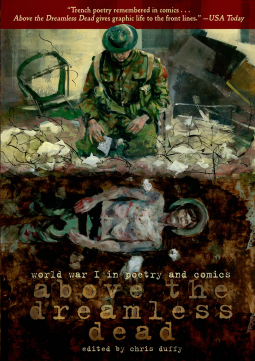
above the dreamless deadAbove the Dreamless Dead, edited by Chris Duffy (:01 First Second, Sept. 2014). $24.99, ISBN: 9781626720657

Recommended for ages 16+

As World War I dragged on, an artistic movement arose from the trenches. The Trench Poets, as they came to be called, were a group of soldiers who wrote about the horrors around them, as a way to cope with what they saw around them. The Trench Poets ultimately became a significant literary movement – but as all things pass, it appears that the memory of the Poets has dulled a bit. No longer. Contemporary comic book and graphic artists have given new life to these poems by giving readers an illustrated retelling. Artists, including Kathryn and Stuart Immonen – two of my favorites – are here, as are Anders Nilsen, Eddie Campbell, Kevin Huizenga, George Pratt, and many more.

There are 20 poems in comic form here, and they present a brutal, beautiful look at World War I through a soldider’s eyes. There’s no glorification of war here; no rousing cries of “Let’s get ‘im, boys!” and no grandstanding. These poets rejected the glorification of war and looked inward at the psychological damage these men knew they were taking home. The stark black and white art adds to the powerful punch delivered by this work.

I consider myself a pretty well-read person. Perhaps it’s because I’m not as up on poetry as I should be, but I’d never heard of the Trench Poets until I got a copy of Above the Dreamless Dead in my hands, and was blown away by what I read. This is a book that should be in every high school library; English and History teachers could put together one heck of a unit with this book. This stands with Maus and Persepolis, as graphic novel interpretations of history that demand to be read to understand, truly understand, a moment in time through the eyes of a person living it.

Some of the Trench Poets didn’t make it home from the War. Their stories are told briefly at the end of the book. I may not have known anything about the Trench Poets when I picked this book up, but I intend to find out more now. And really, that’s one of the best things one can say about a book.

Posted in Fantasy, Graphic Novels, Science Fiction, Tween Reads

Legends of Zita the Spacegirl is out of this world!

legends of zitaLegends of Zita the Spacegirl, by Ben Hatke. :01 First Second (2012), $18.99, ISBN: 978-1-59643-806-4

Recommended for ages 8-14

I just realized that while I’d reviewed both Zita the Spacegirl and the upcoming Return of Zita the Spacegirl, I never wrote a review for the second book in this great series – so I re-read it in order to remedy the situation.

When we rejoin Zita in the second book in her series, she has found intergalactic fame as The Girl Who Saved Scriptorious. Creatures from all over the galaxy are clamoring to meet her, and fame has become a bit overwhelming for Zita. When she encounters a robot that looks just like her, she decides to let the robot handle fame while she and Mouse take off to relax and be anonymous for a while. The only problem is, the robot is an Imprint-o-Tron, which eventually tries to replace their targets – and when two aliens seek “Zita”‘s help in saving their planet from the interstellar scavengers, the Star Hearts, Zita-bot is all too happy to lend a hand, stirring up trouble for Zita and her friends.

I am a big Zita fan, and this second book has every bit of the spirit of fun and adventure that the first book (and the upcoming third) do. We see a slightly different Zita here -she’s overwhelmed by fame, she wants to go home, and she ultimately learns about the power of sacrifice – she’s a more mature Zita who is still, at heart, a kid. The Imprint-o-Tron reminds me of Pinocchio, who wanted to be a real boy. The Imprint-o-Tron, or as I started calling her, the Zita-bot, isn’t bad – she’s following her programming, and she really seems to want to be Zita, to face the exciting adventures that Zita does. There are some great messages to be found in this second book.

There are some great resources on the Web for using Zita materials in the classroom. Comics Are Great has a downloadable lesson plan, along with an hour-long podcast dedicated to the book, where teachers, librarians, and cartoonists discussing the book.

The Zita trilogy is a great middle-grade graphic novel series. She stands as a good role model for any girl or boy who seizes the power of imagination and inner courage.