Posted in Science Fiction, Tween Reads

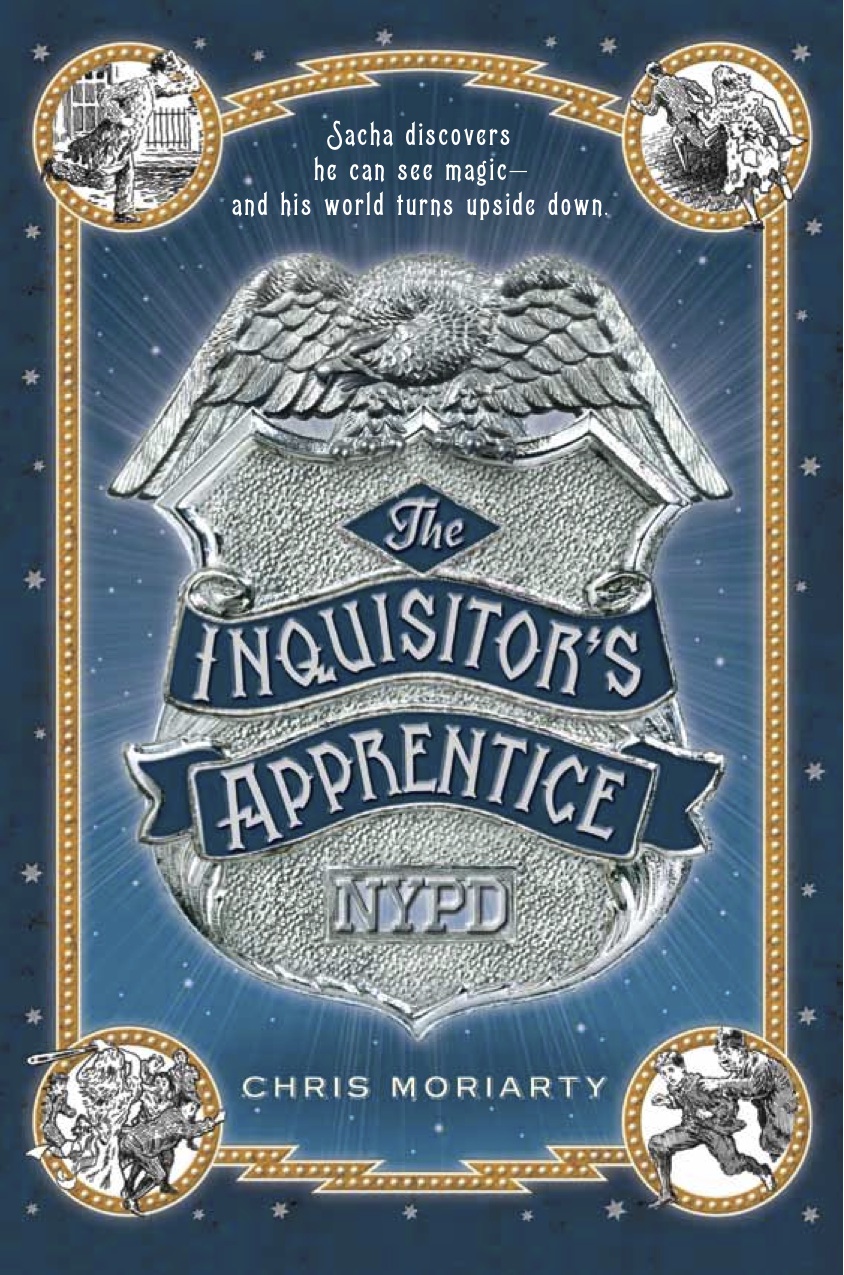
Book Review: The Inquisitor’s Apprentice by Chris Moriarty (Harcourt, 2011)

Recommended for ages 10-14

The Inquisitor’s Apprentice is the first book in a a science fiction/fantasy adventure series, taking place in an alternate New York City around the turn of the 20th century. Magic exists in this world, and each immigrant group has their own magic that they bring to the New World with them. Inquisitors, a branch of the New York Police Department, patrol to make sure magic is not being abused.
Thirteen year-old Sacha Kessler, who lives in the Lower East Side with his family, has the gift of seeing magic; for this, he is recruited into the NYPD, as an apprentice to Inquisitor Wolf; his fellow apprentice, Lily Astral, is from a wealthy New York family and is an entitled snob who rubs Sacha the wrong way almost immediately.

Inquisitor Wolf, Sacha and Lily are put on a case involving death threats to Thomas Edison, who is creating a witch-detectiing machine – every magician in New York City has a reason to want him dead, but as they delve deeper into the case, things become more complicated for Sacha, who sees the case leading back to his neighborhood – and possibly, his own family.

The book is compulsively readable, with well-drawn characters and an interesting alternate New York setting. Moriarty offers a new way of glimpsing life into the Jewish immigrant experience in turn of the century New York; this book would be good companion reading to a unit on immigration in America as it allows for many areas of discussion wrapped within a solidly enjoyable fantasy setting. Some may struggle with the many Yiddish terms, but context should answer most questions. A paperback edition may consider a guide to terms for some readers. Black and white illustrations by Mark Edward Geyer add to the moody feeling that permeates much of the novel.

Chris Moriarty has an Inquisitor’s Apprentice website set up that provides information on the series and on the actual New York City of the time, with photos and information about key individuals that appear in the series, like Harry Houdini and Thomas Edison. There is author event and contact information as well. He blogs at SFness.com about his own books, other author’s books, and offers writing advice. His website features his writing about science fiction and cyberpunk, along with other science fiction subgenres.

Posted in Fiction, Humor, Middle School, Tween Reads

Darth Paper Strikes Back, by Tom Angelberger (Amulet, 2011)

Recommended for ages 9-12
After reading Angelberger’s first book in his “Origami” series, The Strange Case of Origami Yoda, I had to get the sequel. I am pleased to say that the sequel matches up to the original.

The McQuarrie Middle School gang is back, but the happy beginnings we saw at the end of Origami Yoda are nowhere to be found; to top it off, Harvey shows up at school with Darth Paper, his answer to Origami Yoda. In no time, Harvey’s managed to get Dwight suspended and under the threat of being sent to a special school for troubled children. Origami Yoda asks Tommy to put together another case file, this time, to show Dwight in a favorable light and get his suspension overturned. With Harvey threatening to throw a wrench in their work at every turn, can Tommy and his friends make everything right again – this time, without Origami Yoda’s advice?

If readers enjoyed Origami Yoda, they will enjoy Darth Paper Strikes Back. The book is written in the same fun, first-person style as the original, and the conflict with love-to-hate-him Harvey (and Darth Paper) adds a fun counterpoint to Origami Yoda’s sage advice while adding some unexpected depth to the book, particularly at the conclusion.
For more information about The Strange Case of Origami Yoda and author Tom Angleberger, you can see my original post.
 
 
Posted in Fantasy, Tween Reads

The Graveyard Book, by Neil Gaiman (illus. by Dave McKean) (HarperCollins, 2008)

Recommended for ages 12+

Created from an idea author Neil Gaiman had in 1985 that would create a “Jungle Book in a graveyard”, The Graveyard Book tells the story of Nobody “Bod” Owens, orphaned as a toddler and raised by the ghosts of a graveyard he wanders into after his family is murdered. His guardian, Silas, is neither dead nor alive and can navigate both worlds in order to assure Nobody’s needs are taken care of.

The problem is, Jack – the man who murdered Nobody’s family – is still at large, and he’s still looking for Bod to finish his business. He’s working for a secret society who has ordered the boy’s death, but as long as Bod stays within the confines of the graveyard, he is safe. As he gets older, though, Nobody wants to venture outside and see more of the world and have human friends.

Like Coraline and Gaiman’s other work for younger readers, The Graveyard Book is a dark fantasy, yet he manages to make the fact that a boy is raised by ghosts and the undead charming. Nobody is a sweet boy who grows up loved for and cared for by the spirits of the graveyard in which he lives, and the supernatural beings – Silas and Bod’s tutor, Miss Lupescu – who are charged with his care. Mr. Gaiman’s descriptions again let the reader’s imagination run wild, with funny and wry descriptions of everyone from the inhabitants of the graveyard to the sinister murderer, Jack Frost.

The Graveyard Book received the 2009 Newbery Medal, Hugo Award for Best Novel, and Locus Award for Best Young Adult Book; it also won the 2010 Carnegie Medal.

Posted in Fantasy, Tween Reads

Book Review: Coraline, by Neil Gaiman (illus. by Dave McKean) (HarperCollins, 2002)

Recommended for ages 10+

Coraline is a dark fantasy created by author Neil Gaiman. It was adapated into a graphic novel (2009) and an animated feature (2009).

Coraline is a young girl who moves into a new home with her parents and feels out of place. Her parents don’t seem to have too much time for her, so she goes exploring and meets some of her odd new neighbors and the neighborhood cat. One night, she discovers a hidden doorway that leads to a parallel world; it’s here that she meets her “Other Mother”, who seems to have all of the time in the world for Coraline and always makes delicious meals. She desperately wants Coraline to stay, but there’s something… strange… about the Other Mother. As Coraline visits more often, she discovers that the Other Mother is not at all what she seems, and she’ll need the help of the neighborhood cat – who isn’t exactly what he seems, either – to save herself and her family. 

Neil Gaiman has been writing dark fantasy since the 1989, when he revived the DC Comics title The Sandman. He brings his creepy fantasy worlds to children as easily as he does to his older audience, and often makes some of his most unsettling characters adorable. His main characters often go against the grain, and Coraline is no exception – she is an independent, stubborn, curious girl who loves a good adventure; she’s also a smart heroine who can work her way out of a tight situation.
 
Mr. Gaiman creates memorable images with his words – visions of The Other Mother will stick with kids and adults alike and Coraline’s odd neighbors come with their own strange charm that smoothly made the transition from print to screen. His descriptions allow the reader’s imagination to run wild without ever worrying about going over the top – because there simply is no limit.
 
Coraline has won numerous awards, including the 2003 Hugo and Nebula Awards for Best Novella and the 2002 Bram Stoker Award for Best Work for Young Readers. Neil Gaiman’s Mouse Circus website – a Coraline reference – is geared toward his younger readers and offers information about the author, downloadable computer wallpaper, and video interviews and book trailers.
Posted in Fantasy, Media, Science Fiction

DVD Review: Hellboy: Blood and Iron (Starz Home Entertainment, 2007)

Recommended for ages 12+
For those unfamiliar with the Hellboy comic book and movie series, let me provide a very quick overview: Hellboy is a demon from Hell, brought to earth by Nazi occultists during World War II. He was saved by the Allies and raised as a son by Professor Trevor Bruttenholm, and later went to work for the secret international Bureau of Paranormal Research and Defense (BPRD), founded by Professor Bruttenholm. His two closest friends and partners are Liz Sherman, a human who can create fire with her mind, and Abe Sapien, an amphibious humanoid.

In Blood and Iron, the BPRD is asked to investigate a haunted mansion purchased by a billionaire who wants to make money from it as a tourist attraction. They learn that the mansion is haunted by ghosts, witches, werewolves and hellhounds and that the evil undead Hungarian countess and vampire Erzsebet Ondrushko, who Professor Bruttenholm has tangled with before, is back to cause more trouble. Ondrushko appears to be based on the real-life historical figure Elizabeth Bathory, and Greek mythological figures Hecate, goddess of the crossroads and witchcraft, and harpies are also thrown into the mix.

 
Mike Mignola, Hellboy creator, was one of the screenwriters on Blood and Iron and the cast who plays the characters in the movie voice their characters in this animated film. Fans of the comics and the movies will be happy here; there is plenty of paranormal activity, snappy dialogue and character interaction, and wild fight scenes and gunplay. While some of the imagery may be rough for younger viewers – there’s not direct graphic violence, but there is blood and some implied torture – older ‘tweens and teens have played more violent video games. Parents, watch it first, then use your judgement.
Posted in Post-apocalyptic/Dystopian, Science Fiction, Tween Reads

Book Review: The Giver, by Lois Lowry (Houghton Mifflin, 1993)

Recommended for ages 11-14

In the dystopian future, there is no more war, disease, or poverty. There are no choices, either – in 12-year old Jonas’s community, spouses are assigned to one another, children are assigned to families, and children’s milestones are pre-selected and celebrated once a year. At age seven, they receive jackets that button in the front. At the age of nine, they receive bicycles. At the age of 12, they attend the Ceremony of Twelve, where they are assigned their careers. Jonas, who has been experiencing feelings that has made him feel different from his peers, is assigned to be the Receiver of Memory – the sole repository for the collective memories of the community. He begins to work with the outgoing Receiver, now called The Giver, to receive the memories and learns disturbing truths through both the memories and the truths he begins to see in his daily life in the village.

The Giver is one of those books that sticks with you, changing the way you think about things. What price is a group willing to pay to live in a perfect, ordered society? Jonas, in receiving memories, plays the part of Adam in the Garden of Eden – he receives knowledge, and with knowledge comes confusion. Is his community right because they don’t know better? He begins to question everything around him and everything he’s ever known; when he sees his father commit an act in the course of his daily work that he finds unspeakable, the last vestiges of what he believes in are thrown into chaos.
 
The Giver is one of the most challenged books books in middle schools across America, usually for its portrayal of euthanasia (but also for what has been considered a sexual reference). Regardless of its challenges, it remains a popular and important middle-school book that speaks to the power of free will and choice. There are many lesson plans for this book on the Web, including this comprehensive one from the Mountain City Elementary School District in Tennessee. The book won the 1994 Newbery Medal and the 1996 William Allen White Children’s Book Award and has been designated an American Library Association (ALA) Best Book for Young Adults and an ALA Notable Children’s Book. The Giver is the first in a 3-book series that includes Gathering Blue and Messenger.
 
Lois Lowry is an award-winning YA author; she has received numerous awards, including two Newbery medals (for The Giver and Number the Stars). Her website lists all of the awards she’s won in addition to offering book information, a biography, her blog, her photos, and copies of her speeches.
Posted in Adventure, Fantasy, Humor, Tween Reads

Book Review: The Magnificent 12: The Call, by Michael Grant (Katherine Tegen Books, 2010)

Recommended for ages 9-12

Mack MacAvoy is a medium kid – medium in height and build, medium in looks, medium in grades – he’s so ordinary that his own parents don’t really notice him most of the time. That all changes when Grimluk, an ancient man dressed in an old black robe, appears in his school hallway and announces that he is one of the Magnifica, a group of 12 children who will have to save the world from the ancient evil of the Pale Queen. In no time at all, Mack and his bully protector Stefan are swept off to locate the other 11 Magnifica, but it won’t be easy – the Pale Queen’s daughter, Eriskigal, and the monsters at her command, will stop at nothing to destroy them before they even begin.

The Magnificent 12 is a fun adventure series with good character development and interaction; the story moves at a pace that will keep readers’ interest. The chapters alternate between Grimluk’s story, providing an establishing backstory, and Mack’s story, laying the groundwork for the future books in the series. There are villains, monsters, and prophecies galore and with both male and female characters, boys and girls alike should find this a good read. International locales lend a James Bond-type feel to the adventure.

The series website offers the chance for visitors to create their own avatars, play games, and enter a sweepstakes to win a copy of the latest book in the series, The Trap. An online map also acts as Mack’s travel journal where readers can learn facts about the different countries where Mack’s adventures take place. Educators can find essay questions, discussion questions, and lesson starters on the “Educators” section of the site. The author’s website offers a biography, FAQ, information about his books, and contact information.
Posted in Uncategorized

Book Review: The Strange Case of Origami Yoda, by Tom Angleberger (Amulet, 2010)

Recommended for ages 9-12

What would you do if the school oddball showed up with an Origami Yoda on his finger and started dispensing advice one day? What would you do if his advice actually made sense and worked? That’s the dilemma facing McQuarrie Middle School sixth grader Tommy Lomax as he creates the case file known as The Strange Case of Origami Yoda.

At first, Tommy and his friends think Origami Yoda is just another one of Dwight’s odd quirks, but as Origami Yoda’s advice continues to produce positive results and even borders on predicting the future, Tommy and his friends end up seeking Dwight and Origami Yoda out. Tommy has a particular reason for wanting advice and struggles between believing in Origami Yoda’s connection to The Force and the fear of falling victim to a hoax. He compiles a series of case studies from classmates’ experiences with Yoda to review and make a decision; his friend Kellen adds illustratrations and his frenemy Harvey adds his own commentary. Harvey does not believe in Yoda and thinks everyone’s crazy for buying into the whole scheme.

The book is hilarious. It’s a fun read, written from the point of view of Tommy and his friends, with different handwriting and computer fonts and line drawings to give the reader a feeling of reading a middle schooler’s notebook. The banter between characters, carried out on paper, is fun and realistic – there’s sarcasm and anxiety aplenty to go with the light humorous pace. The book is a great, quick read for boys and girls alike looking for a funny book.

The Strange Case of Origami Yoda is the first in a planned trilogy of books by Tom Angleberger. Its sequel, Darth Paper Strikes Back, was released this past summer. The book has won several awards including the Cybil Award for best middle-grade fiction, The Dorothy Canfield-Fisher Award for 2011/2012, and the E.B. White Read-Aloud Award for Middle Grade Fiction.

The author maintains an Origami Yoda/Darth Paper blog that offers tips on folding one’s own Yoda or Darth Paper, along with a “Super Folders Forum” for users to communicate. He also shares a blog with fellow author Sam T. Riddleburger, Berger & Burger.

Posted in Horror, Tween Reads

Book Review: Goosebumps: The Beast from the East, by R.L. Stine (Scholastic, 1996)

Recommended for ages 9-12

R.L. Stine is the Stephen King of kid’s horror. His Goosebumps series has been scaring the daylights out of kids for almost 20 years now, and he has branched out into other Goosebumps series (Horror Land, Hall of Horrors) and a television series based on the novels.

The Beast from the East is like reading a demented version of the old nursery song, Teddy Bear’s Picnic(also referenced in the story). Twelve year-old Ginger, her ten year-old twin brothers Nat and Pat, and their parents go on a camping trip one summer. While their father sets up the campsite, Ginger and her brothers go exploring and end up getting lost in the woods, where they come upon a group of big, blue, furry bearlike beasts that want to play a game where the winners get to live, but the losers get eaten. There are a lot of rules – can they figure them all out and get back to their parents, or will they end up as dinner?

Stine’s stories are short, creepy fun, and end with a macabre twist every time. There isn’t a lot of character development here, but there doesn’t need to be – you learn what you need to know to get through the story, because it’s really the situation that makes the book. Stine is great at describing panic and fear, giving readers the good scare they want in the safety of their own space. The twist is one last parting shot to keep you thinking after the book’s end, or until you pick up the next book.
 
Several books from the series have won Nickelodeon Kids’ Choice Awards and is one of the best-selling children’s series of all time. Scholastic has an official Goosebumps site.
Posted in Fantasy, Tween Reads

Book Review: The Summer of Moonlight Secrets, by Danette Haworth (Walker Books, 2010)

Recommended for ages 9-12

Eleven year-old Allie Jo lives with her mother and father at The Meriwether, a Florida hotel that they help manage. She doesn’t have many friends, and the mean girls at school call her a “hotel rat”. The summer of 1987 changes things for Allie Jo, though – she meets Chase, a fourteen year-old guest traveling with his journalist dad and who’s working through some issues of his own, and they both meet Tara, a mysterious girl who appears one day and says she’s run away. As Allie Jo and Chase learn more about Tara, they’re split as to what they believe – is she a troubled teen, or is her fantastic story true?

A fantasy substory taking place within a realistic fiction plot, The Summer of Moonlight Secrets is great fun with a few big issues going on – there is some minor bullying, the issue of an absentee mom, and a runaway whose stories all intertwine here. Ms. Haworth’s story is evenly paced with well-developed characters. Chapters are narrated in each of the three main characters’ voices, so the reader truly gets a glimpse into each character’s mind and point of view in addition to how each perceives the others. The big reveal is also a pleasant surprise, as Ms. Haworth almost leads to reader to one conclusion to reveal another, more interesting one. Overall, an enjoyable read about friendship that will make readers feel good when they’re done – and leave them with some interesting things to consider.

Danette Haworth’s website offers information about all of her books, her biography, and contact information.