Posted in Preschool Reads, Toddler Reads

Book Review: Minerva Louise, by Janet Morgan Stoeke (Puffin, 2012 edition)

minerva louiseRecommended for ages 2-5

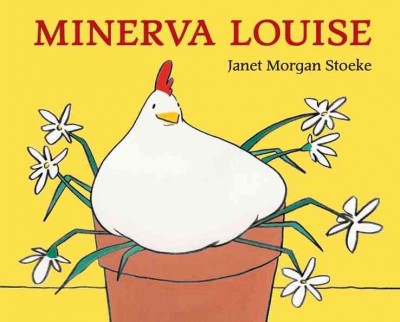
First published in 1988, Minerva Louise is the story of an inquisitive hen who goes exploring and finds a house with all sorts of interesting things to see. The book speaks to toddlers’ and preschoolers’ natural curiosity about the world around them; they can follow her as she wanders into new situations and sees things from her own unique point of view. In this first Minerva Louise adventure, she explores a farmhouse and sees a perfect nest for her (a fireplace), a comfortable chair (a flowerpot), friendly cows (a sleeping cat), a tractor (a tricycle), and more. She encounters a rubber duck in a bathtub, which she sees as a new friend inviting her to play in a pool, but decides to go play in the yard with her friends instead. The artwork is uncluttered; simple but eye-catching: Ms. Stoeke uses a crayon-like line, drawn onto heavy vellum paper and traced onto watercolor paper, filled in with gouache paints and occasional watercolor washes. She uses large, simple shapes and bold, flat colors inside soft black outlines, against a white background. The plain, black font makes for a good read-aloud book that will keep audiences interested in the pictures.

This would be part of a fun animal read-aloud. For a slightly older audience, I would also suggest an Amelia Bedelia companion story, as Minerva Louise tends to see things with her own unique point of view, similar to Amelia Bedelia. There are many farm animal printables that children can color, and there are many farm animal songs and fingerplays.

The author’s website offers links to more of Ms. Stoeke’s books, her art, and information about school visits. The Minerva Louise series includes A Hat for Minerva Louise; Minerva Louise on Halloween; Minerva Louise on Christmas Eve; A Friend for Minerva Louise; Minerva Louise at the Fair; Minerva Louise and the Red Truck. Minerva Louise won the Dutton Picture Book Contest (1988).

Posted in Preschool Reads

Book Review: The Snowy Day, by Ezra Jack Keats (Viking Press, 1962)

snowydayRecommended for ages 3-5

In Keats’ beloved classic, a little boy enjoys the wonder of his first snowfall. Peter wakes up to see snow covering everything as far as the eye can see. After breakfast, he ventures outside and plays in the snow, making snow angels, playing with footprints, making a snowman, and climbing a mountain. He goes home and tells his mother about his day, takes a warm bath, discovers that the snowballs he saved in his pockets are gone, and  goes to sleep, only to wake up to another snowy day. The groundbreaking book was the first picture book to feature an African-American child as the hero of his own story and is still popular with audiences of all cultures and backgrounds today; it is the story of a child enjoying a snowy day – preschoolers will enjoy thinking about their favorite snowy day and appreciate moments that Peter experiences that may be familiar to them: the feeling of snow hitting him on the head, getting hit with a snowball when he tries to play with older boys, and the feeling of a  nice, warm bath  when he gets home.

Mr. Keats used illustrations consisting of cut-outs, varied textures, strong watercolors, geometric shapes, and collages, was also considered an artistic breakthrough. The images are not outlined, giving making for a softer appearance and will keep young audiences interested while the plain black font allows for a read-aloud that will keep audiences interested in the pictures while the reader weaves the tale. The endpapers provide a comfortable lead-in and phase-out to the story, with multi-colored snowflakes on a sponge-like background. Peter also appears in Keats’ books Peter’s ChairA Letter to Amy; and Goggles!

The Snowy Day has won numerous awards and accolades over the last 50 years, including the Caldecott Medal (1963) and the Child Study Children’s Book Committee (1995).

This would be a great anchor story for a winter/snowy day read-aloud. There is a board book version available for even younger audiences; it may be a good idea to have copies on hand for toddlers who want to follow along. Multicultural audiences will appreciate the African-American main character. The author’s website has an interactive version of the story with narration and a soundtrack that should be accessible on library computers. The Perry Public Library’s Snow & Winter storytime offers ideas, fingerplays and songs; children can talk about their favorite snow days and could color snow-related printables available on many children’s websites. Children could use precut shapes to make and decorate their own snowmen.

Posted in Preschool Reads, Toddler Reads

Book Review: T is for Terrible, by Peter McCarty (Henry Holt, 2004)

t is for terribleRecommended for ages 2-4

A T-Rex feels badly about being a “terrible lizard” and wonders if he would be less terrible if he were pink or blue. He is like other creatures, being hatched from an egg and having a mother. If he had the choice, he would be a vegetarian, but that is not in his nature. There is humor to the dinosaur just as there is a healthy dose of understanding what it is that makes him terrible: animals run from him, the ground shakes when he walks, and he has large, sharp teeth. Mr. McCarty’s illustrations, muted pencil-on-watercolor-paper drawings make the dinosaur look soft, not very threatening at all, even sensitive. The textured lines and soft shading give a beautiful sense of depth to the animals and their surroundings. The plain black font on a white background is brief, allowing readers to pay more attention to the beautiful pictures and making this a very good read-aloud choice.

This would be a great choice for a dinosaur read-aloud. This could be a great unconventional dinosaur read-aloud, with stories about dinosaurs who don’t just rampage and eat whatever is in their way. There are many dinosaur songs and fingerplays. The Perry Public Library has I Love Dinosaurs storytime suggestions with stories and songs, and there are dinosaur printable sheets on many websites. The author’s website information about his other books, plus links to his blog and events.

Posted in Preschool Reads, Toddler Reads

Book Review: If You Take a Mouse to School, by Laura Numeroff/illus. by Felicia Bond (HarperCollins, 2002)

if you take a mouse to schoolRecommended for ages 2-4

A mouse accompanies his human friend to school, and things snowball from there. The Mouse, first introduced in Ms. Numeroff’s If You Give a Mouse a Cookie, is back, and he is still pushing his boundaries with his human friend; this time in school. Mouse discovers new friends and activities, which include writing a book, playing basketball, riding a skateboard, and performing a science experiment. Visual cues link If You Take a Mouse to School to the original story: there are chocolate chip cookies on the boy’s pajamas; they show up in a lunch box, and as a refrigerator magnet. Felicia Bond’s watercolors are bright and crisp and stand out against the stark white background, inviting readers to look closely at the action featured on every page. There is a lot of action to see, too; Mouse is in constant motion, popping up in a lunchbox, kicking a soccer ball, or running with a group of children. Preschoolers will enjoy imagining a fun day at school with a tiny visitor of their own.

This would be a fun read-aloud for preschoolers preparing for Kindergarten. There are many back-to-school songs to sing in a school-related read-aloud. There is also a Mouse plush doll available; a fun read-aloud could include Mouse “sitting” with attendees, and asking each attendee how they would spend a school day with Mouse.

The Mouse series includes If You Give a Mouse a Cookie, which is the first Mouse story, and If You Take a Mouse to the Movies. The books are part of the larger “If You…” series, which includes titles such as If You Give a Moose a MuffinIf You Give a Pig a Pancake; and If You Give a Cat a Cupcake.

The author’s website offers coloring pages and resources for teachers and parents.


Posted in Preschool Reads, Toddler Reads

Book Review: Mama Mama by Jean Marzollo/illus. by Laura Regan (HarperFestival, 1999)

mama mamaRecommended for ages 0-4

The bond between mothers and babies is strong, as illustrated by different animals. Seven different animal babies tell their mothers, in rhyme, how they love them. Each spread features a realistic illustration of an animal mother and baby – lions, leopards, chimpanzees, koalas, pandas, elephants, and sea otters – and a four-line rhyme celebrating their love: “Mama, Mama,/Nuzzle, hug,/I’m your little/golden cub”. The font is simple and black, meant for mothers to read to their children during cuddle time. The book is a sweet tribute to mothers and their babies and should be a popular board book selection in any library.

This would be a good read-aloud for a family-related lapsit or a Mother’s Day lapsit. The Perpetual Preschool website offers many Mother’s Day songs and fingerplays that would work well with this type of lapsit.

The author’s website offers free ebooks and activities using her other books. She has written a companion book to Mama Mama called Papa Papa.

Posted in Preschool Reads, Toddler Reads

Book Review: When I Grow Up, by Leonid Gore (Scholastic Press, 2009)

0-545-08597-7Recommended for ages 2-4

A little boy asks his father what he will be when he grows up, and looks at the world around him for ideas. A raindrop tells him he could be “like me” and become the fastest river; a green sprout, the tallest tree; a caterpillar, the most colorful butterfly in the meadow. As the boy paints the images he sees around him, he ultimately makes his own decision: he will be like his dad. The artwork is a simple and soothing series of acrylics and mixed media, with a single die-cut image in each spread acting as a transition to the next spread. The die cuts may not hold up to repeated use and risk tearing, but the pages are thicker than usual and may last longer than expected with gentler use.  Books that illustrate relationships between fathers and sons are not as common as mothers and sons or mothers and daughters, making this a good book to offer the community.

This would be a great addition to a family read-aloud or a Father’s Day read-aloud, as it features a positive relationship between a father and son. There are great Father’s Day crafts that are easily made available, including Father’s Day picture frames using heavy paper, glue and scissors available on Enchanted Learning’s website. Children can bring pictures from home or can use pictures from old magazines. The author does not have a website, but his publisher has an author page with a biography and the ability to become a “fan”.


Posted in Preschool Reads, Toddler Reads, Uncategorized

Book Review: Thank You Bear, by Greg Foley (Viking, 2007)

thank-you-bearRecommended for ages 2-4

Bear finds a box that he cannot wait to share with his best friend, Mouse. On his way to Mouse, he meets other friends – a Monkey, an Owl, a Fox, an Elephant, a Squirrel and a Bunny – who criticize Bear’s gift as being too small, too ordinary, or even a better gift for someone else. Dejected, Bear is unsure whether or not his gift is worth giving, until Mouse shows him that friendship is all about gratitude. Preschoolers will appreciate this simple book on friendship and gratitude, and the joy that even the simplest gifts can bring to another. The font is a spare, typewriter-like print, and the pastel watercolor artwork, outlined with strong black lines, bring simplicity to a story that may diverge from more brightly colored books, but will stand out because of it.


This would be a great addition to a storytime on friendship and gratitude. There is the potential for a wonderful discussion about friends and giving – Shel Silverstein’s The Giving Tree would be a great companion story to this book – and the importance of saying “thank you”. Friendship is a popular storytime theme, with many songs available on children’s CDs. DLTK’s website has a friendship wreath craft made with traced handprints that can be prepared in advance and ready for attendees to assemble with help from their parents/guardians.

The author’s website has downloadable designs for Bear stationery and computer wallpaper, in addition to links to other books. Mr. Foley’s “Bear” series includes Make a Wish Bear; I Miss You Mouse; Good Luck Bear and Don’t Worry Bear, which also features his friend, Mouse.

The book received the Charlotte Zolotow Award in 2008 and was a nominee for Iowa’s Goldfinch Book Award (2011).

Posted in Preschool Reads, Toddler Reads

Book Review: Duck Sock Hop, by Jane Kohuth/illus. by Kane Porter (Dial Books for Children, 2012)

ducksockhopRecommended for ages 2-4

Once a week, ducks grab a bunch of socks from the sock box and head over to dance at the sock hop. They dance and wear all sorts of fun socks that they get from the sock box. Naturally, the party gets a little out of control, but it all ends well, and the ducks get ready for the next sock hop.

The illustrations are fun; cartoon-style and outlined in black with textured with hand-printed patterns on both the socks and the ducks are interesting to look at, and younger readers get a little lesson in shapes as the story describes the exciting socks found in the sock box: socks with squares, dots, moons, cars and spoons! The story is told in rhyme and allows for a fun, movement-oriented read-aloud once the sock hop gets underway as the ducks teeter, tumble, twist and trip their way through the dance. The story font is a bold, rounded font that curves around the pictures, creating further interest.

 This would be a great addition to a movement-oriented storytime. Books like Karen Katz’s Shake it Up, Baby! and Helen Oxenbury’s Clap Hands are good additions to this type of storytime. The Perry Public Library has great Move Your Body storytime suggestions, including fun songs like “Head, Shoulders Knees and Toes” and “If You’re Happy and You Know It”. The author’s website also offers Duck Sock Hop activities, including a Duck Sock Hop Kit that allows you to create your own sock hop – attendees could bring a pair of fun socks to donate to the sock box!

Posted in Preschool Reads, Toddler Reads

Book Review: If You’re a Monster and You Know It, by Rebecca & Ed Emberley (Orchard Books, 2010)

If-You-re-a-Monster-and-You-Know-It-9780545218290Recommended for ages 2-5

The classic song “If You’re Happy and You Know It” gets a monster makeover from Rebecca Emberley and her father, Caldecott Award winner Ed Emberley.

Caregivers have taught toddlers and preschoolers that song, “If You’re Happy and You Know It”, for years. Rebecca and Ed Emberley put a fun, new spin on a familiar song by incorporating monsters, with all of the snorts, growls, wiggles and roars that go with them. Most children will be familiar with the tune, so slotting in new, fun, silly words and actions will be easy and exciting. The neon-bright, digitally created monsters pop off the black page backgrounds, appearing to almost pop off the page. The story font is a bright green for easy reading, but small and almost comic-like in appearance. The action words – stomp, snort, growl, wiggle, roar – are large, brightly colored, and appear to be digitally rendered along with the rest of the artwork, providing an easy prompt for children to take action.


This would be a great interactive read-aloud for toddlers and preschoolers alike, especially for a fun Halloween storytime. There could be a mask-making workshop before the storytime, where participants can color in blank printouts and create their own monsters that will stomp and roar and twitch their tails during the reading. Ed Emberley’s website offers printable mask activities and other October activities that would work with a Halloween read-aloud. There are many fingerplays and songs to be sung during a Halloween storytime; plus, the book comes with a link to a free, downloadable version of the song from the Scholastic website that can be played for a full-on monster dance party.

The authors have further resources on their websites (http://www.rebeccaemberley.com/, http://www.edemberley.com/pages/main.aspx) for more printable, downloadable activities.

The book has received several accolades, including nomination for the Grand Canyon Reader Award and the Building Block Picture Book Award, and designation as an IRA Children’s Choice.

Posted in Preschool Reads, Toddler Reads

Book Review: In the Small, Small Pond by Denise Fleming (Henry Holt & Company, 1993)

In-the-Small-Small-Pond-9780805059830Recommended for ages 2-4

Denise Fleming’s In the Small, Small Pond gives readers get a glimpse of life among the animals living in a small pond as the seasons change. A child – who could be either a boy or a girl – watches life in a small pond change throughout the seasons. Beginning in the spring, tadpoles wiggle and jiggle and baby geese waddle and wade; as the seasons progress, we see turtles doze, minnows scatter, muskrats stack, and finally, a frog – a presence throughout the book – burrow under the mud as winter sets in, waiting for spring.

The artwork uses color to take readers through the seasons: the bright greens and yellows of spring, the blue and green laziness of a hot summer day, the brown and yellow of fall setting in,  and the cool blues and whites of the winter. Ms. Fleming gives life to her story by using collages created by poured cotton pulp through hand-cut stencils onto handmade paper, giving her illustrations a beautiful, handmade feel that will attract the attention of children and adult audiences. The rhythm of the rhyming text will appeal to young readers. The text is bold and black, with few words to a page; more often than not, the text blends with the background, but this is a book meant to be read-aloud; this will not be a distraction to participants. This is a companion book to the author’s In The Tall, Tall Grass, which uses the same type of artwork and storytelling.

In the Small, Small Pond received Caldecott Honors in 1994 and a Child Study Children’s Book Committee award in 1995.

The book would be a great addition to a read-aloud on seasons or it can be part of a read-aloud on pond life: frogs, birds, fish, or turtles, for instance. There are many ideas on seasonal read-alouds and read-alouds related to pond animals on the Web that can be used for free. The author’s website offers a printable “finish the picture” coloring page where children can create their own pond scene, and there is also a match-up game for older audiences where the children match the animal with the verb (i.e., geese waddle, turtles doze).