Posted in Preschool Reads

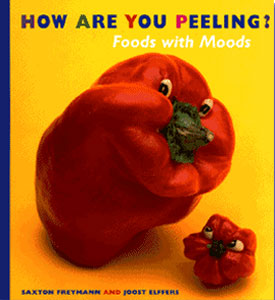
Book Review: How Are You Peeling? Foods with Moods by Saxton Freeman/illus. by Joost Elffers (Arthur A. Levine Books, 1999)

how are you peelingRecommended for ages 2-8

Do you feel silly? Safe? Shy? Saxton Freeman and Joost Elffers sculpted facial expressions into fruits and vegetables to communicate a wide range of emotions in How Are You Peeling? Fruits with Moods. Using an Exacto knife and natural materials like black-eyed peas and beet-juice coloring, the authors enhanced the natural wrinkles, bends and creases in produce to illustrate emotions. The sculptures, photographed against plain but colorful backgrounds, are large and vivid, allowing the youngest readers to easily identify the emotions depicted. Beginning with the opening question, “How are you feeling?”, the text goes on to asks questions that will provoke thought in listeners: “Feeling blue? Feeling bad? How are you when friends drop by? With someone new… a little shy?” The text is brightly colored and small, letting the produce’s expressions speak for them; this is a book meant to be read aloud and to prompt discussion. The New York Times Book Review voted How Are You Peeling? Best Illustrated Children’s Book in 1999.

The book lends itself to a read-aloud about feelings, where patrons can call out answers to the questions asked in the book and identify the emotions portrayed on the featured produce. Activities can include songs about feelings like “If You’re Happy and You Know It”, and craft ideas include a facial expressions printable to color, or, for older (3-4) participants, the chance to draw different expressions that answer the question, “How are you feeling?”

Posted in Preschool Reads

Book Review: What Will Fat Cat Sit On? by Jan Thomas (Harcourt, 2007)

what will fat cat sit onRecommended for ages 2-5

“What will Fat Cat sit on?” is the inquiry that kicks off this story as the Fat Cat in question looks for a seat, terrifying animals – a cow, a chicken, a pig, and a dog – as they imagine him sitting on them. When the mouse offers an alternative seat – a chair – the next question is, “What will Fat Cat have for lunch?” Toddlers and preschoolers can join in the fun, repeating the opening question throughout the story and identifying the animals who try to avoid being sat on. The cartoon illustrations are bright, set against vivid backgrounds. The animals’ facial expressions are exaggerated and simple, easily conveying the emotions of panic and relief. Characters are boldly outlined, allowing them to pop off of the page, and lettering is big and brightly colored, with simple sight words that beginning readers will easily recognize.

This could be part of a “silly animal books” read-aloud. Mo Willems’ Pigeon books are similar in tone and illustration, as is Katie Davis’ Who Hops?; these books offer similar participation opportunities. There are many silly songs and fingerplays about animals that could work well with a silly storytime, including Six Silly Spiders. Jan Thomas’ author website provides printable mask and finger puppets for the Fat Cat and each of the animals that work well for a coloring craft or, as the website suggests, a Fat Cat play, where readers can wear their masks and call out the sounds for their chosen animal.

Posted in Preschool Reads

Book Review: Tugga Tugga Tugboat, by Kevin Lewis/illus. by Daniel Kirk (Hyperion Books for Children, 2006)

tugga tuggaRecommended for ages 2-5

A child’s bath time comes to life as Tugga Tugga Tugboat takes readers on a busy tugboat’s day, navigating busy waters to help move tankers and put out fires. As the story progresses, the artwork gives some hints about the tugboat’s whereabouts away: there are bars of soap and blocks being piled up on the harbor, and there is a rubber ducky in the water. The story is told in rhyme with the refrain, “toot, toot” and “scoot, scoot”, repeated often enough that toddlers and preschool readers will be able to quickly pick up the phrases and participate. Illustrations appear to be bright acrylics and are more realistic than cartoony. Story text is bold and black with differing sizes on the refrains, further prompting young readers to participate.

The book lends itself to a participatory reading, with young readers prompted to call out “toot, toot!” and “scoot, scoot!” There are many bath-related fingerplays and songs, including “Splish Splash” and “Rubber Ducky”, that add to the program and make for a fun, bath-related story time. Oriental Trading sells transportation rubber duckies – rubber duckies in cars and boats – in bulk for a low price, budget permitting.

Posted in Uncategorized

Book Review: I Stink! by Kate McMullan/illus. by Jim McMullan (HarperCollins Children’s Books, 2002)

i stinkRecommended for ages 2-5

While the rest of the city sleeps, a garbage truck wakes up to start his work day. The smiling truck is proud of his powerful engine and the noises and smells that are part of his job – he roars and burps his way through an “alphabet soup” of trash, from apple cores to zipped-up ziti with zucchini-and brags about how much he stinks, telling the reader, “No skunk has ever stunk this bad!” He heads to the river to eject the trash onto a barge, and heads back to the garage to gas up and sleep until the next night. The watercolor-and-ink illustrations use a palette of darker colors to communicate the sleepy city and the colors of the garbage itself. The text is bold and appears in assorted sizes and colors, fitting the garbage truck’s friendly and big personality.

The voice of the truck provides for a fun read-aloud, where children can chime in and make truck noises: burping, roaring, saying ahh. There are many truck crafts, songs and fingerplays to create a truck-related storytime. Children can create their own trucks using construction paper shapes and popsicle sticks; several websites offer printable truck pictures to color.

Posted in Preschool Reads

Book Review: Bears on Chairs, by Shirley Parentau/illus. by David Walker (Candlewick Press, 2009)

bears_coverRecommended for ages 2-5

In this story about sharing, compassion, and teamwork, four little bears sit comfortably on four little chairs until Big Brown Bear shows up and wants to sit down. The four little bears work together to find a seating arrangement that works for all five bears. The brief text offers a rhythm that makes it a good story time candidate, and David Walker’s acrylic illustrations use soothing pastel hues that allows readers to focus on the story.

There are many story time ideas here: we can create a teddy bear story time, with songs like Teddy Bear’s Picnic and Elvis Presley’s “Teddy Bear”, which will get children and adults alike up and moving. Children can bring their favorite teddy bear to cuddle during the story time, and we can incorporate fingerplays including Teddy Bear, Teddy Bear. Other story time ideas include a sharing and friendship-themed story times, with songs and fingerplays about sharing like “If You’re Friendly and You Know It” (to the tune of “If You’re Happy and You Know It”).

Posted in Preschool Reads, Toddler Reads

Book Review: Moo, Baa, La La La by Sandra Boynton (Little Simon, 1984)

moobaalalalaRecommended for ages 0-4

Children learn about animal sounds through fun rhymes with author and illustrator Sandra Boynton in Moo, Baa La La La! Ms. Boynton uses her popular cartoon-style animals and lettering to draw both children and adults in to her story about the silly sounds animals make, including rhinoceroses snorting and snuffing, and horses neighing. Illustrations are drawn in lighter colors featured on pastel backgrounds, soothing to babies who are learning to make sounds and toddlers who are relating animal sounds with the animals that make them.

The book would make for a fun read-aloud, encouraging children and parents/guardians to chime in and call out the animal sounds. The book ends with the author asking the audience what they say, which is a perfect time to get story time participants to say hello and wave or cheer. Story time can be animal-related, with photocopies of animal pictures to color. Songs and fingerplays could include animal-related songs like Old McDonald, which also teaches children about animal sounds.

Posted in Preschool Reads, Toddler Reads

Book Review: What Does Baby Do? by Martin Larranaga (Begin Smart, 2008)

whatdoesbabydoRecommended for ages 0-4

Using lift-the-flaps to teach babies the concept of object permanence, What Does Baby Do? presents cartoon children in different situations and asks the question, “What does baby do?” Each flap reveals how baby handles a new situation: petting a cat, blowing kisses to grandma and grandpa, and waving good-bye to Daddy. Each action is physical, allowing for parents and guardians to interact with their children by asking them the question, “What does baby do?”, and acting out the answers. The book features multi-ethnic families and its artwork is cartoon style with bright colors and pastels and a bold, childlike font. Flaps are oversized for small fingers that are just learning to grasp. A note to parents in the book provides information on object permanence in infants and offers ideas on using the book.

This is a participatory book, so a story time allows the audience to take an active role, repeating the question on each page and acting out the answers. Story time leaders can also teach object permanence games like Peek-a-Boo to parents and guardians, and provide handouts from parenting websites with more information.

Posted in Preschool Reads, Toddler Reads

Book Review: Shake it Up, Baby! by Karen Katz (Little Simon, 2009)

shake it up babyRecommended for ages 1-4

Shake It Up, Baby! is an interactive board book that will get parents and toddlers moving together. The book, which contains a rattle in its spine, leads readers through a dance, encouraging them to “touch your nose, rub your tummy, [and] shake your rattle”. As with Katz’s other books, the featured babies are multiethnic and have big, round heads with cheerful facial expressions. Katz’s artwork uses pastels with her trademark heavy outlines, varicolored backgrounds, and bright colors with bold fonts. Dotted curves depict movement.

The book includes a link to SimonSaysKids.com, the publisher’s children’s division, where parents and guardians can read a parenting guide and discover more Karen Katz activities.

As the book is the activity, a story time using this book gives parents, guardians and toddlers the chance to get up and dance with the book. Story time can include other songs and dances, like the Hokey Pokey and fingerplays like Tommy Thumbs.

Posted in Preschool Reads, Toddler Reads

Book Review: Tubby, by Leslie Patricelli (Candlewick Press, 2010)

tubbyRecommended for ages 0-4

In Leslie Patricielli’s book, Tubby, a toddler’s bath time is fun time! Patricelli takes readers through the ritual of bath time from a toddler’s point of view. The toddler begins with the joy of running around naked; after getting into the bath, he plays with the bubbles and gets soap in his eyes – which Mommy makes all better. After getting rinsed off, dried and diapered, baby is all clean and ready to play. The book, illustrated by Patricelli, uses bright acrylic illustrations and bold, simple text to create a fun story that communicates the excitement of bath time and gives parents and guardians the opportunity to incorporate the story into a bath time ritual.

Patricelli’s book Tubby is the companion book to Potty, featuring the same happy toddler who needs to “go potty” and goes on his own adventure to figure it out.  Patricelli also uses acrylic illustrations and bold, simple text to tell this story.

A fun story time activity could incorporate bath time rhymes, like Rub-a-Dub-Dub, that parents could share with their children at home. Librarians can also purchase small rubber ducks from catalogs like Oriental Trading and hand them out at story time.

Posted in Preschool Reads, Toddler Reads, Uncategorized

Book Review: Baby in Car, by Monica Wellington (Dutton Books, 1995)

baby in a carRecommended for ages 0-4

Monica Wellington’s Baby in a Car begins with the question, “What does baby see?” and answers by taking a toddler on a road trip filled with fun things to see from the car. This brightly colored board book is filled with bold, bright illustrations that toddlers will easily recognize, from traffic lights and taxis to flags and umbrellas.  The cartoon style illustration uses gouache collage to provide texture, including the blades on a helicopter, leaves on an apple tree, and the moon’s shading. Young readers will be attracted to the bright pictures of easily identifiable objects, and the childlike lettering further communicates a young, happy tone. Parents and guardians can use the book on car rides, whether to the grocery store or a longer family trip, to keep children happy and begin conversations about their surroundings.

Baby in a Car is part of a series by Wellington that includes Baby in a Buggy, Baby at Home, and Baby Goes Shopping.

Story time activities could include traveling rhymes and fingerplays including Wheels on the Bus and Over the Mountain. The book can be used in a participatory fashion, with the reader asking, “What does baby see?” and allowing parents and children to respond with each picture.