Posted in Fiction, Post-apocalyptic/Dystopian, Science Fiction, Teen, Young Adult/New Adult

Alena Graedon’s The Word Exchange: an all-too plausible dystopia.

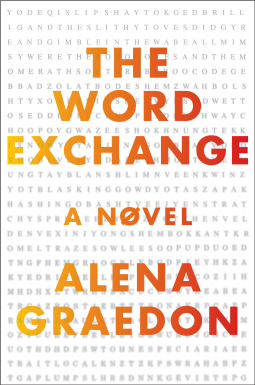
word exchangeThe Word Exchange, by Alena Graedon. Doubleday Books (2014), $13.99, ISBN: 9780385537667

Recommended for 18+

While Alena Graedon’s The Word Exchange isn’t written for YA/New Adult audiences, I wholeheartedly believe that these readers should read it, much in the way that they should read (if they haven’t already) Ernest Cline’s Ready Player One. Alex Awards, are you listening?

The Word Exchange takes place in an entirely believable, very near future. Society is too plugged in – smartphones appear to have morphed into devices called Memes, which think for you. Well, not really – but kind of. They anticipate what you want to do – hail a cab? Order a coffee? – and even offer you words when you can’t think of the word you’re looking for. Ana, a young woman who works with her father, Doug Johnson, at the North American Dictionary of the English Language (NADEL, for short), uses her meme – something Doug has no patience for; he feels like books and language are a disappearing art. He has no idea how right he is.

There’s a virus – WordFlu – that’s erasing language, stealing it from the populace. They start by bungling words here and there, eventually devolving into gibberish, silence, and ultimately, death. When Doug goes missing, Ana goes on the search for her father and finds herself in the middle of something far greater than she, Doug, or the Dicionary could ever be – could there really be a plot in place to erase language?

Told in the form of journal entries by Ana and her friend, Doug’s associate Bartleby (also known as Horace), The Word Exchange examines what would happen in a society that leaves entirely too much to technology. It’s very unsettling, because it’s only a step or two from where we are now. Imagine if someone were to create an app that let you think of the word that was on the tip of your tongue, but you couldn’t remember, for pennies a download? Now imagine if you had a Seamless or taxi service available to you without even picking up your phone or pulling up your app? Those bothersome clicks and pokes to the touchscreen would go away, because your Meme would do all the work for you. Would society really hand over the reins so easily?

The book starts slowly, laying groundwork – the mystery of Doug’s disappearance happens fairly soon in the book, but Ana’s search builds until about halfway through the book, when the action just explodes. Layered and tautly paced, this book was unputdownable for the second half. She’s got complex, three-dimensional characters, and a plot that chilled me to the bone just thinking about it – because it could happen. Very easily.

Teens and young adults should be reading this book, because they’re the next generation – they’ll appreciate the setting and hopefully, the message that Ms. Graedon delivers. It’s a fantastic book discussion group title that explores technology, morality, and the politics of doing business in an increasingly online world. I loved this book and can’t wait to see some of the discussions that evolve around it.

Posted in Science Fiction

Star Wars Reads Day is Back!

I am so excited about this for a number of reasons, not the least being, Star Wars Reads Day is back! Now that I’m a librarian attached to an actual library, I’m planning bulletin boards, events, and displays. I’ll post progress and pictures as it comes together.

star-wars-reads-day-3-logo


From StarWars.com:

Bookstores and libraries will once again feel the power of the Force.

Disney Publishing Worldwide and its publishing partners announced today the third annual Star Wars Reads Day, to be held October 11, 2014. Last year, Star Wars authors and costumed volunteers participated in over 2,000 Star Wars Reads Day events across North America and, for the first time, around the world. On October 11 of this year, Star Wars fans, authors, and artists will again come together in this multi-publisher initiative that celebrates reading and Star Wars. Participating publishing partners include Abrams, Chronicle Books, Dark Horse, Del Rey, Disney Book Group, DK, Klutz, Quirk Books, Random House Audio, Scholastic, and Workman Publishing.

“With the debut of our new animated series Star Wars Rebels launching on Disney XD this Fall, and the upcoming theatrical release of Episode VII in 2015, our third Star Wars Reads Day comes at an exciting time,” says Carol Roeder, Director of Lucasfilm Franchise Publishing, Disney Publishing Worldwide.

The following authors are confirmed to participate in official Star Wars Reads Day events: Chris Alexander (Star Wars Origami), Tom Angleberger (Origami Yoda series), Jeffrey Brown (Goodnight Darth VaderStar Wars: Jedi Academy), Troy Denning (Star Wars: Crucible), Ian Doescher (William Shakespeare’s Star Wars, William Shakespeare’s Empire Striketh Back, William Shakespeare’s The Jedi Doth Return), Jason Fry (LEGO Star Wars: The Visual Dictionary: Updated and Expanded, Star Wars in 100 Scenes), Daniel Lipkowitz (LEGO Star Wars: The Yoda Chronicles), John Jackson Miller (Star Wars: Kenobi), Chris Reiff and Chris Trevas (Star Wars: Death Star Owner’s Technical Manual), Daniel Wallace (The Bounty Hunter Code, The Jedi Path), and Ryder Windham (Star Wars: The Ultimate Visual Guide, Star Wars Rebels Junior Novel).

For updates and more information, follow Star Wars Reads Day on Facebook.

For more information and an FAQ, check out StarWars.com’s Star Wars Reads Day page.

Posted in Middle School, Non-Fiction, Tween Reads

ChitChat Makes Phonics and Language Made Interesting for Middle Graders

chitchatChitChat: Celebrating the World’s Languages, by Jude Isabella/Illustrated by Kathy Boake. Kids Can Press (2013), $17.95, ISBN: 9781554537877

Recommended for ages 9-12

ChitChat takes a look at language – spoken, written, and sign;  how it’s evolved, and how it continues to evolve over time. Author Jude Isabella talks about everything from phonics sentence structures to the Rosetta Stone, slang, dead and endangered languages to how babies and toddlers can learn up to one new word every 90 seconds – all in 44 pages. It’s an incredible amount of information packed into a relative handful of pages, and yet nothing feels forced, rushed, cut off, or – and this is the most important part – boring.

Kathy Boakes’ illustrations are fun and interesting; she creates fun graphics using distorted faces from a wealth of ethnicities and giant mouths that call attention to interesting facts. There are fun callout boxes and graphics, including an interesting look at endangered languages of the world set against a map of the world. I was particularly happy to see a section devoted to diagramming a sentence – I haven’t seen one of those in far too long!

ChitChat is a good book to have in school and home libraries. Middle graders will get a kick out of the bite-sized facts and information, and pick up some Victorian slang while they’re at it (“fizzing fart catcher” is really a term I’d like to see someone bring back).

Posted in Preschool Reads

AJ Smith shows readers that Even Monsters… are just like us!

evenmonstersEven Monsters… by AJ Smith. Sourcebooks Jabberwocky (2014), $16.99. ISBN: 9781402286520

Recommended for ages 3-6

Sure, monsters roar, growl, and stomp around, but did you know that they have to put clean underwear on in the morning, eat their breakfast, brush their teeth, and go to school, just like any other kid? That’s the message AJ Smith communicates to his young audience with his book, Even Monsters… Perfect for preschoolers and Kindergarteners, Even Monsters talks about all the day-to-day, very un-monstery things that kid monsters have to do, illustrating that everyone has to do things like brush their teeth, take a bath, and learn their ABCs. On the bright side, monsters also get to do cool things like play video games, soccer, and hide in tree forts, just like other kids! The book is a great way to show children that no matter how different people may be – heck, they may not even be people – we’re all the same – we even need a kiss goodnight. It’s very reassuring for a young audience who may be experiencing a new routine by entering preschool or kindergarten.

Mr. Smith uses digital art to illustrate his story. His monsters, Glubb and Skeebu, are brightly colored and have friendly expressions, even when they’re being very monster-y, growling, and snarling. The text is bold, black and has an almost paintbrush-stroke feel to it, creating some interest for the reader.

AJ Smith teaches art and has created cartoons for Sesame Street and animated children’s shows like Courage the Cowardly Dog. His website is a treasure trove for kids and grownups alike, with information about author visits and a parent/teacher guide to Even Monsters. The kids’ section has links to a Monster store, art galleries, Monster trading cards, games, a section on how to draw Glubb and Skeebu, and a link to a Glubb and Skeebu webcomic.

Posted in Fiction, Middle School, Science Fiction, Teen, Tween Reads

Henry and the Incredibly Incorrigible, Inconveniently Intelligent Smart Human makes humans the invention.

henry and the humanHenry and the Incredibly Incorrigble, Inconveniently Intelligent Smart Human, by L.A. Messina. Tater Tot Books (2014), eBook: $3.99 ISBN: 9780984901838

Recommended for ages 10-14

Henry is a young teen robot in his 13th upgrade. He’s not the popular kid at school, and he has a faulty processor that comes from a virus that attacked his system when he was younger. When his father’s boss shows up at their home one night with a new human model to test for the market, Henry is thrilled – his own human! But this human isn’t a slack-jawed, drooling blank slate like most humans are. This one makes up words, can do things without extensively detailed commands, and doesn’t want to sleep in his box because it’s not comfortable. At first, Henry is worried – what if this human goes berserk like the one that went on a rampage in his mother’s business? – but he comes to realize that the HueManTech ETC-420- GX-2, or “E”, as Henry calls him, is a very special model.

Unfortunately, Henry’s not the only one who thinks “E” is special, which leads to a taut race to unravel the truth about E, especially when the government begins showing an interest in E and Henry’s family.

The book starts out slow as Ms. Messina establishes the drudgery of Henry’s young teen life – mocked at school, boring job at his mother’s spa, Henry is the lonely kid who takes comfort in his comic books and video games, until something exciting – E’s arrival – sparks up his life. Even then, the narrative moves at a slower pace as Henry discovers how special E really is. But once the plot kicks into motion, involving the government and the origins for both E and Henry, the story moves at a great pace that kept me turning pages and wanting to know more.

The book, available via e-book format, is a good read for tweens and young teens. It provides a wealth of opportunities to discuss what would happen in a society where robots were on the top of things and humans were the creation; it also offers chances to discuss morality and the government. It would be a good discussion group story for educators to encourage among their students and patrons.

Lynn Messina’s website offers a book trailer for Henry, along with fun extras for readers.

Posted in Graphic Novels, Middle School, Non-Fiction, Teen, Tween Reads

Smile, by Raina Telgemeier – A Graphic Memoir of Tweenhood

smileSmile, by Raina Telgemeier. Scholastic (2010), $21.99, ISBN: 978-0-54513205-3

Recommended for ages 10+

Raina Telgemeier’s memoir, Smile, is a coming-of-age memoir that’s framed by the night sixth-grader Raina sustained an injury to her mouth that led to a series of surgeries and orthodontia. Throughout middle school and high school, Raina endures braces, surgeries, retainers, and even headgear. She becomes a target for her friends’ teasing, which leads to her pulling away from them and embracing her love of the artistic. When she finally realizes that her friends aren’t the people she wants to surround herself with, she stands her ground and moves on.

Smile is one of those books that everyone should read, kid or adult. It’s all about fair-weather friends, enduring what feels like the end of the world, and ultimately, finding your own voice. It’s empowering, whether you’re 12 or 92, because it’s something we need to be reminded of, from time to time – “it”, whatever it is, won’t last forever, and the people you surround yourself with may not be the best for you. Dig deep down into yourself and love yourself enough to get through it.

The cartoon art makes the story even more accessible,with friendly-looking, expressive characters and warm colors throughout. The endpapers resemble a yearbook -in fact, Ms. Telgemeier used her yearbook signatures for the book – with signatures and well-wishes from friends, setting the tone for the book.

Smile has received numerous accolades – deservedly so! – including winning the Eisner Award for Best Publication for a Teen Audience (2011), the Dorothy Canfield Fisher Award (2012), and the Maine Student Book Award (2012). Smile was a finalist for the Children’s Choice Book Award (2011) and has received designation as an ALA Children’s Notable Book (2011), an honor book from the Boston Globe-Horn Book Awards (2010), a Kirkus Best Book of 2010, and a New York Times Editors’ Choice (2010).

There are lesson plans on the Web that allow educators to bring Smile into the classroom. Scholastic offers one on their site, along with a template for students to create their own graphic novels; The Graphic Classroom offers some great classroom discussion tips using the book.

A companion book to Smile, called Sisters, which will be published in August 2014 and will examine the relationship between Raina and her sister, Amara, who briefly appears in Smile.

Posted in Fantasy, Graphic Novels, Science Fiction, Tween Reads

Legends of Zita the Spacegirl is out of this world!

legends of zitaLegends of Zita the Spacegirl, by Ben Hatke. :01 First Second (2012), $18.99, ISBN: 978-1-59643-806-4

Recommended for ages 8-14

I just realized that while I’d reviewed both Zita the Spacegirl and the upcoming Return of Zita the Spacegirl, I never wrote a review for the second book in this great series – so I re-read it in order to remedy the situation.

When we rejoin Zita in the second book in her series, she has found intergalactic fame as The Girl Who Saved Scriptorious. Creatures from all over the galaxy are clamoring to meet her, and fame has become a bit overwhelming for Zita. When she encounters a robot that looks just like her, she decides to let the robot handle fame while she and Mouse take off to relax and be anonymous for a while. The only problem is, the robot is an Imprint-o-Tron, which eventually tries to replace their targets – and when two aliens seek “Zita”‘s help in saving their planet from the interstellar scavengers, the Star Hearts, Zita-bot is all too happy to lend a hand, stirring up trouble for Zita and her friends.

I am a big Zita fan, and this second book has every bit of the spirit of fun and adventure that the first book (and the upcoming third) do. We see a slightly different Zita here -she’s overwhelmed by fame, she wants to go home, and she ultimately learns about the power of sacrifice – she’s a more mature Zita who is still, at heart, a kid. The Imprint-o-Tron reminds me of Pinocchio, who wanted to be a real boy. The Imprint-o-Tron, or as I started calling her, the Zita-bot, isn’t bad – she’s following her programming, and she really seems to want to be Zita, to face the exciting adventures that Zita does. There are some great messages to be found in this second book.

There are some great resources on the Web for using Zita materials in the classroom. Comics Are Great has a downloadable lesson plan, along with an hour-long podcast dedicated to the book, where teachers, librarians, and cartoonists discussing the book.

The Zita trilogy is a great middle-grade graphic novel series. She stands as a good role model for any girl or boy who seizes the power of imagination and inner courage.

Posted in Fiction, Humor, Middle School, Tween Reads

Desmond Pucket Makes Monster Magic and Get Laughs

desmond-pucket-makes-monster-magic_0Desmond Pucket Makes Monster Magic, by Mark Tatulli. Andrews McMeel Publishing (2013), $13.99, ISBN: 978-1-4494-3548-6

Recommended for ages 8-12

Desmond Pucket is a middle schooler who loves monster movies and special effects. He’s also a prankster who just can’t resist a good opportunity to use his special effects expertise to scare the daylights out of people, whether it’s his annoying older sister or one of the teachers. He’s been good at covering his tracks, but when he springs a prank on his older sister and her friends at a sleepover, he finds himself in hot water at school – one of his sister’s friends is the daughter of the disciplinary head at his school; he’s been waiting for Desmond to slip up, so he can transfer him to another school! Now Desmond has three chances left before he’s kicked out of school and misses the big field trip to Mountain Full of Monsters at Crab Shell Pier. Can he keep out of trouble for just a little longer?

The book is written in a similar style to Jeff Kinney’s Diary of a Wimpy Kid; it’s a first-person storyteller and illustrated, presumably by Desmond, with black and white sketches. There are even drawings that look like they’ve been sketched on torn bits of paper, to add to the realism of Desmond, and his friend Ricky’s, notes. The endpapers are green and have the appearance of crumpled paper, with more of Desmond’s drawings and notes to the reader.

I loved this book. It’s fun, light, and Desmond is – like Greg in Diary of a Wimpy Kid – a victim of his own making. He can’t stay out of trouble, but unlike Greg, he knows he’s his own worst enemy. He just can’t resist a good prank opportunity to cause mayhem. He even laments not being able to take credit for his brilliant pranks, because he knows it will get him into trouble. When he decides to pull a prank at  his sister’s sleepover, he has no idea of the trouble he’s getting himself into, and when the fallout hits, he has a major crisis on his hands – how can he stay out of trouble and still be himself?  He ultimately decides that being true to himself and owning who he is is more important than anything, including a long-awaited school trip.

Andrews McMeel has a wealth of Desmond activities and information online, especially since the second book in the series, Desmond Pucket and the Mountain Full of Monsters, will be released this August. You can read a sample chapter online at the Desmond Pucket site, follow him on Facebook, and download teacher and librarian resources on the Andrews McMeel site, including a guide to teaching with graphic resources and English/Language Arts and Science curriculum connections to work with, using the book. There are games and activities for readers both online and at the end of the book itself, where Desmond shares some notes on how to make fake blood, cool monster growl effects, a phantom knocker, a ghost, and a gelatin dessert.

I am looking forward to more Desmond books, as is my 10 year-old son, who read this book in about an hour and a half last night!

Posted in Non-Fiction, Tween Reads

How to Make a Planet makes astronomy accessible – and awesome – to middle graders

how to make a planetHow to Make a Planet, by Scott Forbes/Illustrated by Jean Camden. Kids Can Press (2012), $17.95, ISBN: 9781894786881

Recommended for ages 8-12

How to Make a Planet takes the best part of an astronomy textbook and makes it accessible to middle grade students. Written as a how-to-guide to making your own planet, Scott Forbes breaks down the entire process of Earth’s formation, from the Big Bang through to the arrival of… well, us. Mr. Forbes writes about quarks and neutrons, the periodic table of elements and continental drift, all in a way that neither speaks down to his audience nor bores them. Accompanied by Jean Camden’s fun illustrations, including kids working on their planetary masterpiece and bike riding across the solar system, with giant insects, dinosaurs and more, there is always something exciting to read and see. A running “Time Check” box contains information bullets describing what’s happening at different intervals in the Earth’s creation. There is an Amazing Facts page, glossary and index.

This book is a great resource for teachers and librarians to have available in classroom, school, and public libraries. It’s a great way increase science literacy and interest younger readers in the sciences.


HowToMakeAPlanet_2336_spr2 (1)

Posted in Fiction, Uncategorized

The Most Magnificent Thing teaches kids perspective

the most magnificent thingThe Most Magnificent Thing, by Ashley Spires. Kids Can Press (2014), $16.95, ISBN: 9781554537044

Recommended for ages 4-8

One day, a girl and her dog set out to make the “most magnificent thing” – the girl draws up schematics (her dog is the assistant), gets materials, and sets up on the street, getting to work. When she’s finished, she takes a look at it – it’s not really what she had in mind. She tries again. And again. And again. She just can’t make her vision come to life, and she gets MAD. At this point, her assistant suggests a walk, where she starts to feel better; she finds she has regained self-control and even more, perspective, allowing her to go back and look at her previous creations with a refreshed eye.

Ashley Spires, who some may know from her Binky the Space Cat series, looks at the frustrating process of working on something and not having it turn out the way you envision it. It is something everyone can relate to, from a LEGO structure to a Science Fair project to a PowerPoint presentation for the big client meeting. Children, who are still learning the delicate art of self-control, will recognize themselves in these pages, as the girl becomes increasingly frustrated with her work, and once she injures herself, loses her temper. Her dog/assistant serves as comic relief and ends up saving the day by having her walk away and clear her head. The book teaches a valuable lesson to kids and grownups alike; walking away and returning when you’re calmer often allows the ability to see things are not so bad after all, and maybe, you can even find things you liked in the project you were about to crumple up and throw out.

The digital art is adorable. The characters have large, expressive faces, and are set against a mostly line-art, blue and black or white and black background, so they really stand out. There are some beautiful spreads and the font itself is a curvy font with a quirky personality and fits perfectly with the story. The endpapers display the row of brownstones where the story takes place, leading the reader into the story.

This is a good book to use for a storytime on patience or feelings. Perhaps a small LEGO craft afterward, or a construction paper assembly craft will help young minds create their own most magnificent things.