Posted in Fiction, Historical Fiction, Middle Grade, Tween Reads

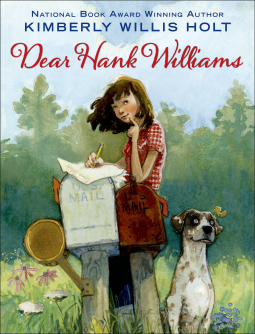
Dear Hank Williams: A young girl copes with life through letters.

cover55692-mediumDear Hank Williams, by Kimberly Willis Holt (April 2015, Henry Holt & Co.) $16.99, ISBN: 9780805080223

Recommended for ages 9-13

Tate Ellerbee is a sweet kid living in rural Louisiana in 1948. She’s a big fan of Hank Williams, a country-western singer she’s started hearing on the radio show, Louisiana Hayride, so she writes him a fan letter, telling him that she’s chosen him to be her pen pal in a class project introduced by her teacher. She lives with her aunt and uncle – her mother’s siblings – and tells Hank Williams all about her life as she waits for him to respond.

The thing is, things aren’t as wonderful for Tate as she initially lets on. Writing these letters to Hank becomes a kind of journal, helping Tate cope with events in her life. Through these letters, we see a vulnerable but determined young lady emerge, someone who’s dealt with more than most children should have heaped on them, but who’s determined to push back and smile at life.

This book started out, for me, as a cute piece about a young fan developing a one-sided crush on a celebrity – totally relatable! – and became much deeper than that. We get a view of a celebrity on the rise from the fan’s point of view, and we see the impact of history on a younger community that didn’t fight the war, but were affected by it – the kids. One of Tate’s classmates is excited to have a pen pal from Japan, which doesn’t sit well with another classmate or, initially, with Tate. There’s solid character development and storytelling here, with three big elements: Tate’s story, Hank Williams’ rise to fame, and the pen pal project – all blending together to tell a good story that will satisfy fiction readers.

Hank Williams is experiencing a resurgence in popularity, with the biopic I Saw the Light hitting theatres later this year. It’s a great time to start talking up this book and playing some of Williams’ music – Tate mentions a few in Dear Hank Williams that could serve as a nice link back to the book.

Kimberly Willis Holt is an award-winning author of children’s literature, including a National Book Award for When Zachary Beaver Came to Town.  Her author website offers teacher resources for many of her books, writing tips, and school visit information.


Posted in Early Reader, Fiction, Fiction, Middle Grade

The Joker’s Dozen: A Batman Choose Your Own Adventure!

cover52077-mediumThe Joker’s Dozen, by Laurie S. Sutton/illus. by Ethen Beavers (2015, Capstone) $6.95, ISBN: 9781434297112

Recommended for ages 7-12

The Joker is back! This time, he’s turning the good people of Gotham City into giggling thieves! It’s up to you to help Batman this time- is he outnumbered, or are the odds pretty evenly matched? What weapon should he use? Will he save the city, or will Joker have the last laugh? You make the call, you choose the adventure!

This is a pretty quick and easy read for young readers who are comfortable with chapter books. Unlike traditional Choose Your Own Adventure Books, these are really just different scenarios, not really affected by the choices you make. Which, for a younger reader, is probably the best way to go. With 12 different endings, this will be a book that kids will get a different experience with time and again- there are a multitude of different choices and stories readers can create!

This is a fun book to have handy for the kid who’s always bored. (You know the kid.) There’s some great Batman artwork from DC comic artist Ethen Beavers, with fast-paced storytelling and a sense of control over the story. For only $6.95, expect this book to see some action, in your home, classroom, or library.

Posted in Fantasy, Science Fiction, Teen, Uncategorized, Young Adult/New Adult

Seeker: A futuristic story of betrayal, power, and time travel

seekerSeeker, by Arwen Elys Dayton (2015, Delacorte BFYR), $18.99 ISBN: 9780385744072

Recommended for ages 14+

Quin Kincaid has been training to be a Seeker since she was eight years old. She and her cousin, Shinobu, finally complete their training take their oaths, only to discover that they have been lied to by their families. This is no honorable profession; they have been duped into becoming pawns of Quin’s awful father, Briac. This is only the first secret Quin uncovers about her father – there is so much more, including what really happened to her boyfriend, John’s family, at Briac’s hands.

Seeker could be an epic YA series. There is time travel, intrigue, and layer upon layer of character backstory and world-building. My main issue with the book is that there is so much plot that the story gets muddled. For instance, just grasping what time the main story takes place in can be a frustrating exercise: there are references to airships and cell phones, horses and lands. Is it a post-apocalyptic universe? A steampunk universe? The time travel aspect is introduced late into the story, so I spent a good portion of my reading wondering what was going on and where. I’m still not sure what the relics, called athames, that a good chunk of the plot involves, really do.

The story is told through the viewpoints of four characters. We don’t always get a lot of motivation, with the narrative being told from four points of view. I found one character’s actions seemingly coming out of nowhere, another character’s background making very little sense, and two characters having a massive portal shift erase 18 months of storytelling time.

All in all, this one isn’t my book. It’s got promise, and perhaps the second book in the series will answer some of these questions.


Posted in Fiction, Fiction, Historical Fiction, Middle Grade, Tween Reads

World War II fiction reminds us that there are stories outside of Germany and the U.S.

A lot of WWII fiction takes place in Germany or the U.S., with good reason – Germany and the U.S. were two big players in the war, after all. But how many people remember that the Nazis occupied Norway? Or that Anne Frank wasn’t the only little Jewish girl with a story to tell, coming out of Amsterdam?

I recently read two great books taking place during World War II, both nominated for the first round of Cybils consideration.

Odins-PromiseOdin’s Promise (2014, Crispin Books, $13.95, ISBN: 978-1-883953-65-2) by Sandy Brehl, looks at life in Norway under Nazi occupation. All signs of nationalism are illegal, but young Mari’s family finds a way to resist – and it becomes a family-wide effort.

Mari and her dog, Odin, find themselves under Nazi scrutiny on a few occasions. Fiercely protective of Mari, Odin is severely beaten by the soldiers, which only strengthens Mari’s resolve to get these men out of her country.

Odin’s Promise is a novel that also gives us a glimpse – briefly, but skillfully – into what life was like for young Nazi soldiers, shuttled to a country where they were actively hated, and “assigned” to families. Not every soldier wanted to be there, and not every soldier was personally detestable, no matter how awful their agenda was.

The story is a slow build to several outcomes – some bittersweet, some awful, some happy – and it’s the story of a young girl’s coming of age in a brutal time.

Sharon E. McKay’s The End of the Line (2014, Annick Press, end of the line$12.95, ISBN: 9781554516582) is based on a true story that I’ve never heard before, but blew me away.

Beatrix, a 5 year-old Jewish girl in Amsterdam, is on the run with her mother. Her Christian father has been taken away, and her mother tells her to trust no one. But when her mother is taken off the train by soldiers, what is she to do? Two elderly brothers, Lars and Hans, who work for the railroad, take the girl home and feed her. They realize what’s happened to her mother and see the heartbroken, malnourished little girl, and decide, with the help of their neighbor, Mrs. Vos, that they will keep her, telling neighbors that she is their niece.

This is an amazing story of what happens when a community comes together to take care of a child. The brothers and Mrs. Vos protect, feed, and clothe Beatrix. They make sure she receives an education, including a religious education, so that she can answer Christian questions if she’s pulled aside at any time.

The End of the Line is one of those stories that makes your heart feel like it’s beating out of your chest with each turn of the page. It’s wonderfully descriptive with emotion, and brings home how the people the Nazis supposedly felt kinship with (like the Norwegians) suffered under their watch. You’ll be angry, you’ll be horrified, but ultimately, you will feel incredible love and relief. I loved this book.

I’ve had a recent spate of middle graders coming into my library and asking for historical fiction related to both the Holocaust and World War II. In addition to Jane Yolen’s Devil’s Arithmetic and Lois Lowry’s Number the Stars, I’ll be recommending these titles.

Posted in Fiction, Graphic Novels, Middle Grade

The Lunch Witch will have you looking at your lunch ladies in a whole new light.

lunch-witchThe Lunch Witch, by Deb Lucke (PaperCutz, 2014) $14.99 ISBN: 978-1-62991-162-5

Recommended for ages 8-13

Remember those lunch ladies when you were in elementary school? Remember how so many of them would slop that unidentifiable morass of…something onto your plate, almost gleeful at your confused or terrified expression. Meet Grunhilda, everyone. With fewer and fewer people believing in magic, she’s out of a job and down on her luck. So what’s a poor witch, with generations of experience stirring up cauldrons of trouble (and possibly, children) to do? You guessed it: she puts on a hairnet and an apron, and goes to work as a lunch lady in a school cafeteria. You’re seeing things from your childhood a lot more clearly now, aren’t you?

Being a cafeteria lady is awesome. Grunhilda cooks up awful pots full of foulness that turn kids’ stomachs upside down, and almost no one seems the wiser. Except for Madison, a quirky kid that kind of sees Grunhilda for who she really is, and attempts to blackmail Grunhilda into helping her. When things go awry for Madison, will Grunhilda actually help a kid? And if she does, how will the witch community feel about that?

The Lunch Witch is one of those graphic novels that works great for readers of all ages. It would go so well with a unit on fairy tales, as a kind of epilogue – what happens to the wicked witch when everyone else lives happily ever after? Fairy tales, and re-tellings of fairy tales, are experiencing a renaissance in media and in the classroom these days, so teachers and parents, jump on this!

I loved the look of this book. The book itself looks like an old tale, with stained-looking pages and black, white, and grey/olive artwork. The occasional use of color is impactful, whether it’s to draw attention to a frog or show the jarring blue of a cafeteria door.

There is some delightfully morbid humor, too. After all, witches aren’t known for being sunshine and flowers, unless you’re talking about Glinda the Good Witch. Any original Grimm’s fairy tale will tell you that these ladies were formidable in their own right. Ms. Lucke uses these awful characteristics to make Gruhhilda’s plight even more desperate in this day and age. You really can’t get away with grave robbery, and how many kids are getting left in the forest to happen upon a candy house these days?

I’d love to see some more Lunch Witch adventures! In the meantime, give this book to your younger readers, and get ready for some laughs when they start looking at the lunch lady differently.

The Lunch Witch is on sale in stores now.


Posted in Uncategorized

Registration for LIPopCon is Underway!

I am so excited about this conference! Full disclosure: I’m going to be speaking at my very first panel here, about the image of the librarian. There are some amazing programs and fantastic exhibitors-check it out and hope to see you there!

lipopcon's avatarLong Island Libraries and Pop Culture Conference

Registration for the first annual Long Island Libraries and Pop Culture Conference (LIPopCon 2015) is underway! Register here:http://www.nyla.org/max/events/lipopcon-2015/219/

LIPopCon Flyer revised

The Long Island Libraries and Pop Culture Conference (LIPopCon) is a yearly conference that provides library professionals and library and information science students with the latest information about trends in pop culture. Covering everything from anime and manga to video games and movies to science fiction and fantasy to graphic novels and comic books, LIPopCon informs attendees of the latest in pop culture and how it affects libraries.

The conference is sponsored by the Nassau County Library Association, the Suffolk County Library Association, and St. John’s University Division of Library and Information Science.

For more information about registration, visit our Registration Page at http://www.lipopcon.org/registration/.

LIPopCon will take place on April 16, 2015 at St. John’s University Oakdale Campus from 8:30AM-5:00PM. CEUs will be rewarded. Best-selling author and artist Raina…

View original post 25 more words

Posted in Early Reader, Fiction, Toddler, Toddler Reads

Mini-Myths – A board book series that brings the myths to your toddlers!

play nice herculesMini Myths: Play Nice, Hercules! (2015, Abrams), by Joan Holub/Illus. by Leslie Patricelli, $6.99, ISBN: 1-4197-0954-2

Recommended for ages 0-3

This series works for me on so many levels, I don’t even know where to begin. This new board book series, written by Joan Holub – whose Goddess Girls chapter book series is a huge hit with the girls at my library – and illustrated by one of my favorites, Leslie Patricelli (Tubby, Yummy Yucky, and Toot, and other fabulous baby board books), is the perfect way to introduce the wonder of Greek myths to your toddler.

Hercules is a strong little boy. He doesn’t want to be nice – he wants to wham-bam monsters! To whomp-stomp bad guys! But when he ka-booms his baby sister’s castle, he learns that being strong also means using strength to help people, too.

This book is wonderfully subtle. Toddlers aren’t going to sit down and have a discourse on Greek mythological heroes, but they can get the big older brother acting like a strong man – or even a bully.  Parents will love the hints Ms. Patricelli includes in the story – Hercules wham-bams a Cyclopean monster, and stomps on Greek soldiers. The blocks of the castle depict the twelve labors of Hercules. A note from Ms. Holub at the end of the story gives more detail on the myth of Hercules, allowing even older siblings to join in the fun and learn about the story of the mythological strong man.

I adore this book. I bought it for my library, and I’m buying a copy for my own little guy. Abrams has a series of Mini Myths ready to hit shelves; Be Patient, Pandora is out right now, and books on Medusa and Midas are coming. Get this series – it’s BRILLIANT.

Posted in Fantasy, Fiction, Humor, Middle Grade

The Imaginary: Peek into the world of imaginary friends

imaginaryThe Imaginary, by A.F. Harrold (March 2015, Bloomsbury USA) $16.99, ISBN: 9780802738110

Recommended for ages 9-13

Ever have an imaginary friend when you were growing up? Do you remember when you grew out of your friend? The Imaginary looks at what happens to imaginary friends when children move on.

Rudger is Amanda’s imaginary friend. He just appeared one day, when she dreamed him up. But when there’s an accident, Rudger finds himself alone – and fading! He has to find Amanda, because his very existence may depend on it – but there’s also a super-creepy man who can see Rudger, and I’m pretty sure it’s not because he’s in the market for a new friend.

The Imaginary is huge fun for middle graders. They’re probably at the age where they remember having an imaginary friend (or… shhh… maybe still have one), so this will spark recognition and sympathy. As Rudger tries to find Amanda, they’ll love seeing other imaginary friends he comes in contact with, and the “big bad” is deliciously creepy, ala Lemony Snicket. It’s a solid story about friendship, loyalty, and growing up, with some chuckle-worthy humor mixed in. Emily Gravett’s illustrations add some beautiful depth to the story and the reader’s imagination.


Posted in Fiction, Graphic Novels, Humor, Intermediate, Science Fiction

The Glorkian Warrior returns, and he’s eating adventure pie!

glorkianThe Glorkian Warrior Eats Adventure Pie, by James Kochalka (March 2015, :01First Second), $12.99, ISBN: 9781626720213

Recommended for ages 5+

The Glorkian Warrior is back! When we last encountered him, he was on a quest to deliver a pizza; this time, he’s at odds with his rival, Buster Glark. As usual, Warrior’s trusty backpack is the brains of the operation, and the Warrior’s buddy, Gonk, is along for the ride.

The Glorkian Warrior Eats Adventure Pie is even more surreal and random than The Glorkian Warrior Orders a Pizza. Kids are going to love it – it’s just goofy, cartoony fun with a lot of moments where you’re giggling and can’t really explain why. There are space snakes, genius elbows, a lovable, brain-sucking alien, and some pretty hilarious fart-related humor. There’s even a bonus comic after the story ends.

Steer some of your reluctant readers and your younger readers toward the Glorkian Warrior books. The cartoony art will catch their attention, and the silly storytelling and goofy characters will appeal to everyone’s sense of humor.

Posted in Fiction, Humor, Teen, Uncategorized

Hellhole shows you why dealing with demons is BAD.

cover46129-mediumHellhole, by Gina Damico (2015, Houghton Mifflin Harcourt), $17.99 ISBN: 9780544307100

Recommended for ages 14+

Max Kilgore is a nice guy. He’s working double and triple shifts at his thankless job so he can help support his chronically ill mother. He’s honest. Squeaky clean, even. Except for that time when he accidentally unearthed a demon named Burg. Who’s now living with him. He’s gross, he makes a mess, he doesn’t like wearing pants, and Max finds himself entangled in a series of bad situations and deals that puts him at Burg’s mercy, because Burg knows exactly how to get to him. It’s up to Max to beat Burg at his own game, but can he? With the help of a schoolmate who may just have a little inside information of her own, he’s got everything to lose.

Hellhole is a heck of a book. I went into it, thinking I’d be getting a light, funny story about a demon who shows up on a kid’s couch, but found myself reading a pretty deep book on morality, evil, where the line falls, and is that line crooked or straight? There’s a lot going on in this story. We’ve got a pretty likable character in Max, a guy we want to root for, and a straight-up despicable jerk in Burg, but it’s not that black and white. You know that old saying, “the road to Hell is paved with good intentions”? Keep that in mind as you read this book.

Teens who enjoy a good satire will love this novel. This would be a great book to booktalk in a library or classroom setting, especially with Summer Reading approaching.