Posted in Uncategorized

The Tale of the Mighty Brobarians!

Brobarians, by Lindsay Ward, (March 2017, Two Lions/Amazon Publishing), $17.99, ISBN: 978-15039-6167-0

Recommended for readers 3-7

“Two barbarians, once at peace – Uh-Oh! – were now at odds.” Otto and Iggy are brothers and barbarians, but when Iggy stages a takeover of the land, Otto fights back and the two go to war. Told as an epic tale, Brobarians is the adorably fun story of two brothers and their disagreement, resolved only when a higher power interferes.

This book is adorable. The endpaper maps that depict Otto’s (he’s the bigger brother, so I assume he created them) layout of his and Iggy’s territory, the illuminated manuscript-like exposition that leads into the tale and the epic storytelling style are wonderful. If you’re a fan of sword and sorcery movies like I am, then you’ll hear the Conan the Barbarian-like narration in your head and squeal with joy.

The art – cut paper, pencil, and crayon on chipboard – escalates, dipping into the brobarians’ imaginations to render them as fierce (but still really cute) brothers on wild steeds. The fonts are exaggerated, colorful, providing readers with a wholly fun storytime experience. You can’t read this in a monotone, you just can’t. I read it to my little guy and immediately slipped into epic narrator mode, with mock gravity and urgency at different points of the story. I was rewarded with belly laughs, which are wonderfully contagious.

You need this book for the kids you love. Heck, you need this book for yourself. Let’s try and see my kid get this off my bookshelf, where it lives next to my Red Sonja comics!

About the Author
Lindsay Ward would never have written this book if she hadn’t stayed up late one night watching Conan the Barbarian. She finds the idea of baby barbarians to be very funny . . . and hopes you do too. Lindsay’s recent books include Rosco vs. the Baby and The Importance of Being 3. Most days you can find her writing and sketching at home in Ohio with her family. Learn more about her at www.lindsaymward.com or on Twitter: @lindsaymward. She’s got Brobarians activities coming soon, too – keep an eye on the website!

Praise for BROBARIANS:

“Highly cinematic, both in imagery and narrative soundtrack…Good and campy and a fine opportunity for vocabulary building.”—Kirkus Reviews

“As readalouds go, it’s pretty epic.” – Publishers Weekly


Giveaway!

One lucky winner will receive a copy of BROBARIANS courtesy of Two Lions (U.S. addresses). Enter a Rafflecopter giveaway here!

Posted in Preschool Reads, Toddler Reads

Before & After – sequential fun!

Before & After, by Jean Julien, (March 2017, Phaidon), $12.95, ISBN: 978-0-7148-7408-1

Recommended for readers 2-4

A haggard cat grooms itself into a stylish feline. Raw spaghetti becomes a tasty dinner. The eternal question of what comes first, chicken or egg, is answered. This is just a sampling of what awaits little hands in graphic designer Jean Julien’s second large format board book, Before & After.

Each spread depicts alternating “before” and “after” artwork; a page dedicated to the drawing and a page boldly declaring “before” or “after”. There are picture books standards – pasta becomes dinner, water pours into a glass – are more amusing, unexpected scenes, like the outcome of wearing sunglasses on a sunny day. A gatefold centerfold is a fun surprise for little lapsitters.

The brush and ink art is fun and boldly outlined, set against bright, digitally painted page backgrounds, and the pages themselves are sturdy, able to hold up to lots of use, which this book will surely experience. Kids can flip pages back and forth, fold and unfold, to their hearts’ content. It’s a great way to teach sequence. Before & After will join Jean Julien’s first board book, This is Not a Book (2016), in my storytime rotation.

See more of Jean Julien’s artwork at his website.

Posted in History, Non-Fiction, Teen, Tween Reads

The Last Civil Rights March of the 60s: The March Against Fear

The March Against Fear: The Last Great Walk of the Civil Rights Movement and the Emergence of Black Power, by Ann Bausum, (Jan. 2017, National Geographic), $18.99, 978-1-4263-2665-3

Recommended for readers 12+

In June 1966, activist James Meredith set out to walk from Memphis to Jackson, Mississippi. He called it his Walk Against Fear; he wanted to conquer his own fears of walking through his home state; he wanted to encourage fellow African Americans to become voters: the Voter Registration Act had passed the year before, but the majority of African Americans had not yet registered, still living in fear of consequences they faced. Two days into his walk, James Meredith was shot in an assassination attempt. While Meredith recuperated, his cause was taken up by civil rights leaders of the day: Martin Luther King and Stokely Carmichael, and the ensuing March Against Fear became an historic march that included 15,000 people, resulted in 4,000 black voter registrations in Mississippi, and saw the rise of the Black Power movement.

Author Ann Bausum, who has connections to this history, captures the strife in Mississippi as whites and blacks clashed over civil rights. She looks at Meredith’s frustration at how his private stand grew into a full-scale movement, and at the discord between Stokely Carmichael and Martin Luther King: Carmichael’s desire for Black Power frightened whites who saw the movement as a possible militant uprising; King wanted to promote a nonviolent, peaceful march. Bausum also looks at why this march, of all marches, seems to have disappeared from history books – I certainly never learned about this one in school – and how we are still “trying to establish the essential truth that Black Lives Matter”.

An essential read for everyone. An essential addition to history classes in high school and college.

For more information about The March Against Fear, check PBS’ American Experience page on the Civil Rights Movement and the National Archives webpage on James Meredith and March Against Fear.

The March Against Fear received starred reviews from Kirkus, School Library Journal, and Publisher’s Weekly.

Posted in Early Reader, Fiction, Preschool Reads, Realistic Fiction

Fun with Phonics: Phoebe Sounds It Out

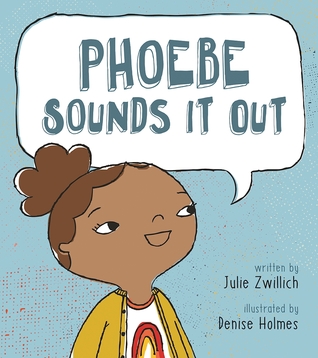
Phoebe Sounds It Out, by Julie Zwillich, (Apr. 2017, Owl Kids), $16.95, ISBN: 978-1-77147-164-0

Recommended for readers 3-7

Phoebe’s teacher announces that the children are going to learn to write their names today. All they have to do is sound it out. Phoebe doesn’t quite agree. First of all, Mama sewed her name on her school bag, and she’s convinced that she made a mistake: Phoebe’s name begins with a P, but that’s not the sound her name makes! She dawdles as the teacher encourages the class to sound it out, and finally, she gives it a shot. Her encouraging teacher tells her that it’s a great start – she did sound it out, after all!

I enjoyed so much about this book. I love that there’s a child of color main character and the diversity reflected in the classroom. One of the two teachers is also a person of color, and there is diversity in the classroom, including a classmate in a wheelchair. I enjoyed Phoebe’s thought process while the rest of the class works on their assignment: she fidgets, she goofs off, she “borrows” a letter from a classmate’s name to jazz up her name as she sounded it out. Kids will recognize themselves in Phoebe.

I’ve seen comments questioning whether a teacher would let Phoebe’s misspelling stand. I tend to say yes, especially for this first attempt. The point of the story is to sound out a word, and Phoebe does just that. When my older kids were in elementary school, the practice for teachers was not to correct spelling errors on similar assignments; the kids were expected to catch on eventually, and they did, through vocabulary words, spelling tests, and reading and being read to.

Denise Holmes’ art is rendered in ink and colored using Photoshop, and it’s very cute. There are bright colors and fun patterns, and sweet touches, like the children’s pictures on their cubby spaces and the handwritten children’s work.

This book presents a fun chance for a similar Sound It Out activity, complete with glitter glue to finish up your kids’ work. Let them sound out their names, or other fun words around them.

Julie Zwillich is a television personality with shows on Food Network Canada. You can see more of Denise Holmes’ illustration at her website.

c

Posted in Early Reader, Fiction, Preschool Reads

Little Blue Chair: the power of sharing, the power of home

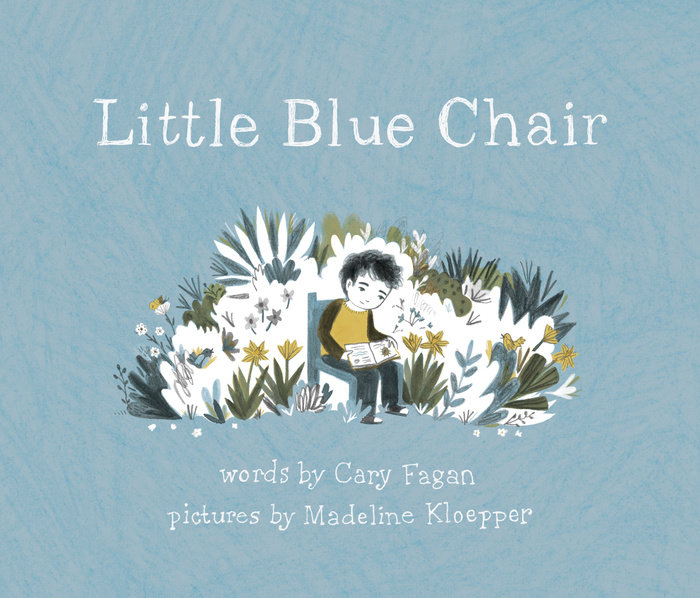
Little Blue Chair, by Cary Fagan/Illustrated by Madeline Kloepper, (Jan. 2017, Tundra Books), $16.99, ISBN: 978-1-77049-755-9

Recommended for readers 3-7

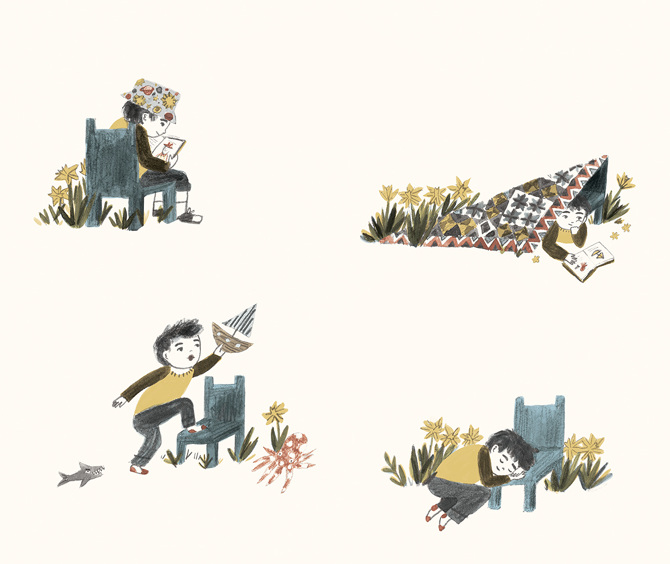
A little boy outgrows his favorite blue chair, so his mother puts it on the curb with a sign reading, “Please take me”. From there, Little Blue Chair follows the chair as it’s passed from hand to hand: it’s used as a replacement seat on a plant stand; a ferris wheel; a bird feeder; a throne, and a chair for elephant rides. It travels to amusement parks, houseboats, and beaches, ultimately coming full-circle as it arrives back where it began. It’s a sweet story about a favorite belonging – it could easily be a toy, as in Kate DiCamillo’s The Mysterious Journey of Edward Tulane – and the power of home, but it’s also a story about the permanence of objects. The chair is never thrown in the trash; it’s used again and again, serving different purposes for different people, all of whom love the chair while they have it. It’s a journey home.

Madeline Kloepper’s ink and pencil illustrations, finished digitally, a soft and gentle, calming to the reader. The palette of opaque greens, reds, dark yellows, and gray-blues gives the story almost dreamlike feel; a child’s imagination realized, from one boy using the chair as a tent, to another using it as a throne, his stuffed toys as subjects. Everything in this world has a story; everything has a value. Read this with your little ones and talk about the stories their toys hold. If you’re in a school, talk about the desks: what stories could they tell?

courtesy of Madeline Kloepper’s website

I’d love to pair this with Mirielle Messier’s The Branch and compare the two stories. They’re both books about reusing and repurposing; one, a child’s chair; the other, a branch from a favorite tree.

Cary Fagan is an award-winning children’s author. See more of Madeline Kloepper’s illustration at her website.

Posted in Early Reader, Fiction, Fiction, Graphic Novels, Humor, Intermediate

Noodleheads See the Future… Is there cake?

Noodleheads See the Future, by Tedd Arnold, Martha Hamilton, & Mitch Weiss/Illustrated by Tedd Arnold, (Jan. 2017, Holiday House), $15.95, ISBN: 9780823436736

Recommended for readers 6-10

Noodlehead brothers Mac and Mac return for a second round of goofy fun in Noodleheads See the Future. The empty-headed brothers (no, really, they’ll show you their hollow pasta heads) are a bit gullible, which leaves them open to pranks by their cousin, Meatball. The Noodleheads head to the woods to get firewood for their mother so she can bake them a cake; where Meatball tricks them and steals their firewood. The joke’s on Meatball, though; the Noodleheads still manage to get the job done for Mom, who bakes them a cake!

Think of the Noodleheads as a first step toward Amelia Bedelia. The brothers take everything literally, like looking up when being told, “heads up”. This is a fun graphic novel to give to emerging independent readers; the text is brief and bold, the panels show events in sequence, and the three chapters are short enough to keep a reader’s attention. Plus, the illustrator and one of the authors is Tedd Arnold, whose Fly Guy series is an Easy Reader favorite. An explanation of the myths inspiring the stories told in Noodleheads of the Future will interest kids and grownups.

This is the second Noodleheads book. The first, Noodlehead Nightmares, was released in 2016. The series is a Guided Reading level L, according to the publisher’s website, and received starred reviews from School Library Journal and Kirkus.


Posted in Fantasy, mythology, Teen, Young Adult/New Adult

The Myth of the Minotaur? That’s BULL.

Bull, by David Elliott, (March 2017, HMH Books for Young Readers), $17.99, ISBN: 9780544610606

Recommended for ages 13+

You may know the myth of Theseus, the Minotaur, and the Labryinth, but I guarantee you’ve never read it like this. Told in verse, with each character’s voice using its own poetric form, from sonnets and stanzas to split couplets.  Poseidon acts as a kind of narrator, boastful and smug, laying out the lay of the land for readers: how Minos wouldn’t sacrifice a bull to him, so he decided to take it out on his wife and son. We have Minos, who’s not winning any father of the year awards; poor, insane Queen Pasiphae, who loves her baby boy and loses her mind when he’s taken from her; Ariadne, Minos’ daughter who just wants to take her brother, Asterion – the Minotaur – away from the hell he’s living, Daedalus, the engineer of the labyrinth, and last but never least, Asterion, the voice of the Minotaur himself.

There are inevitable Hamilton comparisons to be made, and this is a good thing: it’s a modern, compulsively readable, update of the classic myth, full of dark humor, angst, and betrayal. Elliott fleshes out the story by giving his take on the characters’ internal dialogue; most notably, Asterion’s growing despair and rage, also depicted by the progressively darker pages on which his dialogue runs. I’d love to see this staged, and I’m sure many, many high school and college students will, too.

Bull received (well-deserved) starred reviews from Booklist and Kirkus. Language and situations may give some more conservative readers pause, but it is a Greek myth, after all.

Author David Elliott’s webpage has more information about the author and his books, plus information about author visits. There is also a link to Mr. Elliott’s Pinterest page, where readers can find more links to information about the players in Bull and their mythology.

Posted in Adventure, Fantasy, Fiction, Middle Grade, Tween Reads

Fairy Tale Reform School’s seeing some changes in Tricked

Tricked, by Jen Calonita, (March 2017, Sourcebooks Jabberwocky), $15.99, ISBN: 9781492637950

Recommended for ages 8-13

Gilly and friends return in Tricked, the third installment of Fairy Tale Reform School, but things are very, very different now. Gilly’s in school to be a cobbler, like her dad, but she really isn’t into it. Her sister, Anna, is falling in with a bad crowd: Hansel and Gretel are jerks, causing trouble all over town. They go too far with one prank that lands the three of them in – you guessed it – Fairy Tale Reform School, but the school has been through some big changes: Flora, Cinderella’s formerly wicked stepmother, is no longer headmistress; instead, the master dealmaker, Rumpelstiltskin, is in charge now, and the classes seem to encourage the kids to be more villain than hero. Gilly, Jax, and Maxine need to get back on the inside to find out what’s going on in those hallowed halls, get to the bottom of Rump’s treachery, and save Anna while Gilly’s at it: if Anna even wants to be saved.

I’ve been a Fairy Tale Reform School fan from the beginning, and Tricked is every bit as good as the first two. I love the way Jen also manages to address some of the very real things going on in the news today through FTRS, with a trickster who excels in the art of the deal (ahem) pulling the strings and making everyone in that school either blindly follow him or disappear. When things came together for me as I read, I realized how brilliant Tricked is in every respect, and I admire Jen Calonita for taking such a timely message on and communicating it to the kids who need to understand that when something doesn’t seem normal, it really isn’t.

There are strong subplots, addressing the frustration of being in a sibling’s shadow, making your own dreams happen versus living up to others’ expectations.

Tricked is all-around fun reading with big messages for young readers.

Posted in Non-Fiction, Teen, Tween Reads, Young Adult/New Adult

Girl Power! Girl Code!

Girl Code: Gaming, Going Viral, and Getting It Done, by Andrea Gonzales and Sophie Houser, (March 2017, HarperCollins), $17.99, ISBN: 9780062472502

Recommended for readers 12+

Two teens attend NYC’s Girls Who Code Program, become friends, and create a viral video game that addresses the taboo of menstruation. It really happened, and they’re telling their story, hoping to inspire more girls to get involved in the tech space. More importantly, Andrea “Andy” Gonzalez and Sophie Houser talk frankly about the stress and the pressure of being in the spotlight; the sacrifices they made as they learned more about school, tech and entrepreneurship. They discuss the struggle to find a work-life balance. Girl Code is loaded with photos and includes an appendix with a glossary and coding exercises for both PC and Mac and is essential reading for anyone – particularly young women – interested in pursuing STEM careers.

I’ve been a big proponent of STEM for my library kids and for my own kids. I’ve run coding programs at my last library and am working on plans to bring one to my newest location. I urge the kids I see every day to get hands on, whether it’s toddlers playing with water tables to see what floats and what sinks, or tweens making BB-8 and R2D2 follow coding commands to move around a screen. Having two mentors like Sophie and Andy available on bookshelves is important, because they tell all: overcoming shyness and anxiety; encouraging kids to keep plugging away at code because it doesn’t always happen the first time, but perseverance gets results; and most importantly, that there are people out there that want you to succeed, but there are also people out there that will try to take the wind out of your sails once you do. Having two young women talk about their experiences is so much more important than me telling kids to stick two Scratch blocks together to run a command, because representation matters. I want readers to read these young women’s words and think, “I can do that.”

If you don’t have kids that are into code, give them this book anyway. Sophie and Andy take on the very taboo topic of being female in public. You read that right. Their game, Tampon Run, takes on the taboo of “icky girl stuff” – having periods – and puts it front and center, making it visible and real. It’s a big statement, and the thinking and reasoning behind the creation of this game is fascinating and inspiring reading.

Posted in Early Reader, Non-Fiction, Preschool Reads, Toddler Reads

Adorable animal books for toddlers and preschoolers!

Anita Bijsterbosch has two adorable animal books out this month and next, perfect for toddlers who love to explore their books.

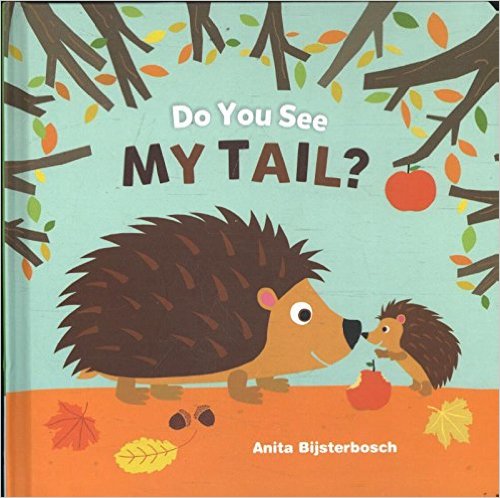
do-you-see-my-tailDo You See My Tail? (March 2017, Clavis Books, $12.95, ISBN: 978-1605373201) introduces readers to seven animals – well, seven animal tails; the rest of the animals are hidden behind local flora. The text drops a hint, and a gatefold reveals the full answer: an animal family! The repetitive question/answer format, and greeting to the animals and their babies, creates a fun discovery experience for little hands. An extra challenge: find the little ladybug hiding on every spread.

Preschoolers will like being able to control finding out more about the animals and learning about animal habitats: beavers play in a nest of tree trunks and branches, rabbits in a hole under the ground. Toddlers will love the excitement of discovery and the very cute artwork.

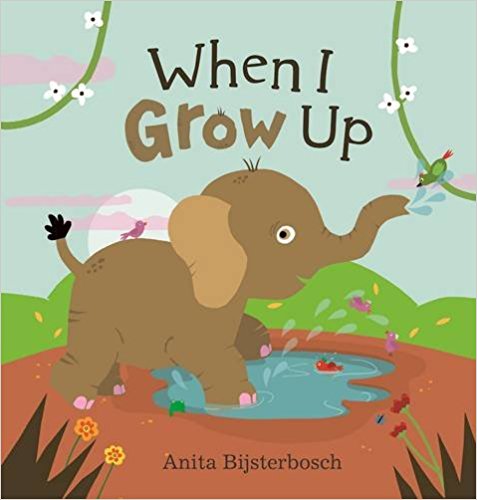
Whewhen-i-grow-upn I Grow Up (April 2017, Clavis Books, $14.95, ISBN: 978-1605373348) features six young animals who dream about what they’ll be able to do once they grow up: a little lion who can only growl softly now will be a big lion whose roar will be heard by all the animals; a little giraffe whose nose barely touches the leaves in a tree will one day be able to reach everything with his long neck. Die cut pages let readers flip the page to reveal the adult animal in the young animal’s place within the same setting.

As with Do You See My Tail?, When I Grow Up offers toddlers the excitement of discovery, with something new on every page. The pages are sturdy and will hold up to multiple page flips (always a concern in my library). Preschoolers can focus on habitats, food, and other animals sharing the living spaces.

Originally published in 2016 in Belgium and Holland, these are fun new choices to bookshelves and collections.