Posted in Post-apocalyptic/Dystopian, Science Fiction, Teen

Ann Brashares The Here and Now gives us time travel and dystopia.

cover35542-mediumThere Here and Now, by Ann Brashares. Random House Children’s (2014), $18.99, ISBN: 9780385736800

Recommended for ages 14+

Ann Brashares, author of the Sisterhood of the Traveling Pants series, gives us a well-constructed story with dypstopian elements, time travel, and a race through the past, present and future to stop a terrifying future.

Prenna is a 17 year-old Traveler – she, her mother, and a group of her people came to our present time to escape a future where a blood plague ravaged the population. The Travelers live under a restrictive list of rules that appear to exist more for their power-hungry leaders rather than the actual good of the people (or the Natives – people in the right timeline – that the rules are supposed to protect). When Prenna finds herself growing closer to her friend Ethan, she starts questioning not only the rules, but the entire structure their society was built on – and she and Ethan find themselves drawn into a race against time to put a stop to the dismal future from which Prenna came, all the while pursued by the leaders who want to silence Prenna, possibly for good.

The Here and Now has elements of The Giver – the post-apocalyptic society governed by rules really spoke to me – and is one of those books that I couldn’t put down. I needed to know what was going to happen next; Ms. Brashares constructed a compelling narrative with enough mystery to keep me going for that famous “one page more”. Within the overall story structure, there are mini-mysteries that the two teens have to unravel to get the next piece of the puzzle; add to that the internal conflict Prenna feels at duty to her family and the love she and Ethan feel for one another, and you have a great read for teens that can spawn interesting conversations about the implications of time travel: what would happen if you went back in time and changed things, even if they were for the better? What kind of society would develop if a blood-borne plague spiraled out of control? More than a teen romance, The Here and Now offers the opportunity to draw teens into complex conversations about the world around them.

Posted in Science Fiction, Teen, Uncategorized

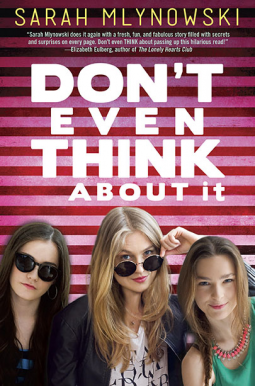
Don’t Even Think About It – Talk About Your Strange Side Effects!

Don’t Even Think About It, by Sarah Mlynowski, Random House Children’s (2014), 9780385737388, $17.99

dontthinkaboutitRecommended for ages 16+

I was lucky enough to be chosen by Random House to review an advanced copy of this book, by Sarah Mlynowski, who I fondly remember from her Red Dress Ink chick lit days. I thoroughly enjoyed her book Milkrun, so I was excited to see that she was writing YA. The plot is certainly different: a group of New York teens, attending Bloomberg Public High school down in Tribeca, develop ESP after receiving a tainted batch of flu shot at school.

Ms. Mlynowski has her ensemble cast: Cooper and Mackenzie the young lovers, one of whom has a secret; Pi, the overachiver; Olivia, the shy girl; BJ, the pervert; Tess, the one with the unrequited love for her best friend – these personalities and more are all here, which gives a feeling of familiarity to those reading the book. You know these kids – we’ve been these kids, in many cases. The characters aren’t soul-searching, and don’t require that depth of character for this quick read. It’s a situational piece of fiction.

What interested me was not the superficial teens, because they mostly are – even “the brain”, Pi, who uses her powers to try and get ahead of the number one student in the school so she can get the vaunted Harvard acceptance letter – it was how they dealt, on their own levels, with their newfound abilities. They didn’t take to Twitter, Instagram, or Facebook to discuss it with the world. They kept it quiet. They didn’t want anyone to know, because they live in a day and age where they know they’d be poked and prodded like test animals, or even worse, have their ability – something to give them an edge, to make them special – taken away from them. At the same time, Mlynowski creates an interesting portrait of what these abilities do to their bearers. It’s not always predictable, and it was enjoyable to see things play out.

The book is suggested for 16 and over for some language and situations. For a quick, light read between tests and papers, Don’t Even Think About It will fit nicely in your backpack.

Posted in Fantasy, Fiction, Graphic Novels, Middle School, Science Fiction, Tween Reads

The Glorkian Warrior Delivers a Pizza: Middle-Grade Hilarity in a Graphic Novel Format

The Glorkian Warrior Delivers a Pizza, by James Kochalka (First Second, 2014), ISBN: 978-1-59643-917-7, $17.99
Pub Date: March 2014

Recommended for ages 8-12

Glorkian-Warrior_AdvanceBooks_FrontCover I first discovered James Kochalka a few years ago, when my son read and adored his book, Peanut Butter & Jeremy’s Best Day Ever. I loved the cartoony art and fun dialogue; when I saw this title available on NetGalley, I immediately requested it, knowing I’d be in for a fun read. I was absolutely right.

Not knowing about the successful Glork Kickstarter that Mr. Kochalka and PixelJam games had back in 2010, I came to Glork as a brand new audience. The book is hilarious and surreal on a level that middle schoolers can truly appreciate and adults will just laugh out loud looking on. The Glorkian Warrior is sitting at home with his Super Backpack, when the phone rings – it is destiny? Well… kind of – it’s a pizza order. While Backpack wants the Glorkian Warrior to disregard the obviously wrong number, the Warrior will not be put off – this is his mission! He grabs a partially eaten pizza from his fridge and sets off on a journey that will introduce him to alien babies and add strange and unusual toppings to the pizza, including ash, tears, and fire damage. Will the Glorkian Warrior fulfill his delivery destiny? Don’t look at me for answers, read the book!

The book, which hits bookshelves in late March, is great fun. The cartoony art is perfect for its middle grade audience, as is the goofy humor. The Warrior is hilariously oblivious, Backpack is the brains of the operation, and together, the two are responsible for bickering and laughs on the level of Star Wars’ C3P0 and R2D2.

I enjoy graphic novels for kids, for several reasons. The first reason? Reluctant readers. They may stare at a page full of words and shut their brains off, but how can you look at a brightly colored, fun adventure and say, “No thanks”? You can’t. This will draw in reluctant readers, who – sadly – also tend to be boys. Having an alien warrior delivery a pizza with his laser-powered sentient backpack will definitely help bring the boys to the reading table. The second reason? Graphic novels teach sequence. Sequential art – art that is broken up into panels, a sequence – gives kids a sense of pacing and “what happens next” – very important concepts in the Common Core these days.

I thoroughly enjoyed riding shotgun with the Glorkian Warrior, and look forward to seeing him again. Reserve this book for any young readers you may have – they’ll get a kick out of it. The book also opens itself up to some great reading group discussions, including drawing your own alien workshop/top your own alien pizza workshop, map out the mission mapmaking sessions, and make your own comic book programs.

Mr. Kochalka has a Tumblr, Kochalkaland, where he features some webcomics (not necessarily young child-appropriate, but then again, neither is Tumblr) and a webcomic at American Elf (again, not young reader-appropriate). You can follow Glorkian Academy on Twitter for news about the books.

I found some interior art from The Glorkian Warrior Delivers a Pizza on the publisher’s website:

GlorkianWarrior-FINAL-5


Posted in Adventure, Espionage, Fantasy, Fiction, Science Fiction, Steampunk

Book Review: Etiquette & Espionage, by Gail Carriger (Little, Brown, 2013)

etiquette and espionageRecommended for ages 13+

Gail Carriger, author of the Parasol Protectorate series, kicks off her YA Finishing School series, set in the same universe as the Parasol Protectorate series, with Etiquette & Espionage.

Fourteen year-old Sophronia is driving her society lady mother crazy. She climbs trees. She takes apart things to figure out how they work. She lines her books with rubber from a dumbwaiter in the house. Fed up with Sophronia’s antics, she sends her to finishing school – Mademoiselle Geraldine’s Finishing Academy for Young Ladies of Quality, to be precise.

What neither Sophronia nor her mother bet on, though, was that this is no ordinary finishing school – when they say “finish”, they mean “finish” – the students learn how to curtsey and flutter their eyelashes, but they also learn about poisoning, espionage, and weapons placement. Sophronia is learning to be a spy and an assassin in addition to being a lady. But she also stumbles into a mystery involving one of the students as soon as she boards the coach to school – what is really going on at Mademoiselle Geraldine’s, and what does her newfound nemesis have to do with it?

While I am a big fan of the Parasol Protectorate series and went into this series with high hopes, I was a little let down here. I understand that this is the first book in a new series, with much to be established, but I felt there was an overall lack of plot to drive the story forward. It seemed more a collection of “look what Sophronia’s got herself into now” moments, with some vague subplot surfacing to give her an archenemy in future books.

The dry humor is there, though, and that kept me reading. I love the way Ms. Carriger writes, and I enjoy her stubborn heroines who can lock horns with a werewolf and then stress about their state of dress and look for a cup of tea. I enjoy the Parasol Protectorate universe, and there’s paranormal and steampunk aplenty here, with werewolves, dirigibles, and automatons for all. There are a few pleasant surprises for Parasol Protectorate fans, too.

If you’re a fan of Carriger’s, you’ll at least enjoy the universe and references. I look forward to the next book in the series.

Posted in Science Fiction, Tween Reads

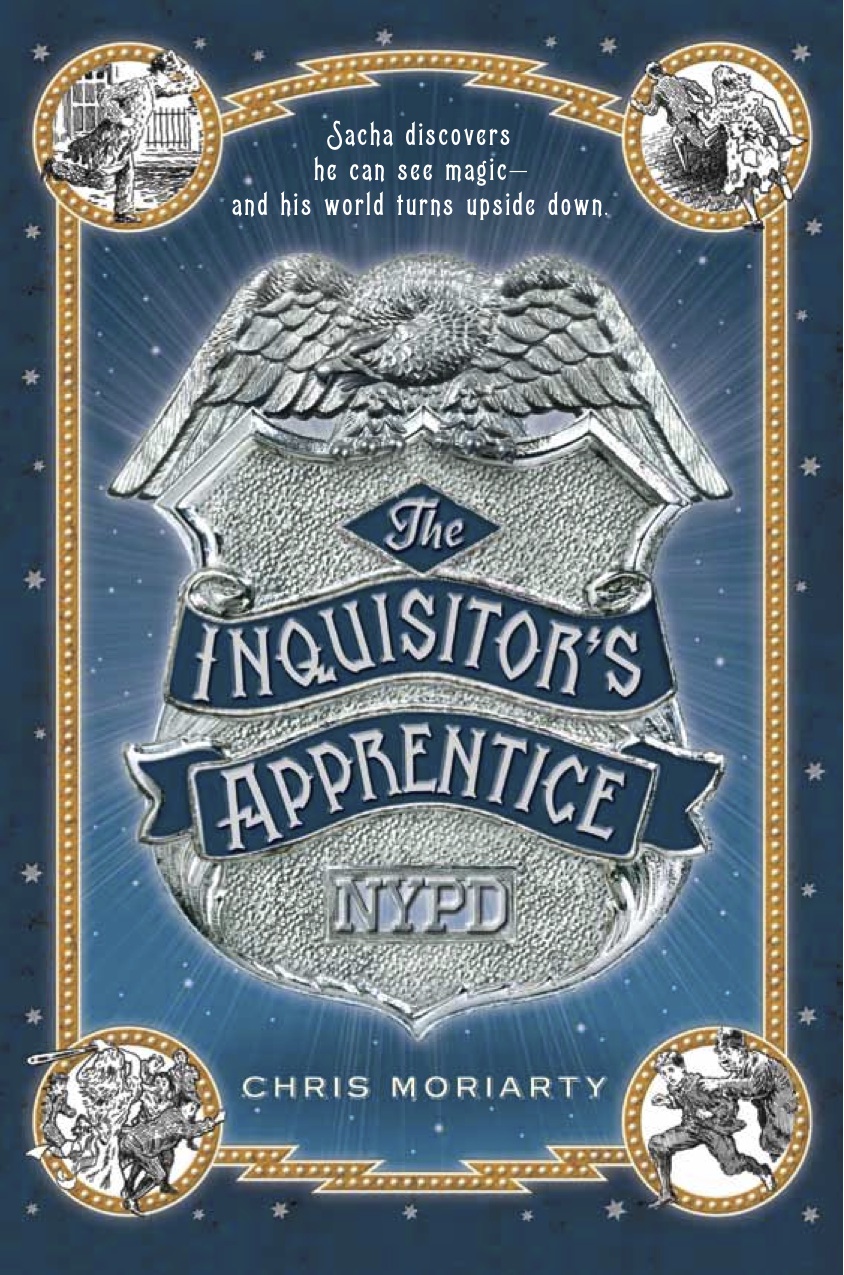
Book Review: The Inquisitor’s Apprentice by Chris Moriarty (Harcourt, 2011)

Recommended for ages 10-14

The Inquisitor’s Apprentice is the first book in a a science fiction/fantasy adventure series, taking place in an alternate New York City around the turn of the 20th century. Magic exists in this world, and each immigrant group has their own magic that they bring to the New World with them. Inquisitors, a branch of the New York Police Department, patrol to make sure magic is not being abused.
Thirteen year-old Sacha Kessler, who lives in the Lower East Side with his family, has the gift of seeing magic; for this, he is recruited into the NYPD, as an apprentice to Inquisitor Wolf; his fellow apprentice, Lily Astral, is from a wealthy New York family and is an entitled snob who rubs Sacha the wrong way almost immediately.

Inquisitor Wolf, Sacha and Lily are put on a case involving death threats to Thomas Edison, who is creating a witch-detectiing machine – every magician in New York City has a reason to want him dead, but as they delve deeper into the case, things become more complicated for Sacha, who sees the case leading back to his neighborhood – and possibly, his own family.

The book is compulsively readable, with well-drawn characters and an interesting alternate New York setting. Moriarty offers a new way of glimpsing life into the Jewish immigrant experience in turn of the century New York; this book would be good companion reading to a unit on immigration in America as it allows for many areas of discussion wrapped within a solidly enjoyable fantasy setting. Some may struggle with the many Yiddish terms, but context should answer most questions. A paperback edition may consider a guide to terms for some readers. Black and white illustrations by Mark Edward Geyer add to the moody feeling that permeates much of the novel.

Chris Moriarty has an Inquisitor’s Apprentice website set up that provides information on the series and on the actual New York City of the time, with photos and information about key individuals that appear in the series, like Harry Houdini and Thomas Edison. There is author event and contact information as well. He blogs at SFness.com about his own books, other author’s books, and offers writing advice. His website features his writing about science fiction and cyberpunk, along with other science fiction subgenres.

Posted in Fantasy, Media, Science Fiction

DVD Review: Hellboy: Blood and Iron (Starz Home Entertainment, 2007)

Recommended for ages 12+
For those unfamiliar with the Hellboy comic book and movie series, let me provide a very quick overview: Hellboy is a demon from Hell, brought to earth by Nazi occultists during World War II. He was saved by the Allies and raised as a son by Professor Trevor Bruttenholm, and later went to work for the secret international Bureau of Paranormal Research and Defense (BPRD), founded by Professor Bruttenholm. His two closest friends and partners are Liz Sherman, a human who can create fire with her mind, and Abe Sapien, an amphibious humanoid.

In Blood and Iron, the BPRD is asked to investigate a haunted mansion purchased by a billionaire who wants to make money from it as a tourist attraction. They learn that the mansion is haunted by ghosts, witches, werewolves and hellhounds and that the evil undead Hungarian countess and vampire Erzsebet Ondrushko, who Professor Bruttenholm has tangled with before, is back to cause more trouble. Ondrushko appears to be based on the real-life historical figure Elizabeth Bathory, and Greek mythological figures Hecate, goddess of the crossroads and witchcraft, and harpies are also thrown into the mix.

 
Mike Mignola, Hellboy creator, was one of the screenwriters on Blood and Iron and the cast who plays the characters in the movie voice their characters in this animated film. Fans of the comics and the movies will be happy here; there is plenty of paranormal activity, snappy dialogue and character interaction, and wild fight scenes and gunplay. While some of the imagery may be rough for younger viewers – there’s not direct graphic violence, but there is blood and some implied torture – older ‘tweens and teens have played more violent video games. Parents, watch it first, then use your judgement.
Posted in Post-apocalyptic/Dystopian, Science Fiction, Tween Reads

Book Review: The Giver, by Lois Lowry (Houghton Mifflin, 1993)

Recommended for ages 11-14

In the dystopian future, there is no more war, disease, or poverty. There are no choices, either – in 12-year old Jonas’s community, spouses are assigned to one another, children are assigned to families, and children’s milestones are pre-selected and celebrated once a year. At age seven, they receive jackets that button in the front. At the age of nine, they receive bicycles. At the age of 12, they attend the Ceremony of Twelve, where they are assigned their careers. Jonas, who has been experiencing feelings that has made him feel different from his peers, is assigned to be the Receiver of Memory – the sole repository for the collective memories of the community. He begins to work with the outgoing Receiver, now called The Giver, to receive the memories and learns disturbing truths through both the memories and the truths he begins to see in his daily life in the village.

The Giver is one of those books that sticks with you, changing the way you think about things. What price is a group willing to pay to live in a perfect, ordered society? Jonas, in receiving memories, plays the part of Adam in the Garden of Eden – he receives knowledge, and with knowledge comes confusion. Is his community right because they don’t know better? He begins to question everything around him and everything he’s ever known; when he sees his father commit an act in the course of his daily work that he finds unspeakable, the last vestiges of what he believes in are thrown into chaos.
 
The Giver is one of the most challenged books books in middle schools across America, usually for its portrayal of euthanasia (but also for what has been considered a sexual reference). Regardless of its challenges, it remains a popular and important middle-school book that speaks to the power of free will and choice. There are many lesson plans for this book on the Web, including this comprehensive one from the Mountain City Elementary School District in Tennessee. The book won the 1994 Newbery Medal and the 1996 William Allen White Children’s Book Award and has been designated an American Library Association (ALA) Best Book for Young Adults and an ALA Notable Children’s Book. The Giver is the first in a 3-book series that includes Gathering Blue and Messenger.
 
Lois Lowry is an award-winning YA author; she has received numerous awards, including two Newbery medals (for The Giver and Number the Stars). Her website lists all of the awards she’s won in addition to offering book information, a biography, her blog, her photos, and copies of her speeches.
Posted in Post-apocalyptic/Dystopian, Science Fiction, Tween Reads

Book Review: The Hunger Games, by Suzanne Collins (Scholastic, 2008)

Recommended for ages 12+
Welcome to Panem, the post-apocalyptic United States of America, divided into the Capitol and 12 districts. Every year, two “tributes” between the ages of 12 and 18 are selected from each district to take part in a brutal contest called The Hunger Games, where they fight to the death. There is only one winner. Sixteen-year old Katniss volunteers to her district’s tribute after her 12-year old sister’s name is drawn.

The Hunger Games is the brutal version of a reality game show – think of Stephen King’s (written as Richard Bachman) novel, The Running Man and you’ll have a good frame of reference. The tributes are given mentors – former winners, condemned to preparing future tributes for the games – and stylists to make them look good. The contestants have to project personality in the week of interviews and preparation so that they have a chance at receiving help from sponsors, who can send food, medicine, and supplies to their contestants during the games. The games are televised for all the districts to watch. Katniss struggles to keep her humanity in the midst of the game and rails against being the Capitol’s pawn.

The book moves at a breathtaking pace with an intensity that starts mere pages in and doesn’t let up until the book’s end. The main characters have a good base for character development that will likely continue in the two following books in the series, Catching Fire and Mockingjay; the others are as developed as they need to be in order to further the story and keep the pace. Ms. Collins makes her point about valuing bloodsport over humanity as eloquently as she is brutal in several key scenes in the book. With a strong mix of violence and compassion, boys and girls have both seized on this series and catapulted it to the top of their reading lists. Katniss emerges as a heroine not only for her strength but her ability to retain her sense of self in the middle of the games. She is a complex, conflicted heroine who resonates with ‘tweens and teens alike.

The Hunger Games has won multiple awards and honors. It is a New York Times and Wall Street Journal besteller, and was one of Kirkus and School Library Journal‘s Best Books of 2008. It is an Americna Library Association (ALA) Notable Children’s Book and one of the Young Adult Library Services Association’s (YALSA) Teens Top Ten for 2009. Lionsgate Studios will release a movie based on the book in March of 2012.

A comprehensive wiki exists for the series and the author’s website offers author and book information. There are many teacher’s resources for teaching the series available on the Web, including Scholastic’s and Hunger Games Lessons.

Posted in Fiction, Realistic Fiction, Science Fiction, Tween Reads

Book Review: When You Reach Me, by Rebecca Stead (Yearling, 2010)

Recommended for ages 10-14When You Reach Me is a science-fiction novel set in a realistic fiction setting. It received the Newbery Award in 2010.

Miranda and Sal are best friends of the same age who live in the same building and both have single mothers. They spend all off their time together until the day when Sal is inexplicably punched in the stomach by a boy on the street. From then on, he shuts Miranda out of his life, leaving her hurt and confused. At about the same time, Miranda begins receiving strange notes from someone saying they are coming to save her friend’s life and his or her own, but that Miranda must write a detailed letter as the author will not be himself when he reaches her. She tries to figure out whether the notes or real or a joke as she navigates her situation with Sal, amkes new friends, and preps her mother to be a contestant on a game show, The $20,000 Pyramid. The notes continue to arrive, each with future predictions that come true, until the day Miranda witnesses an awful accident and brings the truth home: the notes are no joke.

The book is wonderfully addictive, with interesting characters and a realistic, New York in the 1970s setting. Ms. Stead layers plot upon plot, drawing the reader in and dropping little clues throughout the story to guide the reader along while never giving away the surprise until the climax of the story. Madeleine L’Engle’s A Wrinkle in Time figures heavily into the story both as Miranda’s favorite book and a device to further the plot and is woven beautifully into the fabric of the story. Older readers will be better able to sit down and spend some time with this complex book and have great discussions afterwards.

In addition to winning the Newbery, When You Reach Me has received numerous awards and honors including designation as a New York Times Notable Book and an American Library Association (ALA) Notable Children’s Book; it has also won School Library Journals’ Best Book of the Year (2009) and Publishers Weekly’s Best Children’s Book of the Year (2009).

The author’s website provides information and reviews on her books, a link to her blog, and contact information for libraries and schools that wish to host her.

Posted in Adventure, Fantasy, Graphic Novels, Humor, Steampunk, Tween Reads

Book Review: Calamity Jack, by Shannon and Dean Hale (illus. by Nathan Hale) (Bloomsbury, 2010)

Recommended for ages 9-12

Calamity Jack is the sequel to the graphic novel Rapunzel’s Revenge and gives readers the backstory on Rapunzel’s buddy, Jack. Like Rapunzel, this is a fun, new take on the Jack and the Beanstalk fairy tale geared to attract older readers.

When readers first meet Jack in Rapunzel’s Revenge, he’s a guy on the run. Calamity Jack tells the story of why he’s on the run and who he’s running from – a kid who can’t stay out of trouble, Jack ends up getting himself, and by extension, his mother, into trouble with the local giants that run his town. He steals a goose that he hears is due to lay a golden egg and goes on the run, hoping that any golden eggs will pay for the destruction of his mother’s bakery. After his early adventures with Rapunzel, she accompanies him back to his hometown where they hope to reunite Jack with his mother – and find the town under siege by giant ants, his mother a prisoner of the giants, and a sneaking suspicion that the giants are at the heart of all the town’s problems.

Anyone who enjoyed Rapunzel will enjoy Calamity Jack. Written in the same fun spirit, the authors give equal time to the main male and female characters with their own adventures. Graphic novels are a good way to reach male readers, and turning a fairy tale into an adventure tale is a smart way to draw in those readers who may feel they are “too old” for these books.
 
Newbery Award-winning author (for Princess Academy) Shannon Hale writes for ‘tweens, teens, and adults. Her husband, children’s author Dean Hale, wrote Rapunzel’s Revenge and Calamity Jack, with Ms. Hale. Ms. hale’s blog offers links to information about her books, events and games. She also offers a list of favorite books for both children and adults, including some recommendations by her husband.