Posted in Adventure, Fiction, Tween Reads

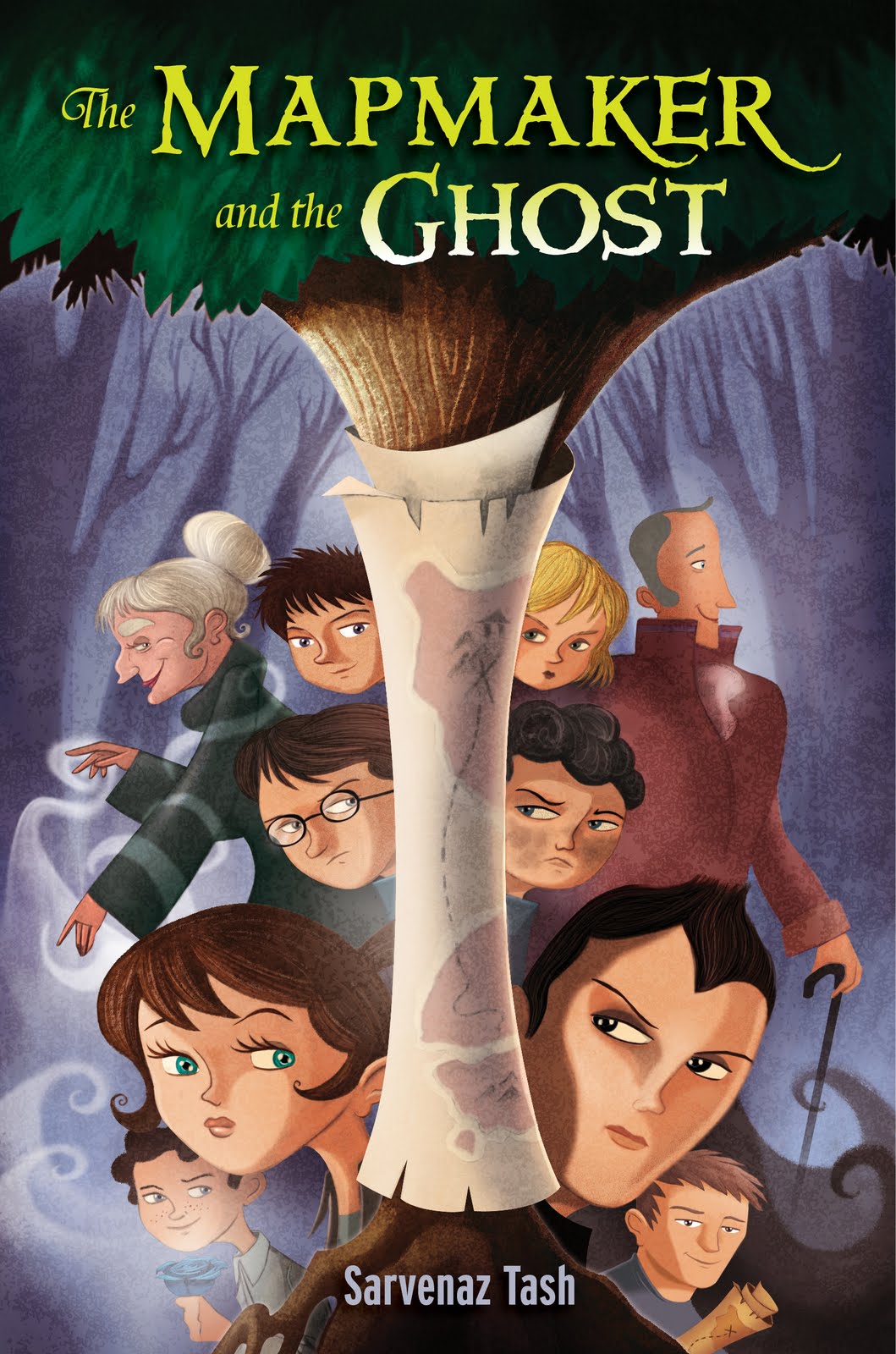
Book Review: The Mapmaker and the Ghost, by Sarvenaz Tash (Walker Books for Young Readers, 2012)

Recommended for ages 9-12

Goldenrod Moram wants to be an explorer and mapmaker like her hero, Meriweather Lewis (of Lewis & Clark fame). When she decides to spend her summer making a map of the forest behind her home, she stumbles into an adventure that has been over a hundred years in the making. Before her summer vacation is over, she will find herself in trouble with a local group of troublemakers, The Gross-Out Gang, and she will meet a strange old lady with an interesting family connection. She will also meet her idol face to ghostly face!

The Mapmaker and the Ghost gives readers a new heroine in Goldenrod Moram. She’s smart and gutsy, like many ‘tweenage characters these days, but she is not on the hunt for treasure – she just wants to make maps like her idol, Meriweather Lewis. And how often do you hear Lewis and Clark coming up as a literary and historical idol? Readers get a look at an important figure in American history and learn a little more about who he is.

 
Some of the characters are predictable. The Gross-Out Gang, for instance, is made up of kids who come from a multitude of mixed backgrounds: the rich parents who have no time for their children; the divorced father in a deep depression who cannot focus on his daughter; and the kid who’s been bounced around from foster home to foster home are all here. The ending is predictably light, but it gives the reader hope that every situation, when you use your brains and bring understanding and honesty to the situation, can work out for the best.
 
This is Ms. Tash’s first book. Her website offers information about the book and a link to her blog.
Posted in Fiction, Realistic Fiction, Tween Reads

Book Review: Wonderstruck, by Brian Selznick (Scholastic, 2011)

Recommended for ages 9-13

Wonderstruck tells the stories of two different people in two different time frames whose lives converge in an unexpected way. One story is told primarily through words and one through pictures; those familiar with Mr. Selznick’s Caldecott-winning The Invention of Hugo Cabret will recognize his artwork immediately.

The story, alternately told in 1927 and 1977, follows a young, girl named Rose who yearns to leave her New Jersey home and travel to New York City to see her favorite actress and a 12-year old boy, Brian, who is reeling after his mother’s sudden death. New York City, particularly the American Museum of Natural History, plays a major role in the book as we see the stories converge.

Wonderstruck relies as much on Selznick’s artwork as it does his prose in creating this story. The art is detailed and provides a comprehensive narrative on its own; his prose is simply stated and powerful. He weaves these two seemingly unconnected stories together and creates a powerful, emotional tale that readers will not want to put down. It is a love letter to New York City and a loving look at families lost and found.

 Brian Selznick’s novel, The Invention of Hugo Cabret, won the 2008 Caldecott Medal and has been made into a movie directed by Martin Scorcese. Scholastic’s Wonderstruck website offers features on American Sign Language and constellations, a link to the author’s website, and a sneak peek at the book for those visitors who haven’t gotten the book yet.
Posted in Fiction, Realistic Fiction, Science Fiction, Tween Reads

Book Review: When You Reach Me, by Rebecca Stead (Yearling, 2010)

Recommended for ages 10-14When You Reach Me is a science-fiction novel set in a realistic fiction setting. It received the Newbery Award in 2010.

Miranda and Sal are best friends of the same age who live in the same building and both have single mothers. They spend all off their time together until the day when Sal is inexplicably punched in the stomach by a boy on the street. From then on, he shuts Miranda out of his life, leaving her hurt and confused. At about the same time, Miranda begins receiving strange notes from someone saying they are coming to save her friend’s life and his or her own, but that Miranda must write a detailed letter as the author will not be himself when he reaches her. She tries to figure out whether the notes or real or a joke as she navigates her situation with Sal, amkes new friends, and preps her mother to be a contestant on a game show, The $20,000 Pyramid. The notes continue to arrive, each with future predictions that come true, until the day Miranda witnesses an awful accident and brings the truth home: the notes are no joke.

The book is wonderfully addictive, with interesting characters and a realistic, New York in the 1970s setting. Ms. Stead layers plot upon plot, drawing the reader in and dropping little clues throughout the story to guide the reader along while never giving away the surprise until the climax of the story. Madeleine L’Engle’s A Wrinkle in Time figures heavily into the story both as Miranda’s favorite book and a device to further the plot and is woven beautifully into the fabric of the story. Older readers will be better able to sit down and spend some time with this complex book and have great discussions afterwards.

In addition to winning the Newbery, When You Reach Me has received numerous awards and honors including designation as a New York Times Notable Book and an American Library Association (ALA) Notable Children’s Book; it has also won School Library Journals’ Best Book of the Year (2009) and Publishers Weekly’s Best Children’s Book of the Year (2009).

The author’s website provides information and reviews on her books, a link to her blog, and contact information for libraries and schools that wish to host her.

Posted in Adventure, Fantasy, Middle School, mythology, Tween Reads

Pandora Gets Jealous, by Carolyn Hennesy (Bloomsbury, 2008)

Recommended for ages 10-13

Get ready for Mean Girls meets Clash of the Titans.

Pandora – Pandy to her friends – has no idea what to bring to school for her project on the gods’ presence in their lives. If she brings the piece of her dad, Atlas’, liver again, she’s totally going to fail. When she stumbles across a locked box hidden away, she knows she should not bring it. Her dad told her that she should never open it. But it would be perfect. When the mean girls at school tease her and tell her that the box is worthless, it somehow ends up being opened, and the seven evils escape into the world, and poor Hope ends up being locked in the box.

Zeus and Hera charge Pandora with tracking down and recapturing all of the evils she released in six phases of the moon, or else. Pandy sets off with her two best friends, Alcie and Iole, and a little stealth help from Olympus. Her first stop: Delphi, to recapture Envy.

Pandora Gets Jealous is the first in Ms. Hennesy’s Pandora series; each book features the evil that she and her friends must recapture. Aimed at girls, the writing starts off light, with Pandora appearing almost vapid, but the story becomes intense very quickly. The solid mythology in the book is a great way to bring these stories to a younger, female audience that may still see Greek mythology as something geared toward boys despite there being gods AND goddesses on Olympus. Like Rick Riordan’s Percy Jackson and the Olympians series, Ms. Hennesy makes Greek mythology contemporary for a new audience.

The author, actress Carolyn Hennesy, has a Pandora-focused website with a wealth of additional content on the series including teachers’ guides, book synopses, and a discussion forum.

Posted in Adventure, Fantasy, Graphic Novels, Humor, Steampunk, Tween Reads

Book Review: Calamity Jack, by Shannon and Dean Hale (illus. by Nathan Hale) (Bloomsbury, 2010)

Recommended for ages 9-12

Calamity Jack is the sequel to the graphic novel Rapunzel’s Revenge and gives readers the backstory on Rapunzel’s buddy, Jack. Like Rapunzel, this is a fun, new take on the Jack and the Beanstalk fairy tale geared to attract older readers.

When readers first meet Jack in Rapunzel’s Revenge, he’s a guy on the run. Calamity Jack tells the story of why he’s on the run and who he’s running from – a kid who can’t stay out of trouble, Jack ends up getting himself, and by extension, his mother, into trouble with the local giants that run his town. He steals a goose that he hears is due to lay a golden egg and goes on the run, hoping that any golden eggs will pay for the destruction of his mother’s bakery. After his early adventures with Rapunzel, she accompanies him back to his hometown where they hope to reunite Jack with his mother – and find the town under siege by giant ants, his mother a prisoner of the giants, and a sneaking suspicion that the giants are at the heart of all the town’s problems.

Anyone who enjoyed Rapunzel will enjoy Calamity Jack. Written in the same fun spirit, the authors give equal time to the main male and female characters with their own adventures. Graphic novels are a good way to reach male readers, and turning a fairy tale into an adventure tale is a smart way to draw in those readers who may feel they are “too old” for these books.
 
Newbery Award-winning author (for Princess Academy) Shannon Hale writes for ‘tweens, teens, and adults. Her husband, children’s author Dean Hale, wrote Rapunzel’s Revenge and Calamity Jack, with Ms. Hale. Ms. hale’s blog offers links to information about her books, events and games. She also offers a list of favorite books for both children and adults, including some recommendations by her husband.
Posted in Adventure, Espionage, Tween Reads

Book Review: Alex Rider – Stormbreaker, by Anthony Horowitz (Walker Books, 2000)

Recommended for ages 10-14

The first book in Anthony Horowitz’s Alex Rider series, Stormbreaker introduces readers to 14-year old Alex Rider, an American boy being raised by his British uncle after his parents’ death. At the beginning of the book, Alex learns that his uncle was not a banker, as he thought, but a spy for MI6 who was killed in the line of duty; the British government now wants him to finish his uncle’s mission – to infiltrate technology billionaire Herod Sayle’s empire and find out the secret behind his new computers, the Stormbreakers. The series has received numerous awards including Children’s Book of the Year at the 2006 British Book Awards and the Red House Children’s Book Award in 2003. Stormbreaker was made into a movie in 2006.

The book is fast-paced and has enough gadgets and intrigue to keep readers engaged. Alex’s character is believable as the reluctant spy pushed into working for MI6, and Horowitz does not shy away from grisly outcomes. Rider’s finds his uncle’s bullet-ridden, bloodstained car in a junkyard, and a madman with a Portuguese man-of-war jellyfish figures prominently in the story. Rider is put through rigorous MI6 training with military men who try to make him fail because of his age; he is not given a free ride and we do not get the sense that any of his training or knowledge came easily. Rider is likeable as much as he is relatable – missions and gadgets aside, he is a young man coping with his uncle’s death and seemingly insurmountable circumstances in front of him, and readers will cheer him on.

The author’s webpage features an Alex Rider minisite with information about all of the books in the Alex Rider series and downloadable desktop wallpapers. The Alex Rider website offers exhaustive information on missions, characters, and criminals in the series; readers can create user accounts on the site to receive regular updates and additional content about the series. The site also links to Alex Rider’s Facebook page and YouTube channel.

Posted in Adventure, Realistic Fiction, Tween Reads

Book Review: Hatchet, by Gary Paulsen (Aladdin, 1987)

Recommended for ages 10-13

Hatchet is a Newbery Award-winning survival novel by Gary Paulsen. The book tells 13-year old Brian’s story of survival in the Canadian woods after the pilot of the plane he’s in has a heart attack and dies at the controls; Brian alone must figure out how to get the plane down and how to survive until help comes – if it comes.

He spends the summer learning how to survive and adapting to his new environment, starting out with only the hatchet his mother gave him when he left. He learns how to identify edible plants, how to hunt and trap animals, and how to cook them; he can make simple tools and fashion a shelter for himself. When he finds hiself with time to think he is consumed with thoughts of his parent’s divorce and his mother’s role in it.

Brian’s story of survival, and the subplot of his parent’s divorce – in the background, but always there – make this a very readable book for boys and girls alike. While the main character is a boy, the struggle to survive and the feelings he finds himself confronted with, told with urgency, make this a page-turner that communicates emotions all tweens and teens can relate to.

Hatchet is the first in Brian’s Saga, a series of books about Brian Robeson written by Gary Paulsen. The author’s Random House site  has information about the other books, with excerpts and teachers’ guides. The book was made into a movie, A Cry in the Wild, in 1990 and is available on DVD. The book has received numerous awards and honor in addition to the Newbery, including designation as an American Library Association (ALA) Notable Book (1987) and a Booklist Editor’s Choice Citation (1988).

There are a wealth of discussion materials for the book available online. Scholastic offers a free lesson plan and unit plan on teaching imagery with Gary Paulsen; Literature Index offers free PowerPoint presentation, clip art, and templates; and BookRags offers a study guide.

Posted in Fiction, Realistic Fiction, Tween Reads

Book Review: Joey Pigza Swallowed the Key, by Jack Gantos (HarperCollins, 2000)

Recommended for ages 9-12

Told in the voice of a boy with ADHD (Attention Deficit Hyperactivity Disorder), Joey Pigza Swallowed the Key moves at an almost frantic pace. Joey is “wired”. He can’t sit still, even when he knows that acting up in class is wrong. Abandoned by both his parents, lives with his abusive grandmother who is also “wired”. When Joey’s mom returns, she struggles to keep him medicated and on track, but she works long hours and she drinks out of frustration.

Joey’s behaviors become self-destructive – he swallows his house key; he sticks his finger in a pencil sharpener; he separates from his class on a school trip and finds himself sitting on a rafter in a barn. The school is trying to be understanding and has him spending part of his day in the Special Education class, but when Joey decides to run with a pair of scissors and injures a classmate, he is suspended and sent to the district’s special ed program for six weeks. There, he meets with a social worker who helps him get his medications adjusted and works to get him – and his mom – back on track.

The frenetic pace of the storytelling gives the reader a glimpse into what goes on in the mind of a child with ADD, and Joey’s explanations help readers figure out what motivates him to do what he does – regardless of it being right or wrong, Joey does have reasons. It is an important read for understanding kids that are sharing classrooms with one another, and gives both adults and children a starting point for discussions on what ADD is and how it affects people.

Joey Pigza Swallowed the Key has won numerous awards including the Newbery Medal. It was a National Book Award Finalist, one of School Library Journal’s Best Books of the Year, and it is an American Library Association Notable Children’s Book. It is the first in a series of Joey Pigza books including Joey Pigza Loses Control, What Would Joey Do?, and I Am Not Joey Pigza.

The Macmillan website for the book offers award information, critical praise, a biography on Jack Gantos, and links to Mr. Gantos’ website, Facebook page, Goodreads page, and Wikipedia page. The Multnomah County Library system offers a discussion guide and related book suggestions.