Posted in Fantasy, Teen, Young Adult/New Adult

YA Fairy Tale creepiness: The Hazel Wood

The Hazel Wood, by Melissa Albert, (Jan. 2018, Flatiron Books), $16.99, ISBN: 9781250147905

Recommended for readers 13+

In this wonderfully dark fantasy, 17-year-old Alice and her mother have lived on the run from the bad luck that always seems to follow them. Her grandmother, Althea Proserpine, author of Tales from the Hinterland, a book of dark fairy tales that achieved cult status, has passed away, allowing Alice’s mother, Ella, to believe they’re finally free. Not likely. Ella is kidnapped and Alice turns to her friend, Finch, a Proserpine fan, to help her find her way into the very real Hinterland, to save her. But the Hinterland has plans for Alice, too; she’s yearned to know her grandmother for her whole life, but what she may find out will change her life and the lives of everyone around her forever.

This is an unputdownable book from the get-go. Alice lives in the shadow of her mythic grandmother, who she’s never had a relationship with; her mother, Ella, is her only attachment in life, as they run from the misfortune that dogs them. Ella will never talk about her mother, and information about Althea is scarce; her book is even more difficult to track down. Alice is a conflicted protagonist, with anger issues and a general disdain for the wealthy, vapid people around her at war with the desire for a stable family life and a relationship with her famous grandmother. As Alice starts unraveling secrets kept by her mother, shadowy figures start making their way into her world: our world. Melissa Albert brings two worlds together and has readers keeping a white-knuckled grip on her book as we try to hold them apart. Rich with world building and main character development, The Hazel Wood left me thoroughly unsettled and wishing that we’d get some more Stories wandering out of the Hinterland. Fantastic for anyone bulking up their summer reading collections, and perfect for anyone looking for a good, creeptastic read.

The Hazel Wood has SEVEN starred reviews: Kirkus; School Library Journal; Shelf Awareness; Publisher’s Weekly; Booklist; VOYA (Voice of Youth Advocates), and the Bulletin of the Center for Children’s Books.

Posted in Historical Fiction, Teen, Young Adult/New Adult

Historical fiction in verse: Blood Water Paint

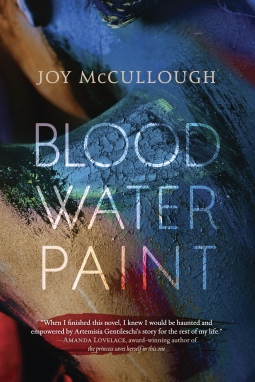
Blood Water Paint, by Joy McCullough, (March 2018, Dutton Books for Young Readers), $17.99, ISBN: 9780735232112

Recommended for readers 13+

It’s an historical fiction type of review day. Blood Water Paint is a stunning story based on true events, told in quiet, powerful verse.

Artemisia Gentileschi is the 17-year-old daughter of Renaissance artist Orazio Gentileschi, but her talents far outweigh his. At the mercy of her cruel father, Artemesia is her father’s assistant, model, and – all too often – the chief artist on the paintings he signs his name to. Her father hires artist Agostino Tassi to work with Artemisia and refine her talents, and she is at first thrilled to have someone recognize her work on its own merit. But when Agostino rapes her, she refuses to play the passive any longer, and brings him to court to keep her honor and reputation intact. As she goes through the grueling judicial process, she remembers the stories of strong women, told to her by her deceased mother, and draws on their strength.

This is feminist historical fiction at its finest. Through Artemisia, we see that women have always had to push back against male society. The very women she paints tell the story: Susanna and her Elders depicts a woman leered at by a group of “respectable” elders; the Biblical heroine Judith, who took matters into her own hands when her husband was murdered by foreign invaders. Artemisia’s relationship with her father is complex: he’s jealous of her talent and berates her, even humiliates her, but when she tells him about her rape and intent to bring Agostino to court, he stands by her – even though he knows, and tells her, that Agostino will not be the one on trial. It will be Artemisia. Sound familiar? Sound like it could be taken from the news this week? Not much has changed.

Artemisia persists, and in that persistence, she empowers every person to pick up this book. She persists in her artwork, and she persists in bringing her attacker to justice. It may not be a justice that suits the crime – sound familiar? – but she accomplishes what most women of the time would never be able to. And this is a true story: Bustle has a brilliant article on the real-life Artemisia, and how author Joy McCullough discovered her thanks to Margaret Atwood.

This book is captivating; a powerful combination of verse and prose that will spark readers’ emotions and start discussions. Blood Water Paint examines issues that are all too relevant today – the perception of women and believing abused women who come forward – and is ultimately an empowering story of a young woman who takes her power back. Put this on your shelves and make sure your teens know about it.

Blood Water Paint has starred reviews from Kirkus, School Library Journal, Booklist, Shelf Awareness, and Publisher’s Weekly.

Posted in Fiction, Historical Fiction, Middle Grade, Realistic Fiction, Tween Reads

Social Justice, Union Organizing, Dairy Wars, and an Orphan Band!

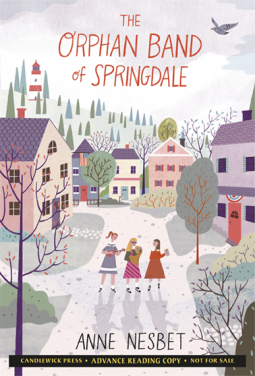
The Orphan Band of Springdale, by Anne Nesbet, (Apr. 2018, Candlewick Press), $18.99, ISBN: 9780763688042

Recommended for readers 8-12

It’s 1941, and things are tense in the U.S. as the world is at war in Europe. Eleven-year-old Gusta is on the run with her father, a German labor organizer, heading toward Maine to stay with her grandmother, when her father disappears. Gusta shows up on her grandmother’s doorstep with the clothes on her back and her beloved French horn. Her grandmother and aunt, who run an orphanage, take her in, and Gusta starts adjusting to life in a place very different from New York. American nationalism runs rampant in Maine, and Gusta’s last name and status as a newcomer brings some suspicion with it, as does her talk about unions and workers’ rights. Her uncle, a mill-worker whose hand was mangled at the factory, can’t work, so Gusta takes it upon herself to approach the owner of the mill to ask him to consider helping with her uncle’s bills. What Gusta doesn’t realize is that her desire to do the right thing puts her at odds with the mill owner, who has a history of his own with her family.

There is such rich and relevant storytelling here. Gusta is a wonderfully realized character with a strong background in social justice: a background that makes her an outsider in her own country. She comes to Small Town America during a time when there of alien registration drives (it really happened) and extreme patriotism; when something as innocuous as a last name aroused suspicion. Gusta is hyper-aware of injustice and determined to do what’s right, whether it’s bringing union reps to her town or point-blank asking for compensation for her uncle’s work-related injury. It’s her unflinching sense of right and wrong that puts her at odds in her community – and her father’s reputation certainly doesn’t help. Thank goodness her tough but loving grandmother is there to lean on. The Orphan Band of Springdale moves at a good pace, has believable characters in relatable situations, and readers can easily draw parallels between 1941 and today.

An author’s note reveals the very personal connection between the author and Gusta’s story. Readers can download a discussion guide and author’s notes from Candlewick’s website. The Orphan Band of Springdale has starred reviews from Publisher’s Weekly and the Bulletin of the Center for Chidren’s Books.


Posted in Middle Grade, Non-fiction, Teen, Tween Reads

To Explore Strange New Worlds…

Pop quiz! We know that outer space is still largely unexplored, but did you know that we’ve explored less than five percent of the world’s oceans? There are some great new books on space and sea exploration for middle graders to dive into (see what I did there?). Read on!
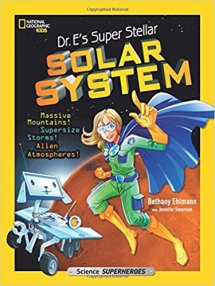
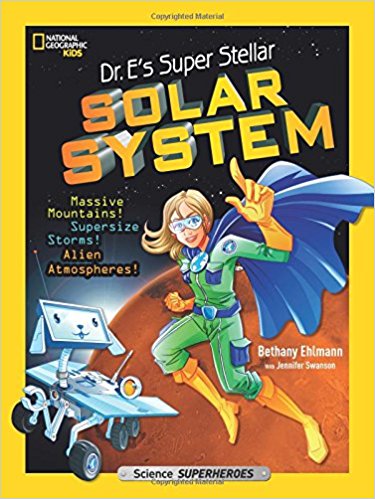
Dr. E’s Super Stellar Solar System, by Bethany Ehlmann with Jennifer Swanson, (Jan. 2018, National Geographic Kids), $12.99, ISBN: 978-1-4263-2798-8

Recommended for readers 8-12

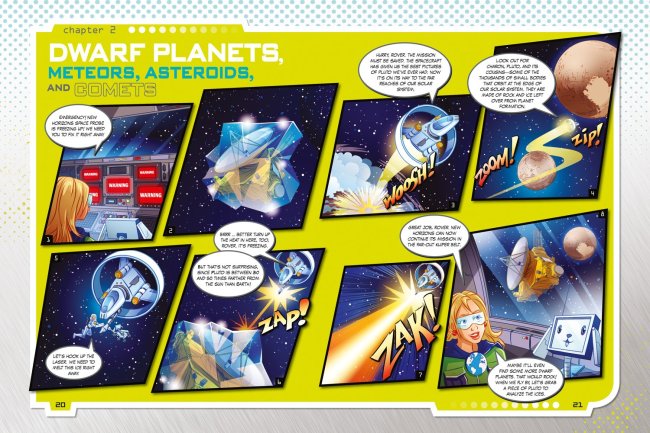
Planetary geologist Dr. E (Bethany Ehlmann) and her sidekick, Rover, take readers on a trip around the universe, filled with activities, photos, facts, and comics. Readers will learn about space exploration and how our big blue dot fits in with our cosmic neighbors: who else has volcanoes and sand dunes; how plate tectonics work; how craters are formed. There’s information about robots and rovers; space exploration and technology; and how learning about space helps us learn more about Earth. Each chapter begins with a 2-page comic spread, following Dr. E and Rover on an adventure related to chapter material. There are scientist profiles throughout the book, thought-provoking questions to generate discussion, and incredible photos. A glossary, list of book and web resources, and index makes this a solid book to have in space collections and a fun gift for kids who love science.
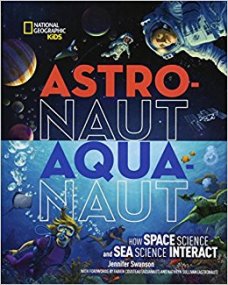
 

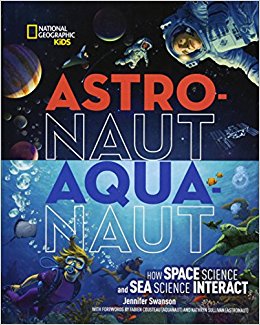
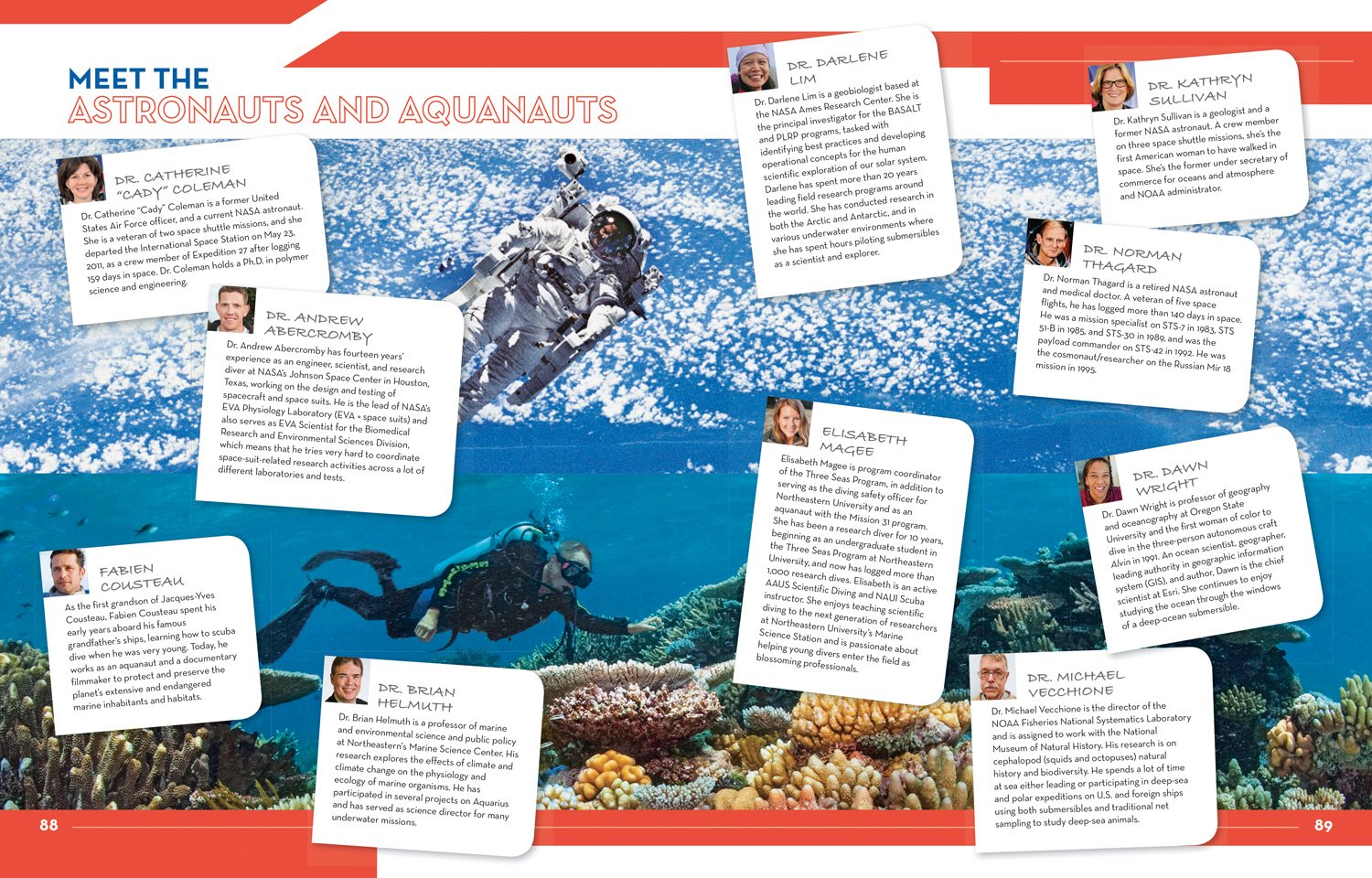
Astronaut-Aquanaut: How Space Science and Sea Science Interact, by Jennifer Swanson, (Jan. 2018, National Geographic Kids), $18.99, ISBN: 978-1-4263-2867-1

Recommended for readers 8-12

What do space and the ocean exploration have in common? SO much. There’s a reason we’re still trying to figure out how to explore both. Extreme pressure, temperatures and climates are all considerations scientists have to make when planning missions up above or far below. Author Jennifer Swanson (she’s co-author on Dr. E’s book, above!) gets a new generation of explorers ready for action with discussions about buoyancy and gravity; the shapes used in space and sea exploration (shape counts!); creating livable habitats; similarities and differences in each form of travel, and more. There’s consideration given to preservation and conservation for both sea and space: we leave a lot of garbage behind, and we need to stop that. Explorer’s Notebook callouts give readers a quick run-down on different topics, like training for a trip and how to create successful living and working environments – ideas that readers can apply to their daily lives while getting ready to be explorers. Activities give readers hands-on opportunities to learn about concepts like docking the International Space Station. There are detailed illustrations and color photos throughout, astronaut and aquanaut profiles, fun facts, resources, a glossary, and an index. NatGeo never disappoints: I love how Jennifer Swanson brings these two areas of exploration together; maybe it will inspire kids to become both astronauts AND aquanauts!


 

The Space Race: How the Cold War Put Humans on the Moon, by Matthew Brenden Wood/Illustrated by Sam Carbaugh, (May 2018, Nomad Press), $17.95, ISBN: 978-1-61930-663-9

Recommended for readers 12-15

The Cold War between the U.S. and Soviet Union led to a race for dominance, and space was best place to push for that dominance. Matthew Brenden’s book, The Space Race, is an interactive chronicle of this pivotal point in history. Beginning with a timeline to give readers background, Brenden takes us from the 1917 Russian Revolution, through World War II (when Russia was our ally) and the Cold War, to July 20, 1969: the date Neil Armstrong and Buzz Aldrin became the first people to walk on the moon.

A  comic strip running throughout the book illustrates and encapsulates the big ideas in the book, adding a little mental break for readers. There are loads of callout boxes, enhanced with QR codes that lead to historical reference and further learning; some topics include McCarthyism, duck-and-cover nuclear war drills, and the first anniversary of the Berlin Wall. Blast Fact callout boxes provide quick facts, and Inquire and Investigate sections provide rich inspiration for projects and research. Questions throughout the text challenge readers to think deeper about the material and would provide a great jumping-off point for book group or class discussions, and Vocab Lab sections offer new words to learn, all defined in the glossary at the end of the book. There are black-and-white and color photos throughout, providing a strong connection to history. Thankfully, there’s a metric conversion table, since science is metric and I’m not; there are additional resources, source notes, and an index.

I love Nomad Press’ books; there are so many entry points for students in each book. This one is a valuable reference for Science or History: in fact, The Space Race is one in a set of four Nomad books exploring great events of the 20th Century (others include Globalization: Why We Care About Faraway Events; The Vietnam War; and World War II: From the Rise of the Nazi Party to the Dropping of the Atomic Bomb).

The Space Race skews slightly older than the NatGeo books above: Nomad recommends this one for ages 12-15, but I think it can go a year or two younger, especially in my children’s room, where it will see more circ than in our teen section. Your library’s mileage, and your kids’ reading interests may vary. It’s a Guided Reading level Z, which can go as young as 9; I’d suggest at least 10 or 11.


Posted in Animal Fiction, picture books, Preschool Reads

Dormouse is afraid to sleep alone… do you have space for him?

Dormouse and His Seven Beds, by Susanna Isern/Illustrated by Marco Somà, (April 2018, NubeOcho), $16.95, ISBN: 978-84-946926-6-6

Recommended for readers 3-6

Green Forest is a pretty quiet, uneventful place until the morning that Rabbit wakes up to discover Dormouse is sleeping in his carrot box. Dormouse apologizes, and says he couldn’t sleep, so he decided to try a new bed. This quickly becomes a habit: Dormouse tries out Robin’s tie drawer, Deer’s antlers, Tortoise’s glasses case, Mouse’s cuckoo clock, and Squirrel’s music box! The animals have a talk with Dormouse: this has to stop; he’s giving everyone a fright! Dormouse disappears the next day, worrying his neighbors. When they start a search, they discover him in Gray Forest, in Wolf’s sock! After a quick rescue, they discover the reasoning behind Dormouse’s wandering: he doesn’t want to sleep alone.

This story is perfect for preschoolers who may have similar fears, and the parents and caregivers who wake up to discover an errant foot or arm lodged in a hip, the small of a back, or a neck. (Speaking from experience.) Dormouse’s desire for company overrides his sense of propriety, leading him to sneak into his neighbors’ homes to be near someone at night; understandably, it’s a little nerve-wracking to wake up with someone unexpected in one’s home, and the group confronts Dormouse, not giving him a chance to explain himself. Parents will understand the guilt the animal friends feel when Dormouse disappears, and both parents and caregivers will appreciate the arrangement everyone comes to for future sleepovers. A sweet addition at the tale’s end gives Dormouse a chance to pay it forward.

Marco Somà’s illustration is just beautiful, with small details that will keep readers noticing something new with every read; from the carrot wallpaper in Rabbit’s home, to the owl’s face built into Owl’s home, and beyond. The blue tinge throughout the artwork lends a peaceful vibe to the story, making this a loving bedtime read, perfect for snuggling with the kiddos before they fall asleep in their own beds (or at least, start out there).

Released in 2017 in Spanish (978-84-946926-5-9), Dormouse and His Seven Beds is part of nubeOCHO’s nubeclassics line, and reads like a classic fable should.

Posted in Fiction, Fiction, Graphic Novels, Intermediate, Middle Grade, Tween Reads

Cuentos populares de latinoamérica en español e ingles!


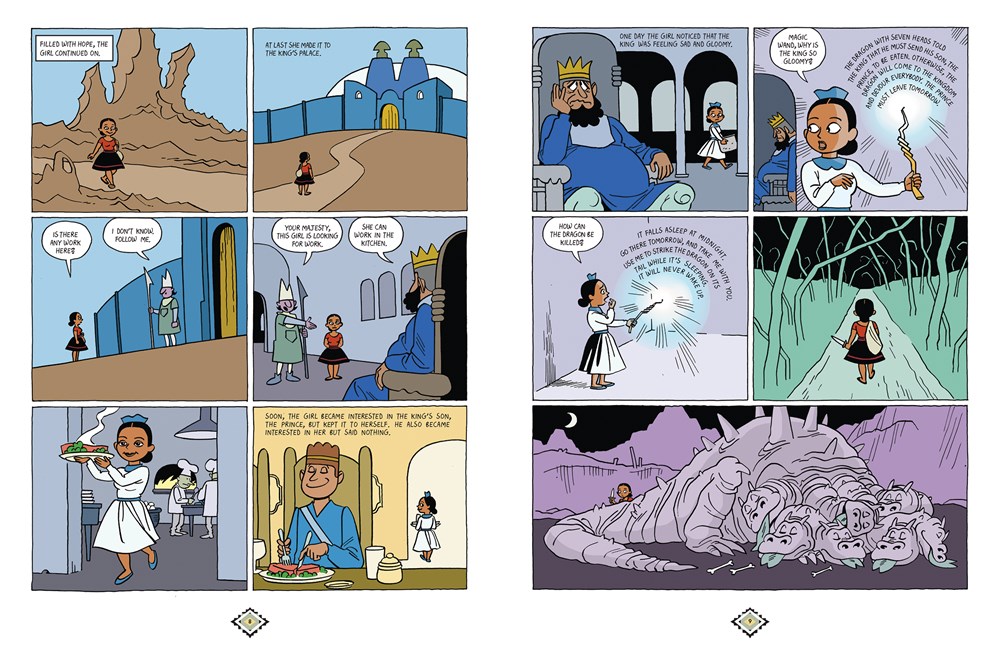
The Dragon Slayer: Folktales from Latin America/La matadragones: cuentos de latinoamérica, by Jaime Hernandez, (April 2018, TOON Graphics), $16.95, ISBN: 9781943145287 (English)/9781943145300 (Spanish)

Recommended for readers 6+

TOON Graphics has a great collection of folktales from Latin America, simultaneously published in English and Spanish. Three tales starring intelligent female characters make up this volume; as with most folk and fairy tales, each one imparts its own wisdom using the story as a vehicle. The title tale, The Dragon Slayer, sees a young woman betrayed by her two horrible sisters; an act of kindness brings a boon in the form of a magic wand, which leads her to employment at a king’s palace, where she falls in love with a prince, who she must save. Twice. It’s got the best parts of a fairy tale: dragons, magic wands and rings, ogres, and a happily ever after; it’s got a strong, smart young woman who can stand toe to toe with mythical monsters and real-life intolerance, and she saves the day AND gets the boy.

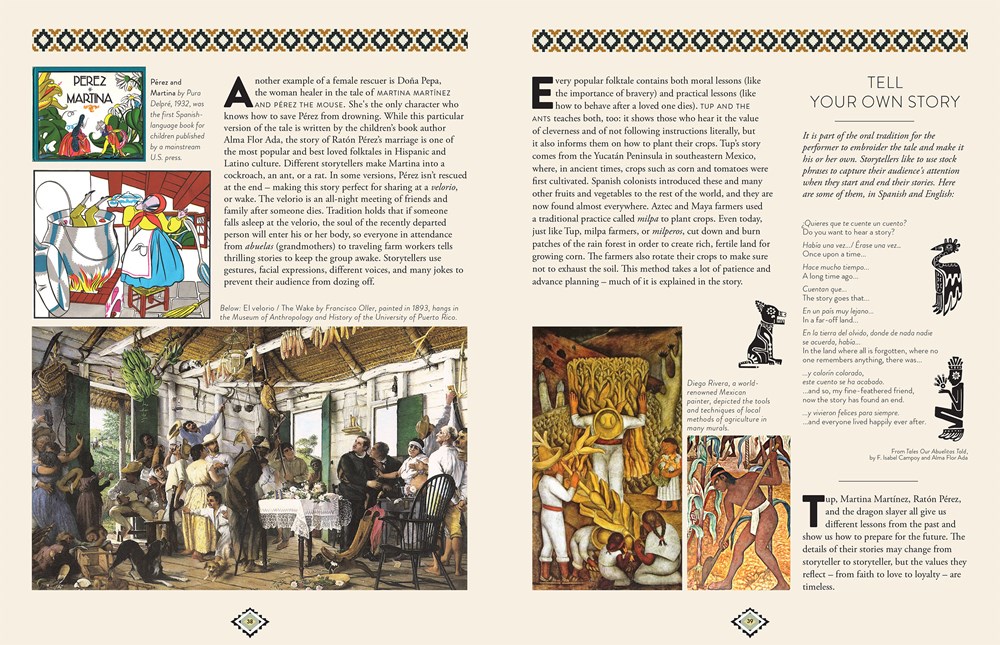
Martina Martinez and Pérez the Mouse stars Ratoncito Pérez, a popular character in Latinx folktales. This version, told by Alma Flor Ada, comes from another book, Tales Our Abuelitas Told”, and is the story of a pretty but shallow young woman, Martina, who marries Pérez after turning down other animal suitors (Martina often shows up as a cockroach in other versions of the tale). When she runs to the store to get salt for a soup, Pérez tries to sneak a taste of onion and falls into the pot! Martina discovers him in the pot and runs sobbing around the village, where birds, a fountain, and a young girl all grieve for her in various ways. It takes a wise old woman to discover that no one has actually tried to save Pérez , and rushes over to put things right again. Always respect your elders, kids! And seriously, use some common sense and try to keep your head in a situation.

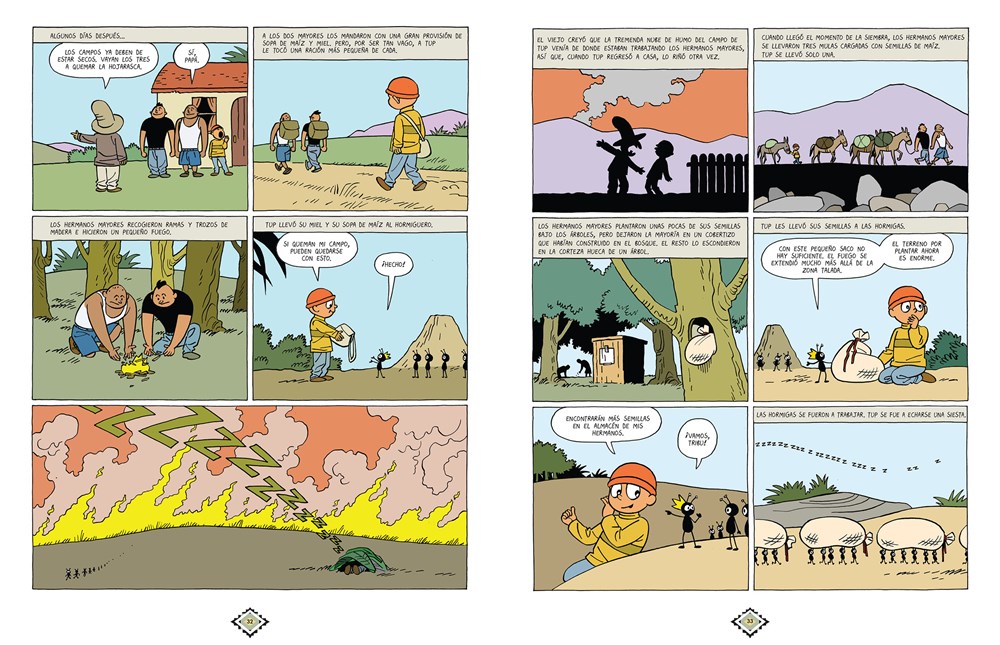
Tup and the Ants is a fun little story about the power of being smart and lazy. Tup is the youngest and laziest of three brothers, who marry three sisters. Tup’s in-laws are not thrilled with their lazy son-in-law, so when they send the three brothers out to clear the land for cornfields, they send Tup with less food to show their displeasure. Doesn’t matter: Tup finds a place to snooze, ends up meeeting a group of ants, and trades his food for their labor. This is a sweet little partnership, and pays off as the two not-so-bright brothers are hopelessly out of their league in clearing and planting a cornfield, and Tup builds his own little empire by continuing to trade food for labor. The moral of the story may be a bit ambiguous, since the lazy guy gets the accolades, but there is something to be said for knowing how to get the job done. And, as a later explanation points out, it’s a story that teaches listeners and readers about planning and undertaking a planting season.

A foreword from F. Isabel Campoy explains the power of folktales and the Latin American tradition, and features beautiful Aztec and Mayan pictograms and popular animals, like jaguars, monkeys, and dogs. An afterword goes into more detail about the origins of these three folktales, with photos and illustrations. A section on the oral tradition invites readers to personalize and create their own tales, with prompts to help them along. A strong bibliograpy includes books and online resources that will strengthen diverse folk and fairy tale collections and provide nice online resources for further research.

I absolutely love this introduction to Latin American folktales, and can only hope there’s a volume 2 somewhere down the line. This is such a great addition to folk and fairy tale collections and diverse, culturally rich collections. This would be great for a storytime for school-age kids – it’s such a fun read! – and a storytelling program.

Posted in Fantasy, Fiction, Middle Grade, Tween Reads

What memories does YOUR door hold?

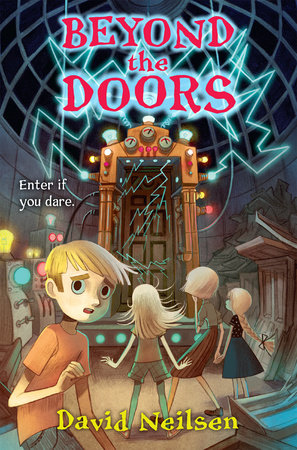
Beyond the Doors, by David Neilsen, (Aug. 2017, Crown), $16.99, ISBN: 978-1-101-93582-8

Recommended for readers 8-13

Four siblings have the weirdest, worst day of their lives when they’re pulled out of class to learn that their father is in a coma after a fire consumed their home. As their mother disappeared years ago, there’s a sobbing social worker, ready to split them up to horrors unknown, until a mystery aunt is located. Janice, Zack, Sydney, and Alexa Rothbaum are quickly shuttled off to this mysterious, scatterbrained aunt. Once the kids start exploring and settling in, they learn the bizarre secret behind their aunt’s fortress home: she’s got a machine that allows her to use doors to access the memories contained within them, and she’s searching for her father: their grandfather.

Remember Monsters, Inc? How the Monsters would go through different doors to reach different kids’ rooms? Think of it like that, but instead of using the doors to get into kids’ rooms, you stepped into the memories of the person most identified with the door. If you stepped through the door to my room from 1986, for instance, you’d see me, sprawled on my bed reading a copy of Bop! Magazine, in a room papered with Duran Duran posters, and talking to my best friend on the phone. The memories are sepia-tinged, and while you can interact to a degree with the memories, too much interaction has… consequences.

It’s a madcap adventure, with a wacky aunt, an off-the-walls social worker with a penchant for the melodramatic, and loads of family secrets to discover, but character development and world-building aren’t as rich as I’d have enjoyed. There’s quite a bit of humor and a climactic battle that’s both gruesome and thrilling, and readers will never look at a bowl of Cheerios without groaning again. Black and white illustrations keep readers invested in the story. Beyond the Doors will appeal to Series of Unfortunate Events and Mysterious Benedict Society fans; display and booktalk with The Problim Children for some fun discussions about weird siblings and families. Ask kids what doors they would like to wander into – or what their doors would have to say. It’s a great creative writing or art exercise!

Posted in Adventure, Fiction, Middle Grade, Science Fiction, Tween Reads

Art takes on a new dimension in The Maker

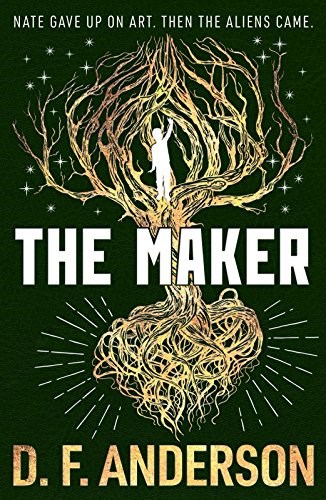
The Maker, by D.F. Anderson, (Jan. 2018, Underdog Books), $14.95, ISBN: 9780991800346

Recommended for readers 9-13

Thirteen-year-old Nate loves to draw. It’s one of his lasting connections with his father, who’s been gone for months, with no word. His mother’s boyfriend, Ted, goes at Nate whenever he gets a chance, insulting his artwork and attacking his grades; his mother is no comfort. Things change rapidly for Nate when a group of aliens show up at his window one night, telling him that he and his father are Makers: artists with the talent to bring their drawings to life. Nate’s father hasn’t abandoned them, he’s been kidnapped, and the aliens from the planet Meer are relying on Nate to help them save his father and the other kidnapped Makers before a cruel alien race wipes them out – and then heads for Earth.

The Maker has a great concept: using living beings as 3-D printers, when you think about it. By channeling their talents, Makers can give life to their drawings to create starships, cities… the sky’s the limit. The Makers connect with an energy source, mica, to give shape to their ideas; they can collaborate on large projects, or work individually to create small, detailed pieces. Readers will get into the sci-fi adventure story and relate to Nate, a kid who’s been put down to the point where he doesn’t believe in his own talent until put to the test – and then exceeds his wildest dreams. The evil parent/boyfriend situation is addressed in a neatly wrapped-up plotline. There are warring alien races, planet-eating machines to stop, and strong relationships that sci-fi and fantasy fans will enjoy, plus some moments of humor, including an evil alien who can be tortured… by pulling on his toe. Made you smile!

Add this to collections where you have sci-fi readers. Display this with some maker titles, and have a booktalk ready when kids come over and ask why it’s there.


Posted in Fantasy, Fiction, Middle Grade, Tween Reads

Aru Shah and the End of Time: Rick Riordan Presents with a strong debut!

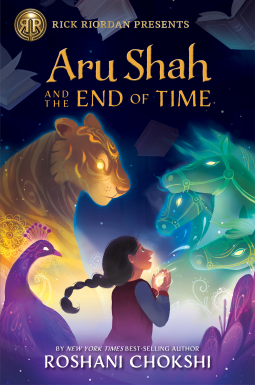
Aru Shah and the End of Time, by Roshani Chokshi, (March 2018, Disney Book Group), $16.99, ISBN: 9781368012355

Recommended for readers 8-12

Rick Riordan introduces his new imprint with Aru Shah and the End of Time, author Roshani Chokshi’s adventure through Indian mythology.

Aru Shah is a 12-year-old Indian girl who has a hard time fitting in at school, so she… embellishes the truth… to keep up with her wealthy classmates. The thing is, they all know she lies, and she’s become a target of derision over it. She lives with her archaeologist mother in the Museum of Ancient Indian Art and Culture, and tells her friends that there’s a cursed lamp in the exhibits. Naturally, they show up, demanding her to prove it. Ignoring her mother’s advice to never touch the lamp, Aru lights it and unwittingly releases The Sleeper – an ancient demon – who’s going to awaken the Shiva, the god of destruction, if Aru can’t make things right in time. After discovering that Aru is the reincarnation of one of the legendary heroes, the Pandava brothers, she sets off on a mythological adventure where she’ll learn more about herself and her mother than she could ever have imagined.


I was so excited to read Aru Shah, especially after finishing Sayantani Dasgupta’s brilliant The Serpent’s Secret a couple of weeks ago. Indian mythology is an area I’ve never read much about, and it’s time that was remedied. Aru is on a quest to save her family and friends, and she’s not alone: she’s got a Pandava sister she meets on the way, and a disgraced god-turned-pigeon to guide her as she seeks out the weapons that will stop the Seeker. There’s great world-building, with humor and a sense of wonder as Aru meets gods and goddesses she thought existed only in myth; the character development is great for people unfamiliar with Indian mythology, as each god, goddess, and demon gets enough of an explanation to keep readers in the story. There’s a glossary at the end to help readers with the origin tales of Indian myths featured in the book.

You know who to give this to: the Percy Jackson/Kane Chronicles/Magnus Chase/Riordan readers who love world mythology; the kids who read Serpent’s Secret and wanted more? Now you can give them Aru Shah and tell them that Rick Riordan Presents has Mayan and Korean mythology coming up next. Aru Shah and the End of Time has starred reviews from School Library Journal, Publisher’s Weekly, and Kirkus.

Posted in Fantasy, Fiction, Humor, Middle Grade, Tween Reads

The Problim Children: Seven kids, seven days of the week, and an age-old mystery

The Problim Children, by Natalie Lloyd/Illustrated by Julia Sarda, (Jan. 2018, Katherine Tegen Books), $16.99, ISBN: 9780062428202

Recommended for readers 8-12

The Problim Children is the first in a new middle grade series about seven… different siblings, each born on a different day of the week, and their adventures. We have Mona, Monday’s child, who may be fair of face, but she’s a bit macabre… Toot, Tuesday’s toddler, who has a catalog of farts for all occasions; Wendell and Thea, twins born on Wednesday and Thursday, who spend all of their time together; Friday’s child, Frida, speaks in rhyme; Sal, Saturday’s child, loves to work in his garden; and Sundae is the eternal optimist. Their parents are away, and the Problims manage to blow up their bungalow in the Swampy Woods, necessitating a move to their Grandpa Problim’s abandoned mansion in Lost Cove. The only problem? The Problims have a history with Lost Cove, and neighborhood busybody Desdemona O’pinion is determined to keep them out at all costs.

Are the Problims magic? Maybe. Are they a family with secrets? Definitely! There’s a history between the O’pinions and the Problims, and the kids get caught up in the shenanigans – while planning plenty of their own. The Problim Children is funny enough – Toot’s ability to communicate solely by fart will make this a home-run with some readers – and readers will love the idea of being left to their own devices as their parents travel the world for work. There are circus spiders, a pet pig, an intriguing mystery, and a villainess who’s right up there with the best of the mustache-twirlers. It’s a little over the top at times, but it’s fun and silly and readers who like a lighter Lemony Snicket will like this one. The Problim Children received a starred review from Booklist.