Category: Tween Reads
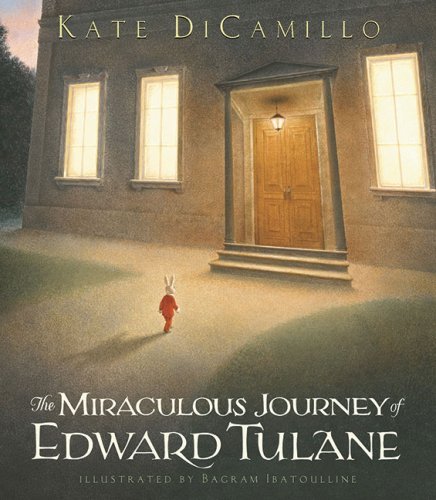
Book Review: The Miraculous Journey of Edward Tulane, by Kate DiCamillo (Candlewick Press, 2009)
Edward Tulane is a stunning china rabbit with real fur ears and wires enabling movement in his arms and legs, and a fashionable silk wardrobe. He is the apple of his owner’s eye, 10-year old Abilene. Abilene changes his outfits daily annd dotes on him. He lives a comfortable life and knows it, but he’s cold and keeps Abilene at a distance, never allowing himself to love her as she loves him; her purpose in his life is to take care of him and coddle him.
Book Review: Larklight: A Rousing Tale of Dauntless Pluck in the Farthest Reaches of Space, by Philip Reeve (Bloomsbury, 2007)
I appreciated Reeve’s strong male and female characters. At first glance , Myrtle appears solely as Art’s antagonist for Art but emerges as a strong, clever character – it’s interesting to see her character evolve. Ssil, one of Jack Havoc’s alien crew, has no idea where her origins lie, providing a sense of mystery and pathos. She has only the family she creates around her, but longs to know who she is. While scientific men are assumed to be the only ones capable of performing the “chemical wedding” that propels aetherships into space, Ssil performs it with ease – indeed, she is the only member of Jack’s crew who can do it.
There are two sequels to Larklight, also by Reeve: Starcross and Mothstorm, that I expect I shall be picking up shortly. The film rights for Larklight have been bought and a film is due out in 2013.
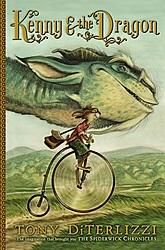
Book Review: Kenny and the Dragon, by Tony DiTerlizzi (Simon & Schuster Books for Young Readers, 2008)
Recommended for ages 9-12
This adorable book teaches children the power of not judging someone (or something) on gossip, and illustrates the potentially destructive power of gossip.
Kenny is a young, bookish rabbit. His parents are farmers, but he’s always got his nose in a book. His only real friend at the book’s beginning is the old badger, George, who runs the bookshop in the nearby village. Kenny visits George to play chess and read in the bookshop, and George often lets Kenny borrow books to take home and read.
One day, Kenny’s father comes home with the news that there is a dragon in his meadow. Kenny runs to his bookshelf and grabs his bestiary, on loan from George, and learns that dragons are vicious, fire-breathing, maiden-devouring beasts. Creating a suit of armor for himself fashioned from pots and pans, he sets out to take a look at the dragon, who ends up being a perfect gentleman named Grahame (“like the cracker, but with an e on the end”) and quickly dispels all myths set forth in the bestiary – in fact, he asks Kenny if he can borrow it, because he loves reading good fiction. Grahame is something of an epicure, enjoying good poetry, music, and food. He spent years trapped in the earth after falling through a fault line, but he never saw the point in chasing maidens and killing knights – his fellow dragons died out because of their taste for terror, and he just wants to enjoy life.
Kenny introduces Grahame to his parents, who also include the dragon in such family activities as picnic dinners where they cook delicious meals just for him. Kenny and Grahame’s friendship is put at risk when other villagers, fearful of the rumored dragon in the land, call for the king to take action. The king calls his retired dragonslayer into service – Kenny’s friend, George Badger. Kenny’s two best friends may have to do combat because no one bothers to learn the truth about dragons – what can Kenny do to save the day?
Tony DiTerlizzi is one half of the duo behind The Spiderwick Chronicles. Kenny and the Dragon, based on the 1898 story The Reluctant Dragon by Kenneth Grahame, introduces readers to a new group of memorable characters as he peppers tributes to the original story throughout the book. Aside from the tribute to Kenneth Grahame, he names George the bookstore owner/dragonslayer after St. George, who features in the Grahame story; other characters from the original story also find a place in DiTerlizzi’s world.
Placing the story in a fantastic, anthropomorphic world is a wonderful way of bringing this story to a new audience. DiTerlizzi expands on the original tale as a way of getting big ideas across to little people – the town mob, pitchforks and all, is riled up by the mere presence of a dragon, but no one bothers to try and get to know him – all they have is rumor to go on, and that’s good enough for them.
DiTerlizzi illustrates Kenny and the Dragon in the same line sketch format as Spiderwick, bringing Grahame, Kenny, and the rest of their world to life. The sketches bring old fairy tale stories to mind.
DiTerlizzi’s website, Never Abandon Imagination, provides more information about his books and includes links to his artwork, blog and social media connections (YouTube, Wikipedia, Facebook).
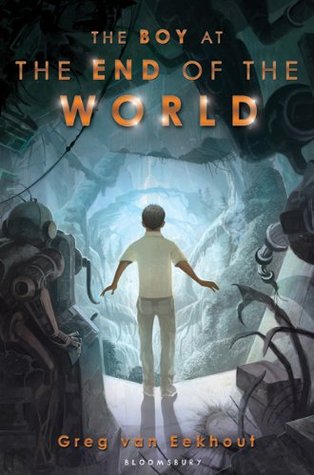
Book Review: The Boy at the End of the World, by Greg Van Eekhout (Bloomsbury Children’s Books, 2011)
Recommended for ages 9-12
A preteen boy (we are led to guess), wakes up in a pod in a devastated shelter. Destruction lies all around him; he sees being similar to himself lying dead in pods similar to his. The only other functional being is a robot, who calls out to him. The boy runs, but the robot catches up to him and reveals the boy’s name, Fisher, to him. Fisher learns that he is the only survivor of the human race.
It’s the usual post-apocalyptic story: Humans ruined the earth and nature took back her planet. Humans genetically engineered animals and more humans, putting them in gel-filled pods, with robots to oversee their care, until the time when conditions allowed for them to awake and rebuild society. The humans were individually programmed with specific survival skills to help create communities. Fisher is programmed to be a fisherman. Click, the name he gives his robot companion, tells Fisher that he has been tasked with helping Fisher “continue existing”, and the two set off to search for more humans in another Ark – the facilities were humans and animals were engineered and kept in hibernation.
Born a blank slate, Fisher learns and adapts through the story’s progression, developing not only intelligence outside of his initial programming but emotional depth. The characters they meet are not cute and cuddly woodland creatures: they’re often chilling. There are groundhogs who blame humanity for the planet’s destruction and hold a grudge; there is a robot who takes his task of preserving the human race permanently – these characters bring a new dimension to the story of a boy and his robot. This is a survivalist tale.
It is difficult to write a postapocalyptic tale without sounding like hundreds of similar books on the market, and the “humans and technology bad, nature good” call to action beats the reader over the head throughout the book. Humans bring the planet to the brink of environmental collapse, so they leave the rest of the planet to deal with it while they go into hiding until the coast is clear. The technology that humans created to save them ultimately turns on them and brings the race to the point of near-extinction, further painting us as hapless ne’er do wells.
That said, the YA market in post-apocalyptic fiction isn’t as saturated as the adult market is yet, so perhaps a younger audience will read this story through different eyes. That said, this is a generation that has been fed this storyline since they were babies: think of Happy Feet, a movie that deceptively sold us a cute story about a penguin who didn’t fit in, and gave us a Greenpeace horror movie halfway through the picture. Think of Wall-E, where we were drowning our society in junk, so we had to go into space to get away from it.
I don’t want it to sound like I didn’t like this book, because I did. I think older middle grade readers, starting with 10-11 year olds, will see Fisher as a hero they can identify with as a young boy who needs to learn to survive, and whose robot companion acts as a friend and parent. Kids can also relate to the marriage of technology and environmental awareness contained in the book’s message.
Greg Van Eekhout knows how to write for kids – he has a Masters in Education and spent ten years developing online curricula for K-12 and college students. He is kid- and teacher-accessible, offering teachers tips on having author events at schools (and libraries), and providing his e-mail address to be contacted about school visits. He offers two presentations that he follows in his appearances. His website is geared toward grownups who are interested in reading his reviews, about his books, and where he’ll be next.
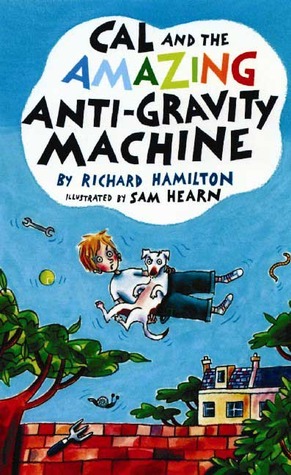
Book Review: Cal and the Amazing Anti-Gravity Machine, by Richard Hamilton (illustrated by Sam Hearn) (Bloomsbury, 2006)
Richard Hamilton and Sam Hearn are an British writer-illustrator team who have worked on four books together.
Book Review: Dragon Slippers by Jessica Day George (Bloomsbury, 2008)
This is a princess-y book for girl who don’t normally like princess book. Creel, the main character, is not a princess, but she is independent and smart; a rags-to-riches character we’ve started expecting from fantasy heroines.
Amalia’s desire for the shoes has nothing to do with being fashionable, and her engagement to prince Milun is a sham – her father’s kingdom wants to take over Feravel, and the slippers give her the power to control the dragons. Creel must join forces with the king’s younger son, Luka, to find a way to break through to the dragons and bring peace to the land.
Book Review: The Guardians of Ga’Hoole Book One: The Capture by Kathryn Lasky (Scholastic, June 2003)
Recommended for ages 9-12
St. Aggie’s, as the Academy is referred to, is a thinly veiled deprogramming center/work camp for owls where they are subjected to sleep deprivation and corporal punishment in order to break them down and create a blank slate upon which the St. Aggie’s owls can build and create an army for owl domination. By sticking together and focusing on their families, each other, and the mythical stories of the Ga’Hoole, the guardians of owlkind, Soren and Gylfie defy the odds and retain their individuality. They ultimately escape St. Aggie’s with some help on the inside and head out in search of the Great Ga’Hoole Tree, where they hope to find help to save the owls from the St. Aggie’s army. They meet two other escapees, Digger and Twilight, who join them in their search.
Kathryn Lasky has written over 100 books for children and has a great website that offers video messages for her fans, a section detailing her awards and information about her upcoming books. Naturally, there is a section devoted to the Guardians series, and she even features fan art dedicated to the series. I really liked that Lasky, who exhaustively researches both her fiction and nonfiction writing, shares her research and links for books she’s working on.
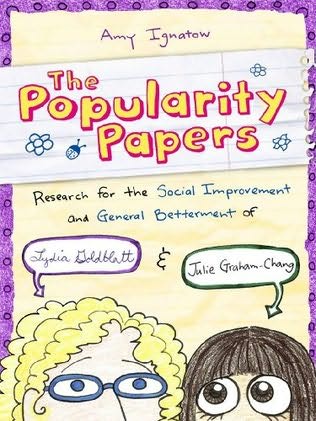
Book Review: The Popularity Papers: Research for the Social Improvement and General Betterment of Lydia Goldblatt & Julie Graham-Chang, by Amy Ignatow (Amulet Books, 2010)
The Popularity Papers is the project (“Learn/Improve”) undertaken by fifth graders Lydia and Julie, who want to be popular by the time they reach middle school. Deciding to observe the most popular girls in the school to figure out what makes them popular, imitate them and perhaps even infiltrate the group, Lydia and Julie record their notes, observations, conversations with family and friends, and drawings to tell the story of their social climb. On the way up, they learn that being popular isn’t always what it’s cracked up to be, that being popular means different thing to different people – including who you like and who you’re not supposed to like – and Lydia discovers what can happen when the quest for popularity goes to your head.
Book Review: Foiled, by Jane Yolen; illustrated by Mike Cavallaro (First Second, 2010)
Recommended for ages 12+
Foiled leaves the reader hungry for a second helping. Aliera, Avery and Caroline are all vibrant, interesting characters, and even when Aliera is at her most guarded, the reader wants to get behind her fencing armor and find out what makes her tick. Older ‘tween and young teen readers alike will enjoy the blending of fantasy into a reality-based setting, and teachers could use this novel in a fairy tale/mythology unit for older readers. The artwork never talks down to the book’s audience, portraying kids as kids rather than caricatures; the fantasy creatures are brightly colored and drawn straight from a vivid imagination and the fencing sketches are dynamic.
Jane Yolen’s website contains information for both students and teachers, an archive of awards the author has received, book trailers, and a link to her blog.