Posted in Fantasy, Fiction, Graphic Novels, Tween Reads

Book Review: Rapunzel’s Revenge, by Shannon & Dean Hale (illustrated by Nathan Hale) (Bloomsbury, 2008)

Recommended for ages 9-12

 In YA and kids’ lit powerhouse couple Shannon and Dean Hale’s retelling of the Rapunzel tale, “Punzie”, as her friend Calamity Jack calls her, isn’t sitting around waiting for some prince to rescue her – she’s taking the matter into her own… hair.

 Rapunzel grows up in the care of Mother Gothel, an evil woman with growth magic that she wields to keep the people of the surrounding lands under her control and to bleed them for all of their money. If they cannot pay her taxes, she dries up their land. She enslaves citizens to work in her mines. Rapunzel believes Mother Gothel is her own mother until one day, she ventures outside to the palace wall and meets her real mother. Furious with Gothel’s lies and cruelty, she demands answers from Gothel; Gothel responds by having Rapunzel taken to a forest and enclosed in a tree for four years. Her growth magic assures that Rapunzel has food to eat and small creature comforts; the growth magic also extends to Rapunzel’s famous hair, which grows and grows. Gothel visits Rapunzel every year to see if she will agree to live by Gothel’s ways as her daughter, but when Rapunzel refuses for the last time, she uses her growth magic to seal Rapunzel up in the tree for good. Luckily for Rapunzel, one of the palace guards taught her how to tie a good lasso. She manages to escape and meets Jack, a young man on the run whose only possessions are the clothes on his back, a goose named Goldy, and a magic bean… who could Jack be running from in this fractured fairy tale? Will Jack be able to help Rapunzel brave the arid lands and get her back to Gothel’s palace so she can free her mother and end Gothel’s reign of terror?

 This book is great fun for boys and girls alike. It is a graphic novel that draws on two favorite fairy tales – Rapunzel and Jack and the Beanstalk – with a modern twist that will appeal to kids who are on that cusp of being teenagers, but still appreciate the comfort of a good fairy tale. Rapunzel is a strong female character who ends up saving her friend Jack as often as he saves her, and Jack is a funny charmer who finds himself feeling very awkward around the beautiful Rapunzel. It’s a classic good versus evil tale with action and snappy banter, magic and a strong sense of right, wrong, and justice.

 Shannon Hale is the Newbery Award-winning author (for Princess Academy) who writes for ‘tweens, teens, and adults. Dean Hale, her husband, writes children’s books and has written both Rapunzel’s Revenge and its sequel, Calamity Jack, with Ms. Hale. Her blog offers links to information about her books, events and games. She also offers a list of favorite books for both children and adults, including some recommendations by her husband.

Posted in History, Non-Fiction, Tween Reads, Women's History

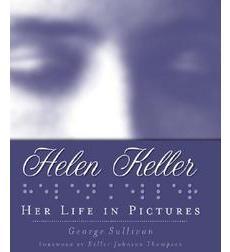
Book Review: Helen Keller: Her Life in Pictures (Scholastic, 2007)

Recommended for ages 8-12

As a little girl, I was captivated by Helen Keller’s life story. One can only imagine Helen Keller’s struggles, but even more amazing and inspirational are her triumphs: graduating college with honors at a time when women were still fighting for the right to vote. Learning to lip read while being blind and deaf, relying only on touch to communicate with the outside world. Becoming a political and social activist at a time when women were supposed to be seen and not heard. She was an amazing woman who was surrounded by amazing women; first, her beloved teacher Annie Sullivan and later Polly Thomson, and when I saw this book in my local library, I snatched it up.

I was not disappointed. Helen Keller: Her Life in Pictures is a gorgeous book filled with photos of Helen throughout her life. There are childhood pictures of her and pictures of her with Annie Sullivan; pictures throughout her college career at Radcliffe, and pictures of her with the many public officials she met throughout her life. Always mindful of her appearance so people would not look at her and see her handicap first, she is always dressed beautifully and perpetually smiling. There are some candid photos, including shots of her with her pets and even a shot of Helen, Annie, and Annie’s husband, John Macy.

Keller’s great-grandniece Keller Johnson-Thompson writes the foreward where she discusses asking her grandmother questions about her famous relative. Notes at the end of the book provide further reading on Helen Keller, including a link to Ms. Johnson-Thompson’s biography on the American Foundation for the Blind’s home page, where she serves as an Ambassador; there are many links to Helen Keller photographs and artifacts on this page. There is also a link to the Helen Keller birthplace museum.

Posted in Fantasy, Fiction, Graphic Novels, Humor, Tween Reads

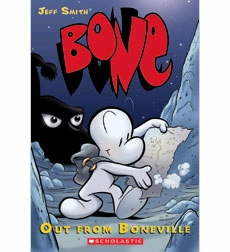
Book Review: Out from Boneville, by Jeff Smith (Scholastic edition, 2005)

Recommended for ages 11-13

Jeff Smith’s Bone was a popular comic book title in the ’90s, winning four Eisner Awards, and three Harvey Awards in 1994. Later on, the book caught on with kids as graphic novels gained more acceptance among educators. Scholastic has taken the 55-issue comic book series and repackaged them into a series of graphic novels. Out from Boneville is the first volume of this series, which follows the adventures of three cousins as they blunder into a fantasy world after being run out of their home, Boneville.

Phoncibile (Phoney for short) Bone is greedy and arrogant, which we are led to believe caused his ouster; Smiley Bone is the laid back one, and Fone Bone, our protagonist, is high-strung but an overall nice guy. Drawn as white humanoid shapes, the Bones resemble Casper with legs. The art is cartoon-like, very tween-friendly, and the banter is light and fun. Even the rat monsters who spend much of the novel trying to eat Fone Bone and seek out Phoney Bone for some dark reason are bumbling and goofy.

Out from Boneville sets up the entire Bone series, so  the storyline leaves a lot of questions unanswered by the end, but they are questions I am willing to pick up another volume to continue the journey.

 For teachers interested in working with graphic novels, Scholastic offers a guide for teachers and librarians (with mentions of Bone). Jeff Smith also maintains a Boneville web page with his touring schedule, his blog, and a section devoted to Bone.

Posted in History, Non-Fiction, Tween Reads, Women's History

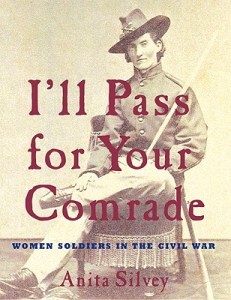
Book Review: I’ll Pass for Your Comrade, by Anita Silvey (Clarion, 2008)

Recommended for ages 9-12

I’ll Pass for Your Comrade is a line taken from a Civil War Ballad, “The Cruel War”; a woman is saying goodbye to her love, leaving to fight, and begs to join him in combat. She offers to “pass for his comrade” – something that, according to the National Archives, at least 250 women did during the Civil War. Many women fought to be with their husbands and fiances. Some women fought for revenge. Some women fought for the thrill of battle. Unfortunately, because they had to keep their stories silent, most of these stories have been lost. I’ll Pass for Your Comrade tells the stories of some of the women who donned men’s uniforms, cut their hair, and went to war.

We hear the words of the women who fought, like Loreta Janeta Velazquez, who wrote about her participation in the Battle of Bull Run as Lieutenant Harry T. Buford. We see photographs of women like Frances Clayton, featured in the book both dressed in her uniform and her dress. We learn about their lives after the War, and how some of them took their secrets to the grave, their families only discovering their truth after death.

The book has black and white photographs and primary documents reprinted throughout, offering students the chance to see history as they read about these women. The author also provides a bibliography for further reading. This would be a strong selection to use during Women’s History Month or during a Civil War unit.

Posted in Fantasy, Fiction, Tween Reads

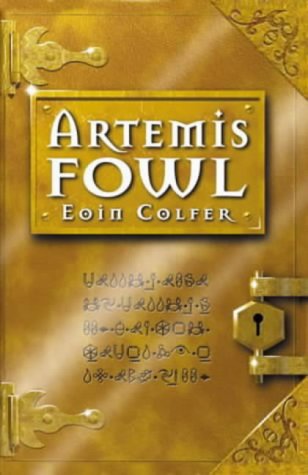
Book Review: Artemis Fowl, by Eoin Colfer (Hyperion, 2002)

Recommended for ages 9-13

When Artemis Fowl was published almost ten years ago, it was hailed as the next Harry Potter type series in terms of kids’ blockbusters. There have been seven novels, plus graphic novels, since, and while it hasn’t reached the Harry Potter level of mania with readers young and old, it is a strong series that has managed to remain on the shelves over the past decade – not something many books can claim these days.

Artemis Fowl the Second is a boy genius and the son of a missing crime lord. To find his father restore his family’s reputation, he needs some help. In this case, “help” means getting a copy of the Rule Book from the Fairy World – because in this world, they are real and they don’t want us to know it – and finding out their secrets to use against them. But now he’s got the attention of the LEPrecon (the Lower Elements Police), and dealing with magic is never predictable.

It took a while for me to warm up to this book. I did not like Artemis, for starters. He is supposed to be an anti-hero, but there was not enough of him to give me a connection; I only thought of him as an annoying kid too smart for his own good for about 3/4 of the book. The LEP characters were somewhat more engaging but they needed some time to hit their stride; when they first appear on the scene, they almost seemed like caricatures in the exaggerated speech and description.

There is a prevalent subplot about how we humans, the Mud People, are destroying the planet. Colfer makes it abundantly clear that The People find humans beneath them and hold them in contempt.

There are plenty of Artemis Fowl websites, incluiding the US and UK websites that provide information about the books, book trailers, and games for visitors. Author Eoin Colfer’s website offers links to author information, information about all of his books, and a message board.

Posted in Fiction, Humor, Middle School, Tween Reads

Book Review: Diary of a Wimpy Kid, by Jeff Kinney (Amulet, 2007)

Recommended for ages 9-12

I am an unabashed fan of the Wimpy Kid series – I’ve read them all am waiting, with my kids, for Cabin Fever, the next book in the series (39 days from today!). My older son had the pleasure of meeting Jeff Kinney at ComicCon a few years ago and he was a very nice guy, autographing his book, mentioning that his son shared the same name as mine, my son and his son shared the same name, and really listening to what my son enjoyed about his book. 

Greg Heffley is a middle school ne’er do well – he’s lazy, he’s selfish, and he can’t figure out what everyone else’s problem is. Despite these qualities, he’s wildly funny, and he does try to do the right thing (he just tends to get a little lost on the way to doing it). He’s a middle schooler, he’s just trying to navigate life and make things easier on himself. Can you blame him?

Diary of a Wimpy Kid is a good book for several reasons, aside from it’s compulsive readability: the characters are well-written and funny, Greg has a clear voice, and this book shows boys and girls alike that keeping a diary – or a journal, whatever you choose to call it – is a good thing. Writing, even to a slacker kid like Greg, can be something fun to do. The book even resembles a diary on the inside and out, with lined pages, handwriting font, and hand-drawn pictures that look like Greg had drawn them filling the book.

Jeff Kinney’s Wimpy Kid series is one of the most popular middle-grade series out today, with five book currently out and the sixth coming in November. The Wimpy Kid website offers information about all of the books (and a countdown clock for Cabin Fever)  and offers news and information about the author, a link to “Wimp Yourself” where kids can create their own Wimpy Kid using preselected templates, links to merchandise.

Posted in Fantasy, Fiction, Tween Reads

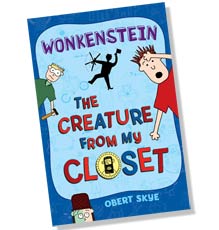
Book Revew: Wonkenstein: The Creature from my Closet, by Obert Skye (Henry Holt, 2011)

Recommended for ages 9-12

Rob is a 12-year old boy whose main use for books is to throw them into his closet. He has better things to do, after all, than read. Plus, Rob’s closet is just strange. It’s not because it’s got a second-hand door with a pony sticker on it that says, “Smile”. For starters, the doorknob is big, gold, and has a bearded man’s face engraved on it – and his expression seems to change. For another, the closet is where Wonkenstein – a creature that seems to be a mashup of Willy Wonka and Frankenstein – comes from one day, and now Rob’s closet will not open so he can send him back.

Rob tries to keep Wonkenstein a secret while trying to get him back to his world, but he ends up getting into more trouble, whether at home or school, the harder he tries. Poor Rob just wants life to go back to normal, but at the same time, he finds himself getting attached to the little guy.

Wonkenstein is a cute book for younger readers and older readers that may have drifted from reading and just need something fun and familiar to pull them back. The book has fun black and white illustrations that look like a child’s drawings and helps, along with the first-person voice of the book, add to the fantasy that Rob is narrating his own true story.

Obert Skye’s website has information about all of his books, plus author and tour information, and the publisher’s website has a book detail page with much of the same information, plus links to the book’s pages on social networking sites incluing Shelfari and LibraryThing.

Posted in History, Non-Fiction

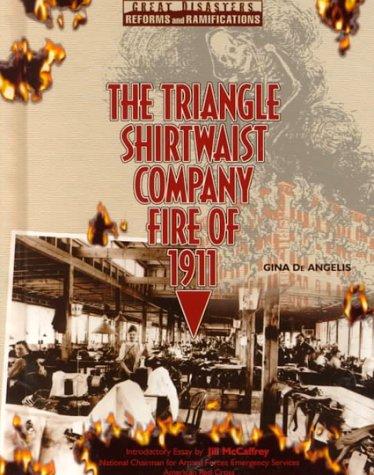
Book Review: The Triangle Shirtwaist Factory Fire of 1911, by Gina De Angelis (Chelsea House, 2001)

Recommended for ages 10+

The shirtwaist was a high-necked, long-sleeved blouse design popularized by the iconic Gibson Girl image in the early 1900s. At this time, New York boasted about 450 shirtwaist factories, but building codes and labor laws left a lot of room for interpretation. As a result, on March 25, 1911, a fire broke out in the Triangle Shirtwaist Company in the Asch Building in downtown Manhattan. Multiple factors – locked doors to prevent workers from leaving early or stealing materials; ineffective and too few fire escapes and elevators, and crowded office conditions among them – caused the deaths of 146 workers, mostly women, many recent immigrants. The fire and the ensuing trial – which exonerated the company’s owners – gave rise to movements pushing for stronger building safety standards and unionization of garment workers, which would help them lobby for better working conditions and better pay.

The Triangle Shirtwaist Company Fire of 1911 tells the story of the fire and the aftermath. Black and white photos taken at the scene and the makeshift morgue bring home the pain of the event and drive home the magnitude of the fire. Readers learn that the owners, Max Blanck and Isaac Harris, went on to continue business and continue the business violations that caused so many deaths at the Asch Building, having been cleared of any wrong doing because the Asch Building was legally sound. The owners made money after the insurance settlement, causing an outcry among the deceased’s family members. The book also details the story of the garment workers labor movement and takes the reader into present-day sweatshop conditions and the continued fight for safe working conditions and a living wage. 

Cornell University’s Kheel Center for Labor Documentation’s web exhibit with primary and secondary sources, a link to a transcript of Blanck and Harris’ trial, and a bibliography. Nonprofit organization Remember the Triangle Fire Coalition, seeking a permanent memorial to the victims, offers an open archive where contributors add their own modern-day remembrances and information and a names map which lists the name, country of origin, New York address, and final resting place of the identified victims.

Short PBS documentary on the Triangle Fire.

Posted in History, Non-Fiction, Tween Reads

Book Review: Little House in the Big Woods, by Laura Ingalls Wilder (HarperCollins, 1971)

Recommended for ages 8+

Most people know Laura Ingalls Wilder’s stories, if not through her books, then through the long-running television series, Little House on the Prairie. A a pioneer child who wrote down her experiences and later had them published, Ms. Wilder wrote nine Little House books, originally published between 1932 and 1943. The series resonated with girls and young women and is popular to this day.

Little House in the Big Woods is the first book in the Little House series, and introduces the reader to the Ingalls family: Laura, her older sister, Mary, baby sister, Carrie, and parents, Ma and Pa (Caroline and Charles). The family lives in the Big Woods in Wisconsin in the later part of the 19th Century, shortly after the Civil War. (Laura even mentions a family member who is “wild since he came back from the army”.)

We go through each of the seasons with the Ingalls family and learn how families lived, ate, and had fun. There are family dances and visits, trips to town, and encounters with bears and bees. There is always time for work, though, and this is where the book acts as a primer. Laura details the process of preserving meats and vegetables to keep the family fed through the lean winter months; how Pa prepares an animal skin to be used as leather goods; how to get sap from a tree, and how to smoke bees out of a hive to be able to get to the honey. It’s a fascinating look at a different time, and while it is written with a girl’s voice, this is should not be considered a “girl’s book”: boys and girls alike can learn much about the wildnerness life.

Laura writes in a clear voice, drawing her readers in because her stories are real. The love of family and nostalgia as she looks back on her life bring to mind the feeling a child gets when listening to a parent or grandparent talking about their childhood. Black and white drawings by Garth Williams add to the book.

There is a wealth of information about Laura Ingalls Wilder online. Wilder’s home in Rocky Ridge Farm in Mansfield, Missouri, where she wrote the Little House books, is now the Laura Ingalls Wilder Historic Home and Museum and word finds, quizzes and coloring pages. The Little House Books website features a family tree tracking the girls of the Little House series from Laura’s great-grandmother to her daughter, Rose. The site also offers games and craft ideas, as well as information for teachers interested in teaching the book.

Posted in Fantasy, Humor, Tween Reads

Book Review: Charlie and the Chocolate Factory, by Roald Dahl (Bantam, 1977)

Recommended for ages 8-12 (and ageless)

This was one of my favorite books growing up, and reading it again all these years later, I find that I love it as much now as I did when I was 8. Having spent the last few years watching multiple viewings of Willy Wonka and the Chocolate Factory (Gene Wilder is Willy Wonka), I ended up surprised on a few occasions when I realized that scenes from the movie – such as the Fizzy Lifting Drinks scene when Charlie and Grandpa have to belch their way down from certain doom – were not in the book after all! While the movie retained much of Roald Dahl’s dark comic humor, nothing beats the book, and Dahl’s wry observations on rude children and the parents who indulge them, and how the meek inherit… well, if not the earth, at least a lifetime’s supply of chocolate.

Charlie Bucket is starving – no, really, he is. He lives with his mother, father, and four sickly grandparents, who are so old and sick that they never get out of bed. Father has a menial job screwing the caps onto toothpaste tubes, and they family is very poor. They are so poor, all they can eat is cabbage soup, and Charlie refuses to take more than his share. Every day he walks past the famous chocolatier Willy Wonka’s chocolate factory and lifts his nose, inhaling the delicious smells; the only time he gets to enjoy a Wonka bar is on his birthday.

It all changes when Willy Wonka announces a contest where five winners will be allowed to tour the chocolate factory – and Charlie is holding one of the Golden Tickets. Grandpa Joe, his elderly grandfather who retains the joy and wonder of youth, jumps out of bed and insists that he go with him, and they’re off. Charlie meets the four other winners – the gluttonous Augustus Gloop, spoiled brat Veruca Salt, TV addict Mike Teavee, and boorish Violet Beauregarde – and their overly indulgent parents at the gates of the factory, and when Willy Wonka’s gates open for the first time in years, the fun really begins. Who will make it through the factory tour?

Dahl’s writing weaves words into pictures that are enhanced by Joseph Schindelman’s black and white illustrations. From Willy Wonka’s mysterious origins to the Oompa Loompa’s cautionary songs, this book is Mr. Dahl’s morality play. It’s a great reminder of the golden rules as children enter into the middle grades: be polite. Don’t be a bully. Share. Don’t be a glutton or have bad manners. Modesty and a humble demeanor reap their own rewards. Reading Dahl is like Emily Post for kids, but with chocolate rivers and candy flowers.

Roald Dahl is a well-known classic children’s author. There is an inactive wiki that appeared to be the start of a comprehensive body of work  with 106 articles; there is a call to revive it on the home page. There is also a wonderful Roald Dahl website that is animated and features links to the Roald Dahl store, museum, and his children’s charity. The site features a “book chooser” that will match kids with a “splendiferous read” of his, a biography on the author, and a “Wonkalator” – a calculator game that asks kids to help Wonka with his latest magical formula.