Posted in Fantasy, Tween Reads

Book Review; Breadcrumbs, by Anne Ursu (Erin McGuire, ill.) (Walden Pond Press, 2011)

Recommended for ages 9-12

Fifth graders Hazel and Jack are best friends until the day Jack decides he wants to be around boys more than a girl. Hazel is miserable at the loss of her friend, but when Jack disappears, she is the only one who ventures into the mysterious woods to find him, and get him back from the White Queen – whether or not he wants to come home.

Breadcrumbs is a trip through fairy tales and middle-grade stories that many readers will be familiar with, all surrounding a retelling of the classic tale of the Snow Queen. The characters are fifth graders who actually act their age; they are fully fleshed out with backgrounds that touch on issues that many readers will be familiar with – multiculturalism, adoption, divorce and remarriage, depression, and the pain of loss and how to move past it. There is a little bit of magic in every world, and Breadcrumbs brings that to life in the form of the main characters’ imaginations and in the more literal, magical forest sense. Erin McGuire’s black and white illustrations bring the chill of the cold forest, particularly the Snow Queen, to life and enhance the text. Compulsively readable, the book also provides numerous opportunities to enhance classroom discussions on topical issues or on a fairy tale unit.

Breadcrumbs is a 2011 Cybils award nominee for Middle Grade Science Fiction/Fantasy. Author Anne Ursu’s webpage offers information about Breadcrumbs and all of Ms. Ursu’s books, plus updated news and appearance information and links to social media.

Posted in Animal Fiction, Fantasy, Historical Fiction, Humor, Tween Reads

The Cheshire Cheese Cat: A Dickens of a Tale, by Carmen Agra Deedy & Randall Wright (Barry Moser, ill.) (Peachtree Publishers, 2011)

Recommended for ages 9-12

Skilley is a street cat who finds himself hired by Ye Olde Cheshire Cheese, a pub in Victorian London where writers like Charles Dickens find themselves inspired to write. Ye Olde Cheshire Cheese makes some of the best cheese in the kingdom, and they’ve got a bit of a mouse problem. It should be a dream job for Skilley, but he has a secret – he doesn’t like to eat mice. He prefers cheese, truth be told. Skilley and the mice of Ye Olde Cheshire Cheese, led by young Pip, work out an arrangement that should keep the staff at the Cheese fooled and Skilley’s belly fed until Pinch – a nasty street cat who’s had run-ins with Skilley before – shows up. Afraid that Pinch will discover his secret, Skilley finds his friendship with Pip at risk and Maldwyn, another guest of the Cheshire, in danger.

The Cheshire Cheese Cat is one of those stories that is just a fun, great read. The authors managed to create a morality tale and a story of friendship that has appeal to a huge age range. It would be a great read-aloud to younger grades, with anthropomorphic characters to keep them interested, and older readers will appreciate the dilemmas Skilley finds himself confronted with: unlikely friendships and looking “cool” in front of one’s peers among them. The characters, human and animal alike, are fleshed out and their interactions have depth. Inserting historical characters like Charles Dickens, who finds himself interested in the goings-on at the Cheese – goings-on that human patrons seem to miss – make the tale more fun, as does the visit from the “surprise guest” teased at the beginning of the book. Black and white illustations by Barry Moser add to the enjoyment and give the readers a little more grease for the imagination’s wheels.

The Cheshire Cheese Cat website offers information about Victorian London, Charles Dickens, The Cheshire Cheese, and more historical references found in the book. A fun page on Cheshire Cheese, thought to be the oldest cheese in England,  provides the history of the cheese and recipes and would be a fun addition to any classes reading the book. Author Carmen Agra Deedy maintains a blog where she also maintains a list of events and appearances, awards and nominations, and her other books.

Posted in Fantasy, Fiction, Tween Reads

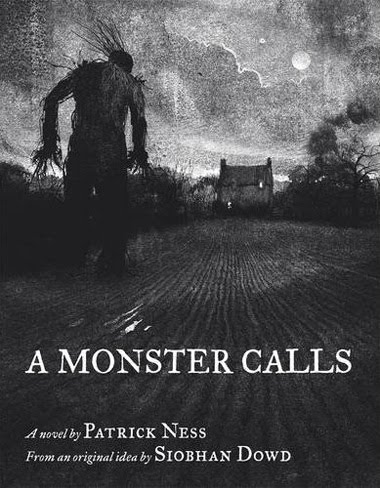
Book Review: A Monster Calls, by Patrick Ness (Candlewick, 2011)

Recommended for ages 11-13

A Monster Calls is one of those books that will tear your heart out while you’re reading it, but when you’re done, you’re glad that you went through the experience. It’s that good.

Conor is a 13-year old boy who lives in Britain with his single mother, has a strained relationship with his father, who has his own life and new family in the States, and is bullied at school. His mother is fighting a battle with cancer, and losing. Around this time, Conor starts receiving visits every night, just after midnight, from a monster in the guise of a yew tree in his backyard. The monster tells him stories – truths – whose outcomes really play with perspective, and he tells Conor that the fourth story will be Conor’s, telling the monster his own truth. It’s a truth that Conor doesn’t want to think about, but that gives him nightmares every night.

The story, originally an idea by author Siobhan Dowd, whose own life was cut short by cancer, is gorgeously written. Ness’ words bring the reader right into Conor’s fear, grief and anger at his mother’s battle, his grandmother’s fussiness, his father’s distance, and the numbness he feels as he endures the bullies at school. When the monster allows Conor’s rage an outlet, the reader feels it, viscerally. Jim Kay’s stark black and white illustations add to the moody feeling of Ness’ prose.
 
A Monster Calls has been shortlisted for several awards including the Galaxy British National Book Award, the Red House Children’s Book Award, and the Cybils Award in Middle Grade Fantasy. The author’s website features his blog, an FAQ, and information about his books and events.
Posted in Fantasy, Humor, Tween Reads

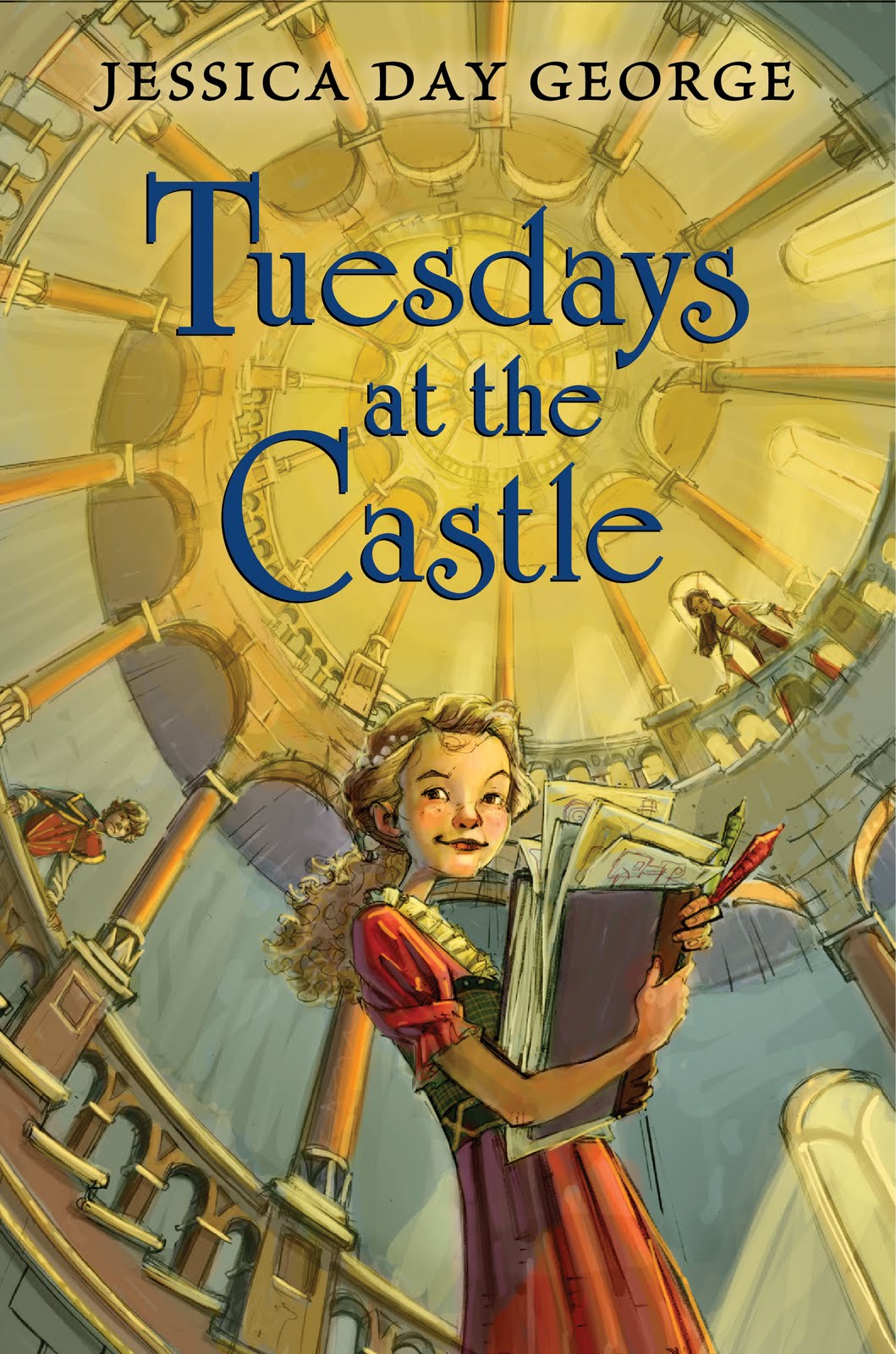
Book Review: Tuesdays at the Castle, by Jessica Day George (Bloomsbury, 2011)

Recommended for ages 9-12

Princess Celie lives with her brother, sister and parents at Castle Glower, a castle that’s alive much in the way Hogwarts is – rooms crop up when they’re needed, and new staircases and passages appear seemingly at will. When her parents, King Glower and Queen Celina leave to attend their eldest son’s graduation from wizard school and are reported missing after their carriage is attacked, Councilors and foreign dignitaries show up and start ordering Celie’s brother Rolf – the heir to the throne – around. The Glower children, the castle staff, and Castle Glower itself all sense that something’s wrong, and work together to get rid of the evil prince that’s trying to take over Castle Glower – and bring their parents home safely.

Jessica Day George is great at writing princess books without all the saccharine included- her heroines are smart, funny, and can keep their heads about them when things are going crazy. Celie is no different, nor is her older sister, Lilah, which is a pleasant change from the “one beautiful and dumb, one smart and resourceful” sister that tends to pop up in YA and ‘tween literature. Their brother, Bran, is an intelligent boy who can defend himself verbally and allies with his siblings and staff to brainstorm solutions and make things happen. Ms. George provides good character development and the action is well-paced. While mostly girls will likely gravitate to this book, there are strong male and female characters for young readers to be inspired by.

Jessica Day George’s website has a section dedicated to Tuesdays at the Castle, in addition to her other books, appearances and news.

Posted in Fantasy, Historical Fiction, Tween Reads

Book Review: Icefall, by Matthew J. Kirby (Scholastic, 2011)

Recommended for ages 10-14

Reading Matthew Kirby’s Icefall is like reading an old Norse tale -there is suspense, there is heroism, there are storytellers, and there is battle. The author puts the reader in the banquet hall with the characters, invites you to take a seat and listen in.

Solveig, the middle daughter of a viking king, her older sister and younger brother, are in hiding at a frozen fortress while their father fights a war at home. The king’s warriors protect them, joined later by a group of berserker warriors that he sends as additional protection. Shortly after the berserkers arrive, though, things start going wrong – livestock disappears, food is poisoned, and it becomes all too clear that someone in the group is a traitor. Solveig and her siblings have to figure out how to survive the winter until the spring thaw, and Solveig works to discover who the traitor is before he – or she – destroys them all.

It is a compelling read with complex characters and a tense situation – a siege tale from within. Solveig is the middle daughter – she is plain, unlike her beautiful older sister Asa; she is not an heir, unlike her younger brother Harald; she is merely Solveig. But Solveig is smart and figures things out quickly. She strives to be a storyteller – a skald – like Alric, the skald in her father’s court, but she learns that being a skald means giving your loyalty to those who may not always warrant it. Solveig finds herself angry at Asa for doing nothing during their days in captivity and she protects Harald as if he is one of her own. The story is told in Solveig’s voice, interspersed with Solveig’s anecdotes involving different characters from before the time of the seige, to further flesh out the players. There are layers and layers to this story; as each layer peels back, the revelations keep the reader turning the pages to discover more.
 
This book crosses genres – it can be considered fantasy, it can be historical fiction, or it can be mystery (it was just nominated for an Edgar award). While the main character is female, there is plenty here to pique both boys’ and girls’ interests: battle, complex relationships, and the frustration of family ties are only part of what this well-written tale has to offer all readers.
 
Matthew J. Kirby’s blog, Kirbside, offers information about his books (with hyperlinked titles to bring you directly to points of interest) and contact information. The Scholastic site for Icefall allows readers to download a sample chapter.
 
Icefall has also been nominated for a Cybils award in Middle Grade Fantasy.
Posted in Fantasy, Tween Reads

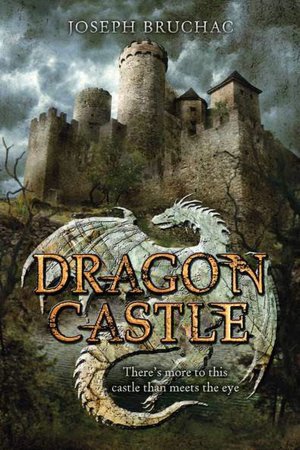
Book Review: Dragon Castle by Joseph Bruchac (Dial Books, 2011)

Recommended for ages 10-13

Prince Rashko, a 14-year old prince, is frustrated by his family. They’re so dumb. His parents are kind, but simple; his older brother Paulek, while a near-perfect warrior, is content to let Rashko do all the heavy thinking. They all live in Hladka Hvorka, a castle rumored to have magical origins, and there is peace in Rashko’s parents’ land – until Rashko’s parents disappear, and the Baron Temny shows up, expecting his young hosts to accommodate him and his entourage. The Baron also brings his ‘daughter’ with him as a potential bride for Paulek, who is thrilled to have company. Rashko suspects that neither there is more to both the Baron and his daughter, and works to find his parents and keep Hladka Hvorka in his family’s name.

Running parallel to Rashko’s story is the story of the legendary warrior Pavol, a hero in Rashko’s land. Orphaned when an evil king took his parents’ land and murdered them, Pavol is raised by a husband and wife living in the magical woodlands on the outskirts of the castle, and trained for the day he will avenge his parents’ deaths. This legend eventually converges with Rashko’s story, and he learns that Hladka Hvorka holds even more secrets than he imagined.

Author Joseph Bruchac is Native American and Slovakian, and draws upon his Slovakian heritage for Dragon Castle. The book contains phrases and words in Slovakian, always reinforced in English, and includes a glossary in the back. It is a great way to introduce younger readers to a new language within a fantasy setting.
 
The story is woven like a classic hero’s tale, with adventure and humor in equal parts. Rashko comes across as a bit petulant and stuck-up at times, particularly in the beginning of the book when he spends most of his time lamenting his superior intelligence and his parents’ and brother’s abject stupidity, but he’s an adolescent – he’s written well. He also realizes, as he gets deeper into his family’s background, that there is more to his parents – and possibly, his brother – than he ever thought possible, and this gives him pause.
 
Having two male main characters is a great way to bring this adventure fantasy to male readers; supplemental female characters will not draw any female readers in that weren’t planning on reading it already, but Dragon Castle is a strong fantasy tale that should appeal to boys and girls who enjoy fantasy, complete with evil sorcery, dragons, and castles.
 
Joseph Bruchac’s website focuses mainly on his music and poetry and features .mp3 files for listeners to enjoy. There is some information about his books and schedule available.
Posted in Science Fiction, Tween Reads

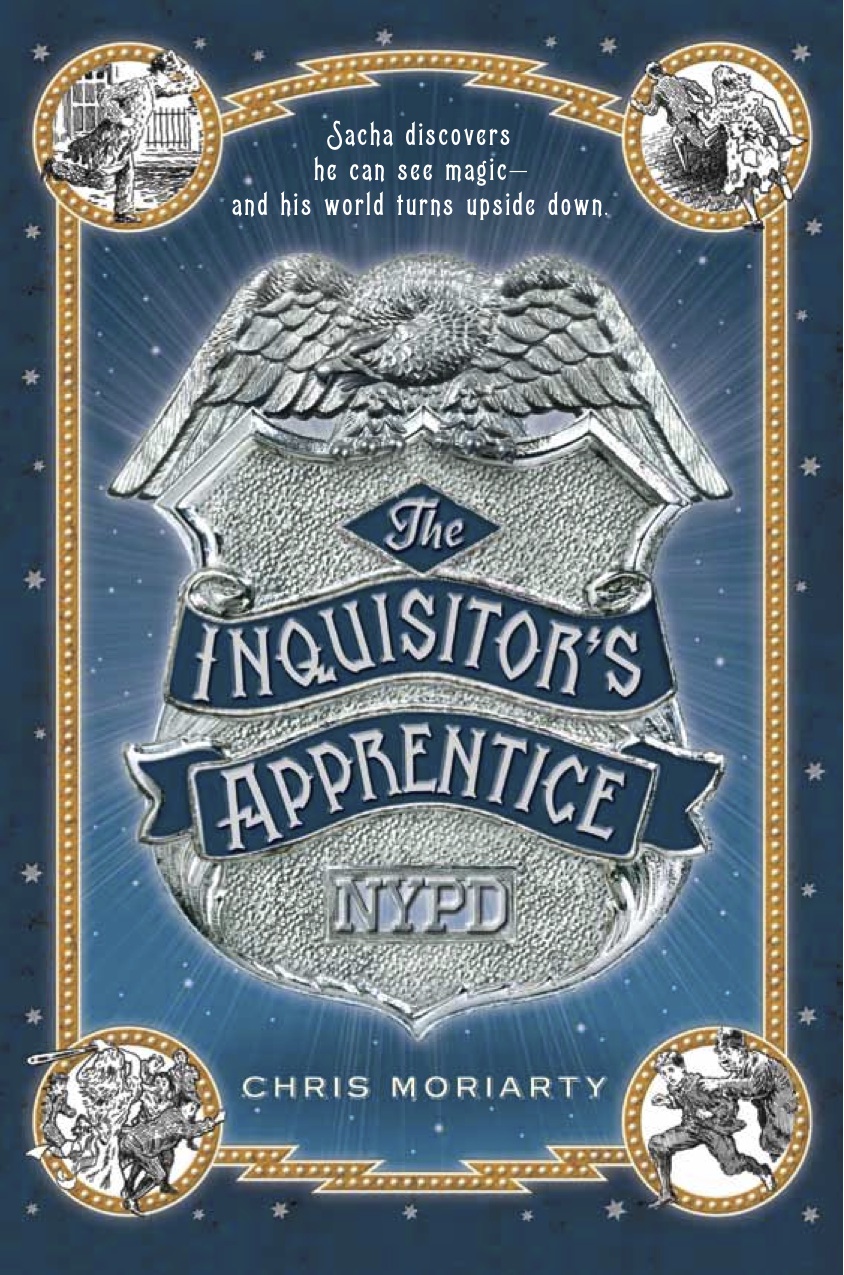
Book Review: The Inquisitor’s Apprentice by Chris Moriarty (Harcourt, 2011)

Recommended for ages 10-14

The Inquisitor’s Apprentice is the first book in a a science fiction/fantasy adventure series, taking place in an alternate New York City around the turn of the 20th century. Magic exists in this world, and each immigrant group has their own magic that they bring to the New World with them. Inquisitors, a branch of the New York Police Department, patrol to make sure magic is not being abused.
Thirteen year-old Sacha Kessler, who lives in the Lower East Side with his family, has the gift of seeing magic; for this, he is recruited into the NYPD, as an apprentice to Inquisitor Wolf; his fellow apprentice, Lily Astral, is from a wealthy New York family and is an entitled snob who rubs Sacha the wrong way almost immediately.

Inquisitor Wolf, Sacha and Lily are put on a case involving death threats to Thomas Edison, who is creating a witch-detectiing machine – every magician in New York City has a reason to want him dead, but as they delve deeper into the case, things become more complicated for Sacha, who sees the case leading back to his neighborhood – and possibly, his own family.

The book is compulsively readable, with well-drawn characters and an interesting alternate New York setting. Moriarty offers a new way of glimpsing life into the Jewish immigrant experience in turn of the century New York; this book would be good companion reading to a unit on immigration in America as it allows for many areas of discussion wrapped within a solidly enjoyable fantasy setting. Some may struggle with the many Yiddish terms, but context should answer most questions. A paperback edition may consider a guide to terms for some readers. Black and white illustrations by Mark Edward Geyer add to the moody feeling that permeates much of the novel.

Chris Moriarty has an Inquisitor’s Apprentice website set up that provides information on the series and on the actual New York City of the time, with photos and information about key individuals that appear in the series, like Harry Houdini and Thomas Edison. There is author event and contact information as well. He blogs at SFness.com about his own books, other author’s books, and offers writing advice. His website features his writing about science fiction and cyberpunk, along with other science fiction subgenres.

Posted in Fiction, Humor, Middle School, Tween Reads

Darth Paper Strikes Back, by Tom Angelberger (Amulet, 2011)

Recommended for ages 9-12
After reading Angelberger’s first book in his “Origami” series, The Strange Case of Origami Yoda, I had to get the sequel. I am pleased to say that the sequel matches up to the original.

The McQuarrie Middle School gang is back, but the happy beginnings we saw at the end of Origami Yoda are nowhere to be found; to top it off, Harvey shows up at school with Darth Paper, his answer to Origami Yoda. In no time, Harvey’s managed to get Dwight suspended and under the threat of being sent to a special school for troubled children. Origami Yoda asks Tommy to put together another case file, this time, to show Dwight in a favorable light and get his suspension overturned. With Harvey threatening to throw a wrench in their work at every turn, can Tommy and his friends make everything right again – this time, without Origami Yoda’s advice?

If readers enjoyed Origami Yoda, they will enjoy Darth Paper Strikes Back. The book is written in the same fun, first-person style as the original, and the conflict with love-to-hate-him Harvey (and Darth Paper) adds a fun counterpoint to Origami Yoda’s sage advice while adding some unexpected depth to the book, particularly at the conclusion.
For more information about The Strange Case of Origami Yoda and author Tom Angleberger, you can see my original post.
 
 
Posted in Fantasy, Tween Reads

The Graveyard Book, by Neil Gaiman (illus. by Dave McKean) (HarperCollins, 2008)

Recommended for ages 12+

Created from an idea author Neil Gaiman had in 1985 that would create a “Jungle Book in a graveyard”, The Graveyard Book tells the story of Nobody “Bod” Owens, orphaned as a toddler and raised by the ghosts of a graveyard he wanders into after his family is murdered. His guardian, Silas, is neither dead nor alive and can navigate both worlds in order to assure Nobody’s needs are taken care of.

The problem is, Jack – the man who murdered Nobody’s family – is still at large, and he’s still looking for Bod to finish his business. He’s working for a secret society who has ordered the boy’s death, but as long as Bod stays within the confines of the graveyard, he is safe. As he gets older, though, Nobody wants to venture outside and see more of the world and have human friends.

Like Coraline and Gaiman’s other work for younger readers, The Graveyard Book is a dark fantasy, yet he manages to make the fact that a boy is raised by ghosts and the undead charming. Nobody is a sweet boy who grows up loved for and cared for by the spirits of the graveyard in which he lives, and the supernatural beings – Silas and Bod’s tutor, Miss Lupescu – who are charged with his care. Mr. Gaiman’s descriptions again let the reader’s imagination run wild, with funny and wry descriptions of everyone from the inhabitants of the graveyard to the sinister murderer, Jack Frost.

The Graveyard Book received the 2009 Newbery Medal, Hugo Award for Best Novel, and Locus Award for Best Young Adult Book; it also won the 2010 Carnegie Medal.

Posted in Fantasy, Tween Reads

Book Review: Coraline, by Neil Gaiman (illus. by Dave McKean) (HarperCollins, 2002)

Recommended for ages 10+

Coraline is a dark fantasy created by author Neil Gaiman. It was adapated into a graphic novel (2009) and an animated feature (2009).

Coraline is a young girl who moves into a new home with her parents and feels out of place. Her parents don’t seem to have too much time for her, so she goes exploring and meets some of her odd new neighbors and the neighborhood cat. One night, she discovers a hidden doorway that leads to a parallel world; it’s here that she meets her “Other Mother”, who seems to have all of the time in the world for Coraline and always makes delicious meals. She desperately wants Coraline to stay, but there’s something… strange… about the Other Mother. As Coraline visits more often, she discovers that the Other Mother is not at all what she seems, and she’ll need the help of the neighborhood cat – who isn’t exactly what he seems, either – to save herself and her family. 

Neil Gaiman has been writing dark fantasy since the 1989, when he revived the DC Comics title The Sandman. He brings his creepy fantasy worlds to children as easily as he does to his older audience, and often makes some of his most unsettling characters adorable. His main characters often go against the grain, and Coraline is no exception – she is an independent, stubborn, curious girl who loves a good adventure; she’s also a smart heroine who can work her way out of a tight situation.
 
Mr. Gaiman creates memorable images with his words – visions of The Other Mother will stick with kids and adults alike and Coraline’s odd neighbors come with their own strange charm that smoothly made the transition from print to screen. His descriptions allow the reader’s imagination to run wild without ever worrying about going over the top – because there simply is no limit.
 
Coraline has won numerous awards, including the 2003 Hugo and Nebula Awards for Best Novella and the 2002 Bram Stoker Award for Best Work for Young Readers. Neil Gaiman’s Mouse Circus website – a Coraline reference – is geared toward his younger readers and offers information about the author, downloadable computer wallpaper, and video interviews and book trailers.