Posted in Fiction, Middle School, Tween Reads

Book Review: How to Rock Braces and Glasses, by Meg Haston (Little, Brown, 2011)

Recommended for ages 10-13

Eighth grader Kacey Simon doesn’t think she’s a mean girl, she’s just brutally honest like a good journalist should be. Life is pretty good for Kacey until the tables are turned when a series of accidents leave her stuck with glasses and braces. Within a day, she goes from A-list to D-list as her cool girl friends pretend she doesn’t exist, she’s dropped from her school news segment and the lead in the school play. Her best friend seizes the opportunity to wrest the cool reins and goes on the attack, and a cruel YouTube video makes the rounds in school.

Alone for the first time, Kacey ends up teaming up with a former friend, Paige and emo musician Zander (aka Skinny Jeans) to get her popularity back. Along the way, Kacey learns that she may have been a mean girl after all – or just misunderstood.

The book is shallow, with an unlikeable heroine written to be likeable. Haston’s message of being real gets garbled; it’s as if the author herself is unsure of whether Kacey’s behavior pre-braces is reprehensible or defensible. I did not come away with the true feeling that she learned her lesson at the end of the day; rather, she just learned to find loopholes and how to use people to get her way. It sends out mixed messages.

Tween marketing powerhouse Alloy Entertainment packaged this title and the book has already been optioned to be a new Nickelodeon show, How to Rock, to air in 2012. Author Meg Haston’s website links to her blog and information about the book; she also has a Twitter feed. There is also an iTunes app that lets users take photos of themselves or friends and try on different braces and glasses combinations.

Posted in Humor, Middle School, Tween Reads

Book Review: I Am a Genius of Unspeakable Evil and I Want to be Your Class President, by Josh Lieb (Razorbill, 2009)

Recommended for ages 10-12

Twelve year-old Oliver only pretends to be “slow”. He wants to keep his genius – and the fact that he is already a multi-millionaire and international villian – a secret from his family and the kids at school. Oliver spends his day blundering along in school, having his secret henchmen shoot darts at bullies (that cause some unpleasant gastrointestinal distress), drinking soda and root bear out of his secretly rigged water fountains, and tormenting his English teacher from a distance. At home, he maintains his secret evil empire.

Until Oliver is nominated for Class President by a classmate as a cruel prank. Initially, Oliver declines the nomination, but his anger toward his father, who Oliver perceives as being perpetually disappointed with him, drives him to get back into the election and play as dirty as possible to win it – even if he has to rig his running mates.

This book is hilarious. Written by the executive producer of The Daily Show, there is plenty of wit and a breakdown of politics on a middle school level that shows the reader how juvenile the entire political process can be. While at a times a bit heavy-handed, it still gets its point across, and in Oliver, Lieb has created a narrator that is like a young Dr. Evil meets Gru from Despicable Me. Middle schoolers will love the idea of a kid running an international evil empire from his underground lair and who has his school rigged for his personal comfort, all while tormenting teachers and bullies anonymously. The frustration of wanting to be loved by one’s parents while being aware of their flaws is a strong theme that will resonate with many readers.

There is a limited website for the book at Sheldrake Industries (Oliver’s cover company in the book) that offers some information about the book, a video with Josh Lieb, and a quiz where readers can figure out how evil they are.

Posted in Fiction, Humor, Middle School, Tween Reads

Book Review: Diary of a Wimpy Kid, by Jeff Kinney (Amulet, 2007)

Recommended for ages 9-12

I am an unabashed fan of the Wimpy Kid series – I’ve read them all am waiting, with my kids, for Cabin Fever, the next book in the series (39 days from today!). My older son had the pleasure of meeting Jeff Kinney at ComicCon a few years ago and he was a very nice guy, autographing his book, mentioning that his son shared the same name as mine, my son and his son shared the same name, and really listening to what my son enjoyed about his book. 

Greg Heffley is a middle school ne’er do well – he’s lazy, he’s selfish, and he can’t figure out what everyone else’s problem is. Despite these qualities, he’s wildly funny, and he does try to do the right thing (he just tends to get a little lost on the way to doing it). He’s a middle schooler, he’s just trying to navigate life and make things easier on himself. Can you blame him?

Diary of a Wimpy Kid is a good book for several reasons, aside from it’s compulsive readability: the characters are well-written and funny, Greg has a clear voice, and this book shows boys and girls alike that keeping a diary – or a journal, whatever you choose to call it – is a good thing. Writing, even to a slacker kid like Greg, can be something fun to do. The book even resembles a diary on the inside and out, with lined pages, handwriting font, and hand-drawn pictures that look like Greg had drawn them filling the book.

Jeff Kinney’s Wimpy Kid series is one of the most popular middle-grade series out today, with five book currently out and the sixth coming in November. The Wimpy Kid website offers information about all of the books (and a countdown clock for Cabin Fever)  and offers news and information about the author, a link to “Wimp Yourself” where kids can create their own Wimpy Kid using preselected templates, links to merchandise.

Posted in Fiction, Humor, Middle School, Tween Reads

Book Review: Dork Diaries: Tales from a Not-So Popular Party Girl by Rachel Renee Russell (Aladdin, 2010)

Recommended for ages 9-12

Dork Diaries: Tales from a Not-So-Popular Party Girl has been hailed as “Wimpy Kid for girls”, and I’m inclined to agree. The book is writtten in similar format – a middle-schooler’s journal – and is complete with illustrations and “OMG!” moments in a pre-teen’s life. Nikki, the protagonist, is not the slacker that Wimpy Kid Greg is, but is definitely not in the cool crowd. She and her friends Chloe and Zoey wish they could be in the CCP (Cute, Cool and Popular) crowd, but Nikki’s nemesis, Mackenzie – a spoiled, rich, mean girl – will do anything and everything to ruin Nikki’s life – including canceling the school Halloween dance just to make Nikki look bad. Nikki and her friends need to pull together to make it happen, and Nikki hopes to get the attention of her crush, Brandon Roberts. The only trouble is, Mackenzie has her sights set on Brandon, too.

The book is fun. Nikki is a vibrant narrator, who speaks fluent middle-school – girls will love her. She writes from a very female point of view, as opposed to the more gender-friendly Wimpy Kid, so I don’t know if boys will get on board with the series (especially as this book has a purple cover). The black and white drawings make you believe you are looking at a ‘tween girl’s diary, as do the script and handwriting fonts. All around, a fun book with a spunky heroine that girls will enjoy – and grown-up girls will laugh along with the more cringe-worthy memories of their own middle school years.

The Dork Diaries website features information on the Dork Diaries books and has a countdown clock for the next book’s release. There is a link to the music inspired by the book, and the Nikki has a blog where she recaps memories (from the books), links fan videos, and features fun contests and printables.

Posted in Fiction, Humor, Middle School, Tween Reads

Book Review: Middle School – The Worst Years of My Life, by James Patterson and Chris Tebbetts (Little, Brown, 2011)

Recommended for ages 10-14
 

Rafe Katchadorian is having a tough year: his mom is working double shifts at her diner job in order to support him, his sister, and her lazy, unemployed fiance, and he’s already attracted the attention of the school bully during his first week of middle school. What’s a kid to do? Make a name for himself, of course!

With some prodding by his best friend, Leonardo the Silent, Rafe decides that he’s going to break every single rule in the middle school code of conduct. There are guidelines to follow, though – he’s got to have witnesses every time he breaks a rule; he’s got three “lives” – he loses one if he passes up an opportunity to break a rule – and finally, he can’t hurt anyone in his quest to break the rules. How bad can a good kid get, and how far is Rafe willing to go to break all the rules, and will he break his own in the process?
 
I started this book expecting a light, humorous tale and was amazed at the punch Patterson and Tibbett packed into this middle school story. Rafe’s family issues aside, there are a multitude of issues in his life. In reality, he would be considered an at-risk tween with a need for a solid support system. Two major plot developments may suprise readers, but these are important stories for tweens and young teens to be exposed to – children with similar life stories may appreciate a literary figure they can relate to, and other readers will glimpse into another kid’s world, possibly starting a dialogue or creating a new sensitivity among them.
 
 Chris Tebbetts is a YA author whose love of books and libraries began as a child. His website suggests links for writerw and readers, and provides a list of Good Reads for young readers and teens.
 

James Patterson is best known for his Alex Cross mystery series, but he is a Children’s Choice Award-winning author, receiving the award in 2010 for his book Max, one of the books in his popular Maximum Ride series. His Daniel X series has been praised by Good Morning America as being some of the best books for boys, and the first book in his Witch & Wizard series spent five weeks on the New York Times bestseller list. Patterson’s website, ReadKiddoRead, is dedicated to getting kids reading and suggests titles for all ages and interests.

Posted in Fiction, Humor, Middle School, Tween Reads

Book Review: Ellie McDoodle: New Kid in School by Ruth McNally Barshaw (Bloomsbury, 2008)

 
Recommended for ages 8-12
 
Ellie McDoodle is the nickname for sixth grader Eleanor McDougal, who fills her notebooks with doodles, journaling the people around her, her family, and her own daily happenings.

When Ellie’s parents announce that they’re moving, Ellie is crushed. She doesn’t want to leave her friends, her school, or her home. She creates a journal to document the move, insisting that “there won’t be much to keep track of… because this is the END of everything good.”

Or is it? Despite some rough patches, like discovering the “New Kid Bingo” card some of her classmates circulate at school or teachers not remembering her name, Ellie learns that being the new kid may not be so bad. Through her own actions, she makes friends, convinces her parents to give her a room of her own in the attic, and organizes her fellow classmates in a peaceful against long lunch lines in the cafeteria. Being the new kid may end up being sort of fun after all.

Ruth McNally Barshaw’s Ellie McDoodle series has been described by Student Library Journal as “reminiscent of Jeff Kinney’s Diary of a Wimpy Kid“, and it is to some degree: both stories have a vibrant narrator who tells his tale in the first person, accompanied by line drawings. To dismiss Ellie McDoodle as merely a feminine Wimpy Kid is selling the book short. Ellie McDoodle is not a Wimpy Kid clone; it is a smart, sensitive book featuring a character to whom both boys and girls can relate.
 
Ellie’s family is as realistic and provides a positive family model. The family eats meals together at the same table; they play friendly pranks on one another, like hiding a spooky-looking Mrs. Santa Claus figure all around the house to take family members off guard; even Ellie’s cranky older sister Risa is never outright abusive, but is more of an angsty teen. Her older brother Jonathan is a friendly clown who makes punny jokes, and her toddler brother, Ben-Ben, is a happy baby who gets into everything. 
Readers will see Ellie as a positive role model who affects her own change rather than waiting for it to come to her. Rather than succumb to her sadness, Ellie seeks ways to make the best of her situation. She befriends a librarian at the local library; meets neighborhood children and accepts their invitiations to play, a move that helps her cope with insensitive schoolmates. Using her talent in art to help make a difference in her school, her peaceful protest gets not only the notice of the principal, but of the local television station.
 
Ruth McNally Barshaw’s website offers information on all of the Ellie McDoodle books and links to more of McNally Barshaw’s art. Readers can find out where she’ll be appearing and read her blog, and create Ellie mini-books and stationery. She offers teens advice on writing their own graphic novels, and has teaching guides available for educators.
 
The Ilsley Public Library in Vermont created a book trailer for New Kid in School, viewable below.
Posted in Graphic Novels, Humor, Middle School, Tween Reads

Book Review: Amelia Rules! The Whole World’s Crazy, by by Jimmy Gownley (Renaissance Press, 2006)

Recommended for ages 9-12
 
Jimmy Gownley’s graphic novels about Amelia McBride and her group of friends remind me of Bugs Bunny cartoons – when you’re a child, they entertain you; when you’re a little older, you get the jokes.
 
In this first volume, we meet Amelia, age nine. Her parents have just divorced and she and her mom have moved from Manhattan to “the middle of nowhere, Pennsylvania”, where they live with her retired pop rock star Aunt Tanner. Tanner provides a ready ear and sometimes, shoulder, for Amelia when she needs to vent.
 
Amelia’s a wise-cracking tomboy, but she isn’t skin deep. We see the effect of her parents’ divorce on her, be it through the frustration and anger with her father for canceling plans for their weekend together because he has a last-minute work commitment or her discomfort in overhearing her mother berating her dad on the phone. She shakes it off, adapts her hard-as-nails persona, and moves on. We all know kids like Amelia;  maybe we have even been in Amelia’s place at one point, and this is what makes her so accessible to kids and grownups alike.
 
Speaking of grown-ups, there are plenty of in-jokes for mom and dad to catch. Amelia and her friends go to Joseph McCarthy Middle School (motto: “Weeding out the wrong element since 1952”). Ann Coulter garners a mention on one of Santa’s lists (hint: it ain’t the “nice” list). There are pop culture references aplenty. The dialogue is funny and smart; Gownley doesn’t talk down to his audience, nor does he shy away from sensitive topics.
 
Amelia’s friends are a mixed bag of personalities. Amelia’s friend Reggie is obsessed with being a superhero, to the point of starting his own league of heroes called GASP (Gathering of Awesome Super Pals). Pajamaman is the most popular kid in school, but never speaks, wears footie pajamas, and comes from a poor family. Rhonda, Amelia’s nemesis (and grudgingly, good friend), has a crush on Reggie and puts herself in competition with Amelia for his attention. The group deals with bullies and crazy teachers, unrequited love and poverty. It’s a group of kids that readers will see themselves reflected in.
 
The Amelia Rules! website offers even more to Amelia fans. There are book trailers, podcasts, a blog, and links to fan art and fan fiction. Visitors can listen to music in Tanner’s Garage and play games in the Ninja Lair.
Posted in Middle School, Post-apocalyptic/Dystopian, Science Fiction, Tween Reads

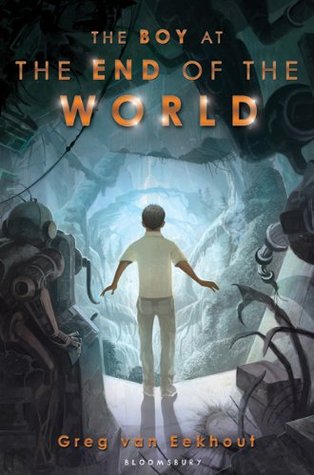
Book Review: The Boy at the End of the World, by Greg Van Eekhout (Bloomsbury Children’s Books, 2011)

Recommended for ages 9-12

A preteen boy (we are led to guess), wakes up in a pod in a devastated shelter. Destruction lies all around him; he sees being similar to himself lying dead in pods similar to his. The only other functional being is a robot, who calls out to him. The boy runs, but the robot catches up to him and reveals the boy’s name, Fisher, to him. Fisher learns that he is the only survivor of the human race.

It’s the usual post-apocalyptic story: Humans ruined the earth and nature took back her planet. Humans genetically engineered animals and more humans, putting them in gel-filled pods, with robots to oversee their care, until the time when conditions allowed for them to awake and rebuild society. The humans were individually programmed with specific survival skills to help create communities. Fisher is programmed to be a fisherman. Click, the name he gives his robot companion, tells Fisher that he has been tasked with helping Fisher “continue existing”, and the two set off to search for more humans in another Ark – the facilities were humans and animals were engineered and kept in hibernation.

Born a blank slate, Fisher learns and adapts through the story’s progression, developing not only intelligence outside of his initial programming but emotional depth. The characters they meet are not cute and cuddly woodland creatures: they’re often chilling. There are groundhogs who blame humanity for the planet’s destruction and hold a grudge; there is a robot who takes his task of preserving the human race  permanently – these characters bring a new dimension to the story of a boy and his robot. This is a survivalist tale.

It is difficult to write a postapocalyptic tale without sounding like hundreds of similar books on the market, and the “humans and technology bad, nature good” call to action beats the reader over the head throughout the book. Humans bring the planet to the brink of environmental collapse, so they leave the rest of the planet to deal with it while they go into hiding until the coast is clear. The technology that humans created to save them ultimately turns on them and brings the race to the point of near-extinction, further painting us as hapless ne’er do wells.

That said, the YA market in post-apocalyptic fiction isn’t as saturated as the adult market is yet, so perhaps a younger audience will read this story through different eyes. That said, this is a generation that has been fed this storyline since they were babies: think of Happy Feet, a movie that deceptively sold us a cute story about a penguin who didn’t fit in, and gave us a Greenpeace horror movie halfway through the picture. Think of Wall-E, where we were drowning our society in junk, so we had to go into space to get away from it.

I don’t want it to sound like I didn’t like this book, because I did. I think older middle grade readers, starting with 10-11 year olds, will see Fisher as a hero they can identify with as a young boy who needs to learn to survive, and whose robot companion acts as a friend and parent. Kids can also relate to the marriage of technology and environmental awareness contained in the book’s message.

Greg Van Eekhout knows how to write for kids – he has a Masters in Education and spent ten years developing online curricula for K-12 and college students. He is kid- and teacher-accessible, offering teachers tips on having author events at schools (and libraries), and providing his e-mail address to be contacted about school visits. He offers two presentations that he follows in his appearances. His website is geared toward grownups who are interested in reading his reviews, about his books, and where he’ll be next.

Posted in Fiction, Middle School, Tween Reads

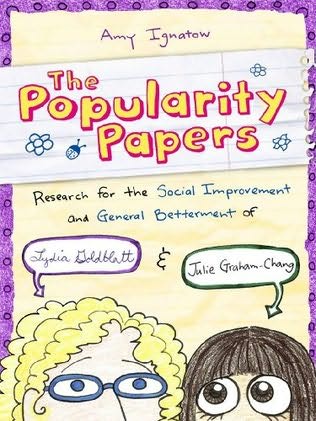
Book Review: The Popularity Papers: Research for the Social Improvement and General Betterment of Lydia Goldblatt & Julie Graham-Chang, by Amy Ignatow (Amulet Books, 2010)

Recommended for ages 9-13
I finished this book in a day. It’s that good. I also giggled out loud while reading this on the subway – it’s that funny.

The Popularity Papers is the project (“Learn/Improve”) undertaken by fifth graders Lydia and Julie, who want to be popular by the time they reach middle school. Deciding to observe the most popular girls in the school to figure out what makes them popular, imitate them and perhaps even infiltrate the group, Lydia and Julie record their notes, observations, conversations with family and friends, and drawings to tell the story of their social climb. On the way up, they learn that being popular isn’t always what it’s cracked up to be, that being popular means different thing to different people – including who you like and who you’re not supposed to like – and Lydia discovers what can happen when the quest for popularity goes to your head.

The characters aren’t your staid, Gossip Girl-type mean girls: One popular girl plays field hockey and knits; Lydia lives with her divorced mom and sister, who made the transition from pretty, tan girl to dark-haired, pale goth; and Julie lives with her two dads, Daddy and Papa Dad. It’s a book that addresses different people and different family structures but it’s not cliche and it doesn’t come across as being portrayed for the sake of being edgy or different. It’s an honest storytelling.
 
The girls’ notes to one another are as hilarious as the situations they find themselves in, and Lydia’s journaling when she finds herself in sole possession of the notebook after she and Julie stop speaking is heartfelt and real. Readers will easily be able to see themselves and their friends in these characters and can hopefully laugh at themselves a little more easily.
 
Amy Ignatow’s Amulet web page offers an author blog and links to author appearances, press and a gallery of some more images from the book. It looks like another Popularity Papers book has come out – I need to get myself a copy.