Posted in Graphic Novels, Middle School, Non-Fiction, Teen, Tween Reads

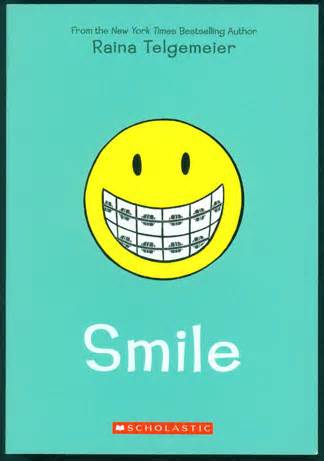
Smile, by Raina Telgemeier – A Graphic Memoir of Tweenhood

smileSmile, by Raina Telgemeier. Scholastic (2010), $21.99, ISBN: 978-0-54513205-3

Recommended for ages 10+

Raina Telgemeier’s memoir, Smile, is a coming-of-age memoir that’s framed by the night sixth-grader Raina sustained an injury to her mouth that led to a series of surgeries and orthodontia. Throughout middle school and high school, Raina endures braces, surgeries, retainers, and even headgear. She becomes a target for her friends’ teasing, which leads to her pulling away from them and embracing her love of the artistic. When she finally realizes that her friends aren’t the people she wants to surround herself with, she stands her ground and moves on.

Smile is one of those books that everyone should read, kid or adult. It’s all about fair-weather friends, enduring what feels like the end of the world, and ultimately, finding your own voice. It’s empowering, whether you’re 12 or 92, because it’s something we need to be reminded of, from time to time – “it”, whatever it is, won’t last forever, and the people you surround yourself with may not be the best for you. Dig deep down into yourself and love yourself enough to get through it.

The cartoon art makes the story even more accessible,with friendly-looking, expressive characters and warm colors throughout. The endpapers resemble a yearbook -in fact, Ms. Telgemeier used her yearbook signatures for the book – with signatures and well-wishes from friends, setting the tone for the book.

Smile has received numerous accolades – deservedly so! – including winning the Eisner Award for Best Publication for a Teen Audience (2011), the Dorothy Canfield Fisher Award (2012), and the Maine Student Book Award (2012). Smile was a finalist for the Children’s Choice Book Award (2011) and has received designation as an ALA Children’s Notable Book (2011), an honor book from the Boston Globe-Horn Book Awards (2010), a Kirkus Best Book of 2010, and a New York Times Editors’ Choice (2010).

There are lesson plans on the Web that allow educators to bring Smile into the classroom. Scholastic offers one on their site, along with a template for students to create their own graphic novels; The Graphic Classroom offers some great classroom discussion tips using the book.

A companion book to Smile, called Sisters, which will be published in August 2014 and will examine the relationship between Raina and her sister, Amara, who briefly appears in Smile.

Posted in Fiction, Humor, Middle School, Tween Reads

Desmond Pucket Makes Monster Magic and Get Laughs

desmond-pucket-makes-monster-magic_0Desmond Pucket Makes Monster Magic, by Mark Tatulli. Andrews McMeel Publishing (2013), $13.99, ISBN: 978-1-4494-3548-6

Recommended for ages 8-12

Desmond Pucket is a middle schooler who loves monster movies and special effects. He’s also a prankster who just can’t resist a good opportunity to use his special effects expertise to scare the daylights out of people, whether it’s his annoying older sister or one of the teachers. He’s been good at covering his tracks, but when he springs a prank on his older sister and her friends at a sleepover, he finds himself in hot water at school – one of his sister’s friends is the daughter of the disciplinary head at his school; he’s been waiting for Desmond to slip up, so he can transfer him to another school! Now Desmond has three chances left before he’s kicked out of school and misses the big field trip to Mountain Full of Monsters at Crab Shell Pier. Can he keep out of trouble for just a little longer?

The book is written in a similar style to Jeff Kinney’s Diary of a Wimpy Kid; it’s a first-person storyteller and illustrated, presumably by Desmond, with black and white sketches. There are even drawings that look like they’ve been sketched on torn bits of paper, to add to the realism of Desmond, and his friend Ricky’s, notes. The endpapers are green and have the appearance of crumpled paper, with more of Desmond’s drawings and notes to the reader.

I loved this book. It’s fun, light, and Desmond is – like Greg in Diary of a Wimpy Kid – a victim of his own making. He can’t stay out of trouble, but unlike Greg, he knows he’s his own worst enemy. He just can’t resist a good prank opportunity to cause mayhem. He even laments not being able to take credit for his brilliant pranks, because he knows it will get him into trouble. When he decides to pull a prank at  his sister’s sleepover, he has no idea of the trouble he’s getting himself into, and when the fallout hits, he has a major crisis on his hands – how can he stay out of trouble and still be himself?  He ultimately decides that being true to himself and owning who he is is more important than anything, including a long-awaited school trip.

Andrews McMeel has a wealth of Desmond activities and information online, especially since the second book in the series, Desmond Pucket and the Mountain Full of Monsters, will be released this August. You can read a sample chapter online at the Desmond Pucket site, follow him on Facebook, and download teacher and librarian resources on the Andrews McMeel site, including a guide to teaching with graphic resources and English/Language Arts and Science curriculum connections to work with, using the book. There are games and activities for readers both online and at the end of the book itself, where Desmond shares some notes on how to make fake blood, cool monster growl effects, a phantom knocker, a ghost, and a gelatin dessert.

I am looking forward to more Desmond books, as is my 10 year-old son, who read this book in about an hour and a half last night!

Posted in Adventure, Fiction, Middle School, Tween Reads

Young Sherlock and Irene Adler Face Off in Sherlock, Lupin, and Me: The Dark Lady

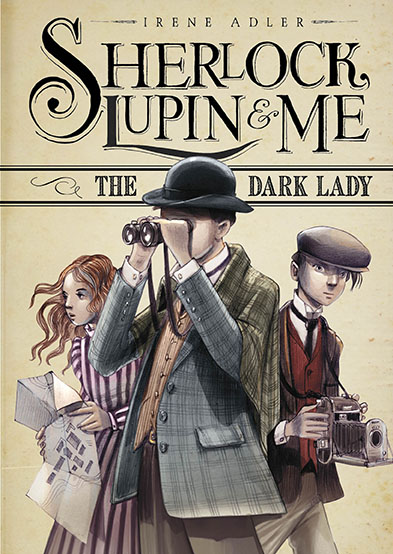
sherlock lupin meSherlock, Lupin and Me: The Dark Lady, by Irene Adler. Capstone Young Readers (2014), $12.95, ISBN: 9781623700409

Recommended for ages 9-14

Written by Irene Adler herself, this middle-grade novel details the first time Irene Adler, a young American girl living abroad and vacationing with her mother in a French coastal town, meets Sherlock Holmes and his friend, Lupin. The three become quick friends; when a dead body washes up on the beach one morning, they decide to solve the mysteries surrounding the dead man: who was he? Was this a suicide or a murder, and why?

Woven into the story’s fabric is background information on Holmes and Adler, offering glimpses into life events that led to the adults they become. Adler lives with her mother and her butler, Horatio Nelson, who seems to double as a chaperone/bodyguard. Young Irene is headstrong and willful, seemingly at endless odds with her mother. Sherlock is a quiet, somewhat surly, brilliant boy who’s reticent to discuss his home life; he has an older brother and a younger sister that annoy him. Arsene Lupin, the son of an acrobat, is a reckless young man who has an eye for Irene, but may eventually find himself at odds with the great Sherlock Holmes.

I really enjoyed this story. Middle graders who have already begun studying Sherlock Holmes will enjoy seeing the character development written into this young, teenage Sherlock, and those unfamiliar with Holmes will doubtless enjoy this introduction, easing them into the great sleuth’s world. The writing is fun and accessible to younger readers, and the sets itself up for a potentially exciting continuing series. For starters, will we find out more about Lupin, who ends up being one of the most famous thieves in literature? Will we meet a young Moriarty? A young Lestrade or Watson? And will we find out more about Irene Adler’s parents, who seem very secretive about something to do with Irene?

Jacopo Bruno’s Victorian-type illustrations add a Holmesian feel to each chapter, setting a mood for the reader.

I love the pairing of the world’s greatest detective with the world’s best gentleman thief as teenagers – I can’t wait to see where this series is going to go.

The Capstone Kids site should be getting a minisite up soon, but I didn’t see anything on Sherlock, Lupin and Me at the moment.

Posted in Fiction, Humor, Middle School, Science Fiction, Tween Reads

M.E. Castle’s The Clone Chronicles concludes with Game of Clones

gameofclones_3 Game of Clones: The Clone Chronicles, #3, by M.E. Castle. Egmont USA (2014), $15.99, ISBN: 9781606842348

Recommended for ages 8-12

In M.E. Castle’s third installment of the Clone Chronicles, seventh grader Fisher Bas and his clone, Fisher-2, put aside their differences to team up and fight Three, the Fisher clone created by the evil Dr. X. Three’s gone rogue, with plans for world domination on his mind, and he’s on track to make it happen – will Dr. X make an appearance? Is the enemy of Fisher’s enemy a friend?

The book is a fast-moving action-adventure series that should appeal to both middle grade boys and girls. Fisher and Fisher-2 have allies in their classmates, Amanda and Veronica, both of whom serve as the boys’ crushes and as intelligent, strong females in the series. Fisher tends to be an overthinker, and Alex struggles to define his own personality despite being a Fisher clone. This struggle runs throughout the book, and mirrors many a tween’s burgeoning identity and personality clashes and crises; where Fisher-2 is a clone, a tween pushes back against being merely “the son” or “the daughter”. Three wreaks havoc in Fisher’s neighborhood and school, forcing him to think of creative solutions and seek help outside of his gadgets; he realizes the power of friendship and of reaching out to ask for help, and it makes him a better person.

Overall, it’s a fun book in a popular series that tweens will enjoy. Game of Clones is part of The Clone Chronicles series; the first two books are Popular Clone and Cloneward Bound.

Posted in Fantasy, Fiction, Graphic Novels, Middle School, Science Fiction, Tween Reads

The Glorkian Warrior Delivers a Pizza: Middle-Grade Hilarity in a Graphic Novel Format

The Glorkian Warrior Delivers a Pizza, by James Kochalka (First Second, 2014), ISBN: 978-1-59643-917-7, $17.99
Pub Date: March 2014

Recommended for ages 8-12

Glorkian-Warrior_AdvanceBooks_FrontCover I first discovered James Kochalka a few years ago, when my son read and adored his book, Peanut Butter & Jeremy’s Best Day Ever. I loved the cartoony art and fun dialogue; when I saw this title available on NetGalley, I immediately requested it, knowing I’d be in for a fun read. I was absolutely right.

Not knowing about the successful Glork Kickstarter that Mr. Kochalka and PixelJam games had back in 2010, I came to Glork as a brand new audience. The book is hilarious and surreal on a level that middle schoolers can truly appreciate and adults will just laugh out loud looking on. The Glorkian Warrior is sitting at home with his Super Backpack, when the phone rings – it is destiny? Well… kind of – it’s a pizza order. While Backpack wants the Glorkian Warrior to disregard the obviously wrong number, the Warrior will not be put off – this is his mission! He grabs a partially eaten pizza from his fridge and sets off on a journey that will introduce him to alien babies and add strange and unusual toppings to the pizza, including ash, tears, and fire damage. Will the Glorkian Warrior fulfill his delivery destiny? Don’t look at me for answers, read the book!

The book, which hits bookshelves in late March, is great fun. The cartoony art is perfect for its middle grade audience, as is the goofy humor. The Warrior is hilariously oblivious, Backpack is the brains of the operation, and together, the two are responsible for bickering and laughs on the level of Star Wars’ C3P0 and R2D2.

I enjoy graphic novels for kids, for several reasons. The first reason? Reluctant readers. They may stare at a page full of words and shut their brains off, but how can you look at a brightly colored, fun adventure and say, “No thanks”? You can’t. This will draw in reluctant readers, who – sadly – also tend to be boys. Having an alien warrior delivery a pizza with his laser-powered sentient backpack will definitely help bring the boys to the reading table. The second reason? Graphic novels teach sequence. Sequential art – art that is broken up into panels, a sequence – gives kids a sense of pacing and “what happens next” – very important concepts in the Common Core these days.

I thoroughly enjoyed riding shotgun with the Glorkian Warrior, and look forward to seeing him again. Reserve this book for any young readers you may have – they’ll get a kick out of it. The book also opens itself up to some great reading group discussions, including drawing your own alien workshop/top your own alien pizza workshop, map out the mission mapmaking sessions, and make your own comic book programs.

Mr. Kochalka has a Tumblr, Kochalkaland, where he features some webcomics (not necessarily young child-appropriate, but then again, neither is Tumblr) and a webcomic at American Elf (again, not young reader-appropriate). You can follow Glorkian Academy on Twitter for news about the books.


Posted in Graphic Novels, Middle School, Non-Fiction, Tween Reads

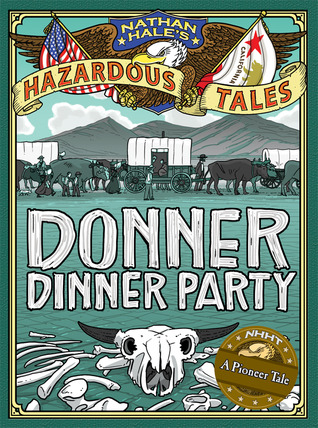
Book Review: Donner Dinner Party, by Nathan Hale (Nathan Hale’s Hazardous Tales), Abrams, 2013

Recommended for ages 8-13

donner

Colonial spy Nathan Hale is sentenced to death by hanging – but WAIT! He’s got stories to tell! His executioner and the British soldier standing guard are intrigued. Off he goes into yet another Hazardous Tale from history, this time, about the infamous Donner Party.

You’ve heard of the Donner Party, if only as a horrific joke. During the Westward Expanion, they were a group of pioneers headed for California who got caught in the brutal winter of 1846 and resorted to cannibalism to survive. Nathan Hale’s book tells the story of the Donner-Reed party, focusing primarily on James Reed, whose “shortcut” caused the doomed wagon train to stray off course into brutal territory.

Written as a graphic novel, this book is a great read for middle schoolers and even the reluctant high schooler. The story cuts between Nathan Hale, the British soldier and the executioner as Hale tells the story, and the story of the Donner-Reed party. The characters are detailed, and kids will love the executioner, who really, REALLY doesn’t want to hear bad news about any of the animals in the story. There are well-drawn diagrams and graphics teaching readers about the members of the party, maps of the territory traveled, and informational bits that enhance the story for all.

Hale doesn’t shy away from the more brutal aspects of this story, but he doesn’t glorify them, either. He presents the facts, even illustrating a specter of death coming for the travelers, with their names, as they pass away, listed on Death’s cloak.

This was my first Hazardous Tale from Mr. Hale, but it certainly won’t be my last. Stock this book in your bookshelves, teachers and parents, and watch kids scramble to learn about history.

Mr. Hale’s website offers information about his other books, his blog (which includes sneak peeks at his artwork for future books!), and a section dedicated to Correction Baby, who helps edit all of his books. Check it out!

DonnerSpread

Posted in Fiction, Humor, Middle School, Tween Reads

Darth Paper Strikes Back, by Tom Angelberger (Amulet, 2011)

Recommended for ages 9-12
After reading Angelberger’s first book in his “Origami” series, The Strange Case of Origami Yoda, I had to get the sequel. I am pleased to say that the sequel matches up to the original.

The McQuarrie Middle School gang is back, but the happy beginnings we saw at the end of Origami Yoda are nowhere to be found; to top it off, Harvey shows up at school with Darth Paper, his answer to Origami Yoda. In no time, Harvey’s managed to get Dwight suspended and under the threat of being sent to a special school for troubled children. Origami Yoda asks Tommy to put together another case file, this time, to show Dwight in a favorable light and get his suspension overturned. With Harvey threatening to throw a wrench in their work at every turn, can Tommy and his friends make everything right again – this time, without Origami Yoda’s advice?

If readers enjoyed Origami Yoda, they will enjoy Darth Paper Strikes Back. The book is written in the same fun, first-person style as the original, and the conflict with love-to-hate-him Harvey (and Darth Paper) adds a fun counterpoint to Origami Yoda’s sage advice while adding some unexpected depth to the book, particularly at the conclusion.
For more information about The Strange Case of Origami Yoda and author Tom Angleberger, you can see my original post.
 
 
Posted in Humor, Middle School, Tween Reads

Book Review: Bindi Babes, by Narinder Dhami (Delacorte, 2004)

Recommended for ages 8-12

The Dhillon sisters – Amber, Jazz, and Geena – are perfect. They are perfect students, perfectly dressed, and perfectly popular. Their teachers always look to them for help with their classmates and for the right answers, and the girls never disappoint. The girls keep their act airtight so no one will sense the pain they are in from losing their mother the year before. The sisters will not even talk about her at home for fear of letting loose all the emotions they have bottled up.

Escaping his grief through work, their father is rarely home and when he is, rarely speaks to them other than to indulge them in nearly everything they ask. When he announces that their Auntie is coming from India to live with them and take care of the girls, they are furious – they certainly do not need anyone to babysit them! When Auntie arrives and starts interfering in their lives – especially when their father starts saying no to new clothes, sneakers and pierced ears – they decide she’s got to go. Marrying her off would be the best way to benefit everyone, but who to choose, and how to do it?

The book is ‘tween chick lit; it is an easy read with little emotional depth or character examination. The ending is predictable but satisfying, and leaves the family’s story open to a sequel. In fact, the book is the first in a 4-book series. Ms. Dhami provides a glimpse into Indian culture which has doubtlessly introduced many girls to a new culture in our increasingly diverse society.

Narinder Dhami has also written the popular film Bend it Like Beckham. Her website offers links to her books, author facts, and a link to Amber’s blog, where the Bindi Babes narrator keeps readers up on the latest gossip. Random House provides a teachers guide complete with discussion questions and links for further reading on diversity.

Posted in Adventure, Fantasy, Middle School, mythology, Tween Reads

Pandora Gets Jealous, by Carolyn Hennesy (Bloomsbury, 2008)

Recommended for ages 10-13

Get ready for Mean Girls meets Clash of the Titans.

Pandora – Pandy to her friends – has no idea what to bring to school for her project on the gods’ presence in their lives. If she brings the piece of her dad, Atlas’, liver again, she’s totally going to fail. When she stumbles across a locked box hidden away, she knows she should not bring it. Her dad told her that she should never open it. But it would be perfect. When the mean girls at school tease her and tell her that the box is worthless, it somehow ends up being opened, and the seven evils escape into the world, and poor Hope ends up being locked in the box.

Zeus and Hera charge Pandora with tracking down and recapturing all of the evils she released in six phases of the moon, or else. Pandy sets off with her two best friends, Alcie and Iole, and a little stealth help from Olympus. Her first stop: Delphi, to recapture Envy.

Pandora Gets Jealous is the first in Ms. Hennesy’s Pandora series; each book features the evil that she and her friends must recapture. Aimed at girls, the writing starts off light, with Pandora appearing almost vapid, but the story becomes intense very quickly. The solid mythology in the book is a great way to bring these stories to a younger, female audience that may still see Greek mythology as something geared toward boys despite there being gods AND goddesses on Olympus. Like Rick Riordan’s Percy Jackson and the Olympians series, Ms. Hennesy makes Greek mythology contemporary for a new audience.

The author, actress Carolyn Hennesy, has a Pandora-focused website with a wealth of additional content on the series including teachers’ guides, book synopses, and a discussion forum.

Posted in Fiction, Middle School, Puberty, Tween Reads

Book Review: Are You There, God? It’s Me, Margaret, by Judy Blume (Yearling, 1970)

Recommended for ages 9-12

This Judy Blume classic follows sixth grader Margaret Simon, whose parents move her from their home in New York to the suburbs of New Jersey, and her search for an identity as she goes through puberty. The book has received numerous awards, including the New York Times Outstanding Book of the Year (1970). In 2005, the book made Time Magazine’s All-Time 100 Novels List.

Margaret meets new friends and they quickly form a secret club called the PTS’s – Pre-Teen Sensations. They have to wear bras to their meetings and they talk about boys, school, and most importantly, when they’re getting their periods. Nancy, the ringleader, makes Margaret uncomfortable with her superior attitude and concern over these things; she’s afraid she’ll be the last to get her period and be made fun of.

Raised without organized religion, Margaret has a very personal relationsihp with God and talks to him whenever she needs a comforting ear. She tells him her insecurities about puberty and her frustration with her family. With the other kids in her neighborhood identifying as either Christian or Jewish, Margaret struggles to know God in one of these faiths, but comes up empty; she asks him, after visiting both a synagogue and a church why she can’t “feel him” the way she does when she talks to him.

I loved this book when I was in sixth grade and re-reading it now, it holds up, mainly because the heart of the story still exists. Mean girls may appear bigger than life now, but Nancy was definitely a pioneering mean girl; Margaret is the Everygirl that we all identified with – insecure about ourselves, insecure about our place in school and our families, and just trying to figure it all out. Blume weaves all of Margaret’s insecurities together to create a solid, realistic character that girls can all identify with. Nobody does puberty like Judy Blume.

Judy Blume’s website features the usual author fare; there is a bio, interview questions, even autobiographical essays. She offers advice on writing and has a section on censorship – she is a very well-known advocate for the freedom to read – and her “Reference Desk” section provides interviews and an index of articles and information about Blume.