Posted in Fiction, Middle Grade, Middle School, Realistic Fiction, Tween Reads

Blind Guide to Normal brings back old friends!

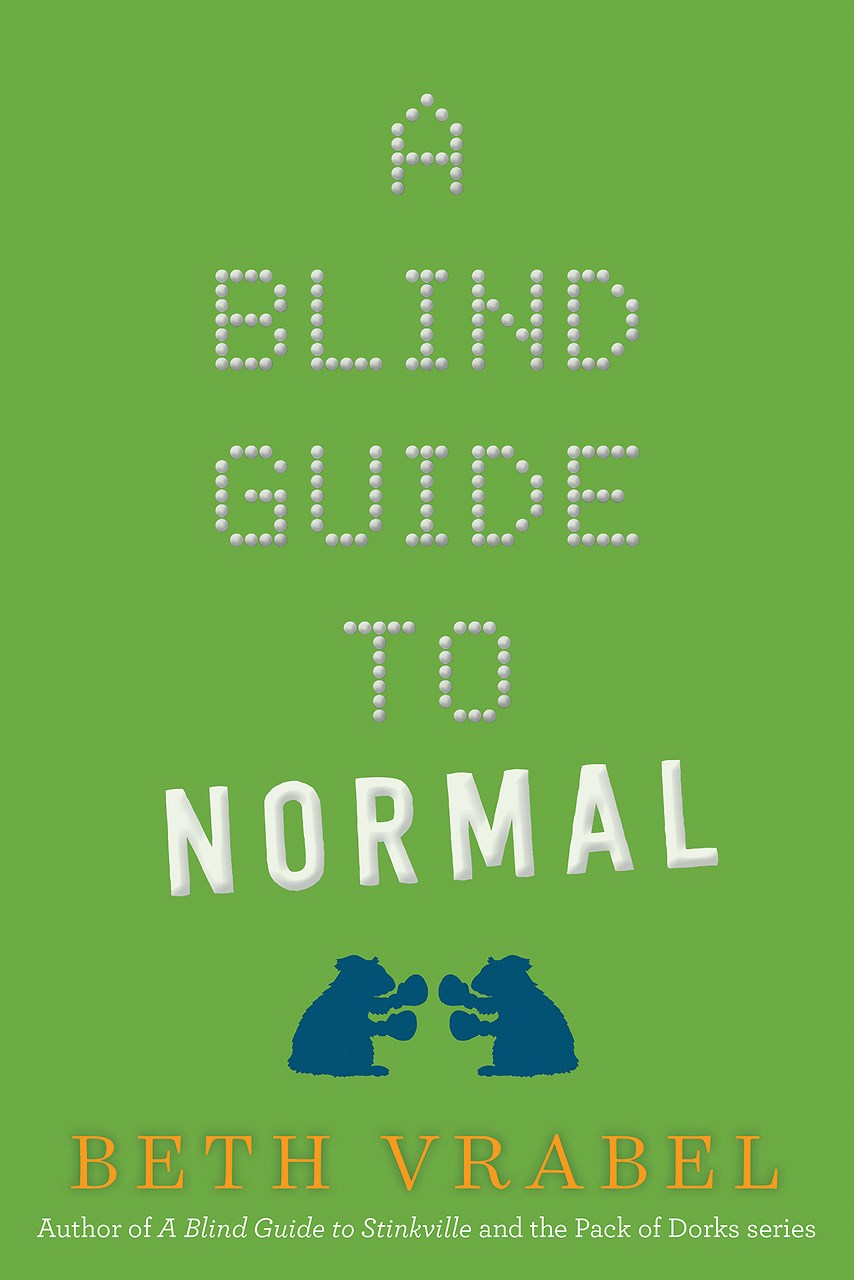
blind-guideA Blind Guide to Normal, by Beth Vrabel, (Oct. 2016, Sky Pony Press), $16.99, ISBN: 9781510702288

Recommended for ages 8-12

Taking place in Beth Vrabel’s Blind Guide universe, readers get to hang out with Ryder, also known as Richie Raymond, in Beth Vrabel’s A Blind Guide to Normal. Ryder is leaving Addison, the school for the blind we were introduced to in A Blind Guide to Stinkville, to head to “normal” school for eighth grade. The thing is, at Addison, Richie was the Big Man on Campus. With his jokes about his prosthetic eye and ability to find a witty comeback for every situation, he was the King of the Hill at Addison. In a mainstream school, it’s starting all over again – and to add to the chaos, he and his mom are moving in with his grandfather while his dad is off studying buffalo. Gramps has a very strange sense of humor, and his cat, General MacCathur, can’t stand him. On his first day of school, Ryder finds himself enrolled in a Quilting class (thanks, Grandpa!), making his bio teacher pass out, and putting himself at odds with the town hero, Max. Forget about fitting in – can Ryder get through the school year as the school punchline? He’ll need some help from his best friend Alice and, unbelievably enough, Gramps, to find out.

Less of a sequel and more of a companion to Blind Guide to Stinkville, Blind Guide to Normal is every bit as great to read as any Beth Vrabel book. Yes, I’m a Vrabel fangirl, and with good reason: she creates characters that I love. They tend to have a sarcastically upbeat outlook, which I can appreciate, and so do many of the kids I talk to in a given day. Her villain here isn’t even a villain, it’s just someone who Max starts off on the wrong foot with, and Max’s gift to see himself descending into car wreck territory but not being able to stop it is so refreshingly normal – how many times have you just not been able to stop talking when you know you’re just making things worse? – that you’ll laugh with embarrassed relief that you’re not alone. I was happy to see Alice again; her FaceTime conversations with Ryder provide a nice, familiar anchor for both Ryder and us readers. His relationship with his grandfather is a great subplot that I hope reaches kids who just don’t get their own grandparents, who they may see as weird or old-fashioned.

I hope Beth Vrabel finds more ways to bring us back to this group of friends. There’s a lot of great diversity in kid lit these days, and Vrabel’s ability to address disability with the suppressed emotion that spills over into a Don Rickles-like wit adds a spark to the expanding dialogue. Get this one and give it to your Blind Guide to Stinkville readers, sure, but also hand this one to your Wimpy Kid readers and tell them that Ryder and Greg would, in the ultimate literary multiverse, probably get along just fine.


Posted in Animal Fiction, Fiction, Middle School, Realistic Fiction, Tween Reads

When activism goes too far? Flip the Bird, by Kym Brunner

flip-the-birdFlip the Bird, by Kym Brunner, (Noc. 2016, HMH Books for Young Readers), $17.99, ISBN: 9780544800854

Recommended for ages 11+

Issues with hunting, falconry, and animal rights activism all come together in Kym Brunner’s Flip the Bird. Fourteen year-old Mercer Buddie wants two things out of life right now: he wants a girlfriend, and he wants to be a falconer, like his father and brother. He’s training as an apprentice to his father, a master falconer, but feels like his dad favors his jock of an older brother and is too critical of him. He captures a red-tailed hawk that he names Flip – to show his dad that falconry doesn’t always have to be a Very Serious Business – and has a few short weeks to train him for the big falconry meet; he’s got his eye on the Best Apprentice Award. Then he meets Lucy, who’s gorgeous and has a great personality and seems to be just as interested in him; the only problem is that she and her family are part of a fanatical animal rights organization called HALT. Mercer tries to play both sides to stay in Lucy’s and his family’s good graces, but sooner or later, the two halves of his life are going to converge. His mother is a scientist at a university lab doing medical research, and his father has a raptor rehabilitation center in addition to being a falconer – which means, a hunter. There are a lot of difficult choices in Mercer’s immediate future.

Flip the Bird brings together a lot of hot button topics to create a moving story about family and going with the crowd. Told in the first person by Mercer, the narrative is humorous while discussing the frustrations of being the little brother; the struggle to be treated like a responsible young adult, and the difficulty in making decisions that may be unpopular with the people you want to impress the most. To impress Lucy, Mercer joins the HALT collective she forms at school, but this puts him at direct odds with his family, and they let him know it. There are consequences to his actions, and we see Mercer grow as he faces those consequences. There’s interesting information about falconry and raptor rescue here, which will appeal to fans of animal fiction and birds. While the author gives a shout-out to some of her research sources in her acknowledgements, and does emphasize the extreme commitment that falconry requires, I’d have liked to see links to information about raptor rescue at the end of the book. I did some quick searching and came up with a quick list for anyone interested: The Raptor Trust, Wild Bird Fund, and A Place Called Hope. PBS’ Falconer’s Memoir page offers a map of states permitting falconry and links to classroom activities for using “A Falconer’s Memoir” in the classroom. The World Wildlife Fund is an organization that works with wildlife conservation and endangered species, and most large zoological preserves pioneer conservation and rehabilitation practices for animals in the wild. Kym Brunner is also a seventh grade teacher, and her author website offers presentations that you can use in the classroom.

I enjoyed the book and the characters. I’ll be adding this to my shelf; if you’ve know realistic fiction, animal fiction, or middle schoolers looking for something new and different to read, add this one to your shelves and shopping lists.

Posted in Fiction, Fiction, Humor, Middle Grade, Middle School, Realistic Fiction, Tween Reads

Blog Tour: Scenes from the Epic Life of a Total Genius

9781492638025-prScenes from the Epic Life of a Total Genius
By Stacey Matson
November 1, 2016; Hardcover, ISBN 9781492638025

Book Info:
Title: Scenes from the Epic Life of a Total Genius
Author: Stacey Matson
Release Date: November 1, 2016
Publisher: Sourcebooks Jabberwocky

Summary:
Lights. Camera. Action! Arthur Bean is back and headed for the big screen.
Arthur and Robbie have called a truce now that the writing contest and school play are over, but plans go astray when Arthur’s new girlfriend, Anila, gets jealous of his friendship with cool-girl Kennedy. And then there’s that little problem of the movie camera Arthur and Robbie borrowed to film their upcoming blockbuster movie…
As Arthur’s life goes off the rails all over again, laughs for the reader are right on track. Emails, doodles, texts, newspaper articles, and AV Club rules (which Arthur and Robbie usually break) give the story the same engaging look as A Year in the Life of a Total and Complete Genius.

Read an excerpt from Scenes from the Epic Life of a Total Genius right here!

 
Goodreads Link: http://ow.ly/7uP4305QZjm

Buy Links:
Amazon: http://ow.ly/2aE0305QZq5
Barnes & Noble: http://ow.ly/Ytjl305QZy0
IndieBound: http://ow.ly/XtcS305QZEc

About the Author:
Stacey Matson has worked in a theater program on Parliament Hill and written theater pieces for the Glenbow Museum and for the All-Nations Theatre in Calgary. She earned her master of arts in children’s literature at the University of British Columbia. Stacey lives in Vancouver, British Columbia. Visit Stacey at staceymatson.com.

Social Media Links:
Author Website: http://www.staceymatson.com/
Twitter: https://twitter.com/staxie

Enter a Rafflecopter giveaway for your chance at a copy of Scenes from the Epic Life of a Total Genius! Runs November 6-November 18 (US & Canada only)
https://widget-prime.rafflecopter.com/launch.js

Posted in Fiction, Fiction, Humor, Middle Grade, Middle School, Puberty, Realistic Fiction, Tween Reads

Realistic Fiction that works: Still a Work in Progress

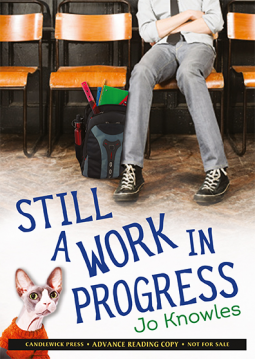
still-a-work-in-progressStill a Work in Progress, by Jo Knowles, (Aug. 2016, Candlewick Press), $16.99, ISBN: 9780763672171

Recommended for ages 9-13

Noah’s trying to make it through seventh grade: his friends are weirding out, girls are weird, and his home life… don’t ask. His older sister, Emma, has been acting strange again. Her increasingly difficult food demands are driving Noah crazy – he really doesn’t like seitan; he just wants a burger – and she’s doing things like wearing lots of bulky clothing layers, moving her food around the plate without actually taking a bite, and arguing with everyone. Just like she did when The Thing They Don’t Talk About began last time. Noah’s only solace these days seems to be in the art room, where he can express himself without stress.

Still a Work in Progress is one of those great middle grade books that tackles tough issues within the framework of every day life: meaning, there’s a lot of laughter, a lot of confusion, and some pain. Overall, the book, narrated by Noah, is hilarious. The dialogue between him and his friends sounds like things I’d overhear my kids talking and arguing about, and Jo Knowles really captures Noah’s inner dialogue beautifully: the mixture of anger and concern for his sister, in particular. Ms. Knowles gives readers a realistic novel that brings together school life, home life, friend life (any kid will tell you friends are a separate sphere), and the frustration of moving through these areas while in the pull of something much, much bigger than you. I also loved the real star of the book: a hairless cat named Curly, who lives at the school and hangs out with the kids (Curly’s on the cover of the book, so you know this is an important cat.)

Great middle grade novel for realistic fiction readers. There’s always a call for good, realistic fiction in my library, so this one will get a good booktalk. Check out Jo Knowles’ author website for a link to the book’s Pinterest page and downloadable discussion guide.

Want more? Here’s Jo Knowles talking about the inspiration behind Still a Work in Progress.

Posted in Middle Grade, Middle School, Non-Fiction, Non-fiction, Teen, Tween Reads

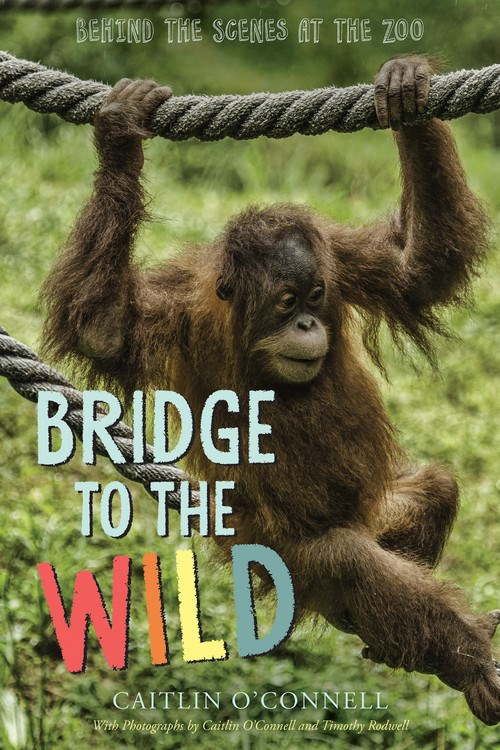
Bridge to the Wild: Zoos connect people and animals

bridge-to-the-wildBridge to the Wild, by Dr. Caitlin O’Connell/Photographs by Timothy Rodwell, (Aug. 2016, HMH Books for Young Readers), $18,99, ISBN: 9780544277397

Recommended for ages 10 and up

I’m about to gush here. If you read my reviews often enough, you probably have guessed that I love any nonfiction book about animals, conservation and preservation, and even better when the ideas are combined. In Bridge to the Wild, Dr. Caitlin O’Connell begins by recalling a childhood visit to the zoo – back when animals were still largely kept in cages (I remember it well), and saw a gorilla, seemingly in deep despair over living in a cage not much bigger than he was.

Thankfully, those days are (mostly) over. Zoos are more like natural preserves now, offering many animals larger spaces to roam; conservation and preservation is the order of the day, with zoo staff rescuing and caring for animals all over the world. As more animals face extinction at the hands of poachers, habitat devastation, and pollutants that contaminate their environment, zoos are playing a bigger part in keeping our wildlife alive, and conducting valuable research on improving their conditions and our world. Bridge to the Wild is Dr. O’Connell’s manifesto, where she lays out the valuable ways zoos are a bridge for humans, to the wild outside our doors.

Dr. O’Connell spent a week working with the staff at Zoo Atlanta –  a private, nonprofit wildlife park and zoo – to observe the relationships between animals and caretakers, to help strengthen this bridge. After all, what we see as observers is only the tip of the iceberg; many, many loving and brilliant people are behind the scenes, learning about and learning from the animals, caring for them, loving them. From the Dawn Chorus – the morning symphony conducted by the tenants as the day begins, to the Dusk Chorus, when they start winding down for the night, Dr. O’Connell and Tim Rodwell introduce us to the inhabitants of Zoo Atlanta, from the pandas, to the hornbills, meerkats, gorillas, tigers and more.

There are anecdotes and beautiful photographs, a “Keeper Feature” that profiles the different keepers at Zoo Atlanta, and a fantastic note on ignorance and extinction, which is a real call to action to end senseless poaching of animal parts for talismans and “remedies” that simply don’t work. A full bibliography and sources are available and provide more research opportunities, and data sheets encourage budding zoologists to do some research on their own, guided by Dr. O’Connell, who lays out simple experiments to observe and record behaviors.

Animal books are hugely popular with my Corona Kids, and I’ve been stacking my collection with plenty of rescue, preservation, and conservation titles for them, to drive home the point that this planet doesn’t only belong to us. Bridge to the Wild is going to be one of those books I talk endlessly about, especially since my library is about a stone’s throw away from the Queens Zoo. I may even slip copies of this book into teachers’ hands during class visits, with a “hint, hint” nudge for a class trip activity (sorry, kids!). That’s how important this book is to me.

Bridge to the Wild has received a starred review from School Library Journal. Learn more about Dr. O’Connell’s work and books at her author website.

Take a peek at a chapter excerpt on meerkats, then go order this book for your animal lovers!
meerkat_1


Posted in Middle School, Non-Fiction, Teen, Young Adult/New Adult

Trying to Float: A New York Childhood

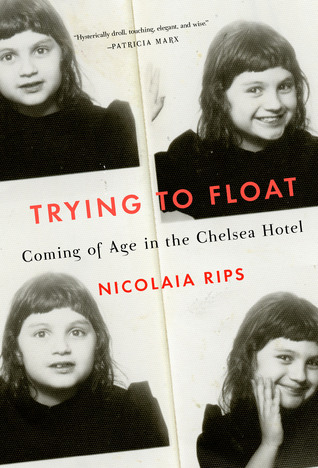
trying to floatTrying to Float: Coming of Age in the Chelsea Hotel, by Nicolaia Rips, (July 2016, Scribner), $25, ISBN: 978-1501132988

Recommended for ages 14+

New York City’s Chelsea Hotel is part muse, part myth. Home to countless artists, luminaries, and eccentric personalities over since it opened its doors in the late 19th century, the Chelsea  seemingly received as much inspiration as it gave. Art decorated the walls of the hotel, often put there by artists moved to add their voice to the hotel’s presence. Among the more recent Chelsea residents were the Rips family: lawyer, Michael, model-turned-artist, Sheila, and their daughter, Nicolaia. It’s Nicolaia’s story we get in Trying to Float: Coming of Age in the Chelsea Hotel.

Nicolaia wrote the memoir of her formative years at the Chelsea before she graduated high school. The project was inspired by her parents, who told her to journal her stories from school and life in general – so kids, take those journaling assignments seriously! Nicolaia’s story, told in a series of anecdotes and memories, alternates between laugh-out loud funny and painfully spot on. She was the lonely kid in the crowd, her parents often wrapped up in their own eccentricities, and she seemed to figure out a lot on her own, or with the help of some of the Chelsea residents.

Her self-deprecation and her wise-beyond-her-years insights make this book an unputdownable read. Teens will love this because they’ll identify with so many moments: mortification at a birthday party, mean girls spreading rumors about you right in front of you, a parent making you want to move away and start life over under the teenager’s version of a witness/parent protection program. New Yorkers and people who love New York will love it because it’s a slice of life in New York City.

Trying to Float received a starred review from Kirkus. Do not miss this one. Get a copy for yourself, get a copy for a teen in your life, and booktalk it with some more New York stories. There are tons out there, including the photo essay book, Living in the Chelsea Hotel by Linda Troeller.

Posted in Fiction, Historical Fiction, Middle School, Realistic Fiction, Teen, Tween Reads

In The Gallery, art speaks volumes – who’s listening?

galleryThe Gallery, by Laura Marx Fitzgerald, (June 2016, Dial Books), $16.00, ISBN: 9780525428657

Recommended for ages 10+

It’s 1929, and 12 year-old Martha has gotten herself thrown out of school for the rest of the school year. Her Ma certainly isn’t going to let her sit home and do nothing, so Martha ends up going to work as a maidservant for Mr. Sewell, the wealthy owner of a major New York newspaper, and his reclusive wife, Rose. Martha’s mother is in charge of the household and oversees all the staff, and Rose isn’t getting any favors by being Ma’s daughter: she’s put straight to work in the kitchen, scrubbing, sweeping, and mopping. She also hears a lot of talk from the servants in the house, who say that Rose is crazy, but Martha isn’t buying it: there’s more there than meets the eye, especially because Mr. Sewell gives her the creeps. When she discovers the Sewell gallery, a conversation with Alphonse – a servant who also seems to know more than he’s letting on – confirms Martha’s suspicions. By learning more about the art that Mrs. Sewell sends down from her locked room to be displayed in the gallery, Martha puts together the real story about what’s going on at the Sewell house.

The only thing better than the story taking place in The Gallery is the fact that it’s based on a true event. Ms. Fitzgerald’s captivating author’s note at the end of the story fills in some crucial details about the story, the true story that inspired it, and more information about events taking place at the time the story unfolds. The Jazz Age, on the brink of the stock market crash and ensuing Great Depression, had anarchists, performers both glitzy and outrageous, defined separation of classes, and a lot of backstabbing, both professionally and personally. It was a fascinating time, and The Gallery is a fascinating look into some of that era.

The Gallery is a metaphor for there being more than just face value to things. Martha sees past Mr. Sewell’s exterior, to be sure, but there’s also a touching subplot about a girl coming of age in the middle of this madness, and realizing that her father isn’t the person she thought he was, either.

Every single character in this book is interesting; the story’s pace is perfect, with just enough exposition, then a slow but consuming buildup to the big finale. The bookend story that frames the entire narrative is just so good, and brings readers full circle. This is a great book to introduce to middle schoolers who want something… more. You know the readers: they want something, but not what everyone else is reading. They aren’t really sure what they’re in the mood for, but they want a good book. This is that book. Suggested books I’ve seen are Chasing Vermeer and The Westing Game, neither of which I’ve read, but have heard great things about. As they’re art-related mysteries, display them together. I’d also suggest The Girls at the Kingfisher Club, an excellent Jazz Age re-imagining of the beloved fairy tale, The Twelve Dancing Princesses, and also includes an autocratic, wealthy male figure that wants to keep the girls in his life locked away so he doesn’t have to deal with them.

Definitely worth the add to your collections. I’m thinking of gifting this to the eldest’s girlfriend; she loves a good story. It’s lovely when there are readers all around you!


Posted in Intermediate, Middle Grade, Middle School, Non-Fiction, Non-fiction, Non-Fiction, Tween Reads

Inside Your Insides puts you under a microscope

inside your insidesInside Your Insides: A Guide to the Microbes That Call You Home, by Claire Eamer/Illustrated by Marie-Eve Tremblay, (Sept. 2016, Kids Can Press), $17.95, ISBN: 9781771383325

Recommended for ages 8-12

This interesting nonfiction book takes a look at the microbes that live on our bodies: in our hair, on our skin, and the ones we pick up everywhere we go. We’re microbiomes: a walking, talking collection of microbes, and Inside Your Insides introduces us to some of the most common microbes we share our surroundings with. We learn about bacteria, archaea, viruses, fingu, protists and mites; their preferred environments; and all the places they live on and around us. Complete with brightly colored, cartoony illustrations, makes this a good introduction or companion for middle grade science students.

There are some good callout facts and groan-worthy jokes scattered throughout the book, and a glossary and index round everything out. Kids will learn that not all bacteria are bad for you: you don’t need everything antibacterial, and it may be doing more harm than good, anyway! A section dedicated to saving our microbes goes into detail on how to take care of ourselves to attract the “good” microbes: play outside, eat lots of fruits and vegetables, and explore your world. The combination of clear, instructional writing with a humorous bent, and the eye-catching illustrations, kids will get a kick out of this intro to microbiology. It’s a good additional purchase for collections where science books circulate.

You can also direct kids to the Genetic Science Learning Center’s Human Microbiome site. There are teacher resources, interactive simulators, informative videos, and information that’s written in a clear, interesting way to get kids excited about learning more.


Posted in Fiction, Fiction, Humor, Intermediate, Middle Grade, Middle School, Realistic Fiction, Tween Reads

A teaspoonful of drama queen: Dara Palmer’s Major Drama

dara palmerDara Palmer’s Major Drama, by Emma Shevah (July 2016, Sourcebooks Jabberwocky), $16.99, ISBN: 9781492631385

Recommended for ages 8-13

Dara Palmer was born to be a star: just ask her, she’ll tell you.  But when she’s passed over – once again – for a part in the school play, The Sound of Music, Dara wonders whether it’s because she looks different. Was she passed over to be Maria because she doesn’t look like a typical fraulein? It’s not, as she learns: she just can’t act. Or rather, she overacts. But this episode starts Dara thinking about her life: about being Cambodian, about being an adoptee, and about not seeing any actresses or models who look like her. And then, it hits her: she’s going to write a play about her own life. Because she has to be the star of that, right?

Emma Shevah nails it again. I loved her voice as Amber in Dream On, Amber; here, she captures another tween who’s facing some big issues: realizing the world doesn’t revolve around her, and feeling like one person “on the inside” while looking like a different person “on the outside”. As an adoptee, she wonders about her birth parents and the circumstances that led her to the Happy Family home where she ended up, ultimately being adopted by her British family. As she becomes more aware of who she is – beyond her daydreams of marrying her British actor crush – she notices that no one looks like her in Hollywood, or on the covers of magazines, and this motivates her to action. She also realizes what fair-weather friends are, and handles it with a minimum of angst, which is beautifully done.

Dara Palmer’s Major Drama has received a starred review from School Library Journal. Booktalk this with Shevah’s first book, Dream On, Amber, and  Nancy Cavanaugh’s Just Like Me.  A great add to reading lists and collections all around for its discussions about adoption, diversity, and ethnicity.


Posted in Fiction, Fiction, Humor, Middle Grade, Middle School, Puberty, Realistic Fiction, Tween Reads

The Dorks are back! Pack of Dorks goes to Camp!

camp dorkPack of Dorks: Camp Dork, by Beth Vrabel (May 2016, Sky Pony Press), $16.99, ISBN: 9781634501811

Recommended for ages 8-12

Lucy and her friends are back in the sequel to Pack of Dorks! The school year is done, and Lucy and her pack are headed to camp: Camp Paleo, where the group gets to live like cavemen for the next week. Because Sheldon thought it would be a cool idea. Sam backs out at the last minute to go to a gymnastics training camp, but Lucy’s grandma comes along for the summer, working as a lunch lady at the techy camp next door. Camp Paleo is decidedly not techy. The campers dig for fossils, learn archery, and have really, really cold, showers with bugs for company. Mr. Bosserman, the camp leader, is a grumpy old man, and Lucy feels her pack falling apart as the week progresses. Lucy’s got to look at some of her own choices and own up to things she’s said and done before she finds herself on the outs for good.

Camp Dork is a solid sequel to Pack of Dorks, which was brilliant in its depiction of a group of tweens coming together to embrace the things that made them unique. They owned their Dork label at school, but sometimes, you don’t want to be a label: you want to be a person, and you don’t want to be fettered by a word that supposedly describes all that you are. It’s something Lucy has to learn, and it’s something that readers are learning, right along with her. Camp Dork explores how people – especially tweens, but even adults – are perceived by different people, at different times, in different situations.

Camp Dork is a great summer read for tweens who are at the same point in their lives: discovering who they are, cultivating different interests and new friends, and maybe, fighting a little bit of change in their lives. If you loved Pack of Dorks, don’t miss Camp Dork. If you didn’t read Pack of Dorks, no worries – there’s enough exposition in Camp Dork to catch you up without you feeling lost.

I love the way Beth Vrabel writes. The dialogue just flows, and it’s at once loaded with inner frustration, wit and sarcasm, and honesty. I just saw on her website that another of her books that I really enjoyed, Blind Guide to Stinkville, has a sequel coming out this Fall, so I’ll be all over it.

There’s a really good librarian-created discussion guide to Pack of Dorks on Beth Vrabel’s website, which makes me feel like I need to start coming up with these things for all the books I read.