Time for Kids 2017 Almanac, by the Editors of Time for Kids, (May 2016, Time for Kids), $12.99, ISBN: 978-1618934154
Recommended for ages 8-12
The latest TFK Almanac presents facts, news, current events, and information, curated from previous issues of Time for Kids magazine in one fun, interactive volume that’s a great desk reference for middle graders. The almanac covers the following subject areas: A Look Back (covering the previous years’ current events); Animals; Arts; Body and Health; Books; Calendars and Holidays; Computers and Games; Countries; Energy and the Environment; Entertainment; Geography; History; Inventions and Technology; Science; Space; Sports, and The United States. There are over 600 photos, quizzes and activities at the end of each section, and maps and timelines throughout the book. Kids will get a kick out of the year’s entertainment and world events wrap up and benefit from reference resources like the breakdowns of the world’s countries, which includes literacy rates, languages, currencies, and capitals; a breakdown of the branches of our government, listing of the states and Presidents, and walkthrough of the scientific method.
This is one of those references that deserves space on students’ desks, right next to their dictionary and thesaurus. It’s a big homework help, with a little extra fun to keep things interesting. I’ll keep one copy in Reference and one or two on the shelves here at the library.
Titanic: Young Survivors (10 True Tales), by Allan Zullo, (Dec. 2015, Scholastic), $5.99, ISBN: 9780545818391
Recommended for ages 10-12
Another solid addition to the 10 True Tales series, Allan Zullo researched survivor stories of the kids who survived the Titanic sinking and told their stories. With heartbreaking statistics – only 86 of about 195 young people under age 17 survived – and tear-jerking stories of children saying goodbye to their fathers as they were lowered into lifeboats, these stories are tough to read, but create an emotional link between readers and the kids who survived the tragic sinking of the luxury liner over 100 years ago. It’s a good additional book to add to nonfiction collections; one that will go beyond the facts and straight to the heart of the people and what they lost. Each story includes a brief epilogue that details what happened to the survivors after arriving back in New York, and any information about the recovery of the survivor’s family members.
If Allan Zullo’s name is on it, I buy it. He’s written over 100 nonfiction books for kids, and knows how to write series nonfiction that reads like page-turning fiction. He knows the subject matter that kids like to read about, from war heroes to surviving sharks, and he makes sure to get a kids’-eye view with books like Kid Pirates and Teens at War. He puts the real face of history into nonfiction text by telling the stories of people affected by world-shattering events.
A Weird and Wild Beauty: The Story of Yellowstone, the World’s First National Park, by Erin Peabody (Feb. 2016, Sky Pony Press), $14.99, ISBN: 978-1-63450-204-7
Recommended for ages 12+
A beautiful book with stunning photo and a powerful ecological and historical message, Erin Peabody’s A Weird and Wild Beauty tells the story of the founding of Yellowstone National Park. She tells us about the hard journey and oftentimes grueling expedition West; about the lives of the men who explored and risked their lives to bring the natural beauty of Yellowstone to the rest of the post-Civil War United States; and provides breathtaking photos and paintings of the natural wonder that is Yellowstone.
More than just a book on the beauty of Yellowstone, readers will discover that there was a fight to keep Yellowstone’s lands untouched: from Jay Cooke, a robber baron who wanted to build a transcontinental railroad that would cut through the lands, to the Native American tribes who wanted their tribal homelands to remain untouched.
A welcome addition to tween and teen nonfiction, A Weird and Wild Beauty is a lovely addition to collections in classrooms, libraries, and homes. I’ll have to booktalk this one to let the kids know it’s on the shelf – nonfiction, especially in the YA area, tends to go unnoticed – but with summer vacation coming, I could pick any picture out of this book and talk about dream destinations. History fans will love the narrative storytelling voice Peabody assumes, and art fans need to know about this book because of the stunning work by the expedition’s photographer, William H. Jackson, and the painter, Thomas Moran. Readers will learn the complex processes behind each photo – there were no negatives in the early days of photography, so photographers (and their poor pack animals) had to carry hundreds of pounds of equipment, including glass plates of different sizes to capture different images – and painting, or woodcut. It’s a beautifully artistic book that art students should not miss.
The book includes maps, a guide to Yellowstone’s hydrothermal features, complete endnotes, sources, photo credits, and an index. Make sure to consider this beautiful resource for your collections.
The President and Me: George Washington and the Magic Hat, by Deborah Kalb/Illustrations by Robert Lunsford, (Feb. 2016, Schiffer Publishing), $12.99, ISBN: 9780764351105
Recommended for ages 8-12
Fifth grader Sam is feeling down. He’s a bit of an introvert, and when his best friend, Andrew, seemingly abandoned him to get more involved in sports, he feels more alone than ever. Plus, the most annoying kid in school took the part he wanted in the school play: the role of George Washington! During a trip to Washington’s home at Mount Vernon, Sam finds himself drawn to a beat-up old hat in the gift shop, but this is no ordinary hat: it’s a magic hat that sends him off to the 18th century, where he meets George Washington himself! As Sam travels back and forth between the present day and the 18th century, he finds himself witnessing pivotal moments in George Washington’s life, and just possibly, building a friendship with the charismatic leader.
The President and Me is a fun middle grade fantasy adventure. The hat has a personality all its own, which makes for some amusing moments; whether he’s trying to find out what a bus is or what this newfangled century is all about, or blathering on while Sam’s trying to keep him a secret, the hat is a good supporting character for Sam, often encouraging him by showing him a time in George Washington’s history that teaches Sam a lesson he desperately needs – lessons that operate under the guise of history, but carry some pretty great lessons that help Sam learn about himself, too. Black and white illustrations add interest.
Readers will find some interesting history and facts about George Washington in the book, too. Most of us know by now that George didn’t really chop down a cherry tree, let alone confess the fact to his dad, but did you know that Mount Vernon was his brother’s estate first? Or that he wanted to be a sailor before he wanted to be a soldier? The author includes some helpful sources in her acknowledgements; pair that with some resources of your own and give kids a great George Washington or Colonial America bibliography. There are a few questions left unanswered, but you can use those areas as kickoffs to discussions. (What would happen if George Washington were given a LEGO spaceship?)
A light, fun addition to your historical fantasy fiction collections.
What Was It Like, Mr. Emperor? Life in China’s Forbidden City, by Chiu Kwong-chiu and Eileen Ng (translated by Ben Wang)/Illustrated by Design & Cultural Studies Workshop, (Oct. 2015, China Institute in America), $12.95, ISBN 978-0-9893776-6-9
Recommended for ages 8-13
Kids learn about the U.S. Presidents, some European royalty (usually Ferdinand and Isabella in Spain, Henry VIII, Elizabeth I, and King George III in England), and current heads of state, but Chinese emperors and ruling dynasties isn’t something that’s normally found on the curriculum. The China Institute in America is taking this dilemma on with the book, What Was It Like, Mr. Emperor? Life in China’s Forbidden City. One of four We All Live in the Forbidden City books, Mr. Emperor introduces kids to China’s emperors, with brief biographies and answers to questions like, “How was the emperor chosen? What was school like? Who were his friends?” We learn a little bit about each emperor – princes who fought off rebel invasions, princes who didn’t do a whole lot during their reign, one emperor who ruled twice, and the roles of other members of court life, including the palace maids, the dowager empresses, and the many advisors to the rulers.
There’s a lot of information packed into these beautifully illustrated pages, and it’s a great companion for an elementary unit on China. It brings the history to kids with questions that they’ll be interested in, and easily digestible facts illustrated by artist Chiu Kwong-chiu. The We All Live in the Forbidden City website is loaded with activities and resources to expand the discussion.
The original book and content have been developed in Hong Kong in consultation with the Forbidden City’s Palace Museum in Beijing, ensuring authentic content and resources.
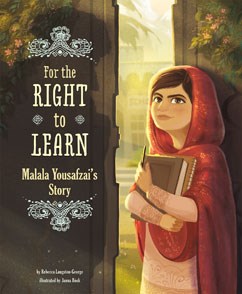
For the Right to Learn: Malala Yousafzai’s Story, by Rebecca Langston-George/Illus. by Janna Bock (Sept. 2015, Capstone), $15.95, ISBN: 9781623704261
Recommended for ages 9-14
There are some great books available on Malala Yousafzai, the Pakistani teenager that defied the Taliban by demanding education for girls and young women, and was shot for her activism. I have most of them in my library – I buy every book I can on Malala, because I want boys and girls alike to know her story and understand that education is a right that not every child enjoys in this world, and the lengths that children will go to in order to have that right.
Rebecca Langston-George’s book For the Right to Learn: Malala Yousafzai’s Story, illustrated by Janna Bock, is nonfiction that reads like fiction. We’ve seen Malala’s photos at the UN, of Malala in the hospital, Malala with her family, but illustrating a book on Malala allows us to see the events in her life that led to the present. Digitally created images, like Malala writing science formulas on her hands when other girls drew flowers are powerful and beautiful. The fear in her eyes and her friends’ eyes when a Taliban soldier boards her school bus, looking for her, grips readers who know what will happen – the drops of blood on a fallen book, set against a stark white background with the words, “Three shots shattered the silence”, is incredibly effective.
For visual middle grade learners, this is a great companion to any social studies/current events discussions. There is a glossary and an index in the back of the book, and there’s a great blog with Web resources that can round out any lesson plan on Malala.
Child Soldier, by Michel Chikwanine & Jessica Dee Humphreys/Illus. by Claudia Davila, (Sept. 2015, Kids Can Press), $18.95, ISBN: 9781771381260
Recommended for ages 10+
In 1993, Michel Chikwanine was a 5 year-old boy living in the Democratic Republic of Congo. He admired his father, a human rights lawyer, and loved his mother, who took care of children from all over the neighborhood who needed food or care. He was surrounded by friends and family, played soccer, and goofed off with his friends.
His father talked to him about the world as they listened to the news on the radio together; he had no idea that he would become directly involved in world events so soon, though.
On the way home from school one day, he was kidnapped by rebel militants and forced to become a child soldier. He was drugged and forced to kill, tortured and starved, until weeks later, he was able to escape and return to his family. But how do you return to a life when, at the age of 5, your childhood has been taken away?
This heartbreaking, yet inspirational biography is Chikwanine’s story, told in graphic novel format. Michel provides a brief background on his country, so that we may follow the history of conflict that has led to a society that creates child soldiers. We see his parents struggle to give Michel his life back and the risks they take as activists to fight against this happening to another child, ever again: his father is jailed, his home attacked, and his family separated as they escape to protect Michael and his siblings.
The story is told, both in words and pictures, in a way that will grasp younger readers’ attention. They can see themselves in Michel’s childhood: playing games, enjoying friends and family, attending school. The story, while horrific, never becomes too graphic for younger readers – it’s important, because we need younger readers here to know this is happening to children their age and younger. It’s also important for children to see that adults can take care of their children; we see Michel escape on his own, but adults in his village return him to his family, and his family takes action to protect their son.
Child Soldier is ultimately an inspirational story: Michel’s childhood has been taken from him, but he rises from the ashes and recreates himself, becoming a young man with a mission. He is a human rights activist with a story to tell and motivates young people to action. A graphic novel is a wonderful and powerful way to introduce a discussion on human rights in the classroom, and Child Soldier includes discussion questions and information, information on how to get involved and help, and primary sources for further research to facilitate these discussions.
Over the last two summers, I’ve noticed more books on child soldiers showing up on summer reading lists for kids in grades 4 and up. I’m glad to see this subject being addressed in the schools, and hope that this book is on next year’s summer reading lists.
Child Soldier is a book in Kids Can Press’ Citizen Kid series, a collection of books about global issues that seeks to make our kids better global citizens.
Child Soldier is on sale on September 1, but you can take a look at the book trailer here and see some of Claudia Davila’s beautiful artwork.
Women Heroes of the American Revolution: 20 Stories of Espionage, Sabotage, Defiance, and Rescue, by Susan Casey (Mar. 2015, Chicago Review Press), $19.95, ISBN: 9781613745830
Recommended for ages 10-14
You’ve heard about Dolly Madison saving Washington’s portrait as the White House burned during the War of 1812. You’ve probably even heard of Molly Pitcher, who took up arms against the British after her husband fell in battle. But did you know about Sybil Ludington, the daughter of a revolutionary colonel, who rode twice as far as Paul Revere in order to warn her father and his troops of an impending attack? Or Deborah Sampson, who donned a man’s uniform and went to war, only to be denied a pension until George Washington himself intervened? Did any of us learn Phyllis Wheatley, kidnapped and sold into slavery at the age of 7, who supported America’s independence and wrote poetry celebrating George Washington?
You can find stories about these women and 11 more in Susan Casey’s Women Heroes of the American Revolution. The book is divided into five parts:Resistors, Supporters and Rescuers; Spies; Saboteurs; Soldiers and Defenders of the Homefront, and Legendary Ladies. Each section highlights 3-5 women who contributed, each in her own way, to the American Revolution. There are images and sources aplenty available for further research, along with a bibliography and further notes available for readers who want to learn more. A glossary helps readers with some terms they may be unfamiliar with.
This is a great go-to reference when beginning a project. I’ve had students come in and ask for books on the American Revolution, where they want to write on a more specific historical figure, but aren’t exactly sure where to begin. Getting some focus on lesser-discussed historical women would be a great way to generate interest for those students who may want something, or someone, “new”.
Women Heroes of the American Revolution is a great addition to Chicago Review Press’ “Women Heroes” series.
Susan Casey’s author page has great resources for librarians, particularly about her Women Invent! and Kids Invent! books.
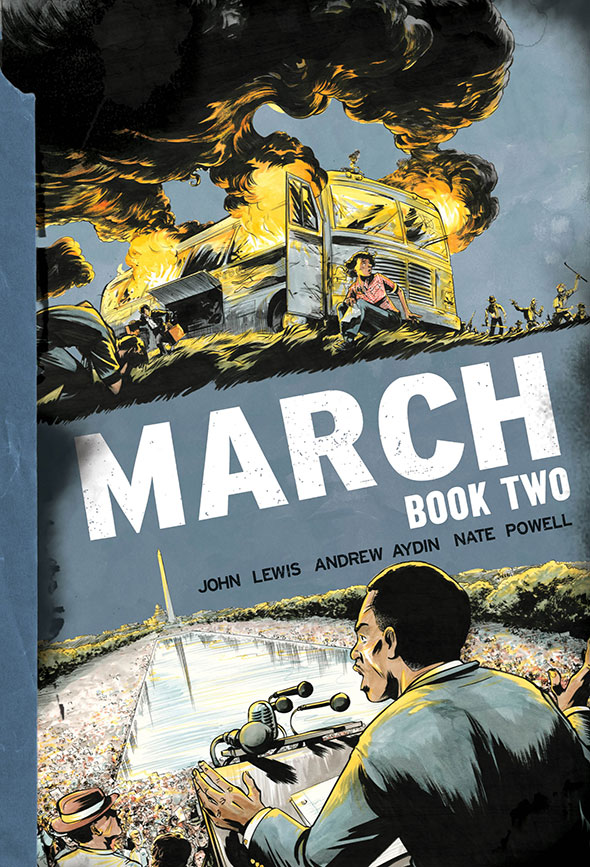
jI’ve made no secret that Rep. John Lewis’ MARCH: BOOK ONE was one of the best books I read last year, and that I was excited about the next book in the series. Well, we’re one step closer – Top Shelf just revealed the cover earlier today!
US Congressman and civil rights icon John Lewis made history with the release of March: Book One, his award-winning and #1 bestselling graphic novel memoir co-written with Andrew Aydin and drawn by Nate Powell. Aside from the unprecedented factor of such a major figure using the graphic novel format, the book has been embraced as both a true work of literature and also a much-needed tool for reaching new generations with the history and lessons of the civil rights movement.
Today, for the first time, we’re revealing the gorgeous cover design of March: Book Two, the much-anticipated second part of the March trilogy. It’s scheduled for release in early 2015, so we’re still half a year away — but the interest in this title is so tremendous that we wanted to showcase something special now, as we head into Comic-Con next week.
Book Two will be significantly longer than Book One, taking a step forward into the tumultuous events of 1961-1963 while continuing the framing narrative of President Barack Obama’s inauguration in 2009. Major plot lines include the famous journey of the Freedom Riders, imprisonment at Mississippi’s Parchman Penitentiary, and young John Lewis’ involvement in helping to plan and lead the legendary 1963 March on Washington.
Nate Powell’s powerful cover showcases (on top) the Freedom Riders’ bus set on fire by a white supremacist mob in Anniston, AL, May 14, 1961, and (on bottom) Lewis’ fiery speech at the March on Washington, August 28, 1963.
Check out this great piece from CNN featuring Rep. Lewis, Andrew Aydin, and author Brad Meltzer!
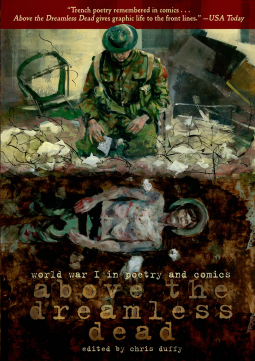
Above the Dreamless Dead, edited by Chris Duffy (:01 First Second, Sept. 2014). $24.99, ISBN: 9781626720657
Recommended for ages 16+
As World War I dragged on, an artistic movement arose from the trenches. The Trench Poets, as they came to be called, were a group of soldiers who wrote about the horrors around them, as a way to cope with what they saw around them. The Trench Poets ultimately became a significant literary movement – but as all things pass, it appears that the memory of the Poets has dulled a bit. No longer. Contemporary comic book and graphic artists have given new life to these poems by giving readers an illustrated retelling. Artists, including Kathryn and Stuart Immonen – two of my favorites – are here, as are Anders Nilsen, Eddie Campbell, Kevin Huizenga, George Pratt, and many more.
There are 20 poems in comic form here, and they present a brutal, beautiful look at World War I through a soldider’s eyes. There’s no glorification of war here; no rousing cries of “Let’s get ‘im, boys!” and no grandstanding. These poets rejected the glorification of war and looked inward at the psychological damage these men knew they were taking home. The stark black and white art adds to the powerful punch delivered by this work.
I consider myself a pretty well-read person. Perhaps it’s because I’m not as up on poetry as I should be, but I’d never heard of the Trench Poets until I got a copy of Above the Dreamless Dead in my hands, and was blown away by what I read. This is a book that should be in every high school library; English and History teachers could put together one heck of a unit with this book. This stands with Maus and Persepolis, as graphic novel interpretations of history that demand to be read to understand, truly understand, a moment in time through the eyes of a person living it.
Some of the Trench Poets didn’t make it home from the War. Their stories are told briefly at the end of the book. I may not have known anything about the Trench Poets when I picked this book up, but I intend to find out more now. And really, that’s one of the best things one can say about a book.
 Time for Kids 2017 Almanac, by the Editors of Time for Kids, (May 2016, Time for Kids), $12.99, ISBN: 978-1618934154




 Mom Read It