Posted in Fiction, Fiction, Middle Grade, Realistic Fiction, Teen, Tween Reads

The Disaster Days is fantastic!

The Disaster Days, by Rebecca Behrens, (Oct. 2019, Sourcebooks), $16.99, ISBN: 978-1-4926-7331-6

Readers 9-13

Thirteen-year-old Hannah Steele lives in the Pelling Island community of Elliott Bay, right off the coast of Seattle. On the day she sets out on her first big babysitting assignment – the first one was just while her neighbor, Andrea, ran local errands – a major earthquake hits the Pacific Northwest. Hannah is stranded with her two younger charges, siblings Zoe and Oscar Matlock. And their pet guinea pig, Jupiter. Both kids are injured in the aftermath, and Hannah, who’s asthmatic, left her rescue inhaler at home. With the power out, cell phones down, and rescue uncertain, Hannah has to use all of her mental and physical resources to keep the kids, Jupiter, and herself alive and safe, especially when the Matlock’s house becomes an unsafe shelter.

Narrated by Hannah, The Disaster Days is a tense, consuming page-turner. By taking everything away from Hannah at the outset – adults, internet, cell phones, TV – Rebecca Behrens creates a survival story fraught with peril. The Zoe and Oscar’s home is not safe; food and medical supplies are almost nil; there’s a gas leak in the Matlock home, so Hannah moves the kids to a tent outside, where they narrowly miss an encounter with a bear. Aftershocks can hit at any moment. Hannah doesn’t know the fates of her parents; Zoe and Oscar’s mother, Andrea; or her best friend, Neha, with whom she had an argument minutes before the earthquake. Within the scope of the big disaster, Hannah copes with her world being upended, and the stress of keeping Zoe and Oscar as comfortable – which includes keeping a lot of their situation from them – as possible. She relies on a crank radio and the voice of a newscaster, Beth Kajawa, to get periodic updates that will help guide her decisions. An author’s note at the end touches on earthquakes, post-quake threats like sand volcanoes and liquefaction, and emergency preparedness. Rebecca Behrens’ author website includes free, downloadable resources for parents and educators and links to websites and online resources about earthquake science, and emergency preparedness.

The Disaster Days is reading you, and your readers, will not want to put down. Have readers who like Hatchet or Rodman Philbrick’s The Big Dark? Give them The Disaster Days. This one is a definite must-read, must-have.

Posted in Animal Fiction, Fantasy, Fiction, Fiction, Historical Fiction, Intermediate, Middle Grade

At the Heels of History, where the goodest pups make history, too – and a giveaway!

Filigree’s Midnight Ride (At the Heels of History #1), by Pam Berkman & Dorothy Hearst/Illustrated by Claire Powell, (Aug. 2019. Simon & Schuster), $17.99, ISBN: 978-1534433335

Ages 8-11

The story of Paul Revere and his daughter’s Pomeranian, Filigree, kick off the first in the At the Heels of History series, where kids get to read about major moments in history as seen through the eyes of the dogs that were there.

Filigree wasn’t always Paul Revere’s dog, but his Loyalist human was shipped back to England and he was adopted by Paul Revere for his daughter, Frances. Poor Filigree is looked down on by the other colonists’ dogs: Sam Adams’s Newfoundland, Jove, bullies him, and even the Revere family cat, Anvil, has complete disdain for the little dog. But Frances loves him, and wants him to protect her father when he leaves home for a secret mission that could put him in danger with the British troops. Is Filigree just going to be in the way, or will he play a major part in a pivotal moment in American history?

This is such a cute book and an enjoyable new historical fiction/What If series! Kids will get a kick out of reading the “real story” behind historical moments like Paul Revere’s famed midnight ride and the American Gold Rush (coming in the next book), witnessed by the loyal canines who stood by their humans as history happened. There are black and white drawings throughout, making this extra fun and giving readers visual context of the time periods and the characters. Filigree’s Midnight Ride’s subplot involves the rough (ruff?) relationship between Jove, Sam Adams’s giant Newfoundland, and little Filigree, so the artwork demonstrating the vast difference in size just adds to the amusing read. Back matter points out some important information about the famed Midnight Ride, which didn’t really happen the way that Schoolhouse Rock taught me that it did (but I’m still going to sing along to the song). There’s a word about marginalized voices, particularly the enslaved, and their support of the patriots against the British.

There’s a website for the series where you can find free, downloadable curriculum guides, fun facts, and downloadable mazes, puzzles, and more for everyone to enjoy.

A cute add to your intermediate/middle grade fiction sections, and a nice additional way to generate interest in history units. At the Heels of History has a second book in the series, Bo-Bo’s Cave of Gold, coming in April 2020.

Hear ye! Hear ye! Enter this Rafflecopter giveaway for a chance to win your own copy of Filigree’s Midnight Ride! (U.S. addresses only, please!)

Posted in Fiction, Historical Fiction, Middle Grade, Realistic Fiction, Tween Reads

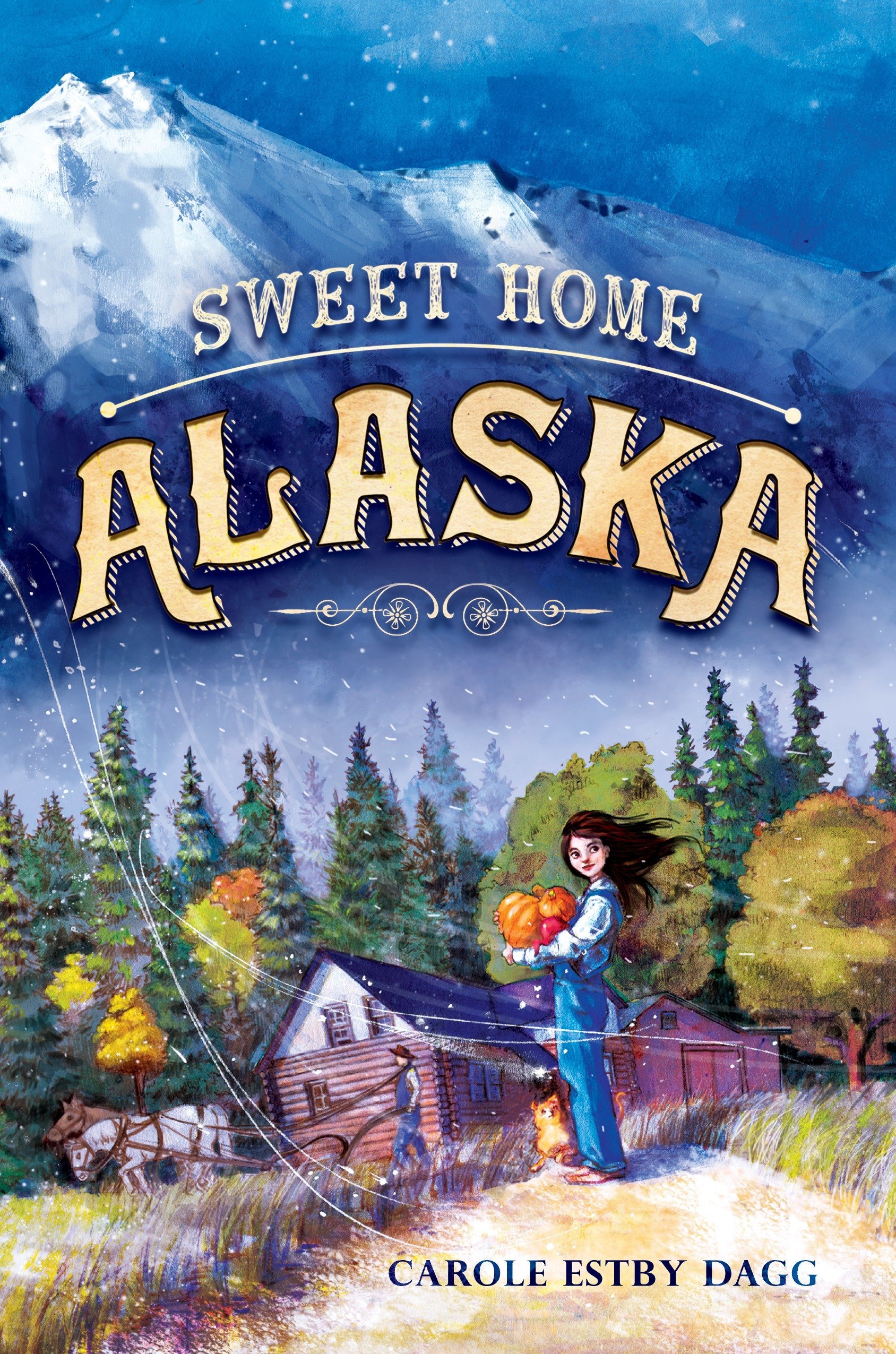
Sweet Home Alaska: Little House, up North

Sweet Home Alaska, by Carole Estby Dagg, (July 2019, Puffin), $8.99, ISBN: 9780147514202

Ages 9-13

Terpsichore Johnson’s family is just one of many families suffering through the American Great Depression in 1934. When the local mill in their Wisconsin town closed, the family relied on whatever they could grow in order to eat, and Terpsichore can make darn near anything out of a pumpkin. Her father is determined to take care of his family, and suggests taking President Franklin D. Roosevelt up on his New Deal offer: become an Alaskan pioneer in his Palmer Colony project! Terpsichore is at once unsure and excited: it’s a chance to be a pioneer, just like her hero, Laura Ingalls Wilder, but it’s so far from everyone and everything she knows. The family decides to give it a year, and they’re off. Life isn’t easy for that first group of colonists: there’s illness, and schedule and materials mismanagement leave a lot of folks living in tents when they should have had homes built, but slowly and surely, life in Alaska starts to grow on the Johnson family, except for Terpsichore’s mother. Can Terpsichore’s prize pumpkin win enough money at the Palmer Colony Fair so she can buy her mother a gift that will make her agree to stay?

I loved this book! Sweet Home Alaska is about the 1935 Matanuska Colony; one of FDR’s New Deal projects that would create jobs, investment in the country and infrastructure, and colonize part of U.S.-owned Alaska, which wasn’t a state just yet. The parallels between Sweet Home Alaska and Laura Ingalls Wilder’s Little House series are wonderful, and a good readalike for readers who enjoy the Wilder books, and Louise Erdrich’s Birchbark House books. (There are no interactions between the mostly white Palmer colonists and indigenous people in Sweet Home Alaska; a point discussed in the author notes at the end of the book.) Terpsichore – pronounced Terp-sick-oh-ree, named for the muse of dancing – even refers to Wilder’s book, Farmer Boy, when growing her pumpkin to show at the Palmer Colony Fair.

The book takes a deeper look into a moment in history I haven’t yet seen captured in historical fiction. While it takes place during the Great Depression, this is new territory, and worth the read. Terpsichore is the eldest child, with twin younger sisters and an infant brother, and handles much of the housework to help her mother out. She’s smart, enterprising, and determined. She and the two friends she makes in Palmer – Gloria, named for actress Gloria Swanson, and Mendel, named for the scientist who studied genetics – work together to start up a colony library and find ways to raise money for books and supplies. She experiences frustration, but always bounces back, stronger than before. The writing just flows from page to page, with adventure, emotion, and excitement throughout. There are wonderful mini-plots throughout, including the telegram to Eleanor Roosevelt that got our President’s attention; a visit from Will Rogers; and a Palmer resident with interesting ties to Terpsichore’s family. I loved spending time with this group.

An author’s note and further reading are included, and really make this a solid choice for kids seeking out historical fiction. There are also some recipes, including one for jellied moose nose. You know you’re curious.

Sweet Home Alaska was originally published in 2016, but I somehow missed it. Glad my friend Barbara over at Blue Slip Media told me I needed to read it now! Check out the free, downloadable discussion and activity guide, and find out about author visits, Skype visits, and contact info (including how to get an autographed bookmark!) at the author’s website.


Posted in Fantasy, Fiction, Fiction, Horror, Intermediate, Middle Grade, Tween Reads

The Great TBR Readdown: Hello, Neighbor and The Land of Broken Time

My Great TBR Readdown continues!

Hello Neighbor: Missing Pieces (Hello Neighbor, Book 1), by Carly Anne West/Illustrated by Tim Heitz, (Sept. 2018, Scholastic), $7.99, ISBN: 978-1-338-28009-8

Ages 10-14

Based on the horror video game, Hello Neighbor, this is the first book in a middle school-and-up series introducing Nicky Roth, a new kid in the town of Raven Brooks, and their neighbors, the Petersons. Nicky and Aaron, the Peterson’s son, become friends over their shared interest in tinkering, but when Nicky visits Aaron’s home, he’s uncomfortable. Aaron’s father makes him uneasy, and Nicky notices that Aaron, his mother, and sister are equally uncomfortable around him. The kids at school seem afraid of Aaron, and secrets and rumors about his father run wild. What’s the Peterson family’s dark secret, and why does Nicky feel like Aaron’s father is stalking him?

Knowing nothing about the Hello Neighbor game, I picked this book up and discovered a quietly creepy, light horror novel for tweens. If you have horror fans, this should be a good book to hand them. There are three in the series so far; the characters have a good background to build on, and the suspense builds nicely throughout the book. Illustrations throughout keep the pages turning.


In the Land of Broken Time, by Max Evan/Illustrated by Maria Evan, (Aug. 2016, self-published), $7.99, ISBN: 978-1520569291

Ages 8-10

A self-published novella by husband-wife team Max and Maria Evan, we’ve got a time-traveling fantasy starring a boy, a girl, and a talking dog, taking place in a fantasy land ruled by time – or the lack of it. Christopher sneaks out of his house to go to a nearby traveling circus, meets a girl named Sophie, and ends up hijacking a hot-air balloon, where the two meet a talking circus dog named Duke. They end up in a land where sibling scientists work at opposite ends: one seek to help them repair time, while the other wants to use time to manipulate his own power struggle.

The books is only about 50 pages, and is a quick enough read. I’d like to see something a little more fleshed out, because the world-building felt a little rushed, but was promising. Where is this land? What are the origin stories for the scientists, gnomes, and townspeople who waited for the prince? How did this power struggle between the two scientists begin? There are Narnian influences here that I enjoyed spotting, and there’s obviously more backstory to draw on; the story’s end leaves a sequel – or a prequel? – open to possibility. Maria Evan’s illustrations are beautiful, bright, and colorful, and brought the land and its characters to life. I’d like to see more. Let’s hope we get it.

Posted in Fiction, Realistic Fiction, Teen, Young Adult/New Adult

Get ready to SLAY!

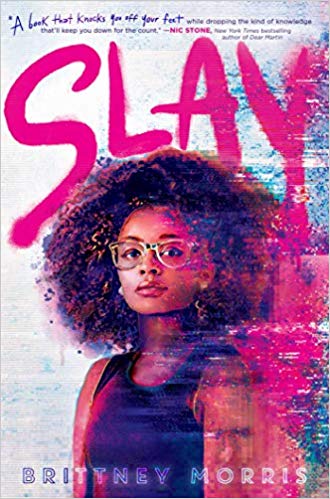
Slay, by Brittney Morris, (Sept. 2019, Simon Pulse), $18.99, ISBN: 978-1534445420

Ages 12+

This is one of the most buzzed-about YA books of the year, and with excellent reason. Slay is phenomenal.

Keira Johnson is a 17-year-old high school senior, math tutor, and one of a small handful of students of color at her high school, Jefferson Academy. Keira is at her happiest, though, when she steps into her character, Emerald, in the VR game she created: Slay. Slay is at once a competitive game and celebration of black culture, with hundreds of thousands of players. Slay lets black players inhabit a world where they don’t need to be a spokesperson for their race; they don’t need to code-switch to move in a white world; they can be, together, while competing in arenas and using cards that praise and elevate notable black men and women throughout history, and touchstones – both weighty and humorous – without having to explain or defend their meaning. Keira can’t let anyone know she’s the one behind Slay, though – her boyfriend, Malcolm, thinks video games are a way to keep young black men and women distracted and off balance, and she worries that her parents wouldn’t approve. But when a Slay-er is murdered over a Slay coin dispute, Keira finds her game the target of the media, who wants to call out the game and its creator as racist, and a dangerous troll, who threatens to take Keira to court for discrimination.

Slay is just brilliant writing. Gamers will love it for the gameplay and the fast-paced gaming action. The writing is sharp, with witty moments and thought-provoking ideas, including how a game can unite a community on a worldwide basis. Told mostly through Keira’s point of view, chapters also switch up to introduce readers to people affected by Slay, including a professor in his 30s and a closeted player living in potentially unsafe circumstances. There’s a strong thread of white deafness here, too – how white friends can ask things like, “Should I get dreadlocks?”, or provoke their “black friend” into speaking for the POC community to get the “different” point of view. Keira and her sister, Steph, come from a solid family, and Keira’s boyfriend, Malcolm, who wants black men and women to rise up together, but whose more radical worldview conflicts with many of Keira’s ideals.

Breathtaking characters that live off the page and in the imagination, fast-paced dialogue and a plot that just won’t quit make Slay required reading for upper tweens, teens, and adults alike. Give Slay all the awards, please.

Slay isn’t out until September, but you can catch an excerpt here at EW’s website. Bustle has a great piece on Slay and another excerpt, if you’re dying for more. Publisher’s Weekly has an article about Black Panther‘s influence on author Brittney Morris, which comes through in a big way through the pages of Slay, and the Slay website has sample cards from the game that you’ll love.


Posted in Fiction, Graphic Novels, Historical Fiction, Middle Grade, Teen, Tween Reads

Queen of the Sea: Re-imagined History

Queen of the Sea, by Dylan Meconis, (June 2019, Candlewick Press), $24.99, ISBN: 9781536204988

Ages 10-14

Inspired by Queen Elizabeth’s exile when her sister Mary I ascended the throne, Queen of the Sea begins with the banishment of Queen Eleanor, a young monarch of an embattled kingdom, to an island where nuns live, pray, garden, and sew. Margaret is a young girl who has spent her entire life on the island in the care of the nuns and finds herself drawn to Eleanor. Margaret learns about the island and the reasons behind her presence there, and quietly begins planning with Eleanor and a mysterious man who washes up on the island one stormy night.

Queen of the Sea is gorgeously created historical fiction with fully realized characters and a solidly constructed plot filled with intrigue; revelations; world-building, even light romance. Dylan Meconis’ pen, ink, and gouache artwork will appeal to Raina Telgemeier and Victoria Jamieson fans; the characters are softly realistic with period costuming and soothing earth and sea colors. I particularly love the back-and-forth between present moment storytelling and Margaret’s narration of history and myth, rendered to appear as stone or stained glass. The character growth is a joy to witness: Eleanor, from a taciturn exile to an embattled young woman embracing her feelings, and Margaret, a naïve child to a young woman coming into herself and her own intelligence make this a wonderful read. An author’s note discusses Elizabeth I’s inspiration of Eleanor. Graphic novel gold.

Queen of the Sea has starred reviews from Kirkus, Publisher’s Weekly, Booklist, and School Library Journal. You can read an excerpt at Candlewick’s website.

Posted in Historical Fiction, Teen, Tween Reads

The Good Son tells a tale in miniature

The Good Son: A Story from the First World War Told in Miniature, by Pierre-Jacques Ober/Illustrated by Jules Ober & Felicity Coonan, (May 2019, Candlewick Studio), $22, ISBN: 9781536204827

Ages 10-14

“About one hundred years ago, the whole world went to war. The war was supposed to last months. It lasted years.” This story about Pierre, a World War I French soldier, is told with spare narrative and is illustrated using antique military miniatures, photographed to create stunning moments.

Pierre is a young French soldier who quietly left his regiment for two days to celebrate Christmas with his mother. Upon his return, he is imprisoned for desertion and awaits execution. As he waits, he looks back on his life as a soldier: his choice to sign up, his dreams of glory, and the horrific truth of the battlefield. He remembers sharing coffee with German soldiers who were tired of fighting, and of spending what would be his final Christmas with his mother. His friend, Gilbert, comes by to bring him food and wine, and makes a promise to carry Pierre’s letter to his mother.

The Good Son is not a picture book for young children; it’s for middle schoolers and up. The use of miniatures brings home the scale of war: seeing the lines and lines of soldiers going into battle looks impressive, but turned becomes chilling when you understand that young men, not toys, headed to battle. There are beautiful and horrifying shots of battlefield explosions and war machines; pensive portraits by firelight as Pierre waits for word from the colonel. The text is heart aching, as we read about a young man’s struggle to understand how to be a good son and a good soldier. An author’s note and a note on the photography process provide a deeper look into the creation of the book and offers some further insight into Pierre’s story.

Beautifully written and photographed, this is a story that will provoke thought and discussion. A good book group choice.

Posted in Animal Fiction, Fantasy, Fiction, Middle Grade, mythology, Tween Reads

Middle Grade Quick Takes: Thundercluck! and The Tiny Hero of Ferny Creek Library

I did some more TBR-diving over the last few weeks, and have some more middle grade quick takes!

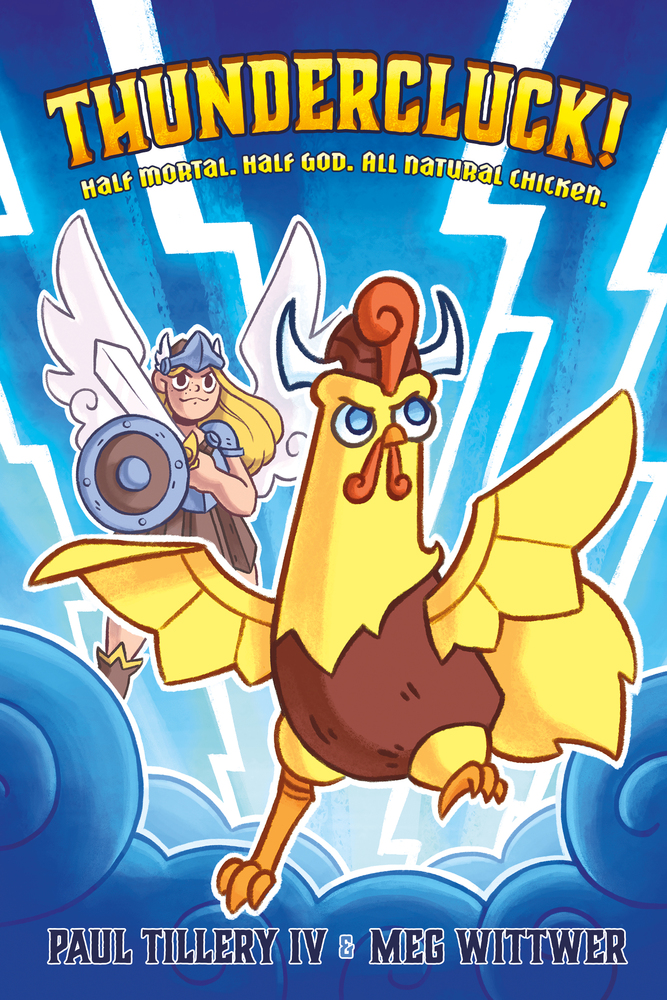
Thundercluck!, by Paul Tillery IV & Meg Wittwer, (Oct. 2018, Roaring Brook Press), $14.99, ISBN: 978-1-250-15228-3

Ages 8-12

How do you not check out a book that has the tagline, “Half moral. Half god. All natural chicken”? Thundercluck is about the valiant chicken of Thor. The story begins when Thor and the evil Under-Cook Gorman Bones fight as Thor defends his hen, Hennda, from the cooking pan. Thor hits Bones with lightning, but Hennda gets a jolt, causing her to lay a giant egg, which hatches and reveals a tiny chick with a horned helmet and little vest, and who shoots lightning from his beak. Behold, the birth of Thundercluck! Raised by Brunhilda, a young Valkyrie in Odin’s court, Thundercluck and Hennda are sent to Midgard (that’s Earth), to be kept safely hidden from vengeful Gorman Bones, but like every epic tale, the heroes return to do battle; it’s the Under-Cook versus the Valkyrie and her faithful chicken for the win!

Thundercluck! is the first in a new series – the next book is due out in September – and is a win for your middle grade readers. There’s a lot of hilarious moments, some good Norse mythology, epic battles, and, at the heart of the book, is the story of an enduring friendship. Black and white illustrations throughout are adorable and will keep readers turning pages. There’s a Thundercluck! website that includes an award-winning short on Thundercluck!, which was author Paul Tillery IV’s MFA thesis. Give this one to your younger mythology fans – if they like Joan Holub & Suzanne Williams’s Thunder Girls series, they’ll love this one!


The Tiny Hero of Ferny Creek Library, by Linda Bailey/Illustrated by Victoria Jamieson, (June 2017, Greenwillow Books), $16.99, ISBN: 978-0-06-244093-8

Ages 8-12

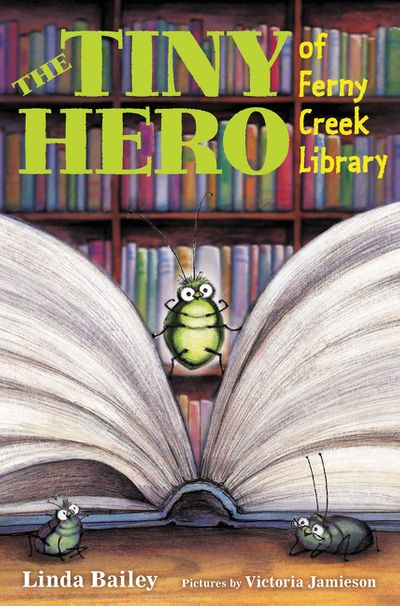
Ferny Creek School Library has a beloved librarian who goes on maternity leave, and her awful replacement wants to get rid of the library and make way for a testing space! Meanwhile, Eddie, a tiny green bug with a passion for books, finds himself in the library as he searches for his Aunt Min, who was injured and can’t get out of the library. Together, the two bookworms – bookbugs? – cook up a Charlotte’s Web-type strategy to plead for the library to stay as is.

The Tiny Hero of Ferny Creek Library is just adorable. The story, loaded with great book references, includes Eddie & Min’s “Bugliography” at the end; a nice listing of all the books mentioned, in one spot, and serves as a good readers’ advisory guide (and display guide). This is a love letter to libraries, particularly school libraries, which have had a really rough time of it these last few years. The heart of the story is the love for a school library, and its librarian, who makes the library a home for the kids at school, versus the mean Mrs. Visch, sister of the school’s superintendent, and testing enthusiast who sees books and reading as frivolous at best. Roller Girl’s Victoria Jamieson created adorable black and white illustrations, featured throughout the book, and really makes readers fall in love with Eddie, Min, and their quest to save the library. It’s a feel good story that book lovers will come to again and again, and reminded me of all the great memories I have from my first library and Mrs. Reale, my first school librarian, who always seemed to know what book to hand me when I needed it.

Posted in Fantasy, Graphic Novels, Historical Fiction, Teen, Young Adult/New Adult

The Iliad goes graphic: Gareth Hinds interprets the epic into a graphic novel for teens

The Iliad, Adapted and Illustrated by Gareth Hinds, (March 2019, Candlewick Press), $27.99, ISBN: 9780763681135

Ages 13+

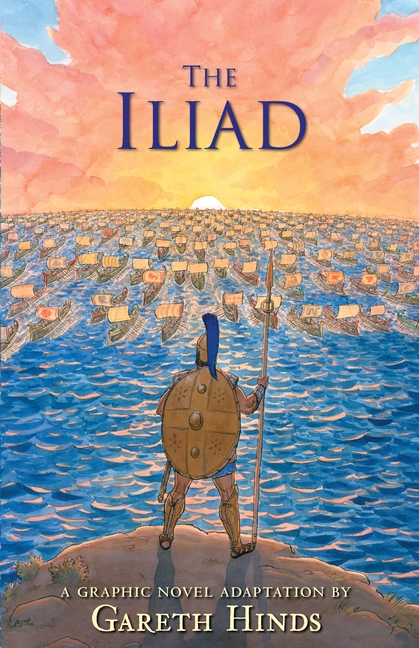
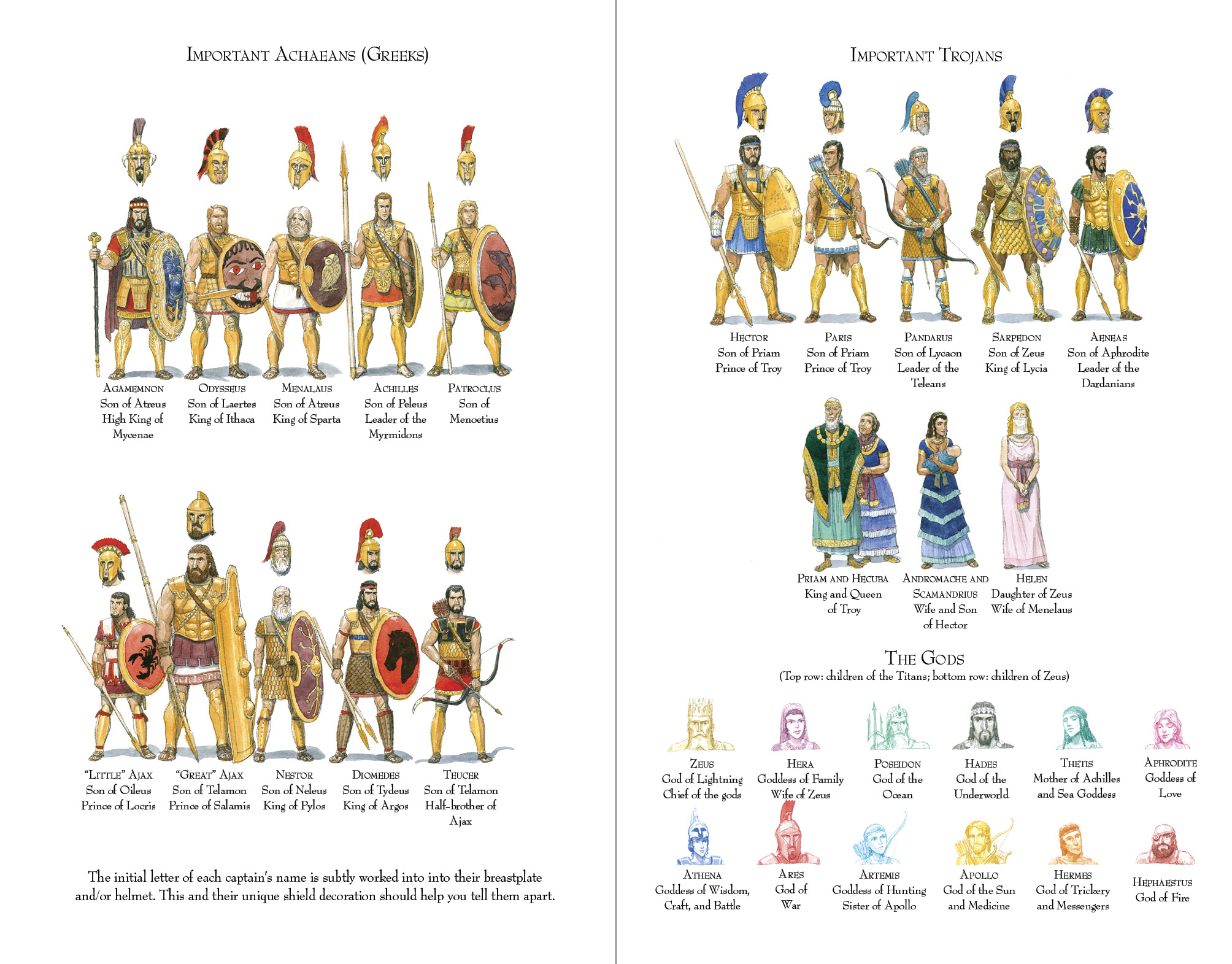
A companion to 2010’s award-winning adaptation of Homer’s The Odyssey, Gareth Hinds adapts Homer’s epic and manages to capture the breathtaking scale. The Iliad is the first part of the epic poem that recounts The Trojan War, introducing readers to legendary characters including Achilles, Hector, Paris, and Odysseus. Hinds gives readers a dramatis personae of important Greeks and Trojans; he also provides illustration of the cantankerous, trouble-making Greek gods, dividing them up between Titans and children of Zeus.

Flowing the story as dialogue between an omniscient narrator (Homer) and the characters is a big help to readers who may be cowed by the epic poem in its original form; Gareth Hinds brings life to the characters and creates landscapes and battle scenes that really engage readers. The drama is more intimate when one feels like a bystander as Hector and his wife, Andromache, say their goodbyes as he goes off to fight Achilles; seeing the gods interfere in the outcomes of battle will have some readers yelling at the book like we yell at our TV screens (okay, the reader in question is me). There’s just so much material to interact with here: an epic story that’s endured for millennia; maps, and notes all come together to make this a great volume to keep on hand for your students, kids, and patrons.

Gareth Hinds’s The Iliad has starred reviews from Publisher’s Weekly and The Bulletin of the Center for Children’s Books. You can find tour dates for Gareth Hinds’s Iliad tour on his website. Candlewick Press has a free, downloadable educator’s guide available.

Gareth Hinds is an award-winning graphic novelist who has some great, epic classics to his credit, including Beowulf, Macbeth, and the works of Edgar Allan Poe. ELA teachers and librarians, get copies of his work into your students’ hands!


Posted in Fiction, Fiction, Middle Grade, Realistic Fiction

Math, Loss, and Zombie Movies: A Good Night for Shooting Zombies

A Good Night for Shooting Zombies, by Jaco Jacobs/Illustrated by Jim Tierney/Translated from Afrikaans by Kobus Geldenhuys, (March 2019, Rock the Boat), $12.95, ISBN: 9781786074508

Ages 10-14

Martin is a South African teen living with loss. His father was killed in a car crash a few years ago, and his mother hasn’t left the house since. His sister is hardly ever home, usually out with her sketchy boyfriend. All Martin has is his chickens – his nickname is Clucky – and his propensity for numbers. When the neighbor kid’s dog kills his prize chicken, he goes over to say something – and ends up making a friend instead. Vusi, whose dog, Cheetah has a taste for chicken, is a horror movie fan determined to make his own zombie movie. He’s also fighting Hodgkin’s lymphoma, but he has no interest in letting that, or his protective parents and nurse, stop him. He quickly recruits Martin as a zombie extra, and before Martin realizes it, he’s sneaking out with Vusi, shooting Vusi’s movie and even developing a crush on a schoolmate. And, bonus: the cover glows in the dark!

Jaco Jacobs knows how to pack a book. While A Good Night for Shooting Zombies is primarily about Martin’s and Vusi’s friendship, it’s also about coping with loss, as Martin and his family grieve in their own ways; it’s about potential loss, as Vusi and Martin cope with Vusi’s lymphatic cancer, and it’s got a quietly compelling subplot about a group of troublemaking teens and Vusi and Martin bumbling their way into their sights. Martin is comforted by his mathematics equations, which he uses as a coping mechanism, very similar to Willow in Counting by 7s. He and Vusi each have their comforts – Vusi’s is horror movies – and as they share these pieces of themselves, they build a deeper friendship. Jim Tierney’s black and grey illustrations add some visual interest, and Jaco Jacobs’ writing keeps pages turning; the end of the story will stick with you long after you close the book.

I became a Jaco fan after reading last year’s A Good Day for Climbing Trees. A Good Night for Shooting Zombies just sealed it. I can’t wait to read more.

A Good Night for Shooting Zombies has a starred review from Foreword Reviews. There’s a free, downloadable readers’ guide available from publisher OneWorld Publications.