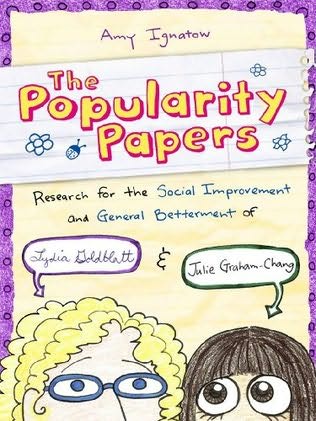
The Popularity Papers is the project (“Learn/Improve”) undertaken by fifth graders Lydia and Julie, who want to be popular by the time they reach middle school. Deciding to observe the most popular girls in the school to figure out what makes them popular, imitate them and perhaps even infiltrate the group, Lydia and Julie record their notes, observations, conversations with family and friends, and drawings to tell the story of their social climb. On the way up, they learn that being popular isn’t always what it’s cracked up to be, that being popular means different thing to different people – including who you like and who you’re not supposed to like – and Lydia discovers what can happen when the quest for popularity goes to your head.
Category: Fiction
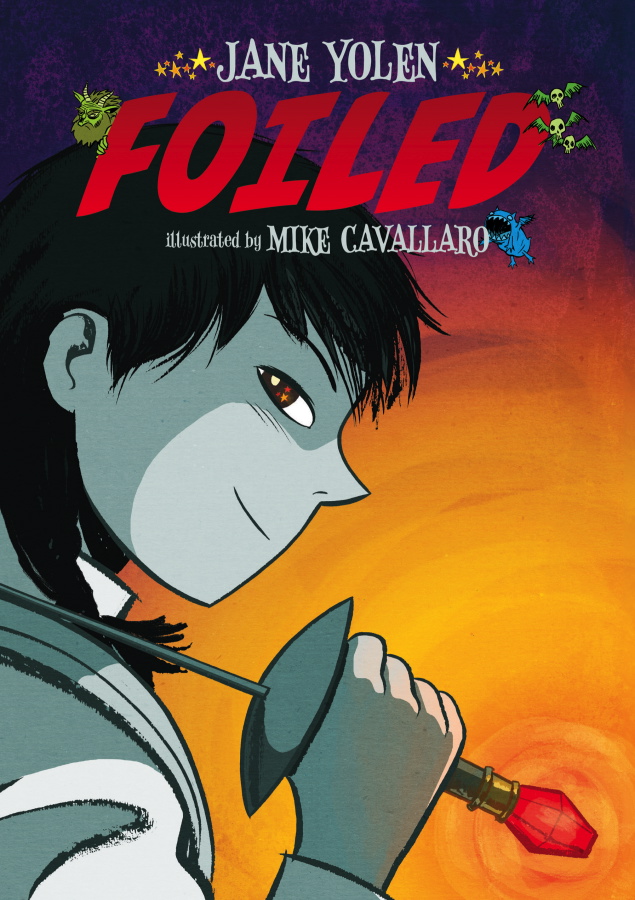
Book Review: Foiled, by Jane Yolen; illustrated by Mike Cavallaro (First Second, 2010)
Recommended for ages 12+
Foiled leaves the reader hungry for a second helping. Aliera, Avery and Caroline are all vibrant, interesting characters, and even when Aliera is at her most guarded, the reader wants to get behind her fencing armor and find out what makes her tick. Older ‘tween and young teen readers alike will enjoy the blending of fantasy into a reality-based setting, and teachers could use this novel in a fairy tale/mythology unit for older readers. The artwork never talks down to the book’s audience, portraying kids as kids rather than caricatures; the fantasy creatures are brightly colored and drawn straight from a vivid imagination and the fencing sketches are dynamic.
Jane Yolen’s website contains information for both students and teachers, an archive of awards the author has received, book trailers, and a link to her blog.
Book Review: Like Pickle Juice on a Cookie, by Julie Sternberg (illustrations by Matthew Cordell) (Amulet Books, 2011)
Recommended for ages 8-10
“I had a bad August. A very bad August. As bad as pickle juice on a cookie. I hope your August was better. I really do.”
Thus begins eight-year old Eleanor’s story. She learns that her beloved babysitter, Bibi, will be leaving her family’s employ and their Brooklyn home and moving to Florida in order to care for her sick father. To make things worse, her best friend, Pearl, is away on vacation with her family. Heartbroken, she doesn’t want to do anything that will remind her of Bibi and she certainly doesn’t want another babysitter. But her parents have to work, and a new babysitter shows up. Eleanor learns that it’s okay to miss Bibi and still make space in her heart for Natalie.
Pickle Juice teaches kids about loss and how to work through it. Told in free verse and accompanied by line drawings, it presents an easy transition for middle graders ready to move on from beginner chapter books. The story presents many areas for discussion for both parents and teachers having read-alouds with their children.
Julie Sternberg’s author website offers a curriculum guide for Pickle Juice, as well as an interesting author biography told through her favorite books. Readers can click through to her blog and contact her regarding author visits.
Book Review: The Tale of Desperaux, by Kate DiCamillo (Candlewick, 2008)
I picked this book up post-hype and after not really watching more than about 10 minutes of the movie (there really is something to be said for the movie-going experience over the at-home one). My expectations were tempered with the worry that comes when a book has been so talked about and featured in the media as Desperaux, but I needn’t have worried.
Desperaux is a story with many layers. It’s a cute animal fable with an adorable hero. It’s a love story between our hero and a princess. It’s a story that addresses hate and it addresses the darker side of nature, and how even the darkest creatures can crave the light. I wasn’t expecting the depth of character that DiCamillo invested in her characters, and I wanted to keep reading.
Desperaux is the only surviving mouse in his mother’s final litter. Born small and with his eyes open, his mother and father both write him off, but he survives. He’s tinier than his siblings and is different from the start, preferring to read books rather than eat them. He falls in love with the Princess Pea. She is enchanted with the tiny mouse, but her father, who hates rats – and equates all rodents with them – chases him away. For allowing himself to be seen by and talk to humans, the mouse council – members of whom include Desperaux’s own father and brother – decide to punish him with a death sentence, and they send him to the dungeon, ruled in darkness by the rats.
In the basement, we meet Chiaroscuro, a rat who loves the light but is forced to live in the darkness after a brief trip up to the castle living area ended with a terrible accident. He seethes and plans his revenge in the darkness, using a slow-witted servant girl with her own tragic past as a pawn in his game.
This book won the Newbery Award in 2004, and as you delve into the book, you can see why. For a children’s book, the characters’ backgrounds are incredible in their detail and complexity. I was amazed at DiCamillo’s ability to create characters with such depth and yet still make them accessible to children. The story moved along at a pace that kept me turning pages; I wanted to know what was going to happen next. Timothy Basil Ering’s illustrations were stark and beautiful, adding more depth to the story by adding to the vision the author’s words painted in my imagination.
There are some very good teaching guides for Desperaux available. Candlewick Press offers an illustrated discussion guide. Scholastic’s reader’s guide considers the movie and includes some illustrations from the animated feature. Reading is Fundamental (RIF) also has a free, downloadable Teacher’s Guide.