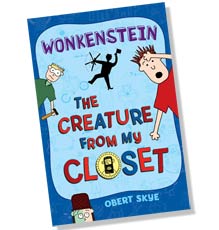
Rob is a 12-year old boy whose main use for books is to throw them into his closet. He has better things to do, after all, than read. Plus, Rob’s closet is just strange. It’s not because it’s got a second-hand door with a pony sticker on it that says, “Smile”. For starters, the doorknob is big, gold, and has a bearded man’s face engraved on it – and his expression seems to change. For another, the closet is where Wonkenstein – a creature that seems to be a mashup of Willy Wonka and Frankenstein – comes from one day, and now Rob’s closet will not open so he can send him back.
Rob tries to keep Wonkenstein a secret while trying to get him back to his world, but he ends up getting into more trouble, whether at home or school, the harder he tries. Poor Rob just wants life to go back to normal, but at the same time, he finds himself getting attached to the little guy.
Wonkenstein is a cute book for younger readers and older readers that may have drifted from reading and just need something fun and familiar to pull them back. The book has fun black and white illustrations that look like a child’s drawings and helps, along with the first-person voice of the book, add to the fantasy that Rob is narrating his own true story.
Obert Skye’s website has information about all of his books, plus author and tour information, and the publisher’s website has a book detail page with much of the same information, plus links to the book’s pages on social networking sites incluing Shelfari and LibraryThing.
The Wiley & Grampa books take the sting out of scary books for kids by making them hilarious and gross. They got in early on the ‘potty humor makes boys read’ trend that I have seen time and again, but author Kirk Scroggs gets it, and he writes well.
The stories revolve around young Wiley, a boy who lives with his grandmother and grandfather, in what appears to be “good ole boy country”. Wiley and his grandfather loves Pork Cracklins and monster trucks, and his grandmother is always after them to finish chores. Somehow, Wiley and Grampa always end up in trouble with the supernatural.
In the first book, Dracula vs. Grampa at the Monster Truck Spectacular, Wiley and Grampa sneak out to go to a monster truck show, despite Gramma’s telling them that with the storm coming, no one is going any where. They meet Dracula himself, and get the sneaking suspicion that Dracula’s very interested in Gramma, who just happens to resemble Drac’s dead wife. If that isn’t enough to entice readers, there are monster trucks. That run on blood.
In Grampa’s Zombie BBQ, Wiley, Grampa and Gramma are having barbecue and Gramma’s making her famous honey paprika barbecue sauce. When a horde of zombies shows up and shows an appetite for Gramma’s food, all is fine – until the food runs out, leaving Wiley and his grandparents to fend for themselves. But can the school lunch lady and her toxic beet borscht save the day?
The books are great for younger readers who are still getting into the swing of chapter books, for readers who want a good laugh, or readers who want their monsters a little less threatening. Wiley and his family are funny, and they are never really in any danger, giving more skittish readers reassurance. The books are illustrated with blackand white sketches on every page and the characters are drawn as exaggerated, caricature-like people.
There are ten Wiley & Grampa books available, the last of which came out in 2009. Kirk Scroggs’ website has a section dedicated to the series and links to more content.
Dork Diaries: Tales from a Not-So-Popular Party Girl has been hailed as “Wimpy Kid for girls”, and I’m inclined to agree. The book is writtten in similar format – a middle-schooler’s journal – and is complete with illustrations and “OMG!” moments in a pre-teen’s life. Nikki, the protagonist, is not the slacker that Wimpy Kid Greg is, but is definitely not in the cool crowd. She and her friends Chloe and Zoey wish they could be in the CCP (Cute, Cool and Popular) crowd, but Nikki’s nemesis, Mackenzie – a spoiled, rich, mean girl – will do anything and everything to ruin Nikki’s life – including canceling the school Halloween dance just to make Nikki look bad. Nikki and her friends need to pull together to make it happen, and Nikki hopes to get the attention of her crush, Brandon Roberts. The only trouble is, Mackenzie has her sights set on Brandon, too.
The book is fun. Nikki is a vibrant narrator, who speaks fluent middle-school – girls will love her. She writes from a very female point of view, as opposed to the more gender-friendly Wimpy Kid, so I don’t know if boys will get on board with the series (especially as this book has a purple cover). The black and white drawings make you believe you are looking at a ‘tween girl’s diary, as do the script and handwriting fonts. All around, a fun book with a spunky heroine that girls will enjoy – and grown-up girls will laugh along with the more cringe-worthy memories of their own middle school years.
The Dork Diaries website features information on the Dork Diaries books and has a countdown clock for the next book’s release. There is a link to the music inspired by the book, and the Nikki has a blog where she recaps memories (from the books), links fan videos, and features fun contests and printables.
I am writing one review for both of these books as they are by the same author and from the same series.
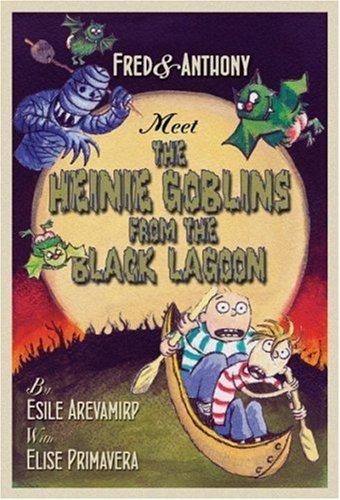
Fred and Anthony are two kids with one big wish: find someone to do their homework for them so they can relax, eat Chex Mix and Pez, and watch horror movies. In their first adventure, Escape from the Netherworld, they decide to make money so that they can afford to pay someone; because they already have a reputation for botched and unfinished jobs im their own neighborhood, they strike out for a new neighborhood and end up discovering The Netherworld when Anthony falls through a bathroom portal. Luckily, Fred has the foresight to grab a Guide to the Netherworld to help them navigate their way past evil dentists, deceptively dressed werewolves, and Count Dracula himself. They make their way back home only to discover that a ghost has followed them – so they hire him as a ghost writer (get it?) to write about their adventures. Their get rich quick plan is under way!
Their third adventure, Fred & Anthony Meet the Heinie Goblins from the Black Lagoon, catches readers up on the first two books, so readers can come in on any book in the series and not feel lost. Fred and Anthony are sent off to Camp Plenty Wampum summer camp in Heinie Goblins; naturally, the camp brochure is a ruse and the camp, run by two Wise Guys named Carmine and Vinnie, is a dump serving cold Hot Pockets with warm water, forcing recreation time in leaky canoes on the questionable Lake Gitchie Lagoonie, and haunting them by dressing up as The Burnt Marshmallow Mummy and The Lone Short-Sheeting Stranger. While out on Lake Gitchie Lagoonie, the boys’ canoe capsizes and they end up back in The Netherworld for a brief time, until their escape from the Creature from the Black Lagoon leads them back up to the Camp.
Deciding that they can make money by charging kids for trips to The Netherworld, the boys launch their next career venture. In The Netherworld, they meet the Heinie Goblins – cute, purple-feathered little batlike creatures with bare backsides. Despite the Guide to the Netherworld’s warning about the goblins being “a pain in the butt”, the boys allow a goblin to accompany them back to the camp, but the goblin brings friends along, who menace the other campers. When Carmine and Vinnie show up dressed as the Lone Short-Sheeting Stranger and the Burnt Marshmallow Mummy, the goblins become jealous of losing the audience’s attention – the book is, after all, named for them – and attack, leaving the boys to figure out a way to make things right.
The books are written with the lower end of the age range or the reluctant reader in mind, with black and white illustrations on every page and a mixture of graphic novel and chapter book format. Gross humor will appeal to boys (or girls!) who giggle at a good bathroom joke. The books are slightly more than 100 pages in length, making them easy and quick reads for younger children.
The author and illustrator, Elise Primavera, “ghost wrote” these books under the name Esile Arevamirp. There are four Fred & Anthony titles, but was surprised that the author’s website had no mention of them; I even attempted to find a website for her alter ego but found nothing. Turning to YouTube, discovered Rat Chat Reviews, an animated video review site for children’s books; the rats posted an interview with Fred and Anthony on the cancellation of their series. Regardless of whether or not there are any more Fred & Anthony books in the future, the series is still a fun set of books for a younger or reluctant reader.
Rafe Katchadorian is having a tough year: his mom is working double shifts at her diner job in order to support him, his sister, and her lazy, unemployed fiance, and he’s already attracted the attention of the school bully during his first week of middle school. What’s a kid to do? Make a name for himself, of course!
With some prodding by his best friend, Leonardo the Silent, Rafe decides that he’s going to break every single rule in the middle school code of conduct. There are guidelines to follow, though – he’s got to have witnesses every time he breaks a rule; he’s got three “lives” – he loses one if he passes up an opportunity to break a rule – and finally, he can’t hurt anyone in his quest to break the rules. How bad can a good kid get, and how far is Rafe willing to go to break all the rules, and will he break his own in the process?
I started this book expecting a light, humorous tale and was amazed at the punch Patterson and Tibbett packed into this middle school story. Rafe’s family issues aside, there are a multitude of issues in his life. In reality, he would be considered an at-risk tween with a need for a solid support system. Two major plot developments may suprise readers, but these are important stories for tweens and young teens to be exposed to – children with similar life stories may appreciate a literary figure they can relate to, and other readers will glimpse into another kid’s world, possibly starting a dialogue or creating a new sensitivity among them.
Chris Tebbetts is a YA author whose love of books and libraries began as a child. His website suggests links for writerw and readers, and provides a list of Good Reads for young readers and teens.
James Patterson is best known for his Alex Cross mystery series, but he is a Children’s Choice Award-winning author, receiving the award in 2010 for his book Max, one of the books in his popular Maximum Ride series. His Daniel X series has been praised by Good Morning America as being some of the best books for boys, and the first book in his Witch & Wizard series spent five weeks on the New York Times bestseller list. Patterson’s website, ReadKiddoRead, is dedicated to getting kids reading and suggests titles for all ages and interests.
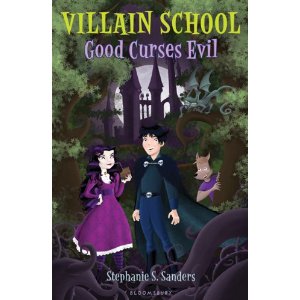
What do you do when your parents are some of the baddest bad guys in history, and you just don’t match up? You get sent to Master Dreadthorn’s School for Wayward Villains. Dracula’s daughter, Jezebel, is there – she prefers hot chocolate to blood. The Big Bad Wolf’s son, Wolf, is in there, too – he saved a human child from drowning. The Green Giant’s son was expelled when they realized that his dad was just some green guy trying to get kids to eat their vegetables.
Rune Drexler, Master Dreadthorn’s 12-year old son, is at villain school, too, but he’s not getting any preferred treatment – quite the opposite; he can’t seem to do anything right in his father’s eyes. When his father calls him to his office and gives him a Plot – a dangerous and evil test to achieve his next EVil (Educational Villain Levels) level, Rune sees his chance to be the villain his father wants him to be. But can he and his two friends carry out the Plot without ending up being heroes?
The story takes a little bit of time to get started; Sanders concentrates on exposition early on in the story. Once the Plot is under way, though, the story becomes a fun read with just enough of a twist to take the reader by surprise. I did not feel cheated by the book’s end – I wanted to know what Rune was going to do next. Middle grade readers will enjoy the good-natured jabs that the characters throw at one another, and the idea of being good while you’re trying to be evil will show younger readers that there is something good in even the baddest of villains.
Ellie McDoodle is the nickname for sixth grader Eleanor McDougal, who fills her notebooks with doodles, journaling the people around her, her family, and her own daily happenings.
When Ellie’s parents announce that they’re moving, Ellie is crushed. She doesn’t want to leave her friends, her school, or her home. She creates a journal to document the move, insisting that “there won’t be much to keep track of… because this is the END of everything good.”
Or is it? Despite some rough patches, like discovering the “New Kid Bingo” card some of her classmates circulate at school or teachers not remembering her name, Ellie learns that being the new kid may not be so bad. Through her own actions, she makes friends, convinces her parents to give her a room of her own in the attic, and organizes her fellow classmates in a peaceful against long lunch lines in the cafeteria. Being the new kid may end up being sort of fun after all.
Ruth McNally Barshaw’s Ellie McDoodle series has been described by Student Library Journal as “reminiscent of Jeff Kinney’s Diary of a Wimpy Kid“, and it is to some degree: both stories have a vibrant narrator who tells his tale in the first person, accompanied by line drawings. To dismiss Ellie McDoodle as merely a feminine Wimpy Kid is selling the book short. Ellie McDoodle is not a Wimpy Kid clone; it is a smart, sensitive book featuring a character to whom both boys and girls can relate.
Ellie’s family is as realistic and provides a positive family model. The family eats meals together at the same table; they play friendly pranks on one another, like hiding a spooky-looking Mrs. Santa Claus figure all around the house to take family members off guard; even Ellie’s cranky older sister Risa is never outright abusive, but is more of an angsty teen. Her older brother Jonathan is a friendly clown who makes punny jokes, and her toddler brother, Ben-Ben, is a happy baby who gets into everything.
Readers will see Ellie as a positive role model who affects her own change rather than waiting for it to come to her. Rather than succumb to her sadness, Ellie seeks ways to make the best of her situation. She befriends a librarian at the local library; meets neighborhood children and accepts their invitiations to play, a move that helps her cope with insensitive schoolmates. Using her talent in art to help make a difference in her school, her peaceful protest gets not only the notice of the principal, but of the local television station.
Ruth McNally Barshaw’s website offers information on all of the Ellie McDoodle books and links to more of McNally Barshaw’s art. Readers can find out where she’ll be appearing and read her blog, and create Ellie mini-books and stationery. She offers teens advice on writing their own graphic novels, and has teaching guides available for educators.
The Ilsley Public Library in Vermont created a book trailer for New Kid in School, viewable below.
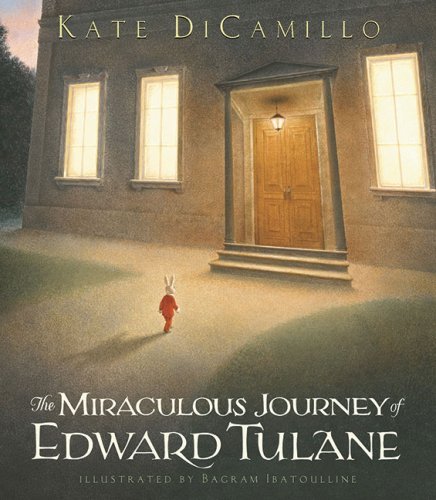
I normally try to stay away from reading multiple books by the same author in a row, but after coming off of The Tale of Desperaux, I really wanted more, so I picked up The Miraculous Journey of Edward Tulane.
Edward Tulane is a stunning china rabbit with real fur ears and wires enabling movement in his arms and legs, and a fashionable silk wardrobe. He is the apple of his owner’s eye, 10-year old Abilene. Abilene changes his outfits daily annd dotes on him. He lives a comfortable life and knows it, but he’s cold and keeps Abilene at a distance, never allowing himself to love her as she loves him; her purpose in his life is to take care of him and coddle him.
Abilene and her family go on a cruise where Edward, as a cruel prank by two boys on the ship, is tossed overboard; thus begins a journey where he finds himself in the company of an old woman, a homeless man, and a dying little girl and her older brother. Each of these people teaches Edward a little more about love, loss and longing.
The reader journeys with Edward, experiencing his growth and heartache through each subsequent companion’s story. Despite the affection – even love – he feels with each new owner, his thoughts always stray back to Abilene, finally understanding what love is and he regrets not reciprocating her affection.
The them of second chances is a dominant theme in the book, leaving the reader with the message that there’s always a chance for redemption – it just make take some time. It is a powerful and relevant theme for middle grade children, who need to understand at this delicate age that their actions can and do have consequences, but that almost nothing is unforgiveable, and reconciliation is always down the road.
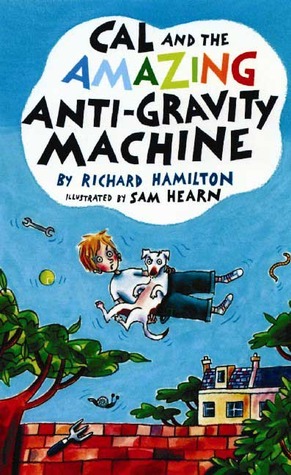
Cal lives with his family, including Frankie, a talking dog that only he can understand, next door to a very loud neighbor. Mr. Frout regularly wakes the neighborhood with clanging and banging in the early hours of the morning. He’s not a very friendly neighbor, so curious Cal decides to spy on him to see what all the commotion is about and discovers Mr. Frout, in a suit of armor, hovering in the air. His experiment goes awry and Cal rescues him, which makes Mr. Frout a little more friendly and Cal learns that Mr. Frout is making an anti-gravity machine. Inevitably, things get out of hand and it’s left to Cal to save the day.
The book skews toward the younger end of the reading range, as it is a chapter book with lots of black and white line drawings that will keep younger readers interested. The characters are well-described, and have just enough reality to them that kids can identify with them, while being fantastic enough to make the story fun. I appreciated that the parents weren’t drawn as hopeless dimbulbs, as often happens in children’s books – I particularly liked a section of the book where Cal’s mother gets angry at him for befriending a stranger (Mr. Frout), despite Cal’s assertions that he is friendly. It was a smart way to take advantage of a teachable moment on stranger danger.
Richard Hamilton and Sam Hearn are an British writer-illustrator team who have worked on four books together.
This is a princess-y book for girl who don’t normally like princess book. Creel, the main character, is not a princess, but she is independent and smart; a rags-to-riches character we’ve started expecting from fantasy heroines.
Orphans Creel and her brother live with their poor aunt and uncle, who have enough children of their own. Creel’s aunt leaves Creel to the local dragon in the hope that either a rich noble or prince will save her and marry her – and share the wealth with the rest of the family – or that the dragon will eat her, giving the family one less mouth to feed. Luckily for Creel, Theoradus the Dragon doesn’t want to eat anyone; he wants to be left alone to enjoy his hoard of shoes (each dragon has his or her own preferred hoard).
Creel strikes out for the king’s city, Feravel, to find her fortune as a seamstress, taking a pair of slippers given to her by Theoradus and befriends two more dragons, Shardas and Feniul, along the way. Upon arriving in Feravel, she finds seamstress work where her embroidery designs gain notice – as do her shoes. The awful princess Amalia, engaged to Feravel’s crown prince Milun, tries to force Creel to surrender the slippers. She ultimately gets them through Creel’s co-worker, Larkin, who Amalia makes a lady-in-waiting if she can get Amalia the slippers.
Amalia’s desire for the shoes has nothing to do with being fashionable, and her engagement to prince Milun is a sham – her father’s kingdom wants to take over Feravel, and the slippers give her the power to control the dragons. Creel must join forces with the king’s younger son, Luka, to find a way to break through to the dragons and bring peace to the land.
I enjoyed this book because it was unexpected. The heroine was intelligent, self-sufficient, and funny – a wry sense of humor permeates the characters without feeling forced or contrived. Jessica Day George carefully builds up without it ever feeling tedious, and she tightly weaves the various characters, plots, and subplots together to keep readers on their toes. Just when I thought I had reached the climax of the book, I realized there was more – and I liked it. The author does not take its young audience for granted.
Dragon Slippers is the first book in Jessica Day George’s Dragon trilogy, and I may visit Creel, Prince Luka, and Shardas the dragon again in the future wiith Dragon Flight and Dragon Spear. Ms. Day George has written other fairy tales with smart heroines, including Princess of the Midnight Ball, winner of the Children’ Literature Association of Utah’s 2011 Beehive Award and its sequel, Princess of Glass. She keeps in touch with her fans through her blog and her website, which links to more information about the author, her books, and social media. She is also featured on the Mormon Arts wiki.
 Recommended for ages 9-12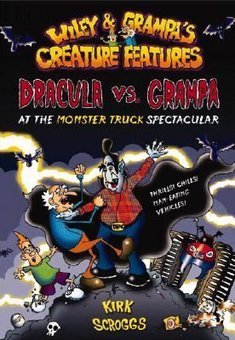





 Mom Read It