Posted in Historical Fiction, Tween Reads

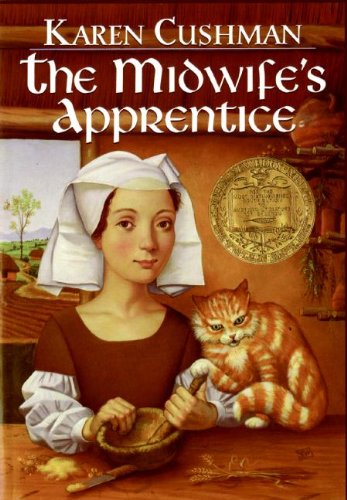
Book Review: The Midwife’s Apprentice, by Karen Cushman (Clarion Books, 1995)

Recommended for ages 8-12

Brat is an orphaned girl with no name or family. When the village midwife discovers her sleeping in a dung heap to keep warm, she takes her on as an apprentice. The reader sees Brat grow in confidence and ability.

A 1996 Newbery winner, this historical fiction novel has a strong message: you can make your own way in this life, no matter what cards you are dealt. Alyce remembers no mother and no home; she is the target of village bullies and sleeps in a dung heap to keep warm, but she never believes in giving up. When the midwife is cruel with her words, she shakes it off and continues to learn by observation. She does not wait for someone to provide her with a kinder name than Brat or Beetle, the name given her by Jane the midwife; she decides she likes the name Alyce and tells people to call her by that name. She finds a way to even the score with the cruel villagers and earns the respect of one of the village bullies when she aids him in delivering a calf. This is medieval girl power.

In addition to winning the Newbery medal, The Midwife’s Apprentice has also been designated as one of the American Library Association (ALA)’s Best of the Best Books for Young Adults and the New York Public Library’s “One Hundred Titles for Reading and Sharing”. Ms. Cushman also received Newbery Honors for her book Catherine , Called Birdy.

The author’s website offers a full bibliography of Ms. Cushman’s books, along with an author biography and “odd facts”. An FAQ is available for popular questions, and there is a link to contact the author for appearances. There are a wealth of resources available online for discussing and teaching this book, including a robust guide at eNotes.
Posted in Fiction, Realistic Fiction, Tween Reads

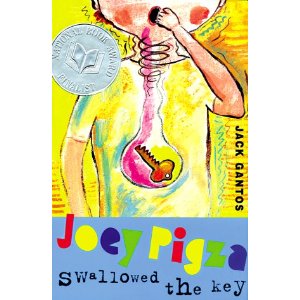
Book Review: Joey Pigza Swallowed the Key, by Jack Gantos (HarperCollins, 2000)

Recommended for ages 9-12

Told in the voice of a boy with ADHD (Attention Deficit Hyperactivity Disorder), Joey Pigza Swallowed the Key moves at an almost frantic pace. Joey is “wired”. He can’t sit still, even when he knows that acting up in class is wrong. Abandoned by both his parents, lives with his abusive grandmother who is also “wired”. When Joey’s mom returns, she struggles to keep him medicated and on track, but she works long hours and she drinks out of frustration.

Joey’s behaviors become self-destructive – he swallows his house key; he sticks his finger in a pencil sharpener; he separates from his class on a school trip and finds himself sitting on a rafter in a barn. The school is trying to be understanding and has him spending part of his day in the Special Education class, but when Joey decides to run with a pair of scissors and injures a classmate, he is suspended and sent to the district’s special ed program for six weeks. There, he meets with a social worker who helps him get his medications adjusted and works to get him – and his mom – back on track.

The frenetic pace of the storytelling gives the reader a glimpse into what goes on in the mind of a child with ADD, and Joey’s explanations help readers figure out what motivates him to do what he does – regardless of it being right or wrong, Joey does have reasons. It is an important read for understanding kids that are sharing classrooms with one another, and gives both adults and children a starting point for discussions on what ADD is and how it affects people.

Joey Pigza Swallowed the Key has won numerous awards including the Newbery Medal. It was a National Book Award Finalist, one of School Library Journal’s Best Books of the Year, and it is an American Library Association Notable Children’s Book. It is the first in a series of Joey Pigza books including Joey Pigza Loses Control, What Would Joey Do?, and I Am Not Joey Pigza.

The Macmillan website for the book offers award information, critical praise, a biography on Jack Gantos, and links to Mr. Gantos’ website, Facebook page, Goodreads page, and Wikipedia page. The Multnomah County Library system offers a discussion guide and related book suggestions.

Posted in Fiction, Tween Reads

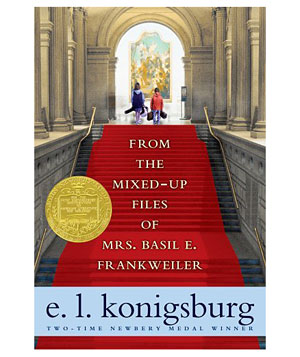
Book Review: From the Mixed-Up Files of Mrs. Basil E. Frankweiler, by E.L. Konigsberg (Athenum Press, 1967)

Recommended for ages 9-12

After reading this Newbery Medal award winner as a child, I wanted to run away and live in the Museum of Natural History. Yes, the museum was different from The Met, where the main characters ran away to, but I wanted to live with dinosaurs.

Claudia is a precocious 11-year old who lives in Connecticut with her family and feels unappreciated and bored. She decides to teach her family a lesson in “Claudia appreciation” and plans to run away. She invites her 9-year old brother, Jamie to go with her because he’s cheap and has money. When he agrees, she sets her elaborate plan in motion, and the two run away and spend a week living in the Metropolitan Museum of Art.

While wandering around all of the exhibits, Claudia and Jamie happen upon a new exhibit of Angel, a statue rumored to be one of Michelangelo’s earlier works. Focused on solving the mystery of Angel’s origin, Claudia cannot go home until she has figured it out. She feels that knowing the secret will change her somehow; give her running away a purpose.

 Their search for information takes them all the way to the statue’s previous owner, Mrs. Basil E. Frankweiler, a wealthy widow living in Connecticut. She manages to get the children to tell her where they have been for the past week, and offers them, in return for their story, an hour in her file room where the secret to the statue lives; they are then driven home by her chauffer.

This story is still relevant over 40 years later.  Parts of it may not resonate with new audiences – maybe an 11- and 9-year old wandering the streets of New York City sounds riskier in this day and age – but it is, at heart, a child’s fantasy. What preteen hasn’t felt unappreciated by his or her family and dreamed of running away? This is a New York adventure that boys and girls alike should read and enjoy.

Konigsburg does not speak down to her audience; rather, she details how intelligent Claudia and Jamie are as she details the planning process for running away, their complex hiding arrangements, and their need to stick to a budget. They make mature decisions: Jamie nixes the idea of a bus or a cab for transportation, saying it will eat into their money too quickly; they take care of themselves by bathing in the fountains (and also collecting some of the coins tossed in there to add to their nest egg) and doing their laundry; they strive to learn something every day, despite not being in school.

E.L. Konigsburg received Newbery Medals for From the Mixed-Up Files of Mrs. Basil E. Frankweiler and The View from Saturday; she also received Newbery Honors for Jennifer, Hecate, Macbeth, William McKinley, and Me, Elizabeth. There is a wealth of information about the book online, including discussion guides through Scholastic and the Wake County Library system.

Posted in Fantasy, Fiction, Tween Reads

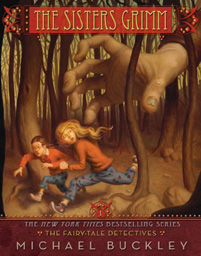
The Sisters Grimm: The Fairytale Detectives, Book 1, by Michael Buckley (Amulet, 2007)

Recommended for ages 9-12

Sisters Daphne and Sabrina have been shuttled from foster home to foster home since their parents disappeared, so when a woman claiming to be their grandmother contacts the orphanage to claim them, Sabrina is suspicious; their parents told the girls that their grandmother was dead.

Not only is their grandmother very much alive, the girls learn that they are descended from the famous Grimm brothers and that their “fairy tales” were actually case studies – magical creatures are very real, and they’re stuck in Ferryport Landing, New York, with a Grimm to act as the guardian.

As Grandma Relda and her friend Mr. Canis are investigating a  mystery involving a giant, Mayor Charming and a house crushed flat, they are kidnapped by a giant and Sabrina and Daphne must find a way to rescue them. But can they trust Jack the Giant Killer, who offers to help them? What magical creatures are there to help them or hurt them – and how can they tell the difference?

This first adventure in the 7-book series is great fun for kids and adults alike – it’s a great bridge between a fun, action-adventure story and the fairy tales we all grew up with. The dialogue is well-paced and smartly written, never talking down to its audience, and the characters are likable and provide a good mix of fantasy and reality. These are children who miss their parents and who fell into the cracks of a child protective system that fails to do its job. Even when they find their fantasy grandmother to love them and connect them back to their family, they face surreal dangers and have to figure out who they can trust. This is a great book for a family book group discussion, providing many ideas to talk about and delve deeper into between parents and kids. The publisher’s website provides a readers’ guide for this purpose (geared at librarians and teachers, but parents can build on this). The site also offers a fairy tale “regurgitator” that helps visitors create their own fairy tales.

Posted in Fiction, Middle School, Puberty, Tween Reads

Book Review: Are You There, God? It’s Me, Margaret, by Judy Blume (Yearling, 1970)

Recommended for ages 9-12

This Judy Blume classic follows sixth grader Margaret Simon, whose parents move her from their home in New York to the suburbs of New Jersey, and her search for an identity as she goes through puberty. The book has received numerous awards, including the New York Times Outstanding Book of the Year (1970). In 2005, the book made Time Magazine’s All-Time 100 Novels List.

Margaret meets new friends and they quickly form a secret club called the PTS’s – Pre-Teen Sensations. They have to wear bras to their meetings and they talk about boys, school, and most importantly, when they’re getting their periods. Nancy, the ringleader, makes Margaret uncomfortable with her superior attitude and concern over these things; she’s afraid she’ll be the last to get her period and be made fun of.

Raised without organized religion, Margaret has a very personal relationsihp with God and talks to him whenever she needs a comforting ear. She tells him her insecurities about puberty and her frustration with her family. With the other kids in her neighborhood identifying as either Christian or Jewish, Margaret struggles to know God in one of these faiths, but comes up empty; she asks him, after visiting both a synagogue and a church why she can’t “feel him” the way she does when she talks to him.

I loved this book when I was in sixth grade and re-reading it now, it holds up, mainly because the heart of the story still exists. Mean girls may appear bigger than life now, but Nancy was definitely a pioneering mean girl; Margaret is the Everygirl that we all identified with – insecure about ourselves, insecure about our place in school and our families, and just trying to figure it all out. Blume weaves all of Margaret’s insecurities together to create a solid, realistic character that girls can all identify with. Nobody does puberty like Judy Blume.

Judy Blume’s website features the usual author fare; there is a bio, interview questions, even autobiographical essays. She offers advice on writing and has a section on censorship – she is a very well-known advocate for the freedom to read – and her “Reference Desk” section provides interviews and an index of articles and information about Blume.

Posted in Fiction, Middle School, Tween Reads

Book Review: How to Rock Braces and Glasses, by Meg Haston (Little, Brown, 2011)

Recommended for ages 10-13

Eighth grader Kacey Simon doesn’t think she’s a mean girl, she’s just brutally honest like a good journalist should be. Life is pretty good for Kacey until the tables are turned when a series of accidents leave her stuck with glasses and braces. Within a day, she goes from A-list to D-list as her cool girl friends pretend she doesn’t exist, she’s dropped from her school news segment and the lead in the school play. Her best friend seizes the opportunity to wrest the cool reins and goes on the attack, and a cruel YouTube video makes the rounds in school.

Alone for the first time, Kacey ends up teaming up with a former friend, Paige and emo musician Zander (aka Skinny Jeans) to get her popularity back. Along the way, Kacey learns that she may have been a mean girl after all – or just misunderstood.

The book is shallow, with an unlikeable heroine written to be likeable. Haston’s message of being real gets garbled; it’s as if the author herself is unsure of whether Kacey’s behavior pre-braces is reprehensible or defensible. I did not come away with the true feeling that she learned her lesson at the end of the day; rather, she just learned to find loopholes and how to use people to get her way. It sends out mixed messages.

Tween marketing powerhouse Alloy Entertainment packaged this title and the book has already been optioned to be a new Nickelodeon show, How to Rock, to air in 2012. Author Meg Haston’s website links to her blog and information about the book; she also has a Twitter feed. There is also an iTunes app that lets users take photos of themselves or friends and try on different braces and glasses combinations.

Posted in Fantasy, Fiction, Graphic Novels, Tween Reads

Book Review: Rapunzel’s Revenge, by Shannon & Dean Hale (illustrated by Nathan Hale) (Bloomsbury, 2008)

Recommended for ages 9-12

 In YA and kids’ lit powerhouse couple Shannon and Dean Hale’s retelling of the Rapunzel tale, “Punzie”, as her friend Calamity Jack calls her, isn’t sitting around waiting for some prince to rescue her – she’s taking the matter into her own… hair.

 Rapunzel grows up in the care of Mother Gothel, an evil woman with growth magic that she wields to keep the people of the surrounding lands under her control and to bleed them for all of their money. If they cannot pay her taxes, she dries up their land. She enslaves citizens to work in her mines. Rapunzel believes Mother Gothel is her own mother until one day, she ventures outside to the palace wall and meets her real mother. Furious with Gothel’s lies and cruelty, she demands answers from Gothel; Gothel responds by having Rapunzel taken to a forest and enclosed in a tree for four years. Her growth magic assures that Rapunzel has food to eat and small creature comforts; the growth magic also extends to Rapunzel’s famous hair, which grows and grows. Gothel visits Rapunzel every year to see if she will agree to live by Gothel’s ways as her daughter, but when Rapunzel refuses for the last time, she uses her growth magic to seal Rapunzel up in the tree for good. Luckily for Rapunzel, one of the palace guards taught her how to tie a good lasso. She manages to escape and meets Jack, a young man on the run whose only possessions are the clothes on his back, a goose named Goldy, and a magic bean… who could Jack be running from in this fractured fairy tale? Will Jack be able to help Rapunzel brave the arid lands and get her back to Gothel’s palace so she can free her mother and end Gothel’s reign of terror?

 This book is great fun for boys and girls alike. It is a graphic novel that draws on two favorite fairy tales – Rapunzel and Jack and the Beanstalk – with a modern twist that will appeal to kids who are on that cusp of being teenagers, but still appreciate the comfort of a good fairy tale. Rapunzel is a strong female character who ends up saving her friend Jack as often as he saves her, and Jack is a funny charmer who finds himself feeling very awkward around the beautiful Rapunzel. It’s a classic good versus evil tale with action and snappy banter, magic and a strong sense of right, wrong, and justice.

 Shannon Hale is the Newbery Award-winning author (for Princess Academy) who writes for ‘tweens, teens, and adults. Dean Hale, her husband, writes children’s books and has written both Rapunzel’s Revenge and its sequel, Calamity Jack, with Ms. Hale. Her blog offers links to information about her books, events and games. She also offers a list of favorite books for both children and adults, including some recommendations by her husband.

Posted in Fantasy, Fiction, Graphic Novels, Humor, Tween Reads

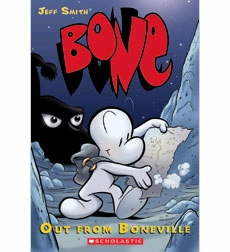
Book Review: Out from Boneville, by Jeff Smith (Scholastic edition, 2005)

Recommended for ages 11-13

Jeff Smith’s Bone was a popular comic book title in the ’90s, winning four Eisner Awards, and three Harvey Awards in 1994. Later on, the book caught on with kids as graphic novels gained more acceptance among educators. Scholastic has taken the 55-issue comic book series and repackaged them into a series of graphic novels. Out from Boneville is the first volume of this series, which follows the adventures of three cousins as they blunder into a fantasy world after being run out of their home, Boneville.

Phoncibile (Phoney for short) Bone is greedy and arrogant, which we are led to believe caused his ouster; Smiley Bone is the laid back one, and Fone Bone, our protagonist, is high-strung but an overall nice guy. Drawn as white humanoid shapes, the Bones resemble Casper with legs. The art is cartoon-like, very tween-friendly, and the banter is light and fun. Even the rat monsters who spend much of the novel trying to eat Fone Bone and seek out Phoney Bone for some dark reason are bumbling and goofy.

Out from Boneville sets up the entire Bone series, so  the storyline leaves a lot of questions unanswered by the end, but they are questions I am willing to pick up another volume to continue the journey.

 For teachers interested in working with graphic novels, Scholastic offers a guide for teachers and librarians (with mentions of Bone). Jeff Smith also maintains a Boneville web page with his touring schedule, his blog, and a section devoted to Bone.

Posted in Fantasy, Fiction, Tween Reads

Book Review: Artemis Fowl, by Eoin Colfer (Hyperion, 2002)

Recommended for ages 9-13

When Artemis Fowl was published almost ten years ago, it was hailed as the next Harry Potter type series in terms of kids’ blockbusters. There have been seven novels, plus graphic novels, since, and while it hasn’t reached the Harry Potter level of mania with readers young and old, it is a strong series that has managed to remain on the shelves over the past decade – not something many books can claim these days.

Artemis Fowl the Second is a boy genius and the son of a missing crime lord. To find his father restore his family’s reputation, he needs some help. In this case, “help” means getting a copy of the Rule Book from the Fairy World – because in this world, they are real and they don’t want us to know it – and finding out their secrets to use against them. But now he’s got the attention of the LEPrecon (the Lower Elements Police), and dealing with magic is never predictable.

It took a while for me to warm up to this book. I did not like Artemis, for starters. He is supposed to be an anti-hero, but there was not enough of him to give me a connection; I only thought of him as an annoying kid too smart for his own good for about 3/4 of the book. The LEP characters were somewhat more engaging but they needed some time to hit their stride; when they first appear on the scene, they almost seemed like caricatures in the exaggerated speech and description.

There is a prevalent subplot about how we humans, the Mud People, are destroying the planet. Colfer makes it abundantly clear that The People find humans beneath them and hold them in contempt.

There are plenty of Artemis Fowl websites, incluiding the US and UK websites that provide information about the books, book trailers, and games for visitors. Author Eoin Colfer’s website offers links to author information, information about all of his books, and a message board.

Posted in Fiction, Humor, Middle School, Tween Reads

Book Review: Diary of a Wimpy Kid, by Jeff Kinney (Amulet, 2007)

Recommended for ages 9-12

I am an unabashed fan of the Wimpy Kid series – I’ve read them all am waiting, with my kids, for Cabin Fever, the next book in the series (39 days from today!). My older son had the pleasure of meeting Jeff Kinney at ComicCon a few years ago and he was a very nice guy, autographing his book, mentioning that his son shared the same name as mine, my son and his son shared the same name, and really listening to what my son enjoyed about his book. 

Greg Heffley is a middle school ne’er do well – he’s lazy, he’s selfish, and he can’t figure out what everyone else’s problem is. Despite these qualities, he’s wildly funny, and he does try to do the right thing (he just tends to get a little lost on the way to doing it). He’s a middle schooler, he’s just trying to navigate life and make things easier on himself. Can you blame him?

Diary of a Wimpy Kid is a good book for several reasons, aside from it’s compulsive readability: the characters are well-written and funny, Greg has a clear voice, and this book shows boys and girls alike that keeping a diary – or a journal, whatever you choose to call it – is a good thing. Writing, even to a slacker kid like Greg, can be something fun to do. The book even resembles a diary on the inside and out, with lined pages, handwriting font, and hand-drawn pictures that look like Greg had drawn them filling the book.

Jeff Kinney’s Wimpy Kid series is one of the most popular middle-grade series out today, with five book currently out and the sixth coming in November. The Wimpy Kid website offers information about all of the books (and a countdown clock for Cabin Fever)  and offers news and information about the author, a link to “Wimp Yourself” where kids can create their own Wimpy Kid using preselected templates, links to merchandise.