Posted in Animal Fiction, Fiction, Fiction, Graphic Novels, Historical Fiction, Intermediate, Middle Grade

Geronimo Stilton goes to the ends of the earth in his latest graphic novel adventure

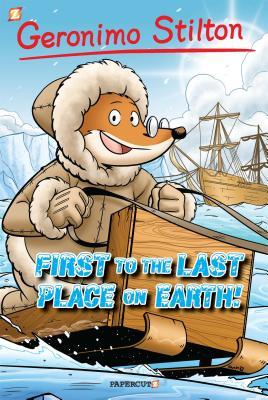
geronimo-stiltonGeronimo Stilton #18: First to the Last Place on Earth, (Nov. 2016, Papercutz), $9.99, ISBN: 9781629916033

Recommended for ages 6-10

Journalist mouse and time traveler Geronimo Stilton’s latest adventure takes him and a group of friends (including his younger sister, Thea!) back to 1911, where they join explorer Roald Amundsen’s expedition to the South Pole. They have to beat the awful Pirate Cats, who plan to sabotage the expedition and ruin history, so Geronimo will need to stay extra sharp!

The Geronimo Stilton graphic novels are fun because they’re another addition to the Stilton family of storytelling. The stories are original – no rehashes of the chapter books here! – and offer kids some interesting facts mixed in with their fun. Geronimo is insanely popular, as are all his spinoff titles; your intermediate and middle grader readers will gobble these up. You won’t even need to booktalk this book – just put it out and stand back.

Want to use Geronimo to promote your exploration titles? I don’t blame you. Talk up Ernest Shackleton’s 1914 Antarctic expedition; Matthew Henson’s exploration of the North Pole, and the lost Franklin expedition of 1845. Nomad Press’ Mysteries and Mayhem: Survival is a good book to talk up, and the I Survived series will always get kids listening and reading.

Posted in Animal Fiction, Fiction, Fiction, Humor, Intermediate

Oh, no! Bad Kitty has forgotten how to cat!

badkittyBad Kitty Takes the Test, by Nick Bruel, (Jan. 2017, Roaring Brook Press), $13.99, ISBN: 9781626725898

Recommended for ages 7-10

Bad Kitty’s back in his 9th chapter book adventure, and this time, it’s a doozy (isn’t it always?). The Society of Cat Aptitude has decided that Kitty just isn’t cutting it as a cat, so she needs to take a Cat Aptitude Test to determine whether or not she still deserves to be considered a cat. Kitty shows up to take her required course and test, but things… are not exactly business as usual, starting with the instructor. Poor Uncle Murray shows up, thinking he’s there to renew his driver’s license – maybe he’s spent enough time with Kitty to qualify as a cat, too!

I love Bad Kitty! My sons introduced her to me back when they were little guys, and I’ve laughed along with her antics ever since. She’s the star of picture books, chapter books, 8×8″ paperback picture books, board and activity books, making her a household name. Kids come into my library asking for Bad Kitty books about as often as they do Babymouse, Goosebumps, and the Wimpy Kid; she’s kind of a big deal. Her latest adventure is filled with the usual laughs, wacky plot, and black and white art. Part Wile E. Coyote and part Bugs Bunny, this latest story puts kitty and company into a classroom with an instructor that’s working with a hidden agenda, and Uncle Murray, who has a habit of blundering into burgeoning catastrophes, is here for additional laughs.

You don’t need to have much familiarity with the series to begin enjoying the books; you can just jump on with any one of them, incuding Bad Kitty Takes the Test. Intermediate readers and reluctant readers will get their Bad Kitty fix with this latest entry into the series.

There are activity kits and coloring sheets, plus a newsletter sign-up, on the Bad Kitty website. I’ve run successful book groups using the Bad Kitty Mad Libs and comic template sheet, and with the holidays coming, you’re sure to enjoy some of the holiday activities on the site.

Posted in Animal Fiction, Fiction, Middle School, Realistic Fiction, Tween Reads

When activism goes too far? Flip the Bird, by Kym Brunner

flip-the-birdFlip the Bird, by Kym Brunner, (Noc. 2016, HMH Books for Young Readers), $17.99, ISBN: 9780544800854

Recommended for ages 11+

Issues with hunting, falconry, and animal rights activism all come together in Kym Brunner’s Flip the Bird. Fourteen year-old Mercer Buddie wants two things out of life right now: he wants a girlfriend, and he wants to be a falconer, like his father and brother. He’s training as an apprentice to his father, a master falconer, but feels like his dad favors his jock of an older brother and is too critical of him. He captures a red-tailed hawk that he names Flip – to show his dad that falconry doesn’t always have to be a Very Serious Business – and has a few short weeks to train him for the big falconry meet; he’s got his eye on the Best Apprentice Award. Then he meets Lucy, who’s gorgeous and has a great personality and seems to be just as interested in him; the only problem is that she and her family are part of a fanatical animal rights organization called HALT. Mercer tries to play both sides to stay in Lucy’s and his family’s good graces, but sooner or later, the two halves of his life are going to converge. His mother is a scientist at a university lab doing medical research, and his father has a raptor rehabilitation center in addition to being a falconer – which means, a hunter. There are a lot of difficult choices in Mercer’s immediate future.

Flip the Bird brings together a lot of hot button topics to create a moving story about family and going with the crowd. Told in the first person by Mercer, the narrative is humorous while discussing the frustrations of being the little brother; the struggle to be treated like a responsible young adult, and the difficulty in making decisions that may be unpopular with the people you want to impress the most. To impress Lucy, Mercer joins the HALT collective she forms at school, but this puts him at direct odds with his family, and they let him know it. There are consequences to his actions, and we see Mercer grow as he faces those consequences. There’s interesting information about falconry and raptor rescue here, which will appeal to fans of animal fiction and birds. While the author gives a shout-out to some of her research sources in her acknowledgements, and does emphasize the extreme commitment that falconry requires, I’d have liked to see links to information about raptor rescue at the end of the book. I did some quick searching and came up with a quick list for anyone interested: The Raptor Trust, Wild Bird Fund, and A Place Called Hope. PBS’ Falconer’s Memoir page offers a map of states permitting falconry and links to classroom activities for using “A Falconer’s Memoir” in the classroom. The World Wildlife Fund is an organization that works with wildlife conservation and endangered species, and most large zoological preserves pioneer conservation and rehabilitation practices for animals in the wild. Kym Brunner is also a seventh grade teacher, and her author website offers presentations that you can use in the classroom.

I enjoyed the book and the characters. I’ll be adding this to my shelf; if you’ve know realistic fiction, animal fiction, or middle schoolers looking for something new and different to read, add this one to your shelves and shopping lists.

Posted in Animal Fiction, Early Reader, Fiction, Preschool Reads

Sugar and Spice and everything… Candy Pink?

candy-pink-coverCandy Pink, by Adela Turin/Illustrated by Nella Bosnia, (Nov. 2016, NubeOcho), $15.95, ISBN: 978-84-944446-7-8

Recommended for ages 5-8

A classic written 40 years ago with the goal to promote equality between boys and girls arrives in the United States for the first time. Candy Pink is written in the style of a folk tale, explaining how elephant all became gray. You see, male elephants were always gray, but female elephants were candy pink. To get that color, they ate only peonies and anemones, wore bibs and shoes, and stayed together in a little walled garden, while the boy elephants playing in the mud, eating yummy grass, and sleeping beneath trees. When one little elephant named Daisy doesn’t turn pink, her father is harsh and cruel, her mother, sad. They pressure her to eat more pink food and threaten her by telling her no one will want to marry her. When they finally give up, the girl elephant embraces her freedom, sheds her bib and shoes, and enjoys life – something that doesn’t go unnoticed by the other female elephants. And, well… you can’t tell the difference between boy and girl elephants anymore, can you?

I was taken aback the first time I read Candy Pink, because it seems harsh on a young girl: the emphasis on appearance and girlish pursuits, Daisy’s parents’ terrible reaction to her inability to fit their mold for her. A second reading put more in perspective for me – the little elephant embraced her uniqueness and wasn’t ostracized for it – the other female elephants flocked to her, and made a huge change that exists to this day. It’s a powerful little story for school-age kids that lends itself to some pretty big ideas. Originally published in Italian in 1976 with the title Rosaconfetto, Adela Turin tackled gender identity and the pressure society puts on appearances by using a parable that everyone could understand and that young girls could relate to. Forty years later, Candy Pink is just as relevant.

Award-winning illustrator Nella Bosnia’s artwork is beautiful. She uses shades of gray and pink against muted background colors for the world of the story; primarily greens, blues, and yellows for the assorted flora and fauna. The bibs, shoes, and bows on the elephants tails are frilly and exaggerated, even pinker than the pale pink elephants; against Daisy’s natural gray, it’s a true contrast.

An interesting and still-timely look at gender, society, and the expectations parents put on their own children. A good addition to bookshelves. Booktalk and display with self-esteem boosters like Karen Beaumont’s I Like Myself!, Peter Reynolds’ Ish, and Todd Parr’s It’s Okay to Be Different. Want another elephant fairy tale? Emma Dodd’s Cinderelephant is a light-hearted, fun take on the classic fairy tale.

Posted in Animal Fiction, Early Reader, Fiction, Preschool Reads

Catch Ralfy Rabbit, the Book Burglar!

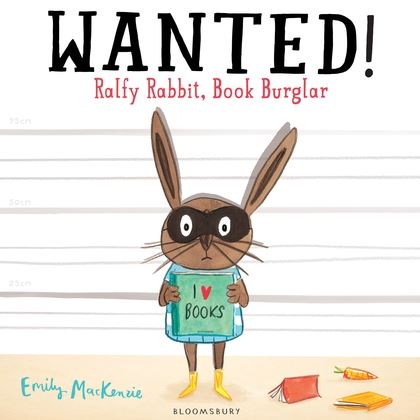
ralfyWanted! Ralfy Rabbit, Book Burglar, by Emily MacKenzie, (May 2016, Bloomsbury), $16.99, ISBN: 978-1681192208

Recommended for ages 4-7

Ralfy Rabbit LOVES books: he dreams about them; he makes lists of them; he wants to be surrounded by books ALL THE TIME. He loved books so much that he started sneaking into people’s bedrooms and reading their books while they were sleeping, but even that wasn’t good enough; he upgraded to taking the books home! One little boy named Arthur noticed that his books were starting to go missing, and to add insult to injury, soggy lettuce and half-eaten carrots were left behind. He makes a plan to catch the book burglar, but can Ralfy be rehabilitated?

A fun story with a good subplot about borrowing (and a great shout-out to libraries!), Wanted! Ralfy Rabbit, Book Burglar is a great storytime book and a great independent read. Kids can appreciate Ralfy’s single-minded love for books and understand Arthur’s dual frustration at having his books go missing and have no one believe him. Arthur’s confrontation and solution makes for good conflict resolution and problem-solving that works for everyone.

Emily MacKenzie’s artwork is adorable. Ralfy is wide-eyed and innocent, even when he’s up to no good; when he’s caught red-handed, his eyes fill up with tears and readers can’t help but feel bad for the poor book bandit. Arthur is drawn with a kindness that will invite readers to put themselves in his place right away. The pictures are sketched with defined outlines, and the font changes for emphasis: bolds, enlarged fonts, angled text to keep readers’ attention.

I’ve paired this with Helen Docherty’s Snatchabook and Ian Schoenherr’s Read It, Don’t Eat It! for library visit read-alouds; the kids love Ralfy and Arthur, but know that Ralfy’s “not being nice” when he takes books. One Kindergartner even called out, “He should just go to the library!” (Love that kid!) You can have a great discussion about borrowing versus taking things with kids as young as preschool; for younger audiences, use Ralfy’s adventure as a good starting point for talking about sharing and forgiveness.

Originally published in 2015 in the UK, Ralfy’s just arrived on US shores. Give him a welcome space on your shelves! There’s an activity kit available from Bloomsbury UK, and you can see more of Emily MacKenzie’s art and books at her author site.

Posted in Animal Fiction, Fiction, Fiction, Intermediate, Middle Grade

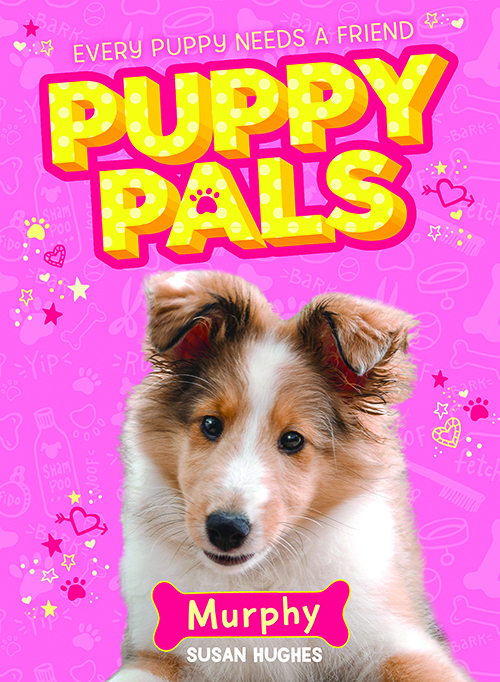
Blog Tour: Puppy Pals – MURPHY!

9781492634003-prMurphy, by Susan Hughes
November 1, 2016; Trade Paper, ISBN 9781492634003

Book Info:
Title: Murphy
Author: Susan Hughes
Release Date: November 1, 2016
Publisher: Sourcebooks Jabberwocky

Summary:
The newest adventure in the pawsitively adorable Puppy Pals series!

Kat and her BFF Maya love playing with the puppies at her Aunt Jenn’s grooming business, Tails Up!, and the girls are always there to help a puppy in need.

So when a shy Shetland puppy named Murphy arrives, Kat and Maya can’t wait to play with him. But Kat invites new-girl Grace along, and Maya is less than pleased. Then they find a lost cocker spaniel named Tawny, and the girls can’t seem to agree on what’s best for her. Will Tawny find her way back home? And can Kat be friends with both Maya and Grace? Maybe Murphy can help them sort it all out!

Goodreads Link: http://ow.ly/LtfM305R2HW

Buy Links:
Amazon: http://ow.ly/fRpS305R2Nh
Barnes & Noble: http://ow.ly/8Rmm305R2VH
IndieBound: http://ow.ly/czVP305R33u

susan-hughes-head-and-shoulder-shot-by-georgia-coles-june-10-2012About the Author:
Susan Hughes is a writer and editor, and has been writing children’s books and articles for nearly twenty years. She has received numerous nominations for Canadian children’s writing awards. She lives with her family in Toronto. Visit Susan at www.susanhughes.ca.

Social Media Links:

Author Website: http://www.susanhughes.ca/

Twitter: https://twitter.com/childbkauthor


Enjoy an excerpt from Murphy right here!

9781492634003-prChapter One

Puppies were scampering across the grass. There must have been over twenty of them!

Some puppies were brown, some were black, and some were brown with white spots. Some puppies had perky ears, and some had floppy ears. Some had big, wide paws; some had little, dainty paws. All the puppies had sparkling eyes and wagging tails.

Kat was in her classroom, sitting at her desk.

Her eyes were closed. She was having her favorite puppy daydream.

Her mother and father smile at her.

“Of course you can have a puppy, Kat,” her mother says.

Her father sweeps out his arm. “Have any one you want!”

Kat smiles too. She looks at all the puppies, and she tries to choose. The little red Irish setter puppy gazing up at her with the dark-­brown eyes? The black-­and-­white dalmatian puppy tumbling across the grass? The adorable wheaten terrier pup with the brown face and the black muzzle?

Suddenly the bell rang. School was over for the day, and the dream ended. But that was okay. Kat had puppy plans this afternoon.

“Let’s go!” Kat said to Grace, who was at the desk next to hers. The girls jumped out of their seats, grabbed their things, and made a beeline for the classroom door. But before they reached it, they heard their teacher’s voice.

“Katherine, Grace, where are you off to in such a hurry?” Ms. Mitchell stood at the front of the classroom. She was smiling.

Kat liked her fourth-­grade teacher a lot. For one thing, Ms. Mitchell knew how much Kat loved puppies—­and her teacher liked puppies too.

“You won’t believe it, Ms. Mitchell!” said Kat. “Remember how I told you my aunt opened up a dog-­grooming salon? We get to help her with a puppy today!”

Ms. Mitchell smiled. “How wonderful!”

“Her business is doing really well,” explained Kat. “She thought it would take some time to get going, but she was swamped with customers all last week. So she asked Maya and me to help out after school. Did you know that Grace loves puppies, just like me?”

“I had an idea that she might,” Ms. Mitchell confessed, her brown eyes sparkling.

Grace chimed in, “When Kat found out, she asked me to help out at Tails Up! too!”

Grace was new to the town of Orchard Valley. She was slim with brown eyes. Grace often wore her long red hair in braids. She reminded Kat of Anne of Green Gables.

It had taken a few days, but Kat and Grace had become friends. Not best friends, like Kat and Maya—­they did almost everything together. Maya liked to tease Kat and make her laugh. She said, “You love puppies, but your name is Kat? That’s crazy!” In return, Kat helped Maya with school projects and told her silly jokes. They had been in the same class since kindergarten, but not this year.

But now Kat had a new friend: Grace. And Maya had agreed to try to be friends with Grace too, even though the girls didn’t know each other at all and they didn’t seem to have much in common. Grace was quiet. Maya wasn’t. Grace had trouble saying how she felt about things. Maya did not.

Kat was keeping her fingers crossed that her two friends—­her best friend and her new friend—­would get along. This was the first time they were going to hang out together. They were going to Tails Up! together, and Kat had invited both girls to come over for dinner after. Maya had been to Kat’s house at least a million times, but it would be Grace’s very first time.

“Well, how lovely!” Ms. Mitchell looked pleased. “Any puppy would be very lucky to have you three looking after him. Have fun, girls!”

Kat and Grace hurried out of the school and across the playground. They stopped to look for Maya. They were all walking to Tails Up! together.

“Sorry I’m late.” Maya ran up, trying to catch her breath. “Okay, let’s go. But just tell me one thing: did I miss the answer to the joke?”

“Oh, right, the joke!” Grace said, grinning. She rolled her eyes. Every morning, Kat told a joke. Today it was, “Why are dalmatians not good at hide-­and-­seek?” As usual, she made her friends wait forever before she told them the answer.

“So tell us, Kat-­Nip,” Maya demanded. “Answer.”

“Are you sure?” Kat teased. “You don’t want to guess again?”

“Oh, please. Put us out of our misery,” Maya said. “Right, Grace?”

“Right!” Grace chimed in.

“Here goes: dalmatians aren’t good at hide-­and-­seek because they’re always spotted!” Kat said.

“Agh!” moaned Grace and Maya.

“Worst joke ever!” Maya complained hap­pily, as they all rushed toward Tails Up!


Don’t miss your chance to win your own copy of Murphy! Enter the a Rafflecopter giveaway today! (Runs until November 18, so enter now!) 
Posted in Animal Fiction, Early Reader, Fiction, Fiction, Intermediate, Preschool Reads

The Bear Who Wasn’t There and the Fabulous Forest: unbridled optimism!

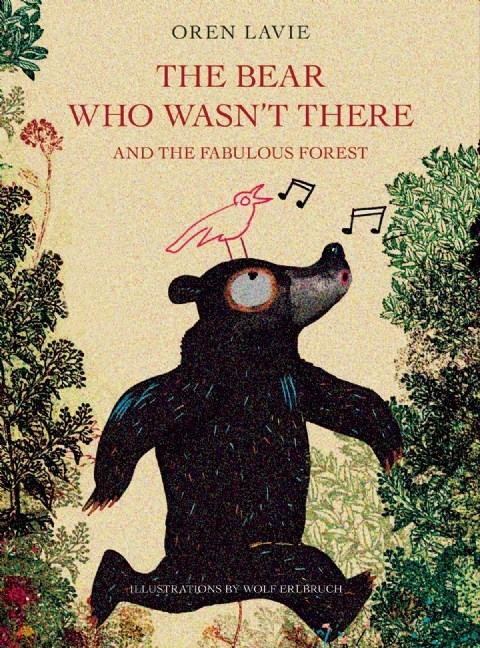
bear_covThe Bear Who Wasn’t There and the Fabulous Forest, by Oren Lavie/Illustrated by Wolf Erlbruch, (Oct. 2016, Black Sheep/Akashic), $17.95, ISBN: 9781617754906

Recommended for ages 4-8

A bear searches for himself, using clues he’s discovered scrawled on a note in his pocket: 1) I am a very nice bear; 2) I am a happy bear; and 3) Very handsome too. As he searches, he discovers more about the world around him, seeing things with a childlike sense of wonder that all readers will enjoy. Originally published in Germany, The Bear Who Wasn’t There is a debut picture book by composer and playwright Oren Lavie and illustrated by German illustrator Wolf Erlbruch, both renowned for their crafts.

I adore this bear. He’s perpetually upbeat, excited to learn more about himself and ready to explore the world around him. He’s drawn with huge, wide eyes, eager to take in everything he sees, and his mouth is curved into big, happy red smile. He wanders through the Fabulous Forest and meets other creatures who help him on his quest for self-discovery: the Convenience Cow and the Lazy Lizard; the Penultimate Penguin, and the Turtle Taxi, all of whom guide him in some way. Bear is thrilled with everyone he meets; even the snappish Penguin. Lavie’s words are lyrical, beautifully curling themselves around the characters. I love the bantering between Bear and each character; it’s sweet and gentle, and shows kids how to respond to others, as is the case with the standoffish Penguin. Bear never loses his idealism, best seen when he counts flowers, deciding that the number is “beautiful”. When he’s told that “beautiful” isn’t a number, Bear has already moved on, thinking to himself, that it’s better to smell flowers than count them, and that “Flowers are more Beautiful than they are thirty-eight.”

bear_1

This is such a happy, sweet book to read to younger kids and to older, school-age kids. Kids see things in a different way; a more inspiring, upbeat way. Books like The Bear Who Wasn’t There are a great reminder to kids and adults that sometimes, it really is better to smell flowers than to count them.

Add this one to collections where animal books are popular. The Bear Who Wasn’t There has received a starred review from Publishers Weekly.


Posted in Animal Fiction, Fiction, Middle Grade, Puberty, Realistic Fiction, Tween Reads

Avenging the Owl takes on big tween themes

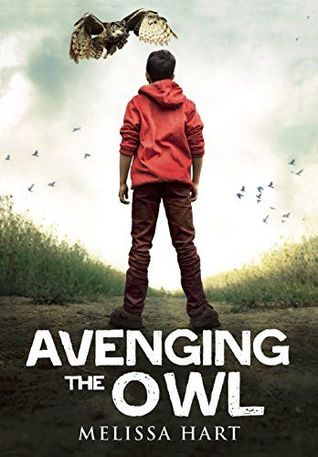
avenging-the-owlAvenging the Owl, by Melissa Hart, (Apr. 2016, Sky Pony Press), $15.99, ISBN: 9781634501477

Recommended for ages 9-13

Solo Hahn (his mom is a huge Star Wars fan) is a tween having a heck of a time. Not so long ago, in a galaxy not terribly far away – although it may seem that way – he had a great life: home in Redondo Beach, California; surfing with his buddies and loving his life; his mom loved her job as a professor, and his dad drew comics for a living. But things have changed; his dad has moved them to a trailer on a patch of land in Oregon, his mom has all gone vegetarian, crunchy granola on him, and his father is a shadow of the man he once was. The only thing Solo still had to hold onto was the kitten he found on the property as they were moving in; and then, an owl swooped in and took that away from him, too. Solo wanted revenge, but now he’s been labeled an “at-risk youth” and is doing community service at a raptor rescue center, where he’s taking care of the very types of birds that took his kitten from him.

Avenging the Owl is a great realistic fiction novel that tackles depression and suicide, and the toll it takes on a child when it happens to a parent. Even greater is the frustration of being a kid and having no control over anything in your life. Solo’s parents upend his life without any consideration as to its effect on him, and then voice frustration with him. It’s a valid, real portrait of adolescence, where kids’ independence are ultimately subject to their guardians’ plans.

There are good supporting characters in Avenging the Owl, including Solo’s group at the raptor rescue and Eric, Solo’s neighbor and friend. The story is a voyage of self-discovery for Solo, who emerges a different person than he was going into the story. He develops a relationship with Eric, a teen with Down Syndrome, initially at his mother’s behest but ultimately, develops genuine admiration and feeling for him. He learns to accept that Nature is not always fair. He learns to love his parents again, and just as important, they learn to see Solo for who he is. The thread running quietly through the novel about conservation and preservation is a great discussion theme for reading and discussion groups.

I enjoyed this book, and will add it to my realistic fiction collection. My middle graders enjoy animal fiction and often need to read realistic fiction for school, so this brings their two worlds together in a powerful way. Check out a great interview with author Melissa Hart on the From the Mixed-Up Files of Middle Grade Authors blog for some more insights.

Posted in Animal Fiction, Early Reader, Fiction, Preschool Reads

What happened to the Moon? Mr. Squirrel and Moon tries to figure it out.

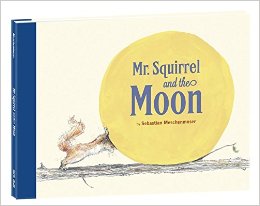
squirrel_2Mr. Squirrel and the Moon, by Sebastian Meschenmoser, (Jan. 2015, North South Books), $18.595, ISBN: 9780735841567

Recommended for ages 3-6

Mr. Squirrel wakes up one morning to discover that the moon has fallen from the sky and landed on his tree! Afraid that he’s going to be blamed for stealing the moon, he desperately tries to get rid of it in this entertaining cumulative tale. The squirrel tries to shove the moon off of his branch, where it lands – and sticks – on a hedgehog. Together, the two attract the attention of a billy goat, some bees, and mice, but can they get the moon back where it belongs before someone notices?

The best parts of Mr. Squirrel and the Moon are the wordless, black and white interludes between episodes of trying to dispose of the moon, when Mr. Squirrel’s imagination takes over, picturing him in a jail cell with a (human) cellmate. The detail is hilarious, from the tiny toilet for the squirrel to the little uniforms for Mr. Squirrel and the rest of the animals as they join him in the cell, to the sight of the moon, back in the sky, with the hedgehog still stuck to it.

The endpapers give readers a clue as to what’s really going on, and the subdued artwork challenges readers to look closer to discover the wonderful little extras Sebastian Meschenmoser adds to his story. This is a fun read-aloud, and is even better for independent readers to sit down and look through at their leisure. There’s so much to discover here.

squirrel_1Image source: PictureThisBook.com

Mr. Squirrel and the Moon was a Winter 2015 Top Ten IndieNext Pick.


Posted in Animal Fiction, Fiction, Fiction, Intermediate, Middle Grade, Non-fiction, Non-Fiction

What Dog Knows

what-dog-knowsWhat Dog Knows, by Sylvia Vanden Heede, (Sept. 2016, Gecko Press), $16.99, ISBN: 9781776570362

Recommended for ages 7-10

Wolf is tired of his cousin, Dog, always knowing more than he does, so he checks a book out of the library (never mind that he can’t read), and tries to outsmart Dog with his new knowledge about mummies, knights, and dinosaurs.

Mixing facts into the fictional tale of the Dog and Wolf, this seems like it’s geared toward younger readers, but then throws in the process of mummification, and a plotline where Wolf intends to mummify Cat, his antagonist, and suddenly, things take a little bit of a weird turn. This wasn’t really my book, and I don’t see the kids in my library really catching on with this one because it’s a bit disjointed and quirky. The art is very sweet, and I did love that Cat struck fear into Wolf’s heart, but overall, it didn’t work for either age group (4-7 vs 8-12) for me.

This is the second Dog and Wolf book from Gecko. Wolf and Dog was published in 2013.