Posted in Preschool Reads, Toddler Reads

Book Review: What Does Baby Do? by Martin Larranaga (Begin Smart, 2008)

whatdoesbabydoRecommended for ages 0-4

Using lift-the-flaps to teach babies the concept of object permanence, What Does Baby Do? presents cartoon children in different situations and asks the question, “What does baby do?” Each flap reveals how baby handles a new situation: petting a cat, blowing kisses to grandma and grandpa, and waving good-bye to Daddy. Each action is physical, allowing for parents and guardians to interact with their children by asking them the question, “What does baby do?”, and acting out the answers. The book features multi-ethnic families and its artwork is cartoon style with bright colors and pastels and a bold, childlike font. Flaps are oversized for small fingers that are just learning to grasp. A note to parents in the book provides information on object permanence in infants and offers ideas on using the book.

This is a participatory book, so a story time allows the audience to take an active role, repeating the question on each page and acting out the answers. Story time leaders can also teach object permanence games like Peek-a-Boo to parents and guardians, and provide handouts from parenting websites with more information.

Posted in Preschool Reads, Toddler Reads

Book Review: Shake it Up, Baby! by Karen Katz (Little Simon, 2009)

shake it up babyRecommended for ages 1-4

Shake It Up, Baby! is an interactive board book that will get parents and toddlers moving together. The book, which contains a rattle in its spine, leads readers through a dance, encouraging them to “touch your nose, rub your tummy, [and] shake your rattle”. As with Katz’s other books, the featured babies are multiethnic and have big, round heads with cheerful facial expressions. Katz’s artwork uses pastels with her trademark heavy outlines, varicolored backgrounds, and bright colors with bold fonts. Dotted curves depict movement.

The book includes a link to SimonSaysKids.com, the publisher’s children’s division, where parents and guardians can read a parenting guide and discover more Karen Katz activities.

As the book is the activity, a story time using this book gives parents, guardians and toddlers the chance to get up and dance with the book. Story time can include other songs and dances, like the Hokey Pokey and fingerplays like Tommy Thumbs.

Posted in Preschool Reads, Toddler Reads

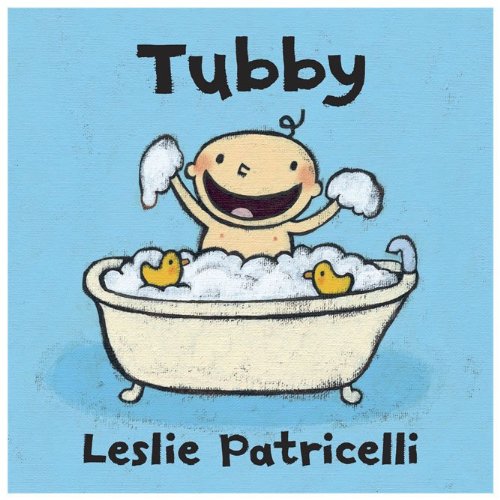
Book Review: Tubby, by Leslie Patricelli (Candlewick Press, 2010)

tubbyRecommended for ages 0-4

In Leslie Patricielli’s book, Tubby, a toddler’s bath time is fun time! Patricelli takes readers through the ritual of bath time from a toddler’s point of view. The toddler begins with the joy of running around naked; after getting into the bath, he plays with the bubbles and gets soap in his eyes – which Mommy makes all better. After getting rinsed off, dried and diapered, baby is all clean and ready to play. The book, illustrated by Patricelli, uses bright acrylic illustrations and bold, simple text to create a fun story that communicates the excitement of bath time and gives parents and guardians the opportunity to incorporate the story into a bath time ritual.

Patricelli’s book Tubby is the companion book to Potty, featuring the same happy toddler who needs to “go potty” and goes on his own adventure to figure it out.  Patricelli also uses acrylic illustrations and bold, simple text to tell this story.

A fun story time activity could incorporate bath time rhymes, like Rub-a-Dub-Dub, that parents could share with their children at home. Librarians can also purchase small rubber ducks from catalogs like Oriental Trading and hand them out at story time.

Posted in Preschool Reads, Toddler Reads, Uncategorized

Book Review: Baby in Car, by Monica Wellington (Dutton Books, 1995)

baby in a carRecommended for ages 0-4

Monica Wellington’s Baby in a Car begins with the question, “What does baby see?” and answers by taking a toddler on a road trip filled with fun things to see from the car. This brightly colored board book is filled with bold, bright illustrations that toddlers will easily recognize, from traffic lights and taxis to flags and umbrellas.  The cartoon style illustration uses gouache collage to provide texture, including the blades on a helicopter, leaves on an apple tree, and the moon’s shading. Young readers will be attracted to the bright pictures of easily identifiable objects, and the childlike lettering further communicates a young, happy tone. Parents and guardians can use the book on car rides, whether to the grocery store or a longer family trip, to keep children happy and begin conversations about their surroundings.

Baby in a Car is part of a series by Wellington that includes Baby in a Buggy, Baby at Home, and Baby Goes Shopping.

Story time activities could include traveling rhymes and fingerplays including Wheels on the Bus and Over the Mountain. The book can be used in a participatory fashion, with the reader asking, “What does baby see?” and allowing parents and children to respond with each picture. 

Posted in Preschool Reads, Toddler Reads

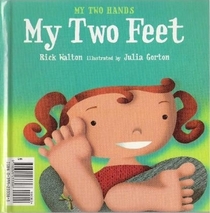
Book Review: My Two Hands/My Two Feet, by Rick Walton/illus. by Julia Gorton (Putnam, 2000)

my two handsRecommended for ages 2-5

My Two Hands/My Two Feet is two stories in one, each story celebrating the many things that hands and feet can do over the course of a day. On one side, we have hands: stretching, washing, making a cup for water, holding onto someone, and folding together at bedtime. Flip the book over and discover what feet can do: wiggle, dance, stomp, twirl, and lie still at bedtime. The stories meet in the middle, with the two narrators asleep side by side. The endpapers clue readers in as to which body parts they will read about first, with overlapping hands decorating one side and overlapping feet, the other. The stories are told in rhyme and illustrated in airbrushed acrylics, with bright colors and full-bleed images on each page. The illustrations are flat, and the characters are semi-realistic looking, with large heads and small, black shiny dots for eyes. The only texture in the images comes by way of the characters’ knitted sweaters, which appear to be collage.

The story, told in rhyme, uses simple language that younger readers will understand and enjoy. The font is a simple yet decorative font, alternating in black and white to stand out on the brightly colored backgrounds.

This is a great opportunity for an interactive read-aloud. Children can be invited to pantomime the movements mentioned in the book, like wiggling their toes and stretching their hands.  This would also allow for a fun, movement-based storytime: get the children up and dancing, play Ring Around the Rosie, maybe even a game of Simon Says. Younger attendees can play “Head, Shoulders Knees and Toes”.

The author’s website links to information about Mr. Walton, including school visits and a biography; he also links to free book resources online for parents, writers, and educators.

Posted in Preschool Reads, Toddler Reads

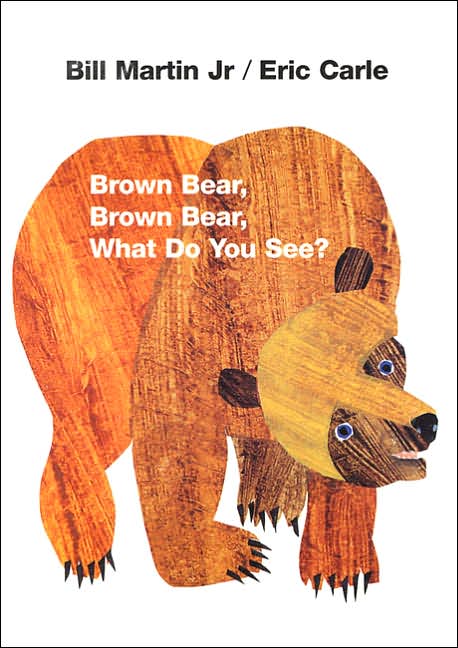
Book Review: Brown Bear, Brown Bear, What Do You See? by Bill Martin, Jr./illus. by Eric Carle (Holt, Rinehart & Winston, 1967)

brown bear Recommended for ages 0-5

Brown Bear, Brown Bear, What Do You See? is a children’s literature classic. An unseen narrator asks different animals what they see; the animals respond that another animal is looking at them, repeating the process throughout the book. The animals are described in terms of color: a brown bear, a red bird, a yellow duck, a blue horse. The endpapers lead readers into this study in color, with the colors named in the book appearing, striped, across them.

Bill Martin’s repetitive question-and-answer rhyme format, coupled with Eric Carle’s signature hand-painted and layered collage technique, appeals to toddlers and preschoolers alike, giving the animals a textured appearance that makes them stand out on the white background of the page. The font is a simple, black font; the question appears on the left hand page of each spread, and the response on the right. The rhythm of the book is comfortably repetitive, so children know what to expect on each spread. There is a board book version available that is perfect for the tiniest hands.

This is a great book to add to a read-aloud on color and would translate well to a felt board. DLTK’s website offers printable pictures of animals named in the book, complete with instructions on how to use the sheets as felt board characters and can provide an enjoyable, post-story coloring craft. Attendees may enjoy getting a hand stamp with one of the animals named in the book, to have as a memento of the storytime, and a guide to the book on the Macmillan website features a printable matching game where readers can connect the color to the animal mentioned in the book.

Bill Martin Jr. and Eric Carle collaborated on other children’s classics, Polar Bear, Polar  Bear, What Do You Hear?, Panda Bear, Panda Bear, What  Do You See? and Baby Bear, Baby Bear, What Do You See? that fall into the same cadence and predictive text, providing opportunities for additional read-alouds.

The author’s website offers information on school visits and the Bill Martin model for reading, which is valuable reading for anyone who reads to young children.

Posted in Preschool Reads, Toddler Reads, Uncategorized

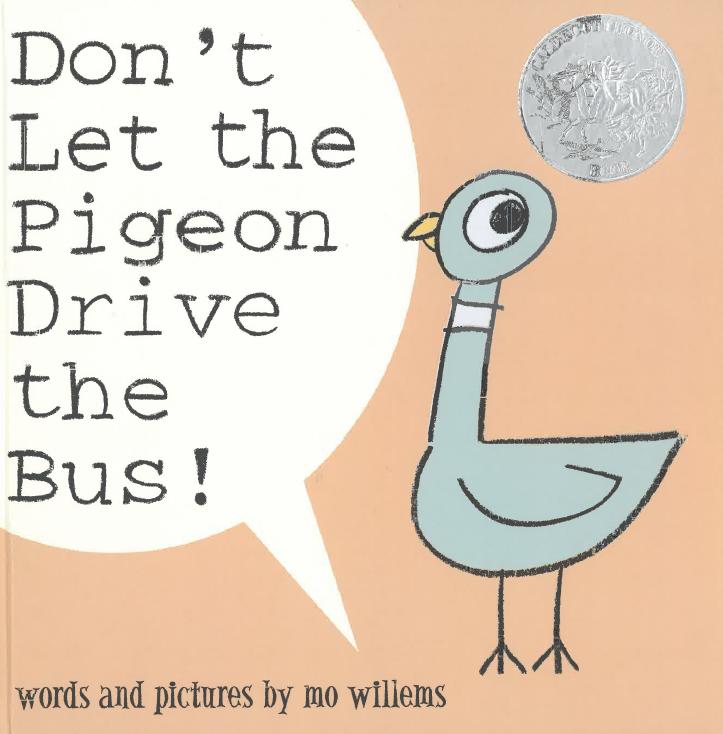
Book Review: Don’t Let the Pigeon Drive the Bus! by Mo Willems (Hyperion, 2003)

pigeon_coverRecommended for ages 0-5

A bus driver appears on the scene and asks his audience to watch his bus while he tends to something off-page; he is very firm in his request for one favor: don’t let the Pigeon drive the bus! As soon as the bus driver leaves, we meet the Pigeon, who spends the rest of the book asking, pleading, cajoling, and throwing a temper tantrum as he attempts to get readers and listeners to allow him to drive the bus. Mo Willems, an Emmy-award winning animator who worked on Sesame Street, uses simple line drawings and a plain palette to bring the Pigeon to life and allows him exaggerated facial expressions and that communicates his increasing agitation. Mr. Willems also makes great use of the page edges to denote action taking place off-page, particularly during Pigeon’s meltdown, which takes up an entire spread and is indicative of the stomping and thrashing that accompanies many a meltdown. Willems uses a bold, simple typewriter font to communicate to audiences, except for Pigeon’s meltdown, where the typewriter font is enlarged, capitalized, bolded, and outlined in yellow to emphasize his tantrum. The simplicity of the art allows audiences to focus on the text and the Pigeon himself; preschoolers will recognize themselves in his behavior and laugh along with him.

Don’t Let the Pigeon Drive the Bus! received Caldecott Honors in 2004 and is the first in the Pigeon series, including the  titles Don’t Let the Pigeon Stay Up Late!, The Pigeon Finds a Hot Dog!, The Pigeon Wants a Puppy!, and The Duckling Gets a Cookie?! There are Pigeon board books with original content for younger readers, including The Pigeon Loves Things That Go! and The Pigeon Has Feelings, Too!

Don’t Let the Pigeon Drive the Bus! is an interactive story, making it perfect for a story time. The Pigeon’s dialogue is meant to be responded to, and listeners can tell him “NO!” as he continues pleading to drive the bus. Like No, David!, Don’t Let the Pigeon Drive the Bus! can be used as part of a story time on following rules; it can also be a read-aloud that talks about feeling. Mo Willems’ website offers printable Pigeon and Duckling finger puppets and a printable picture of the month, both of which will work for a Pigeon craft.


Posted in Preschool Reads, Toddler Reads

Book Review: No, David! by David Shannon (Blue Sky Press, 1998)

no davidRecommended for ages 1-5

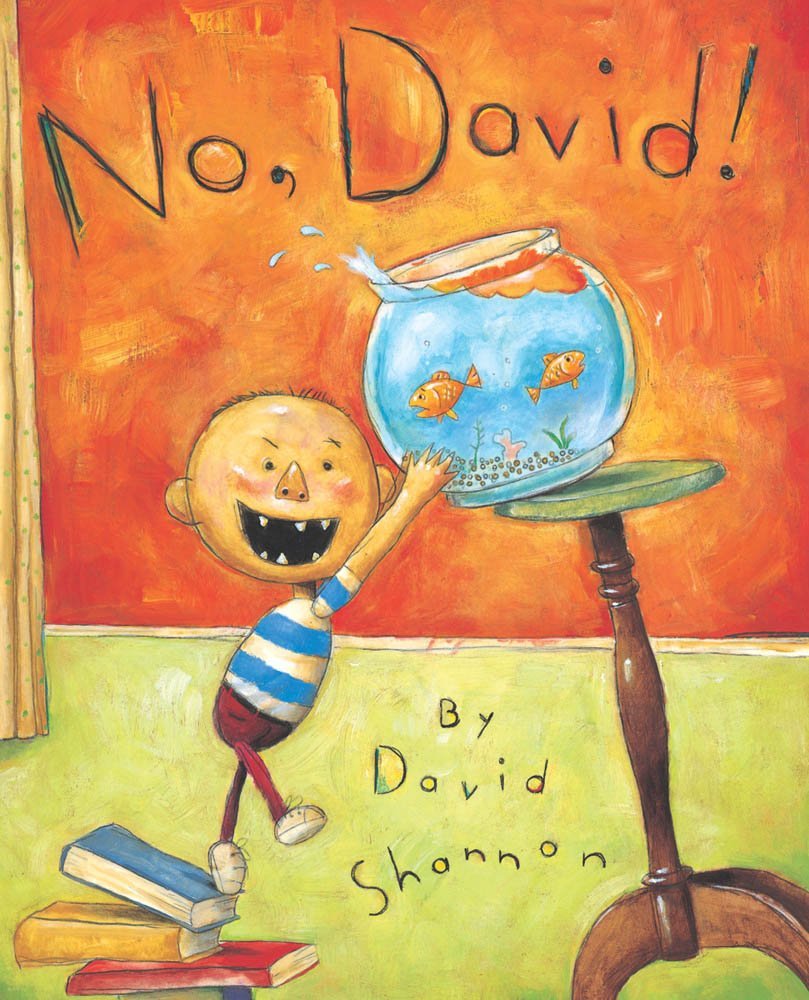
Preschoolers and toddlers alike will understand where David, the little boy in David Shannon’s No, David! is coming from: he’s a little boy who just wants to have fun, whether it’s running down the street naked, causing a flood as he plays in the bathtub, picking his nose, or chewing his food with his mouth wide open. David’s mother is the only voice heard throughout the story, and what she has to say will also be very familiar to No David’s audience: “Come back here!” “No! No! No!” “Put your toys away!” “Stop that this instant!” When David ends up being punished for breaking a vase, though, Mom is also tells him “Yes, David. I love you!” The book, which received Caldecott Honors in 1999, reinforces to young listeners and readers – and parents – that no matter how much trouble you get into, and whether or not your parents get angry with you, they will always love you. David Shannon’s use of bright acrylics will attract readers and listeners alike, as will David’s exaggerated facial expressions and actions. There are very few words in the book, and the font is a large, handwritten font that makes for a fun and interactive read-aloud. Shannon’s illustrations give a hand-painted feel to the story and he makes David appear almost toylike, with a giant head and a wooden doll’s body, with an open mouth full of pointed teeth. Making a caricature of David adds a dose of fun to the story, moving No, David! away from the story of a naughty little boy and embracing the silly aspects of being a child. Preschoolers will identify with David, and toddlers will enjoy seeing what David will do next.

In addition to winning Caledecott Honors, No, David! is an ALA Notable Children’s book, a School Library Journal Best Book of the Year, and a Bulletin of the Center for Children’s Books Blue Ribbon title. It was also on the New York Times Best Illustrated Book list.

No, David! is part of a David series by Shannon that includes David Goes to School, David Gets in Trouble, and It’s Christmas, David!. The Diaper David series of board books for younger readers also stars David and includes the titles David Smells!, Oh, David!, and Oops!

The book is perfect for a read-aloud, allowing audiences to put themselves in their caregiver’s place and call out “NO!” as David embarks on his next act of mischief. There could be a David-centric story time or a story time centered on following rules, with a quick game of Simon Says or Red Light, Green Light (space permitting).

Posted in Preschool Reads, Toddler Reads

Book Review: Good Night, Gorilla, by Peggy Rathmann (Putnam, 1994 edition)

GoodnightGorilla1Recommended for ages 1-5

A zookeeper is followed home by all of the animals he thinks he’s locked up at the zoo for the night. The story begins with the zookeeper locking each of the animals’ cages for the night, wishing each of them a good night. He doesn’t realize that the gorilla has taken his keys and is leading a menagerie back to the zookeeper’s house! When his wife realizes that her house is full of animals, she leads them all back and goes home – but someone may have followed her back. The art appears to be watercolor, with bright colors against sparse white backgrounds. The endpapers lead readers into and out of the story, with the gorilla showing up and holding what we presume to be the zookeeper’s keys as he bounces around the book cover’s frame.

The book is sparsely worded, which makes for great interactive storytime potential as the leader can ask children things like, “What’s happening now?” “What do you think will happen next?” Each animal is identified as the zookeeper says good night, reinforcing different animal names for younger readers. Young audiences may also connect with the animals who resist both their bedtimes and being left in their rooms all night. The animals even have toys in their cages – a fun storytime task could involve asking the children to point out the toys in each animal’s cage. The book is also available as a board book, and would be good to have on hand for the littlest users to be able to see and enjoy.

This book could be part of either a zoo-focused read-aloud or a bedtime stories read-aloud. For a zoo-focused read-aloud, it would be great to bring in some toys – Fisher-Price’s Little People have zoo and animal sets that are easily washable and would be  great fun for little hands to play with and act out the story. There are Fisher-Price Little People school buses that could bring “students” on a school trip to the zoo! Decorating the storytime area with plush zoo animals, even small Beanie Babies, would add to the fun atmosphere. There are many fun fingerplays and songs that can be incorporated into the storytime as well.

Good Night, Gorilla has received numerous awards and accolades, including designation as an ALA Notable Children’s Book (1994); Bulletin Blue Ribbon (1994); Horn Book Fanfare Selection (1995); Parenting Magazine Best Children’s Book of 1994, and New York Public Library’s Children’s Books: 100 Titles for Reading and Sharing (1995).

The author’s webpage provides award and review information about Good Night, Gorilla and her other books.

Posted in Preschool Reads, Toddler Reads

Book Review: Twinkle, Twinkle, Little Star, by Iza Trapani (Whispering Coyote, 1997)

twinkle-twinkle-little-star-illustrated-by-iza-trapaniRecommended for ages 0-5

“Twinkle Twinkle Little Star” is one of the first nursery rhymes many children learn, either from their parents, daycare providers, or preschool teachers. Ms. Trapani’s extended version of the song allows children to sing along as they view the story of a little gold star who takes a little girl on a trip through the night sky. After taking her to see the planets and sun, the star shows the girl how it guides ships at sea and shines light on loving families and sleeping animals and children. The star promises to shine on the little girl every night when it returns her back to her bed. The watercolor illustrations give a soft, dreamlike feel to the story, and the star itself appears to be rendered in a foil of some sort, so it stands out. The colors are muted, nighttime colors but for the light by the sun and the moon. There is a companion CD that lets readers sing along and can also help beginning readers sharpen their skills. There is also a Spanish translation available for a Spanish storytime.

This is a great candidate for a nursery rhyme-centered storytime, either with or without the CD accompaniment. There are many fingerplays available for Twinkle, Twinkle Little Star, and a felt board may be fun to incorporate into the story, with the many sights the star takes the little girl to see through the course of the tale. The sheet music and lyrics are available in the back of the book and, with permission, may be handed out at the beginning of the storytime for parents, guardians, and children to sing along. The book’s publisher, Charlesbridge, has a free printable of the cover art that would make for a fun coloring project. The Perry Public Library has a wonderful “Star Light Star Bright” storytime that includes songs, rhymes and a star chart, an updated one of which can easily be found online.

The author’s webpage also offers downloadable activities and guides for her books.